San Francisco Land Use and Transportation Committee Meeting - September 30, 2024
STREAMING COPY IN PREPARATION — RECORDING AVAILABLE FROM THE ORIGINAL SOURCE
San Francisco Land Use and Transportation Committee Meeting - September 30, 2024
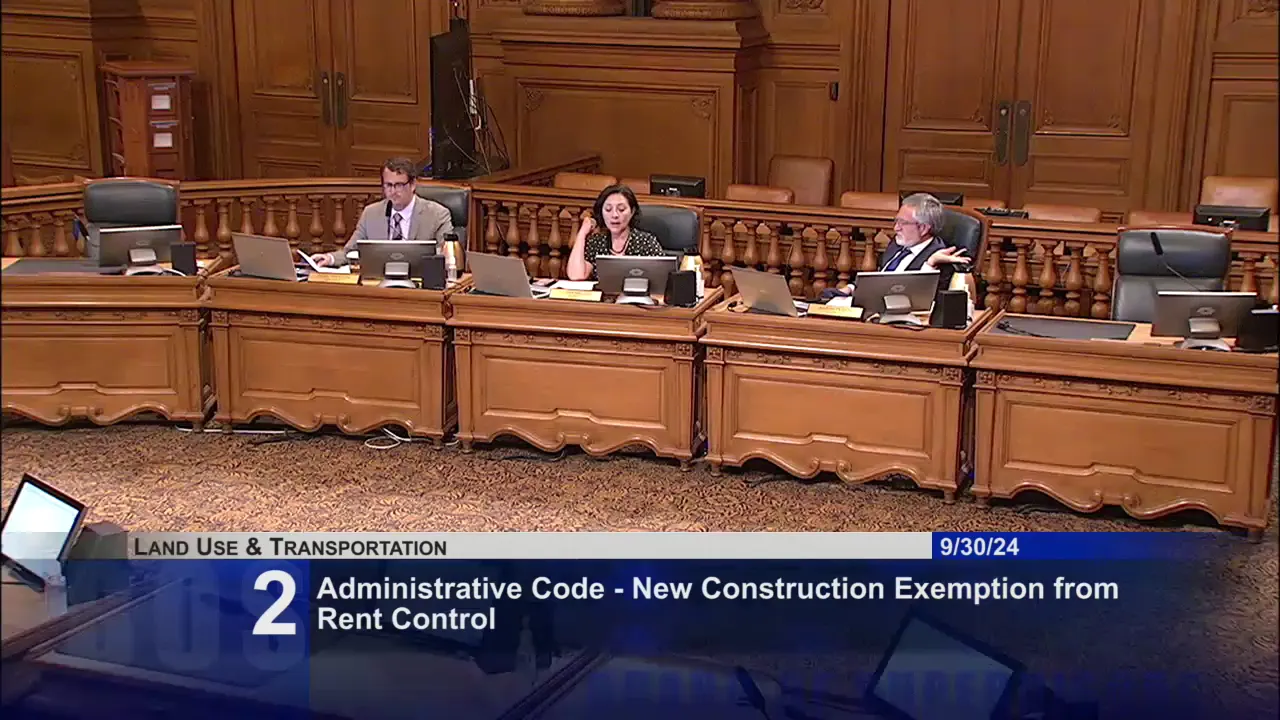
The Land Use and Transportation Committee of the San Francisco Board of Supervisors met on September 30, 2024, at 9:45 AM, chaired by Supervisor Mirna Melgar, joined by President Aaron Peskin and Vice Chair Dean Preston. The committee considered three items: a building code amendment to simplify permitting for small businesses, a rent control expansion ordinance contingent on repeal of the Costa Hawkins Act, and a housing code amendment requiring elevators in smaller apartment buildings. Public comment was heard on each item, and votes were taken.
Public Comments & Testimony
- Item 1 (Building Code - Change of Use): Ben Blyman (Entertainment Commissioner, speaking personally) supported the legislation, noting that architectural drawing costs have risen from $1,500 to $8,000-$10,000. Teresa Delales (SoMa resident) urged ensuring the law applies only to small businesses, not developers, to avoid a loophole.
- Item 2 (Rent Control Expansion): Several speakers supported the ordinance. Ann (tenant counselor, South of Market Community Action at Work) shared a story of a client facing a massive rent increase after a parent's death. Zachary Friel (D5 resident, Zomkin) cited studies showing rent control does not impact new construction and that Bay Area cities with rent control built 1.8 times more housing per resident. William Palmer (re-entry advocate) said rent control stops gentrification and displacement. Molly Goldberg (San Francisco Anti-Displacement Coalition) noted that over 80,000 units lack rent control due to state preemption. Charlie Sciammas (Council of Community Housing Organizations) supported the three P's: production, preservation, protection. Calvin Welch (Haight Ashbury Neighborhood Council) stated rent control is the only local control on market-rate housing. Kristin Evans (small business owner) said rent control helps retain employees. Mitchell Omerberg (Affordable Housing Alliance) noted that tenants in post-1979 buildings lack predictability. Carla (community organizer, District 7) described patients unable to afford rent. Opposing speakers: Corey Smith (Housing Action Coalition) argued the ordinance could lead to rent control on new housing, harming financing, and suggested a 30-year rolling exemption. Charlie Goss (San Francisco Apartment Association) called it an anti-housing proposal that would stop new housing development, urging a studied approach.
- Item 3 (Elevator Maintenance): Kevin Eisenstadt (District 5 resident, Mosser Tower) described hardship when both elevators were out for nearly a week, affecting seniors and disabled residents.
Discussion Items
-
Item 1: Building Code - Change of Use Designation (File 240798)
Director Katie Kang (Office of Small Business) presented the Mayor Breed-sponsored ordinance. It would remove architectural plan requirements for building permits when there is a change of use but no construction or change in occupancy classification. The legislation codifies a pilot program that has helped about a dozen businesses, saving thousands of dollars and time. A common example is a limited restaurant adding a liquor license. Chair Melgar expressed support but raised concerns about existing building code violations, noting a constituent's billiards-to-childcare conversion required costly corrections. Tate Hannah (DBI) confirmed that violations must be corrected before permits, per code. The committee voted unanimously to recommend the ordinance.
-
Item 2: Administrative Code - New Construction Exemption from Rent Control (File 240880)
President Peskin introduced the ordinance, which would extend rent control to multifamily buildings completed up to November 5, 2024, effective if Costa Hawkins is repealed (e.g., via Proposition 33). He argued it does not affect new construction. Vice Chair Preston expanded on protections rent control provides: limits on rent increases, pass-throughs, rent reductions for repairs, and access to the Rent Board. Chair Melgar expressed concern about potential interaction with the inclusionary housing program (Planning Code Section 415), worrying it might undermine the nexus study and deed restrictions. Staff from the Rent Board clarified that deed-restricted affordable units are already exempt from rent control. After public comment, President Peskin made non-substantive amendments to clarify the June 13, 1979 date. The committee voted 2-1 to recommend the amended ordinance (Peskin and Preston in favor, Melgar opposed). Chair Melgar then moved to duplicate the file and continue it to the call of the chair, which passed unanimously.
-
Item 3: Housing Code - Operational Elevators (File 240807)
Lorenzo Rosas (from Supervisor Stefani's office) presented the ordinance, which fixes a loophole in Housing Code Section 713. Currently, only buildings over 50 feet are required to maintain operable elevators, allowing owners of 3-4 story buildings to let elevators fall into disrepair, affecting mobility-impaired and senior tenants. The ordinance would allow housing inspectors to cite under-50-foot buildings with elevators. Non-substantive amendments were adopted: removing subsection C (which addressed good-faith repair efforts) and adding findings. Vice Chair Preston offered a friendly amendment to add a finding that a non-functional elevator creates extreme hardship for seniors and persons with disabilities, which was accepted. The committee voted unanimously to recommend the ordinance as amended.
Key Outcomes
- Item 1: Passed unanimously (3-0) with a positive recommendation to the Board of Supervisors as a committee report. Chair Melgar added as co-sponsor.
- Item 2: Passed 2-1 (Peskin, Preston in favor; Melgar opposed) to recommend the amended ordinance to the full board. A duplicated file was continued to the call of the chair (3-0).
- Item 3: Passed unanimously (3-0) with amendments (including Preston's hardship finding) and a positive recommendation to the full board.
Meeting Transcript
Good afternoon. This meeting will come to order. Welcome to the September 30th, 2024 regular meeting of the land use and transportation committee of the San Francisco Board of Supervisors. I'm Supervisor Mirna Melgar, Chair of the Committee joined by Board of Supervisors President Aaron Paskin. And Vice Chair Dean Preston, the committee clerk today is John Carroll. Welcome, Mr. John Malamet. It's good to see you. Yes, thank you, Madam Chair. Please ensure that you've silenced your cell phones and other electronic devices you have brought with you into the chamber today. If you have any documents to be included as part of the file, you should submit them to me. Public comment will be taken on each of the three items on today's agenda. When your item of interest comes up and public comment is called, please don't have to speak along the right hand side of the room. Alternatively, you may submit public comment and writing in either of the following ways. First, you may email your written comments to me at J-O-H-N, period C A R R O L L at SFGOV.org. Or you may send your written comments via U.S. Postal Service to our office in City Hall. The address is one Dr. Carlton B. Goodlit Place, room 244, San Francisco, California 94102. If you submit public comment in writing, I will forward your comment to the members of this panel and also include your comments as part of the official file upon which you are commenting. Items acted upon today are expected to appear on the Board of Supervisors' agenda of October 7th. Excuse me, October 8th, unless otherwise stated. Okay, thank you so much, uh, Mr. Clerk. Uh please call item number one. Agenda item number one is an ordinance amending the building code to excuse the requirement for professionally prepared architectural drawings for building permits to change certain use designations that do not increase occupant load or occupancy class or include alterations and affirming the planning department's secret determination. Madam Chair, we have a memo from your desk requesting this matter be agendized as a committee report, and it may be sent for potential consideration by the Board of Supervisors on the agenda tomorrow for October 1st, 2024. Thank you, Mr. Clerk. Uh, we are joined here today by our director of the Office of Small Business, uh, Ms. Katie Kang. Welcome. Great. Good afternoon, Supervisors and SFGov TV, we have a quick presentation. All right, thank you. So very quickly, um, the legislation for you today, which is sponsored by Mayor Breed. Um, there are a couple of goals that we're trying to address here through the legislation. Um, you've heard, of course, from many small businesses who want to experience an easier time getting through our city's permitting process. And so this is designed to reduce some of those barriers as people are trying to uh get into a new storefront. Namely, it would remove the costly architectural plan requirements under certain circumstances when there's a change of use and no construction uh being done to the space. And then lastly, we want to clearly define when uh building permits are required when there's a change of use permit involved. So the legislation before you today um in a nutshell um really again clarifies that when you're just going through a change of use process under the in particular the planning code, but there isn't a change in the occupancy classification under the building code, and there's no increase to the occupant load and no construction being done. That um you either there will be certain scenarios where you don't need to submit a building permit, and in some scenarios, you would have to submit a building permit. Um however, you would be able to submit dimension drawings instead of plans completed by licensed architects. The legislation codifies an existing pilot program that has been in place for small businesses that have uh again undergone a change of use from producing architectural plans. So this legislation would codify that process. Um to date, roughly a dozen businesses have been able to go through this more simplified uh process without issue. Um, the most common example that I'll describe for you is when there is a limited restaurant under the planning code definition, and they want to add a liquor license and become a full restaurant. So it's a change of use under the planning uh code definition.
openpublica.com