San Francisco Land Use and Transportation Committee Meeting - February 24, 2025
STREAMING COPY IN PREPARATION — RECORDING AVAILABLE FROM THE ORIGINAL SOURCE
San Francisco Land Use and Transportation Committee Meeting - February 24, 2025
The Land Use and Transportation Committee of the Board of Supervisors met on February 24, 2025, at 9:45 AM, chaired by Supervisor Mirna Melgar, with Vice Chair Cheyenne Chen and Supervisor Bilal Mahmud. The committee considered three items: a resolution supporting SFMTA's joint development program, a planning code amendment for alcohol uses on Third Street, and a new neighborhood commercial district on Leland Avenue. All items were recommended to the full Board of Supervisors for the March 4, 2025 agenda.
Public Comments & Testimony
- On Item 1, several speakers urged prioritizing affordable housing and community benefits on public land. David Wu (Soma Filipinas) and Zachary Friel (South of Market Community Action Network) argued that public land should be used for 100% affordable housing, not private profit. A speaker from the Muni Now Muni Forever campaign noted that thousands of emails were not specifically about joint development and urged using emergency funds to prevent service cuts. Another speaker cited the Hudson Yards example in New York to caution against prioritizing market-rate development.
- On Item 3 (Leland Avenue NCD), multiple speakers including Kelly McCord (business owner, raised three children in Visitation Valley), Wilbur Moy (co-owner of Greenway Learning and Leland Merchant Circle), and Rebecca Miller (25-year homeowner and community group representative) expressed strong support, citing extensive community process and the need for a vibrant commercial corridor.
Discussion Items
Item 1: Resolution Supporting SFMTA’s Joint Development Program Goals and Policy
- Chair Melgar introduced the resolution, emphasizing the need to address SFMTA’s structural deficit (projected significant near-term and long-term gaps) and generate revenue from its land holdings. She stated that MTA is an enterprise department like the Port or Airport and should prioritize financial health to maintain a world-class transit system, noting that Muni is vital for youth, seniors, low-income residents, and climate goals.
- Wade Wickreff, SFMTA Joint Development Program Manager, presented. He explained that the MTA board unanimously adopted the joint development policy with three goals: (1) maximize public good through revenue, (2) create inclusive communities, and (3) build sustainable projects. The policy identifies 25 properties (out of 90+ MTA-owned parcels) for potential development, with a requirement that at least 50% of land at large sites be used for residential uses and at least 25% of units be affordable (80% area median income or below). Initial estimates for 4-12 properties suggest $12-47 million in net new annual revenue, potentially exceeding $100 million if all 25 sites are developed.
- Supervisor Chen proposed amendments to add a "whereas" clause highlighting successful community-serving projects on MTA land (e.g., 1100 Ocean Avenue, 100% affordable housing for transitional age youth; Capuzol at Balboa Park, 100% affordable housing and child care; Geneva Powerhouse, community arts space) and to urge SFMTA to model a range of alternatives that maximize community development, housing affordability, and green goals. The amendment passed unanimously (3-0).
- The committee then voted to recommend the amended resolution to the full board (3-0).
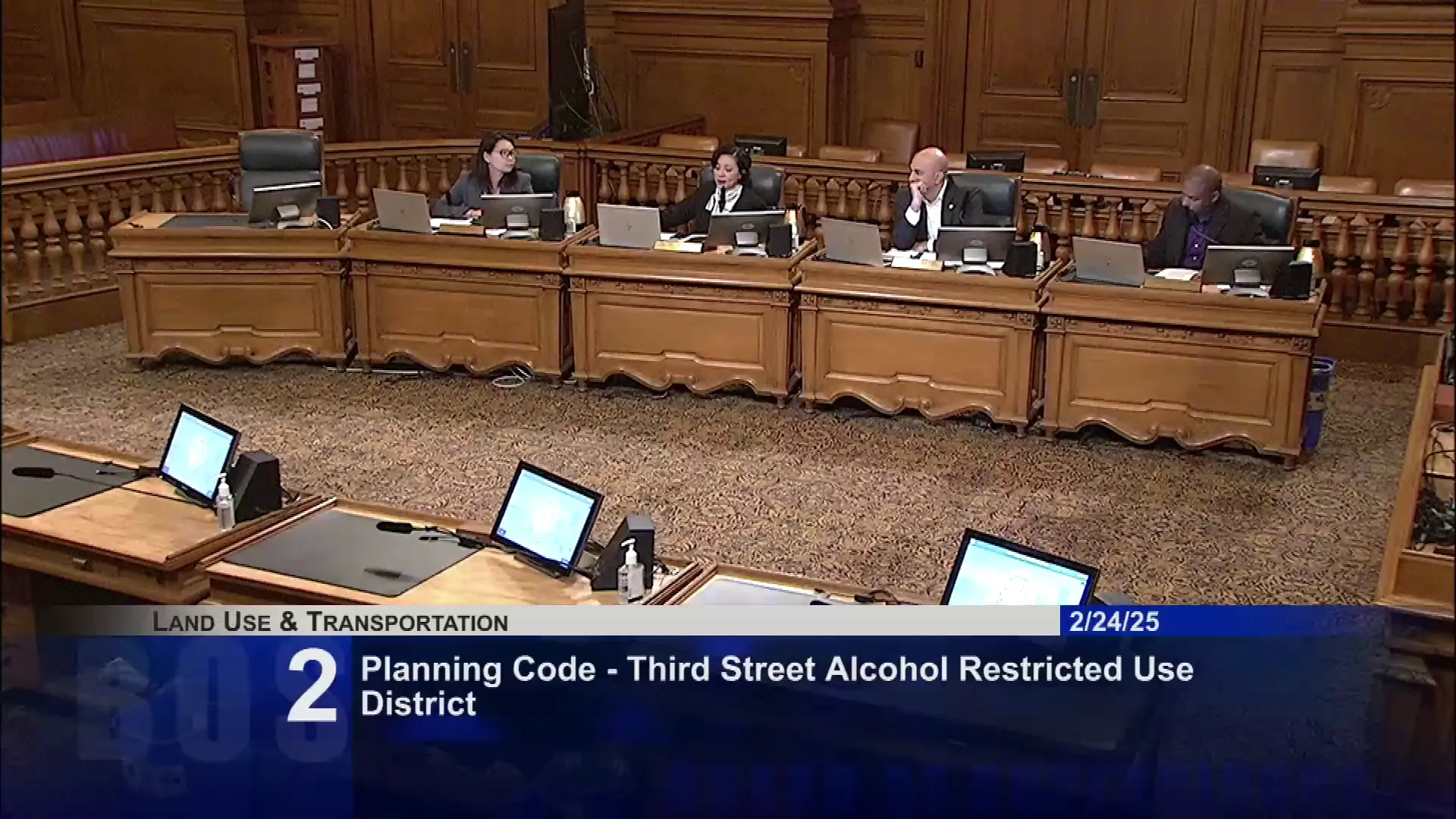
Item 2: Planning Code – Third Street Alcohol Restricted Use District
- Supervisor Walton, who introduced the item, explained that it creates an exception for distilleries, wineries, and breweries to establish on-sale liquor establishments in the Bayview Neighborhood Commercial District, subject to conditional use authorization. The goal is to draw businesses and foot traffic to the Third Street corridor.
- Planning Department staff noted the Planning Commission approved the ordinance on December 5, 2024. No public comments were heard. The committee voted to send it as a committee report to the full board (3-0).
Item 3: Planning Code, Zoning Map – Leland Avenue Neighborhood Commercial District
- Supervisor Walton presented the item, stating it was a community-driven effort (initiated in 2023 by residents and merchants) to establish a new NCD for Leland Avenue between Bayshore Boulevard and Cora Street. The goal is to enhance foot traffic, foster a welcoming environment for small businesses, and link to the Visitation Valley Greenway. The controls were carefully chosen by the community, and the Planning Commission approved it on February 6, 2025.
- Supervisor Walton noted that the community opposed including child care facilities near a cannabis shop, and the Planning Commission supported the community's vision. The committee heard public comments in support. The committee voted to recommend as a committee report (3-0).
Key Outcomes
- Item 1: Resolution amended and recommended to the full Board of Supervisors (3-0) for the March 4, 2025 agenda.
- Item 2: Ordinance recommended as a committee report to the full Board of Supervisors (3-0) for consideration on February 25, 2025.
- Item 3: Ordinance recommended as a committee report to the full Board of Supervisors (3-0) for consideration on February 25, 2025.
- The meeting adjourned after all items were considered.
Meeting Transcript
Good afternoon, everyone. Uh, welcome to uh the February 24th, 2025 regular meeting of the land use and transportation committee of the Board of Supervisors. I'm Supervisor Mirna Melgar, chair of the committee, joined by Vice Chair Supervisor Cheyenne Chen and Supervisor Bilal Mahmud. The committee clerk today is Mr. John Carroll. Um I would also like to acknowledge Kalina Mendoza at SFGup TV for helping us broadcast this meeting and bring it to people's homes. Uh Mr. Clerk, do you have any announcements? Yes, thank you, Madam Chair. Please ensure that you've silenced your cell phones and other electronic devices you've brought with you into the chamber today. If you have any documents to be included as part of any of today's files, you can submit them to me. Public comment will be taken on each item on today's agenda. When your item of interest comes up and public comment is called, please sign up to speak along your right hand side of the room. Alternatively, you may submit public comment in writing in either of the following ways. First, you may email your comments to me at J-O-H-N, period C A R R O L L at SFGOV.org. Or you may send your written comments via U.S. Postal Service to our office in City Hall. The address is one Dr. Carlton B. Goodlit Place, Room 244, San Francisco, California 94102. If you submit public comment in writing, I will forward your comment to the members of this panel and also include your comments as part of the official file on which you are speaking. And Madam Chair, items acted upon today are expected to appear on the Board of Supervisors agenda of March 4th, 2025, unless otherwise stated. Thank you so much. Please call item number one. Agenda item number one is a resolution supporting the San Francisco Municipal Transportation Agency's joint development program goals and policy to set a citywide policy on the joint development of transit and housing projects, address the SFMTA's budget deficit and advance San Francisco's housing and equity goals. Thank you very much, Mr. Clerk. I just want to acknowledge that we have just been joined by our colleague from District 10, Supervisor Shimon Walton. Thank you for joining us today, Supervisor Walton. Colleagues, I introduce this resolution and I will have uh Wade White Graff from the SFMTA come up and um give a presentation about what the MTA passed. Uh but first I wanted to explain what this is and why I thought we should weigh in on this issue. Um the MTA, as we all know, as has been widely publicized in the press is uh in trouble right now. We are facing a deficit for the next couple years that's significant and may lead to uh service reductions. Um and then we're facing a structural deficit after that that is significant, and we must do something different to address that crack from getting wider. Uh, I am really grateful that the MTA board has uh taken this on uh in a serious way, and that staff has been working through all the different possibilities. Part of it is gonna have to be um what we do with our neighbors at a regional level and how we move people around the region. Part of it is gonna have to be how we approach our own taxation, maybe sales tax, maybe parcel tax. We're still exploring all those possibilities. What we know is that we must do something, or we may lose the world-class system that we have today. And this is important for a lot of reasons. You know, for youth, uh, you know, the earlier board uh approve the free muni for youth program because for youth, Muni means freedom. It means opportunity, access to educational opportunities, access to all of the rich experiences of the city for seniors. It means living a life of dignity without isolation for low-income folks. It means access to work and education. It means lots of different things for people. The MTA has underinvested in its capital for you know a couple generations now, and we need to rectify that in order to meet our climate goals and our uh goals of connecting all communities, including those that are farther from downtown, um, and not just serving you know the downtown core. Um so everything that we do in terms of supporting our educational institutions like City College, San Francisco State in my district, or um lower income neighborhoods, neighborhoods that have traditionally been isolated, like those in Supervisor Walton's neighborhoods, um, or um you know, providing access for the entire region to institutions like uh uh City College and San Francisco State are predicated on having a functioning accessible and affordable uh public transportation system. So we have to act. The MTA owns a lot of land uh around San Francisco. And recognizing that different communities have different needs for that land, you know, um the the neighborhoods around the Balois reservoir have very different needs in the community of the marina, for example.
openpublica.com