Land Use and Transportation Committee Regular Meeting - April 14, 2025
STREAMING COPY IN PREPARATION — RECORDING AVAILABLE FROM THE ORIGINAL SOURCE
Land Use and Transportation Committee Regular Meeting - April 14, 2025
The Land Use and Transportation Committee of the San Francisco Board of Supervisors met on April 14, 2025, chaired by Supervisor Mirna Melgar, joined by Vice Chair Supervisor Cheyenne Chen and Supervisor Bilal Mahmood. The committee heard two items: an ordinance to remove the conditional use requirement for formula retail on Van Ness Avenue and an ordinance requiring notice for housing element rezoning. Both items were advanced with amendments.
Public Comments & Testimony
- Item 1 (Van Ness Formula Retail): Marlene Morgan from the Van Ness Corridor Neighborhood Coalition expressed support for the legislation with the caveat that legacy eligible businesses be protected and that efforts be made to break up large spaces with fewer barriers from the Department of Building Inspection. An additional public speaker supported the initiative to increase foot traffic and reduce vacancies.
- Item 2 (Housing Element Rezoning Notice): Jane Matoly, San Francisco organizing director for UMB Action, spoke in opposition, arguing the notice goes beyond what is necessary and could create undue alarm, and that the money could be better spent elsewhere during a tough budget season. Lori Brook with Neighborhoods United SF strongly supported the legislation, emphasizing that residents deserve full information about major land use changes. Tess Wellbourne from the REP Coalition supported the focus on existing residents and affordable housing needs. Multiple other speakers (Robert Ho, Lance Carnes, Jessica Vinus, Janet Monfredini, and others) supported the notice, citing lack of awareness and need for transparency. Small Business Forward also supported, noting potential displacement risks for small businesses.
Discussion Items
- Item 1: Removing Conditional Use for Formula Retail on Van Ness Avenue – Supervisor Stephen Sherrill introduced the ordinance, citing a 53% ground floor commercial vacancy rate on Van Ness compared to 7.7% citywide. He stated that the average permitting timeline of 7.5 months deters tenants, with some properties vacant for over five years. He proposed amendments: extending the boundary north to Chestnut Street and adding a provision to remove the requirement for a conditional use authorization (CUA) when a new formula retail operator replaces a previous one that did not have a CUA (e.g., the former Safeway on Fillmore). Supervisor Bilal Mahmood supported, noting the impact on District 5, including the 40,000-square-foot Safeway in the Fillmore, and emphasized food security. Supervisor Cheyenne Chen expressed support while underscoring the importance of formula retail restrictions for neighborhood character. Michelle Andrews, aide to Supervisor Danny Sauter, supported, noting the Van Ness 49 Muni line saw 142% ridership recovery in February 2025 (861,837 boardings). Planning Department’s Audrey Merlone presented the commission’s recommendation, including a request to replace “properties” with “lots” and a requirement for a one-year report on the corridor’s condition.
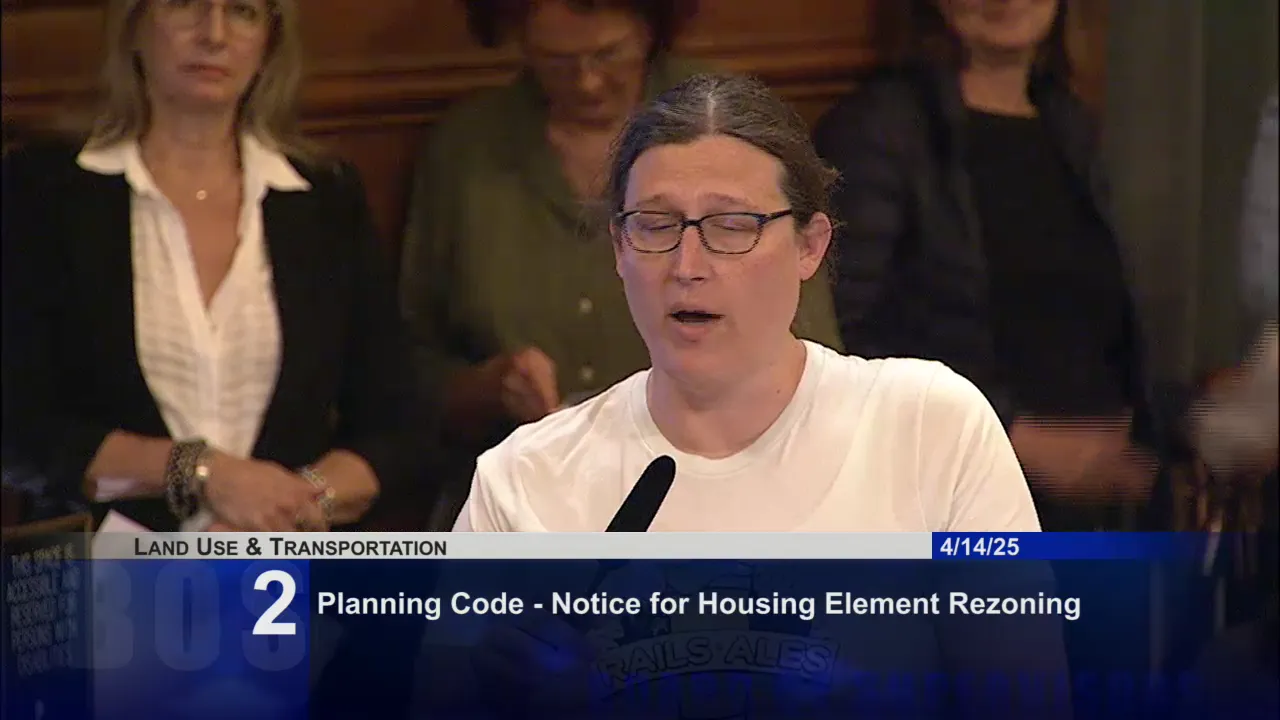
- Item 2: Notice for Housing Element Rezoning – Supervisor Connie Chan introduced the ordinance, which requires the Planning Department to notify property owners, residents, and commercial lessees within 300 feet of parcels proposed for upzoning. Notification would be via postcard with a QR code linking to a website with draft proposals, sample images, and legislative process information. The planning commission recommended modifications, including urging the Board to allocate resources for costs (estimated at $200,000 for production alone, excluding staff time and translation). Supervisor Chan circulated amendments to remove minimum font size and clarify that the website needs only sample images. Planning Department’s Veronica Flores noted the estimate could rise with the final map and that staff time is not included. Deputy Director Joshua Switsky stated that direct community engagement has been more effective than mailers. Supervisor Melgar expressed concerns about the cost and noted that previous large rezonings (Eastern Neighborhoods, Central SoMa) did not include such notification. She acknowledged the need for housing for the next generation but questioned the plan’s effectiveness. The committee debated the necessity and cost, with Supervisor Chan arguing for transparency and language access.
Key Outcomes
- Item 1: The committee voted unanimously (3-0) to adopt the amendments presented by Supervisor Sherrill (extending boundary to Chestnut Street and adding the CUA provision for former formula retail without CUA). The ordinance was then continued to the April 21, 2025 meeting of the Land Use and Transportation Committee (vote 3-0). Supervisor Melgar added herself as a co-sponsor.
- Item 2: The committee voted unanimously (3-0) to adopt Supervisor Chan’s amendments (removing minimum font size, clarifying sample images). A motion to send the amended ordinance to the full Board of Supervisors without recommendation passed 2-1, with Vice Chair Chen dissenting. The item will appear on the Board’s April 22, 2025 agenda.
Meeting Transcript
Good afternoon, everyone. This meeting will come to order. Welcome to the April 14th, 2025 regular meeting of the Land Use and Transportation Committee of the San Francisco Board of Supervisors. I'm Supervisor Mirna Melgar, Chair of the Committee, joined by Vice Chair Supervisor Cheyenne Chen and Supervisor Bilal Mahmood. The committee clerk today is John Carroll. Mr. Clark, do you have any announcements? Yes, thank you, Madam Chair. Please ensure that you've silenced your cell phones and other electronic devices you've brought with you into the chamber today. If you have any documents to be included as part of a legislative file assigned to land use, you can submit that to me and I'll meet you at the rail to pick it up. Public comment will be taken on each item on today's agenda. When your item of interest comes up and public comment is called, please line up to speak along your right hand side of this room. Alternatively, you may submit your written public comment in either of the following ways. First, you may email your comments to me at J-O-H-N, period C A R R O L L at SFGOV.org. Or you may send your written comments via U.S. Postal Service to our office in City Hall. The address is one Dr. Carlton B. Goodlit Place. Room 244, San Francisco, California, 94102. If you submit public comment in writing, I will forward your comment to the members of this panel and also include your comments as part of the official file on which you are commenting. And finally, Madam Chair, items acted upon today are expected to appear on the Board of Supervisors' agenda of April 22nd, 2025, unless otherwise stated. Thank you. Mr. Clerk, please call item number one. Agenda item number one is an ordinance amending the planning code to remove the conditional use authorization for formula retail uses in the residential commercial zoning district along Van Ness Avenue between Broadway and Redwood for properties fronting Van Ness Avenue. The ordinance affirms the planning department's secret determination and makes findings of public necessity, convenience, and welfare under planning code section 302 and findings of consistency with the general plan and eight priority policies of Planning Code Section 101. Thank you so much, uh Mr. Clerk. We are joined by uh District 2 supervisor Stephen Sherrill. Welcome to the committee. Um would like to give you a chance to give a few remarks, and then we'll turn it over to Audrey Merlone to have the stack presentations. Well, Chair Melgar, thank you very much for scheduling this item today. Um, as mentioned by the clerk, this ordinance principally permits formula retail along Van Ness between Redwood Street and Broadway. Well, why are we doing this? Frankly, Van Ness is facing a crisis of persistent commercial vacancies. Planning department surveys found 53% ground floor commercial vacancy rate on Van Ness. And when you compare it to a citywide retail vacancy rate of about 7.7%, and even the shockingly higher 22.1% vacancy rate in Union Square, the Van Ness commercial vacancy rate is simply put, absurdly high. Since taking office, I have heard from many building owners on Van Ness, all of whom have faced significant challenges in filling these spaces under the existing conditional use requirements. They're replete with stories of potential tenants deterred by the on average 7.5 month-long permitting timeline. And lo and behold, some of these prop properties have remained vacant for longer than five years. This is bad for Van Ness, and it's bad for the city as a whole. Van Ness is part of Highway 101. It is a major north-south arterial through this city. This street has an outsized impact on the public perception of the city's economic health. And with a challenge like this, we should be helping fill these vacancies, not standing in the way, especially when this change is in line with the history of Van Ness's commercial identity. Now, following the devastation of the 1906 earthquake, Van Ness emerged as temporary downtown with new department stores, trade shops, and banks filling the corridor. When downtown was rebuilt, Van Ness kept its commercial identity, becoming a home to many automobile showrooms, restaurants, and more in the 1920s. However, since the 1970s, more and more of these showrooms have left Van Ness, leaving exorbitantly large retail spaces empty and difficult to occupy. Now, despite this history of large retailers and chain stores on the street, and despite a decline in tenants that now is reached over three uh into its third decade, our planning code restricts formula retail from filling these large spaces, requiring prospective stores to navigate multi months-long conditional youth processes.
openpublica.com