San Francisco Planning Commission Meeting – June 12, 2025
STREAMING COPY IN PREPARATION — RECORDING AVAILABLE FROM THE ORIGINAL SOURCE
San Francisco Planning Commission Meeting – June 12, 2025
The San Francisco Planning Commission met on Thursday, June 12, 2025, at approximately 12:15 PM. The meeting covered a range of items including continuances, consent calendar approvals, informational presentations on the Railyards development and a housing project at 668 Guerrero Street, adoption of the Racial and Social Equity Action Plan Phase 2, and a conditional use authorization to merge two dwelling units at 301 Main Street. The Commission voted to adopt the equity plan, deny the unit merger, and continued several items.
Consent Calendar
- Item 3 (1635 Divisadero Street): Unanimously approved (6-0) a Conditional Use Authorization for a real estate office (Tusker Corporation) on the consent calendar.
Public Comments & Testimony
- Continuances: A member of the public questioned why the Community Investments Toolkit item keeps being continued, noting its importance to the Housing Element implementation. Joseph Smook (Race and Equity and All Planning Coalition) supported further continuance to allow more engagement. Another speaker urged the city to lobby Sacramento to exempt Priority Equity Geography neighborhoods from SB 423.
- General Public Comment: Several speakers addressed SB 79 (state density bill), with Catherine Petrin (Neighborhoods United SF) and Bridget Maley urging the Commission to request a full analysis of costs and impacts. A housing navigator shared personal stories about housing insecurity and the need for transparency.
- Racial and Social Equity Action Plan (RSEAP): Numerous community members and organizational representatives spoke in strong support of adopting Phase 2, including Dale Seymour (Equity Council), Leah Johnson (Friendship House), Atheus Cervantes, Krista Larcon Luna (MEDA), Annie Chung (Self-Help for the Elderly), Eric Argoyo (Cultura y Arte Nativo de las Americas), Naima Hall, Brianna Morales (Housing Action Coalition), Isan Looper (Tenderloin CBD), Patty Rodriguez (small business owner), and Alma Casalanos (Klecha). All stressed the importance of institutionalizing equity, building community trust, and maintaining funding.
- Railyards Development (Prologis): A speaker expressed disappointment that affordable housing was not mentioned in the presentation. Another speaker (self-identified as new to the process) supported the project’s ambition and called for continued momentum. A speaker via reasonable accommodation requested that presentations be posted online and noted the lack of live broadcast on SFGovTV.
- 668 Guerrero Street: Georgia Shudish questioned why the project is classified as an alteration, asked about demolition calculations, and which units would be affordable. Bridget Maley echoed concerns about height and unit mix.
- 301 Main Street (Unit Merger): Georgia Shudish referenced a past merger on California Street where kitchens were kept separate, and urged a strong policy against merging flats. Bridget Maley raised concerns about future impacts on housing stock. A neighbor spoke in favor of property owners’ rights to adapt units for aging in place.
Discussion Items
- Item 8 – Racial and Social Equity Action Plan Phase 2 Adoption: Staff presented the plan, highlighting community feedback, revisions for feasibility and accountability, and division-level strategies (historic context statements, code equity audit, impact analysis toolkit). The Commission unanimously supported adoption, with members praising the collaborative process, the inclusion of output/outcome metrics, and the institutional commitment. Director Hillis noted the plan is adaptive and builds on existing external work.
- Item 9 – Railyards Site Development (Prologis) Informational Presentation: Prologis presented a vision for a 20-acre transit-oriented development with up to 7 million square feet of mixed use, thousands of homes, a new Caltrain station, and parks. The project envisions heights up to 850 feet as a regional transit hub. Commissioner questions focused on community engagement (led by Prologis with city oversight), affordable housing commitments (still under discussion), parking ratios, bike parking, and the need for more detailed urban design diagrams. The item was informational only; no vote taken.
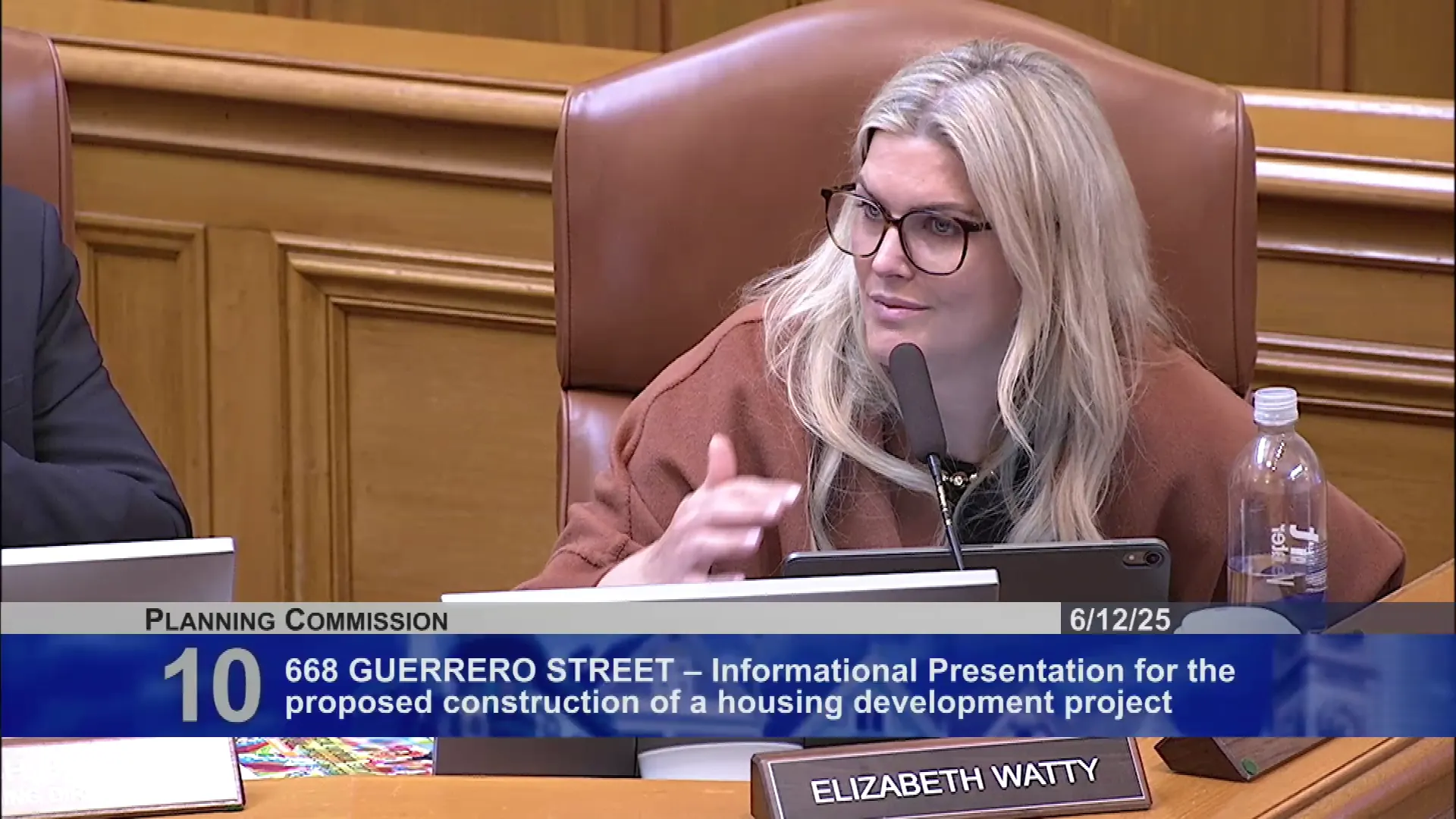
- Item 10 – 668 Guerrero Street Informational Presentation: The architect presented a 12-unit state density bonus project (SB 423) with a mix of unit sizes, including two- and three-bedroom units. Commissioners noted the improved presentation compared to previous SB 423 projects, supported the unit mix, and asked about affordable unit placement (determined later during permitting) and notification procedures. The item was informational; no vote.
- Item 11 – 301 Main Street 26A & 26B – Conditional Use Authorization to Merge Two Dwelling Units: Staff recommended denial, citing loss of a housing unit in a time of shortage. The project sponsor argued for multi-generational living and aging in place, noting the merger would allow a live-in caregiver for the owner with a vision condition. Commissioners debated the policy trade-offs: some were sympathetic but ultimately voted to deny by 5-1 (Commissioner Campbell dissenting). A condition requiring the units to be restored upon sale was discussed but not applied due to the denial.
Key Outcomes
- Continuances Approved: Item 1 (935 Geary Street) continued to July 24, 2025; Item 2 (Community Investments Toolkit) continued indefinitely. Vote: 6-0.
- Consent Calendar Approved: Item 3 approved 6-0.
- Racial and Social Equity Action Plan Phase 2 Adopted: Unanimous 6-0 vote. The plan sets two- and five-year checkpoints and prioritizes existing projects. Next steps include publishing the full plan and an equity dashboard.
- 301 Main Street Conditional Use Denied: Motion to deny the unit merger passed 5-1 (Commissioner Campbell against). The project would have removed a housing unit in a transit-rich area.
Meeting Transcript
Okay, good afternoon and welcome to the San Francisco Planning Commission hearing for Thursday, January June 12th, 2025. When we reach the item you are interested in speaking to, we ask that you line up on the screen side of the room or to your right. Each speaker will be allowed up to three minutes. And when you have 30 seconds remaining, you will hear a chime indicating your time is almost up. When your allotted time is reached, I will announce that your time is up and take the next person cued to speak. There is a very convenient timer on the podium where you can see how much time you have left and watch your time tick down. Please speak clearly and slowly and if you care to state your name for the record. I ask that we silence any mobile devices that may sound off during these proceedings. And finally, I will remind members of the public that the Commission does not tolerate any disruption or outbursts of any kind. I would like to take roll at this time. Commissioner Chair Moore. Here. Commissioner Braun. Here. Commissioner Campbell. Here. Commissioner Imperial. Here. Commissioner McGarry. And Commissioner Williams. Here. Thank you, Commissioners. We expect Commission President so to be out today. First, on your agenda, Commissioners is consideration of items proposed for continuance. Item one, case number 2023, hyphen 011606. CUA at 935 Gary Street conditional use authorization is proposed for continuance to July 24th, 2025. And item two, case number 2024, hyphen 0081808 OTH for the Community Investments Toolkit in Equity Geographies Informational Presentation is proposed for an indefinite continuance. Commissioners, I have no other items proposed for continuance. So we should open up public comment. Members of the public, this is your opportunity to address the Commission on their items proposed for continuance only on the matter of continuance. Yes, on this item for continuance community investment toolkit. I guess I just, if it's possible to have someone comment on why this item keeps getting continued. This is an important component of the housing element implementation plan. And I think we'd just like to understand why it keeps getting continued. Thank you. Good afternoon, Commissioners. Joseph Smook with the Race and Equity and All Planning Coalition. I'm also addressing the item titled Community Investments Toolkit and Equity Geographies. I just want to state that Rep appreciated the letter that we received yesterday from Director Hillis, which states the Department agrees that the toolkit must be shaped by the priorities of those most affected. We look forward to working closely with the staff working on this toolkit to make sure that it is relevant and responsive to the needs and experiences of residents and workers in our communities. We support further continuance of this item to allow for the time for this engagement and collaboration to happen. And we look forward to hearing from staff with an updated timeline and specific opportunities to engage. Thank you. Hi, Georgia Shudish. Um I prepared something, but I've carrying it around for several weeks to submit and I'll just wait till it comes. But I guess my question is is like, you know, SB 423 applies to the whole city, and it just seems contrary to the intent of the private geography neighborhoods to have SB 423 apply to those neighborhoods. And I really encourage, I will continue to encourage the city to lobby Sacramento to remove the priority equity geography neighborhoods from being uh having to be under SB 423. That does not seem right. Doesn't seem like what was intended by the city and county of San Francisco when uh the project geography SUD was created. So we'll see what happens this summer or whenever.
openpublica.com