San Francisco Police Commission Meeting - July 13, 2022
STREAMING COPY IN PREPARATION — RECORDING AVAILABLE FROM THE ORIGINAL SOURCE
San Francisco Police Commission Meeting - July 13, 2022
The San Francisco Police Commission met on July 13, 2022, to review crime trends, receive reports from the Department of Police Accountability (DPA), discuss the Early Intervention System (EIS) fourth quarter 2021 and first quarter 2022 reports, address delays in updating Department General Orders (DGOs), and vote to adopt revised DGO 3.01. The meeting included public comment on unsolved homicides and policy concerns, and a closed session on personnel matters.
Public Comments & Testimony
- A caller criticized the proposed pretext stop policy (DGO 9.01), asking about acceptable racial disparities and comparing San Francisco's stop data to other cities. Commissioner Carter-Oberstone offered to meet to discuss the questions.
- Ms. Brown called regarding her son Arve Avakasa's unsolved 2006 murder, urging the department to address the "snitch culture" and solve cold cases. She asked for safety measures for witnesses.
- David Calderon called during the later discussion on pending DGOs, inquiring whether SFPD has a policy for when an investigator is found guilty of presenting perjured testimony, referencing his mother's case.
Chief's Report
- Chief William Scott reported crime trends for the week ending July 13, 2022: violent crime up 6% year-to-date (homicides flat at 26, robberies up 2%, assaults up 11%), property crime up 6% (burglaries down 25%, larcenies up 15%, auto burglaries up 7%). 539 guns seized (116 ghost guns). Hate crimes: 22 year-to-date, down from 113 all last year.
- Major incidents included a homicide on July 9 at Dakota and 23rd Street; four shootings; the annual "Hill Bomb" event declared an unlawful assembly due to crowd hostility and vandalism; and vandalism of a new community center at 24th and Harrison.
- Chief discussed the 19B surveillance camera ordinance before the Board of Supervisors, seeking authority for real-time monitoring of felony/misdemeanor activity and large events. He noted the current ordinance only permits live monitoring in exigent circumstances.
- Commissioners expressed concerns about the new District Attorney Brooke Jenkins' emphasis on enforcement, particularly regarding drug users. Chief responded that the department is enforcing open-air drug use based on community complaints, but policy remains unchanged.
- Commissioner Yanes urged continued focus on violent crime rather than regressive approaches; Chief agreed to agendize the topic for fuller discussion.
DPA Director’s Report
- Director Henderson reported DPA statistics: 346 cases opened in 2022, 367 closed, 240 pending, 38 sustained, 11 mediated. 20 cases past the nine-month investigation period (15 due to civil/criminal pending tolling). 45% of new cases involve failure to take required action (e.g., write reports); 18% involve inappropriate behavior.
- Summer Law and Justice program interns met with various justice system officials; a presentation will be given at end of summer.
- DPA launched a new FAQ document on their website under "Resources," explaining the complaint and investigation process in plain language. Commissioners praised the FAQ and requested it be hyperlinked from the commission website.
Commission Reports
- Commissioner Benedetto reported on a six-hour ride-along with Mission Station officers, calling it enlightening. He also outlined community outreach for DGO 9.01 (pretext stops), including town halls and targeted meetings with Asian Pacific Islander and Latino groups starting August 2, 2022.
- Commissioner Carter-Oberstone requested quarterly raw stop and search data (QADR) from Chief Scott; Chief said data would be provided by Thursday, July 14.
- Vice President Elias agendized a report on the expired juvenile DGO and a meeting with command staff on DGO priorities.
Early Intervention System (EIS) Presentation – 4th Quarter 2021 & 1st Quarter 2022
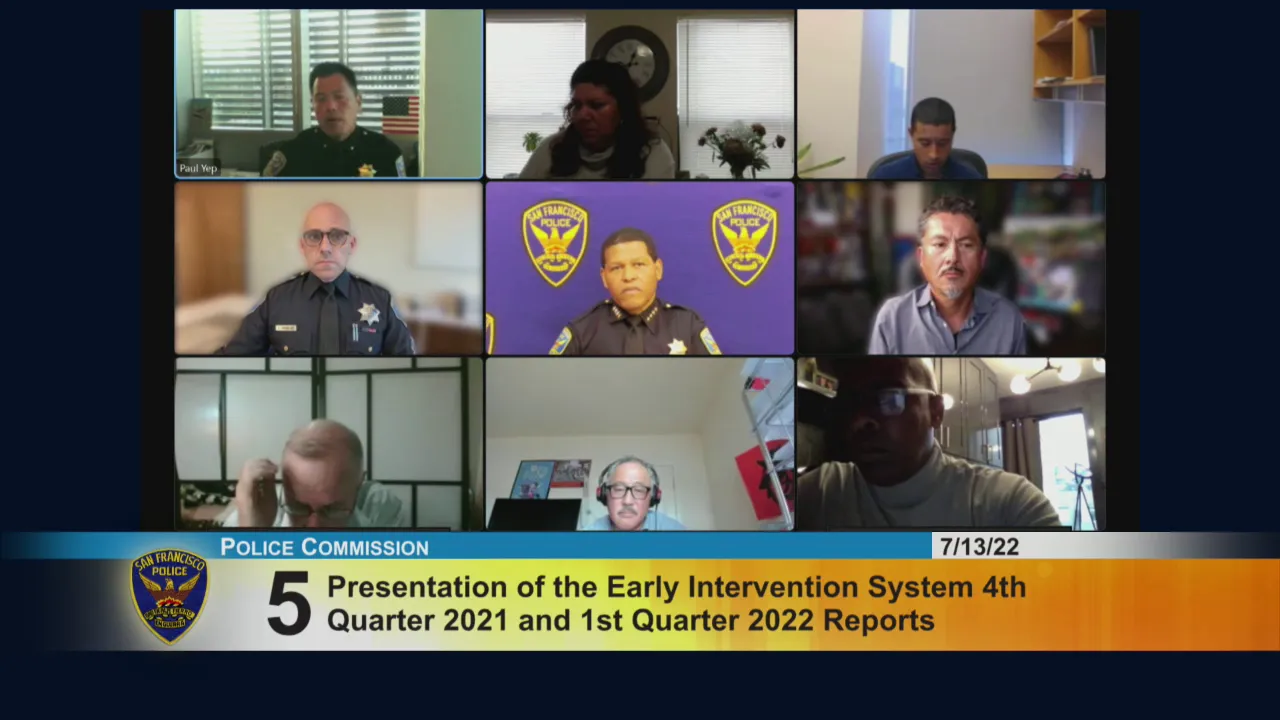
- Commander Paul Yap presented: 3.3% of active sworn members generated EIS alerts in Q4 2021 (100 alerts from 70 members); 3.2% in Q1 2022 (89 alerts from 65 members). The most common trigger was three or more uses of force in three months (48 in Q4, 35 in Q1).
- Interventions: informal counseling (61 Q4, 71 Q1); formal counseling (4 Q4, 1 Q1); performance improvement plans (2 Q4, 3 Q1).
- A new EIS system with Benchmark Analytics is in development, expected production release January 2023, aiming to reduce false positives and improve predictive analytics.
- Discussion: Commissioners asked about weighting of indicators (all equal), under/over-inclusivity, and whether thresholds lead to formal written plans. Chief noted that psychological counseling referrals are voluntary, not mandatory.
- Commissioner Byrne raised the importance of using EIS to encourage officers to seek mental health support; Chief acknowledged but said current policy only mandates evaluation through fitness-for-duty process.
Discussion on Pending Department General Orders
- DPA Policy Director Janelle Kwood presented a list of 26 DGOs that have languished for unreasonable periods (e.g., Duties of Patrol Officer pending 785 days; Field Training Program pending 826 days). She noted the DOJ criticized this in 2016 and the problem persists.
- Chief Scott responded that the department has been focused on CRI (Collaborative Reform Initiative) compliance, subject matter experts (SMEs) are pulled for field duties, and the written directives unit has only three staff. He announced a restructuring with new civilian positions (two for policy writing, two for community work groups) funded in the upcoming budget.
- Director Henderson argued delays are systemic and go beyond staffing; DPA offered to draft policies but was told not to redline. He asked the commission to monitor DGO progress monthly.
- Ms. Kwood noted that the department instructed DPA not to speak directly to SMEs, causing bottlenecks.
- Commissioner Carter-Oberstone expressed concern that delay undermines the commission's regulatory authority. The commission requested monthly status reports and asked Chief to present the new DGO structure in September.
- Vice President Elias asked the Chief to prioritize simple DGOs for quick completion.
Closed Session
- The commission unanimously voted (6-0) to hold Item 9 in closed session. After closed session, they voted unanimously (6-0) not to disclose any discussion.
Key Outcomes
- Adopted revised DGO 3.01 (Department Written Directives) – Vote: 6-0 in favor.
- Data sharing: Chief Scott agreed to provide quarterly stop and search data to the commission by Thursday, July 14.
- DGO monitoring: Commission will receive monthly progress reports on pending DGOs; Chief to present new DGO development structure in September.
- DGO 9.01 outreach schedule: Announced town halls on September 6, 13, and 20, plus targeted meetings with community groups starting August 2.
- Closed session: No disclosure of closed session discussion.
Meeting Transcript
Thank you. Welcome everyone to the July third, sorry, July 13, 2022 police commission meeting. Um, if we can stand and do the pledge of allegiance, please. I pledge allegiance to the flag of the United States of America and to the Republic for which it stands one nation under God, indivisible with liberty and justice for all the thank you so much. Welcome everyone. Sergeant, can you please take role? Yes, ma'am. Commissioner Benedicto Present. Commissioner Benedict is present. Commissioner Yannis. President. Commissioner Carter Oberstone. Present. Mr. Carter Oberstone is president. Um present. Commissioner Byrne? Here. Commissioner Byrne is here. Commissioner Yee? Here. Commissioner Yes. You have a quorum also here with us tonight. We have Chief William Scott from the San Francisco Police Department. And we have Chief of Staff Sarah Hawkins for the Department of Police Accountability. Thank you. Welcome. Sergeant, can you please call the first matter? Line item one, general public comment. At this time, the public is now welcome to address the commission for up to two minutes on items that do not appear on tonight's agenda but are within the subject matter jurisdiction of the police commission. Under police commission rules of order, during public comment, neither police or DPA personnel nor commissioners are required to respond to questions by the public, but may provide a brief response. Comments are opportunities to speak during public comment period are available via phone by calling 415-655-0001 and entering access code 2495-668-9618. Alternatively, you may submit public comment on either of the following ways. Email the Secretary of the Police Commission at SFPD.commission at SFgov.org. Our written comments may be sent via U.S. Postal Service to the public safety building located at 1245 Third Street, San Francisco, California, 94158. If you would like to make public comment at this time, please press star three. Good evening, caller. You have two minutes. Commissioner Oberstill, the more I read your pretext stop policy, the more I see Aaron Peskin is termed out any need to launch a political career. The introduction of your policy clearly implies that you believe that race is the only reason for the stops. So I ask you to present the following as you do develop this policy. What disparity, if any, is acceptable? Number two, is your thought process on crime that it relates to the population of each demographic and location and cannot ever be overrepresented without racism? Three. How do you compare the number of stops made by police versus the reported numbers of suspects by victims? Four. If poverty is a driver of crime, as described by Felicia Jones and her group, then if any demographic has a higher instance of poverty versus their population in a given area, would this not account for some disparities on police contacts? Five. San Francisco has some of the worst anti-black study statistics anywhere.
openpublica.com