San Francisco Police Commission Meeting - November 2, 2022
STREAMING COPY IN PREPARATION — RECORDING AVAILABLE FROM THE ORIGINAL SOURCE
San Francisco Police Commission Meeting - November 2, 2022
This meeting of the San Francisco Police Commission on Wednesday, November 2, 2022, convened at 1:45 PM and covered a wide range of topics including a presentation on racial disparities in traffic stops, the adoption of a revised use of force policy (DGO 5.01), a grant for violence intervention, and updates on department accountability. The commission heard extensive public comment, approved several items, and deferred action on a memorandum of understanding with the District Attorney's Office.
Consent Calendar
- Adoption of Minutes (October 12, 2022): Approved unanimously (6-0).
- Consent Calendar Items: Received and filed, including the SFPD Family Code 6228 quarterly report for the second and third quarters of 2022, and approval to accept four tickets from the San Francisco Police Credit Union for the SF PAL golf tournament (valued at $900). Approved unanimously (6-0).
Public Comments & Testimony
- Paul Allen (retired lawyer, 30-year resident) argued for a more rigorous process before adopting a traffic enforcement order, including citywide hearings and an evidentiary memorandum. He expressed concern about adverse consequences for public safety and police morale.
- Ms. Brown (mother of murdered son Abre Abacasso) pleaded for progress on unsolved homicides, stating she has the names of perpetrators but no action taken.
- Callers raised issues about camping enforcement, anti-blackness in policing, and called for urgency in addressing racial disparities. Several callers (including members of Wealth and Disparities in the Black Community) demanded stronger oversight and criticized the pace of reform, with one noting black San Franciscans are 15 times more likely to be subject to use of force than white residents.
- Deputy Public Defender Brian Cox urged the commission to enact a strong traffic stop policy (DGO 9.01) and emphasized the harms caused by pretext stops.
- Susan Bachman (Wealth and Disparities) expressed concern that police officers' opinions in work group meetings are not representative of community interests.
- Evan Sean Bland (Walk SF) asked SFPD to focus on five most dangerous driving behaviors to improve Vision Zero goals.
- Other callers supported limiting pretext stops and requested data per capita by race.
Discussion Items
- Racial Disparities in Traffic Stops (Item 7): Magnus Lofstrom, policy director at PPIC, presented findings from a study of 3.4 million traffic stops by California's 15 largest law enforcement agencies in 2019. Key findings:
- 211,000 stops resulted in no enforcement and no discovery of contraband; officers spent 80,000 hours on these stops.
- 905 stops led to firearm confiscation, with 75 in San Francisco (50 for non-moving violations).
- Racial disparities peaked around midnight, with black and Latino drivers overrepresented in searches but less likely to be found with contraband.
- Veil of darkness analysis suggested evidence of racial bias in stop decisions by local law enforcement.
- Recommendations included mailing citations for non-moving violations, automated enforcement for moving violations, implicit bias training, diversifying police staff, and reallocating officers to same-race neighborhoods.
- Commissioners expressed interest in local data and requested follow-up on San Francisco-specific outcomes.
- Chief's Report (Item 4): Chief Bill Scott reported crime trends: overall crime up 7% year-to-date, violent crime up 8%, property crime up 7%. Homicides down 2% (43 total), shootings up slightly. 890 firearms seized (5% increase), including 163 ghost guns. Fentanyl seizures in the Tenderloin reached 52,867 grams, nearly double 2021. Chief provided details on the October 28 attack on Paul Pelosi, commending dispatcher Heather Grimes and officers for rapid response. Other incidents included four non-fatal shootings and two fatal collisions.
- DPA Director's Report (Item 5): Director Paul Henderson reported 570 open cases, 52 sustained cases (up from 41 last year), 18 mediated cases, and 22 cases beyond nine months. Updates on audits and outreach.
- Commission Reports (Item 6): Commissioners reported on DGO assignments and listening sessions for DGO 9.01 (traffic stops). President Elias highlighted a Glide program where officers engage in plain-clothes community service. Several more listening sessions were announced.
- Revised Use of Force Policy (DGO 5.01) (Item 8): After discussion, the commission adopted the revised policy unanimously (6-0) with an effective date of December 8, 2022. The policy expands reporting requirements, prohibits neck/throat restraints even if inadvertent, adds a safeguarding dignity section, and was developed collaboratively with SFPD, DPA, and the Police Officers Association.
- $6 Million Grant for Violence Intervention (Item 9): The commission voted unanimously (6-0) to urge the Board of Supervisors to retroactively authorize acceptance of a $6,000,000 grant from the California Board of State and Community Corrections for the California Violence Intervention and Prevention Program. The grant funds life coaching and cognitive behavioral therapy for individuals at risk of gun violence.
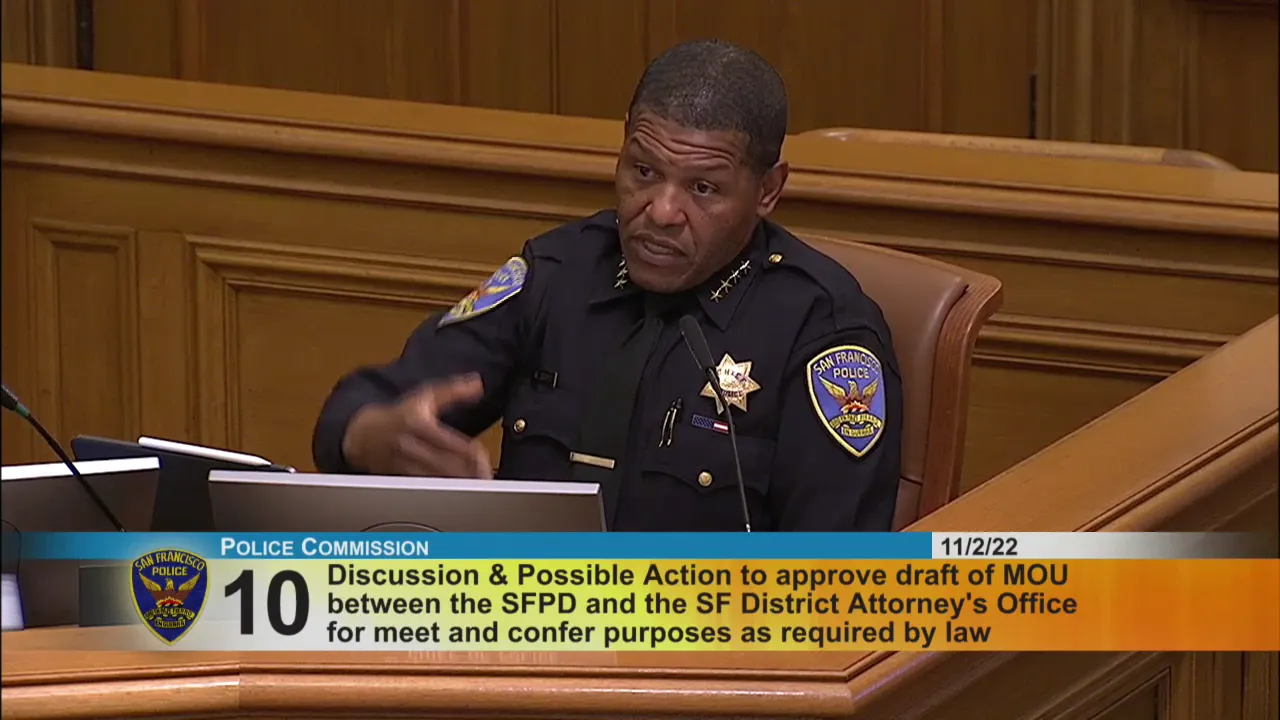
- MOU between SFPD and SFDA (Item 10): Discussion was held but no vote taken. Chief Scott and Director Henderson reported ongoing negotiations; a meeting with the judge was rescheduled for November 4, 2022. The commission deferred action to the November 16 meeting, with Vice President Carter Oberstone raising concerns about information sharing and the need for independent investigations. Commissioner Byrne noted the commission's role is not merely advisory.
Key Outcomes
- Adopted: Minutes of October 12, 2022 (6-0).
- Adopted: Consent calendar items (6-0).
- Adopted: Revised DGO 5.01 (Use of Force Policy) effective December 8, 2022 (6-0).
- Adopted: Resolution urging Board of Supervisors to accept $6 million grant (6-0).
- Deferred: Approval of draft MOU with San Francisco District Attorney's Office to November 16, 2022, pending further negotiation.
- Calendared: Presentation on San Francisco-specific traffic stop data for December 2022, and a report on impact of Tenderloin policing on youth for December 7, 2022.
- Next Meeting: The commission will not meet November 9; next regular meeting is November 16, 2022.
Meeting Transcript
The flag of the United States of America and to the Republic for which it stands on nation under God. Justice. President Lyons, if I can take roll. Please. Commissioner Walker. Here. Commissioner Walker is here. Commissioner Benedicto. Present. Commissioner Yanes. President. Commissioner Byrne. Here. Commissioner Yi is excused. Vice President Carter Oberstone is in route. President Lyons, you have a quorum with us tonight. We have Chief Bill Scott from the San Francisco Police Department and Executive Director Paul Henderson for the Department of Police Accountability. Thank you. Welcome everybody. Welcome, Director Henderson, welcome back. Welcome to the public, to those in the audience to our November 2nd 2022 Police Commission meeting. Happy Wednesday. It is my favorite day of the week. So with that being said, let's go ahead and start. Line item one, general public comment. At this time, the public is now welcome to adjust the commission for up to two minutes on items that do not appear on tonight's agenda but are within the subject matter jurisdiction of the police commission. Under police commission rules of order during public comment, neither police or DPA personnel nor commissioners are required to respond to questions by the public, but may provide a brief response. Comments or opportunities to speak during the public comment period are available via phone by calling 415-655-0001 and entering access code 2483 985032. Alternatively, you may submit public comment in either of the following ways. Email the Secretary of the Police Commission at SFPD.commission at sfgov.org or written comments may be sent via U.S. Postal Service to the public safety building located at 1245 Third Street, San Francisco, California, 94158. If you would like to make public comment, please press please come to the podium and press star three if you are virtual. Go ahead, sir. Yes, uh good afternoon, Commissioners. Scott, my name is Paul Allen, 30-year resident of the city and a retired lawyer. I come here to address briefly the uh May 6th draft traffic enforcement order, and I wish to make four points. I previously submitted memos on this. Number one, in terms of process, it seems to me that if a draft order becomes ripe for serious commission consideration, it is incumbent upon this commission on banc to hold hearings around the city rather than simply delegating this matter to the Human Rights Commission or to the listening sessions. Number two, in terms of evidence, prior to the uh holding of those hearings, this commission should publish an evidentiary memorandum that clearly sets forth the basis for the order, the alternatives considered, that is to say, alternatives other than barring SFPD from making uh traffic stops, and why those alternatives, those less restrictive alternatives are deemed to be unsatisfactory by the commission. Third, consequences. What it seems to be lacking from this is a discussion of the burden as well as the benefit. That is to say, what are the reasonably foreseeable adverse consequences of barring S fe SFPD from citing in connection with uh Baker's dozen of traffic enforcement uh statutes? Those reasonably foreseeable consequences could be adverse effect to public safety, police department morale retention and recruitment. Those must be itemized. And finally, burden. It seems to me that for the commission to proceed uh in an order of this nature, it would have it ho it has a very high burden. This is an unelected, unaccountable body. Moreover, the public uh views on safety have obviously changed. Five months ago, the voters voted by essentially 45 55 to 45 that they wanted more traffic. Thank you, sir.
openpublica.com