San Francisco Police Commission Meeting - November 16, 2022
STREAMING COPY IN PREPARATION — RECORDING AVAILABLE FROM THE ORIGINAL SOURCE
San Francisco Police Commission Meeting - November 16, 2022
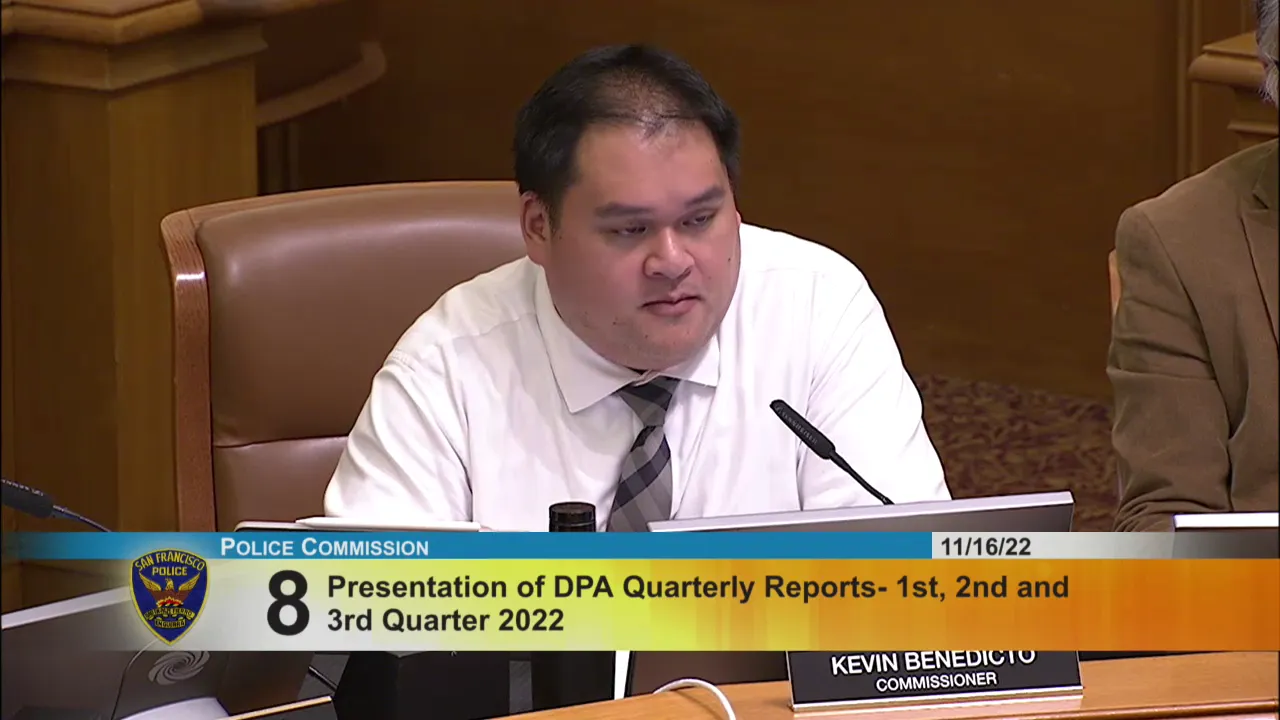
The San Francisco Police Commission met on Wednesday, November 16, 2022. The meeting featured an early presentation by the Center for Policing Equity (CPE) on racial disparities in traffic stops, reports from the Chief of Police and the Department of Police Accountability (DPA), adoption of an SB16 personnel records policy, a review of DPA quarterly statistics, an Early Intervention System (EIS) update, and a closed session. Due to a WebEx technical issue, the originally scheduled general public comment period was moved and reopened later in the meeting.
Agenda Order and Technical Note
- Item 7 (CPE presentation) was taken out of order at the start of the meeting before the regular general public comment.
- The first general public comment period was interrupted by a WebEx technical difficulty; the Commission later reopened general public comment before moving to the consent calendar.
Consent Calendar
- Adoption of Minutes for the meetings of October 19, 2022 and November 2, 2022 was moved, seconded, and passed unanimously (6 yes; Commissioner Yi initially noted he was not present on November 2 and was told he could not abstain under the charter, then voted yes).
- Consent Calendar items were received and filed by a 6-0 vote. Items included SFPD and DPA SB1421/SB16 monthly reports, the Collaborative Reform Initiative monthly update, and the SFPD/DPA quarterly document protocol for Q3 2022.
Public Comments & Testimony
- Gene Bridges, volunteering with Wealth and Disparities in the Black Community, stated that public comment had been "effectively cut off" because phone participation started late. He argued that CPE's findings support eliminating pretext stops, cited DOJ criticism of SFPD, and said SFPD's own data show Black San Franciscans are 5 times as likely to be stopped, 10 times as likely to be arrested, and 15 times as likely to experience force. He called for required narrative justifications for stops and accountability.
- A second caller from the same group expressed frustration that the commission had not shown urgency, said community members had contacted Attorney General Bonta, and challenged the notion that San Francisco needs a "special" approach while also waiting for evidence from other cities.
- Susan Buckman, also volunteering with Wealth and Disparities in the Black Community, commented on the consent calendar, saying California and SFPD have some of the worst racist and violent policing outcomes in the nation and arguing that SFPD resists accountability and the release of personnel records under SB1421/SB16.
Discussion Items
Presentation by the Center for Policing Equity (CPE) on Traffic Stops
- Presenters: Charlotte Reesing (Government Affairs Manager) and Scarlett Neath (Policy Research Manager) presented CPE's white paper on redesigning traffic safety. CPE said it partners with over 60 law enforcement agencies in 30 states and uses science to reduce bias.
- CPE Recommendations: End pretextual stops; invest in public health approaches to road safety; limit fines and fees; pilot alternatives to armed enforcement; and improve data collection and transparency.
- Key Statistics Cited: Pretext stops produced contraband or arrest in only 0.03% of analyzed stops; Fayetteville, NC reduced non-safety-related stops from 56% to 32% after reform; Virginia's law produced a 7.5% reduction in stop volume but unchanged racial disparities; Los Angeles saw pretext stops fall from 21% to 12%; an analysis of San Diego Sheriff's data estimated $43.9 million in officer hours spent on low-yield stops.
- CPE Positions: CPE said "situations predict bias much more than individual biases," and expressed support for banning all pretextual stops. They stated research shows no measurable negative effect on crime in jurisdictions that adopted such bans, citing Washington state and Fayetteville. They also said departments should document reasons for stops and leadership should communicate the intent of reform.
- Commissioner Questions and Positions:
- President Elias asked whether banning pretext stops would create a safety risk, noting officer concerns about losing a crime-fighting tool. CPE responded that studies show no negative impact on crime and that the yield from such stops is very low.
- Commissioner Benedicto asked why the reforms should be adopted as a holistic package. CPE said the combination reduces disparities while maintaining road safety, and that each element reinforces the others.
- Commissioner Walker questioned whether there is data showing all three approaches work better than one, and suggested pilot programs to test what works. CPE said individual reforms have evidence, but no jurisdiction has implemented all three together; they offered to share further data. Commissioner Walker also expressed concern about existing infrastructure for mail-in tickets and repair vouchers.
- Commissioner Yi asked about projected budgets for fine/fee changes and alternatives to armed enforcement. CPE mentioned income-based waivers, repair voucher programs (e.g., Lights On in Chatham County, GA and Minnesota), and cautioned that automated enforcement must be implemented equitably.
- Commissioner Yannis asked about cost analyses and whether changes improved clearance rates. CPE said they were unaware of cost studies but that policy changes are low-cost, and no study yet shows clearance rate improvements; they encouraged San Francisco to become a leader.
- Chief Scott said he had read the report, thanked CPE, and said SFPD has been working with CPE.
Chief's Report
- Chief Scott reported weekly crime trends: violent crime up 7% (311 more crimes than last year), property crime up 6% (just short of 3,000 more); robberies up 5%, aggravated assaults up 10%; burglaries down 21%, larceny up 13%, auto burglaries steady at 9%; homicides up 2% (one additional), firearm-related homicides down by 4; 961 guns seized, including 163 ghost guns.
- He detailed three homicides, several auto burglary and catalytic converter arrests, and said holiday deployment had begun in Union Square and shopping corridors, with foot beats and ambassadors in several neighborhoods.
- No public comment was offered.
DPA Director's Report
- Acting Director Diana Rosenstein reported DPA statistics: 601 cases opened in 2022 (vs. 695 last year), 636 closed (vs. 781), 245 pending (vs. 274), 53 sustained (vs. 43), and 18 mediated (vs. 36). Twenty-three cases were past the 270-day mark.
- She highlighted outreach at station meetings, a NACO presentation, an active shooter training attended by DPA staff, and ongoing audit work. She also thanked the commission for signing intern certificates and said officers are eager for more training.
- She mentioned a draft MOU between DPA and SFPD; Chief Scott said SFPD received it, met with the District Attorney, and would follow up with DPA.
Commission Reports
- Commissioner Benedicto reported on DGO 9.01 community listening sessions (at least 9-10 total) and the CIT awards.
- Commissioner Walker reported on the hate crimes DGO work, recruitment commitments (including the 30x30 contract), and meetings with community/business groups to coordinate public safety efforts.
- Commissioner Yannis reported on an upcoming ride-along, DGO 701 juvenile work, and a request to agendize a data review of the video feed collection program.
- Commissioner Yi reported on DGO updates and meetings.
DPA Quarterly Reports – Q1, Q2, Q3 2022
- DPA Operations Manager Nicole Armstrong presented quarterly data.
- Highlights included the launch of the new complaint portal, over 90 policy recommendations, 68 cases where body-worn camera footage was outcome-determinative, 17 mediated cases, and 16 interns contributing over 400 research hours.
- Armstrong noted a national downward trend in complaints to oversight agencies, high rates of "decline to state" demographics among complainants, and plans for training investigators to ask demographic questions and an officer portal.
- Commissioner Yannis asked about national trend data; DPA clarified the comparison was for cases received, and sustained-rate data may not be directly comparable. Commissioner Benedicto asked about the drop in policy failure findings in Q3; DPA attributed it to case resolution timing rather than a specific cause.
- Discussion turned to body-worn cameras. Acting Director Rosenstein said when in doubt, turn it on; Chief Scott noted cost and privacy concerns, but mentioned future technology that could activate cameras in critical incidents.
SB16 Personnel Records Policy (Item 9)
- The Commission considered adopting a joint policy document for release of personnel records under California Penal Code Section 832.7 as amended by SB16.
- Acting Director Henderson/Rosenstein requested advance engagement and pointed out that page three incorrectly listed "Department of Public Accountability" instead of "Department of Police Accountability."
- The Commission amended the document to correct the name, then voted 7-0 to adopt the policy.
Early Intervention System (EIS) Q2 2022 (Item 10)
- Commander Paul Yep and Sergeant Darwin Naval presented the EIS quarterly update.
- EIS alerts rose to 471 in Q2 2022, a 429.2% increase over Q1; 16.2% of active sworn members (321 officers) generated at least one alert, compared to the usual 3-4%. There were 1,945 indicator points vs. 267 in Q2 2021.
- The increase was attributed to the revised DGO 5.01 use-of-force thresholds and new CDW reporting software. Of the alerts, 70% were active/pending review; one intervention remained active.
- The department is migrating to the Benchmark early intervention system.
- Chief Scott explained the numbers were inflated by the previous 5.01 reporting criteria and said the newly approved revision (set to take effect December 8, 2022) should normalize the numbers.
- Commissioner Yannis asked about interventions; Sergeant Naval explained they are individualized plans created with the member and supervisor, with check-ins at 90 days, 180 days, and one year, and can include training, counseling, or behavior health check-ins.
Key Outcomes
- Adopted minutes of October 19 and November 2, 2022 (6-0).
- Received and filed the consent calendar (6-0).
- Adopted the SB16 personnel records policy with an amendment correcting the DPA's name (7-0).
- Held a closed session after voting to do so (7-0), and voted not to disclose any discussions held in closed session.
- Referred future topics: a possible Benchmark presentation to the Commission, a December review of the video-feed data collection rollout, and continued work on DGOs including 9.01, 7.01, and hate crimes.
- Next steps from the CPE presentation: the Commission will continue its DGO 9.01 policy process using CPE's report and public feedback; CPE offered to share additional data with Commissioners.
Meeting Transcript
Has called the meeting to order. If you could please rise if you're able for the Pledge of Allegiance. Pledge allegiance to the flag of the United States of America. And to the Republic for which it stands. One nation under God, indivisible with liberty and justice for all. President Lyas, if I can call roll. Commissioner Walker. Here. Commissioner Benedicto. Present. Commissioner Yannis. Commissioner Byrne. Here. Commissioner Yi. Here. Commission Vice President Carter Oberstone is in route. President Lyus, you have a quorum also here with us tonight. We have Chief Scott from the San Francisco Police Department and Diana Rosenstein, Chief of Staff of the Department of Police Accountability. Thank you. Please follow the first item. First item is going to be general public comment. At this time, the public is now welcome to make to address the commission for up to two minutes on items that do not appear on tonight's agenda but are within the subject matter jurisdiction of the police commission. Under police commission rules of order during public comment, neither police or DPA personnel nor commissioners are required to respond to questions by the public, but may provide a brief response. Comments or opportunities to speak during public comment period are available via phone by calling 415 65501 and entering access code 2482 8007508. Alternatively, you may submit public comment in either of the following ways. Email the Secretary of the Police Commission at SOPD.commission at SFGUB.org. Or written comments may be sent via U.S. Postal Service to the public safety building located at 1245 Third Street, San Francisco, California, 94158. For members of the public who'd like to make public comment, please approach the podium or press star three. Next item, please. I believe we're taking an item out of order. Yes, ma'am. Line item seven will be taken, which is presentation by the Center of Policing Equity, CPE, report and analysis on traffic stops. Discussion. And Scarlett, can you hear us? And I can actually get us started. Uh Scarlett and I are doing a dual presentation here. Can we get our slides up or is that something that we have to share? Yes, please. We have great technical support, so they are on it as we speak. Oh, beautiful, beautiful. We are not tech geniuses. So by tech support, I mean Sergeant Youngblood. So well, we appreciate Sergeant Young Blood. Oh, yeah. There you go. Thank you for joining us. We know you're on East Coast time, so that's why we're taking this out of order. Thank you so much. And thank you so much for having us.
openpublica.com