San Francisco Police Commission Meeting - December 7, 2022: Pretext Stops, Juvenile Arrests, and DPA Audit
STREAMING COPY IN PREPARATION — RECORDING AVAILABLE FROM THE ORIGINAL SOURCE
San Francisco Police Commission Meeting - December 7, 2022
The San Francisco Police Commission met on December 7, 2022, at 1:45 PM UTC (rescheduled to evening) to discuss a range of policing issues, including a proposed Department General Order (DGO) 9.01 to curtail pretextual traffic stops, a presentation on juvenile and transitional-age youth arrests in the Tenderloin, and a key issues report from the Department of Police Accountability (DPA) on the SFPD's public reporting of officer misconduct and discipline. The meeting also included the Chief's report on crime trends, a presentation from the Human Rights Commission (HRC) on community feedback regarding traffic stops, and other routine items.
Consent Calendar
- Approved acceptance of a $3,000 donation from Hung On Tong Society to the SFPD Police Foundation for the SFPD Holiday Toy Drive. (Unanimous)
Public Comments & Testimony
- General Public Comment: Multiple speakers criticized the SFPD's proposed use of killer robots, racial disparities in policing, and the lack of transparency. One speaker urged the commission to address anti-blackness in traffic stops and use of force. Another speaker raised concerns about homelessness and the closure of the Delancey Street Center.
- On DGO 9.01 (Pretext Stops): Dozens of callers and in-person speakers expressed support or opposition. Supporters argued that pretext stops disproportionately harm Black and brown communities, waste resources, and do not improve public safety. Opponents claimed the policy would legalize minor infractions, reduce traffic safety, and undermine police authority. Several speakers shared personal experiences of being racially profiled during traffic stops.
- On Tenderloin Juvenile Arrests: Advocates from CARC (Community Assessment and Referral Center) and Huckleberry Youth Programs described challenges in diverting youth from the criminal justice system and called for better coordination among agencies.
Discussion Items
Chief’s Report (Chief William Scott):
- Violent crime is up 7% year-to-date, property crime up 4%. Homicides down 2% (51 vs 52). Gun violence down 6% overall. Seized 961 firearms year-to-date, including 163 ghost guns. Fentanyl seizures in the Tenderloin totaled over 60,000 grams, nearly double 2021. Reported no homicides for the week, but several school bomb threats (unsubstantiated). Deputy report on stunt driving: 200 cars gathered for a sideshow; 40 vehicles seized since follow-up investigations began.
- MOU with DA and court extended to January 30, 2023, pending resolution.
Human Rights Commission Presentation (Dr. Cheryl Davis, Jessica Campos, Sarah Sang):
- HRC conducted 19 community engagements with over 300 participants and a survey with 200+ respondents to gather feedback on proposed traffic stop reforms. Key themes: community members felt stops for minor infractions (e.g., tinted windows, expired registration, sleeping in car) were not related to public safety and often led to racial profiling. Many reported being stopped without cause and experiencing trauma. Recommendations included better officer training, more community engagement, and improved data collection and transparency. HRC emphasized the need for a culture shift, not just policy changes.
**Discussion on DGO 9.01 “Traffic Enforcement & Curtailing the Use of Pretext Stops”: **
- Vice President Carter Oberstone outlined the draft policy: bans stops for nine low-level infractions (e.g., failure to signal, broken taillights, expired registration, sleeping in car) unless there is a public safety need. Also restricts consent searches and investigatory questions without reasonable suspicion. Requires enhanced data collection. The goal is to reduce racial disparities and reallocate resources to more effective crime-fighting.
- Commissioners debated the policy. Some expressed concerns about public safety, especially regarding turn signals, registration, and sleeping in cars. Others cited evidence that such stops do not reduce crashes or crime and disproportionately harm people of color. The Chief noted that the department is reviewing the draft and will provide feedback by the end of the week. Commissioner Yee raised concerns about community education and the impact on seniors. Commissioner Byrne questioned whether the policy aims to reduce stops or disparities, and cited Virginia’s experience where disparities persisted despite fewer stops. Commissioner Benedicto and Carter Oberstone responded that a comprehensive approach (including restrictions on searches) can reduce disparities, and that jurisdictions like Oakland and Nashville have seen success.
- Public comment was extensive and polarized.
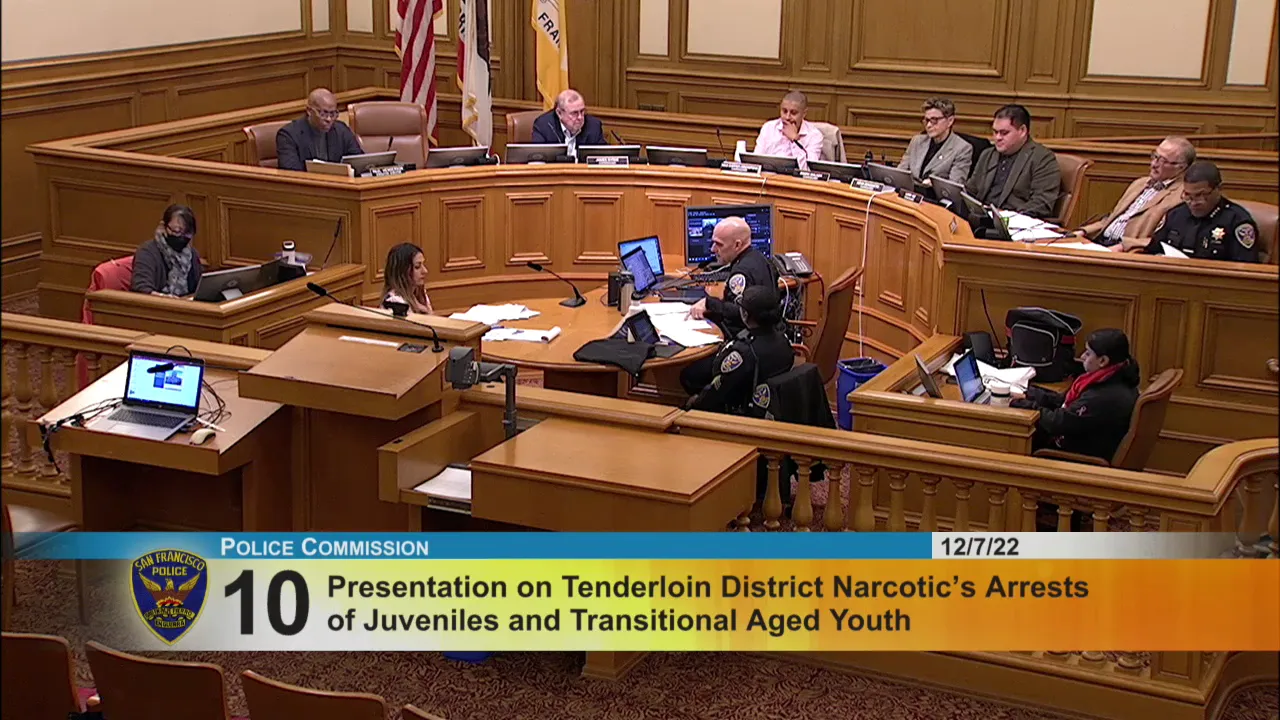
Presentation on Tenderloin District Narcotics Arrests of Juveniles and Transitional-Aged Youth:
- Lieutenant Kevin Healy presented data: from 2018 to 2022, juvenile arrests for narcotics dealing in Tenderloin have increased slightly (30 in 2022 YTD vs 29 full year 2021). Most were cited rather than booked. Chief Scott noted that juveniles are being used by drug trafficking organizations.
- Representatives from CARC explained diversion programs and current gaps, especially during non-operating hours (after 10 PM and weekends). They called for coordinated response and better follow-up for youth who fail to attend intake.
DPA Key Issue Report on Public Reporting of Officer Misconduct and Discipline:
- Steve Flaherty presented findings: SFPD failed to comply with multiple reporting requirements under Administrative Code 96A and Police Commission Resolution 97-04. Specifically, SFPD did not publish monthly reports on DPA-sustained cases, did not report pending discipline decisions, and used vague categories for misconduct allegations. Also, SFPD did not meet the 45-day timeline for discipline decisions in 67% of cases (average 59 days, range 7–288 days). The report recommended better data presentation and alignment with best practices from other cities.
- Chief Scott acknowledged the issues and stated a captain has been assigned to fix the systemic problems, but noted challenges with legacy data systems.
Key Outcomes
- Adoption of Minutes: Approved with an amendment (correcting spelling of Commissioner Lee to Yi). Unanimous.
- Consent Calendar: Approved donation for holiday toy drive. Unanimous.
- DGO 2.01 (General Rules of Conduct): Approved revised version to go to meet-and-confer with the Police Officers Association. Unanimous.
- Closed Session: Voted to enter closed session and assert attorney-client privilege regarding Item 15. Unanimous. Afterwards, voted not to disclose closed session discussions. Unanimous.
- Next Steps for DGO 9.01: Chief Scott will provide feedback on the latest draft by the end of the week; further discussion and possible vote scheduled for a future meeting.
- DPA Audit Follow-Up: Chief Scott assigned a captain to address reporting deficiencies; Commissioner Benedicto requested a written response and presentation from the department after the holidays. Director Henderson suggested assigning a commissioner to oversee compliance.
- Adjournment: Meeting adjourned after closed session.
Meeting Transcript
Vice President Carter Oberstone, I'd like to take a roll. Commissioner Walker. Here. Commissioner Benedicto. Here. All right. Commissioner Yannis. Commission Yannis is here. Commissioner Byrne. Here. Commissioner Yee. Here. Vice President Carter Overstone, you have a quorum also here with us tonight as Chief Scott from the San Francisco Police Department and Executive Director Paul Henderson from the Department of Police Accountability. Thank you, Sergeant. Could you please call the first item? Line item one. General public comment. At this time, the public is now welcome to address the commission for up to two minutes on items that do not unappear on tonight's agenda but are within the subject matter jurisdiction of the police commission. Under police commission rules of order, during public comment, neither police or DP personnel nor commissioners are required to respond to questions by the public, but may provide a brief response. Comments or opportunities to speak during the public comment period are available via phone by calling 415-655-0001 and entering access code 2497 227352. Comments or opportunatively, you may submit public comment in either of the following ways. Email the Secretary of the Police Commission at SFPD.commission at sfgov.org. Our written comments may be sent via U.S. Postal Service to the public safety building located at 1245 Third Street, San Francisco, California, 94158. We will take public comment by presenters at the podium and then we will move over to online. Go ahead, sir. Hello. My name is Michael Patrellus, and I'm here tonight to speak against killer robots. Thank you. Can you please stop the uh clock, please? Maybe you can show it to that camera back here. I can't hear you. Maybe you can show you. The camera back there. Just hold it up. I was just here for a three-hour meeting of the um heritage commission, and they showed us from the face. I want to show my face and my sign. And the uh I think that is a very reasonable request. Um can you please restart um at two o'clock at two minutes? Thank you very much. Hello. My name is Michael Petrellis, and I'm here holding a sign that says no SFPD killer robots. I'm here to speak against uh what has happened recently with the police department um making this request to um have electronically controlled robots um that contain explosives. First of all, no one was helped by the fact that um the police department and the rules committee did not give the public enough advanced notice about what was being discussed in the rules committee, and I believe what is also discussed here in May. Um the policy that you presented didn't uh get created overnight. And um I I'm not saying that even if you had given us advanced notice and had taken much public comment that I would be in favor of killer robots. I'm not saying that. I'm saying that this is another example of why I do not trust the SFPD because you've not been transparent about developing this policy. Um I am also uh criticizing the supervisors uh for not keeping tabs on what was being developed in the rules committee. I have also criticized on social media um a number of organizations, starting with the ACLU, the Electronic Frontiers Foundation, all of them were caught short.
openpublica.com