Public Safety and Neighborhood Services Committee: Treatment on Demand and SFUSD Sexual Violence Hearings - October 27, 2022
STREAMING COPY IN PREPARATION — RECORDING AVAILABLE FROM THE ORIGINAL SOURCE
Public Safety and Neighborhood Services Committee: Treatment on Demand and SFUSD Sexual Violence Hearings - October 27, 2022
The Public Safety and Neighborhood Services Committee, chaired by Supervisor Gordon Mar, held a two-part meeting on Thursday, October 27, 2022, beginning at 9:15 AM and reconvening at 4:00 PM for a special order. The morning session focused on an update on the FY2020-2021 Annual Proposition T (Treatment on Demand) report, while the afternoon session addressed student experiences of sexual assault and harassment at SFUSD schools. The meeting featured presentations from city departments, community organizations, and extensive public testimony, including from youth advocates.
Public Comments & Testimony
- Morning session (Prop T): Multiple speakers expressed concerns about unmet demand for treatment, including from the Treatment on Demand Coalition, which noted staffing shortages, pay inequity, and the need for low-threshold services. Public commenters urged faster action on step-down beds, culturally competent care, and addressing open-air drug markets.
- Afternoon session (SFUSD): Over a dozen students and youth advocates testified, describing failures in reporting processes, victim-blaming by staff, and lack of support for survivors. Specific demands included consent education from elementary school, mandatory training for athletic coaches, transparent Title IX investigations, and immediate separation of perpetrators from victims.
Discussion Items
- Proposition T Hearing (9:15 AM – ~2:00 PM):
- Supervisor Mandelman opened by criticizing the city’s lack of a clear process to measure unmet treatment demand, noting overdose deaths rose 478% from 2015 to 2020. He urged better data and policy focus.
- Dr. Hilary Cunnins (DPH) reported on the continuum of care, noting that 40% of San Francisco Health Network patients with substance use disorder received services (above the national 10%). Wait times: withdrawal management <1 day, residential treatment median 4 days. Gaps identified for Spanish speakers, dual-diagnosis patients, and justice-involved individuals.
- Adult Probation (Chief Christelle Tulach, Steve Adami, Destiny Kletch) highlighted a 3% recidivism rate, 55 re-entry programs serving 2,700 people, and reduced wait times for treatment from 49 to 6 days through partnerships with DPH. They launched the MENA Project (75-bed dual-diagnosis housing) and Positive Directions TRP Academy.
- Treatment on Demand Coalition (Laura Thomas, Sarah Short) stressed that demand measurement must include people discouraged by past negative experiences, and called for a community process to allocate opioid settlement funds. They emphasized workforce equity and low-threshold overdose prevention.
- Criminal justice partners:
- David Moroff (Pretrial) noted staffing challenges and that clients’ past negative experiences with treatment are not tracked, leading to broken trust.
- Malethi Alphamongkol (Public Defender) outlined barriers: DPH packet requirements causing 2-3 month delays, lack of Spanish-language and dual-diagnosis beds (only one 12-bed Spanish inpatient program).
- Susan Christian (DA) reported 3-6 month wait times for residential treatment for justice-involved individuals, and called for more gender-affirming and dual-diagnosis beds, plus interim stabilization facilities.
- Lt. Mario Molina (SFPD) described a “revolving door” where officers spend hours connecting people to care only to see them return to the streets. He noted that since 2018, officers administered Narcan 695 times, saving lives.
- Gary McCoy (HealthRIGHT 360) emphasized the need for step-down residential beds, stating the current few hundred should be tripled or quadrupled.
- SFUSD Sexual Violence Hearing (4:00 PM – ~6:30 PM):
- Student delegates Isabella Hansen and Cal Kenoshita presented demands from the 2021-2022 student walkouts: mandatory consent education from elementary school, training for walk-on coaches, accessible Title IX resources (posters, Synergy), a separate class change process for survivors, and a mandatory consent seminar for student athletes.
- Kisara Williams (SFUSD Office of Equity) reported that on October 11, 2022, the Board of Education approved a policy requiring investigations under both Title IX and the bullying/harassment policy. A Title IX Student Advisory Group is ongoing. She acknowledged that prior communication about the two-track investigation process was poor.
- Maria Su (DCYF) committed to expanding wellness centers and mental health services in high schools and middle schools, and to partnering with SFUSD on curriculum and training.
- Allison Ludbuster (DPH) described the KSARC program (child/adolescent trauma services) and crisis response teams available to students.
- Dulce Garcia (SHARP Office) presented complaint forms for survivors and a planned youth town hall and healing summit. She noted that while no formal complaints against SFUSD have been filed, most requests for support involve high school-age students.
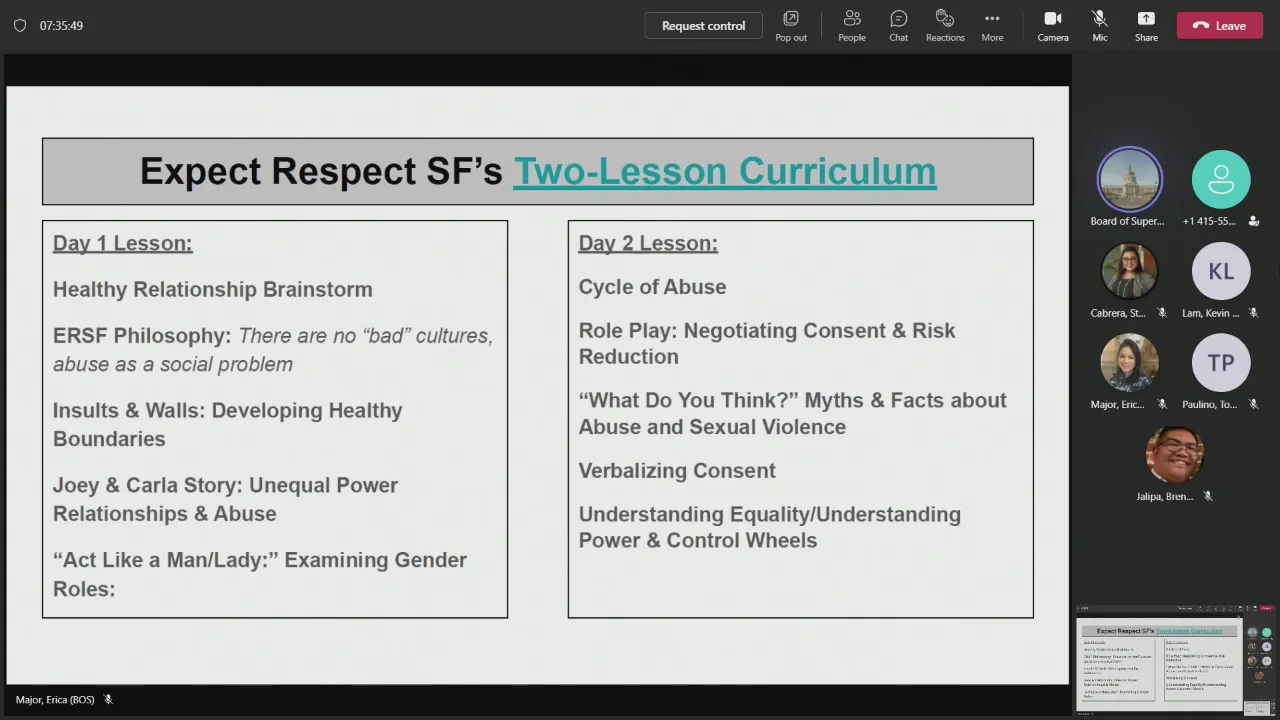
- Adele Fils Carpenter and Shela Cervantes (City College Project Survive/Expect Respect) detailed peer-led prevention education: two-day curriculum in 9th grade health classes, reaching 230 classrooms pre-pandemic (80 this semester). They called for investment to expand to 11th/12th graders and to address staffing shortages at City College and community organizations.
Key Outcomes
- Proposition T Hearing: The committee voted unanimously (3-0) to file the hearing. Supervisor Mandelman indicated he would continue to press for better metrics on unmet demand, including from justice-involved populations.
- SFUSD Sexual Violence Hearing: The committee voted unanimously (3-0) to continue the item to the call of the chair, signaling ongoing oversight. Supervisor Melgar committed to formally transmitting the hearing’s findings and student demands to the SFUSD Board of Education, and to exploring revival of the Safer Schools Sexual Assault Task Force with youth representation.
Meeting Transcript
Good morning. The meeting will come to order. Welcome to the Thursday, October 27th, 2022 meeting of the Public Safety and Neighborhood Services Committee. I'm Supervisor Gordon Maher, the chair of this committee, and I'm joined by Vice Chair Catherine Stephanie and committee member Mirna Malgar. And we're also joined by uh Supervisor Raphael Mandelman this morning. Thank you to us Stephanie Cabrera for staffing this meeting today. And I'd also like to thank uh Matthew Igneo from um SFGUV TV for staffing as well. Uh Madam Clerk, do you have any announcements? Yes, thank you, Chair. The Board of Supervisors and its committees are now convening hybrid meetings that allow in-person attendance and public comment. While still providing remote access and public comment via telephone, the board recognizes that equitable public access is essential and will be taking public comment as follows. First, public comment will be taken on each item on this agenda. Those attending in person will be allowed to speak first, and then we'll take those who are waiting on the telephone line. For those watching either channel 26, 28, 78, or 99, and sfgovtb.org. The public comment call in number is streaming across the screen. The number is 41565501. Again, 41565001. When prompted, enter the meeting ID 2486 7935172, then pound, and then pound again. When connected, you will hear the meeting discussions, but you will be muted and in listening mode only. When your item of interest comes up and public comment is called, those joining us in person should line up to speak along the wall to your right, and those on the telephone should dial star three to be added to the speaker line. If you are on your telephone, please remember to turn down your TV and all listening devices you may be using. As already indicated, we will be taking public comment from those attending in person first, then we will go to our public comment telephone line. Alternatively, you may submit public comment in writing in either of the following ways. Email them to myself, the public safety and neighborhood services clerk at Stephanie.gabrera. C A B as in Bay, R E R A at SFgov.org, or if you'd like to submit public comment via email, you can also forward it to the supervisors, or it will be forwarded to the supervisors. You may also send your written comments via U.S. Postal Service to our office at City Hall. One, Dr. Carlton B. Goodlit Place, room 244, San Francisco, California 94102. Finally, items acted upon today are expected to appear on the Board of Supervisors agenda of November 8th, unless otherwise stated. That concludes my comment. Thank you, Madam Clerk. Can you please call item number one? Item number one is a hearing to provide an update on the fiscal year 2020 through 2021, annual proposition T, treatment on demand report and requesting the departments of public health, adult probation department, Sheriff's Department, Superior Court, District Attorney's Office, Police Department, and Treatment on Demand Coalition to report. Members of the public who wish to provide public comment on this item should call 415-655-0001. When prompted, enter the meeting ID to 486-793-5172, then pound, then pound again. If you haven't already done so, please dial star three to line up to speak. The system will prompt and indicate that you have raised your hand. Please wait until the system indicates that you have been unmuted, and you may begin your comments when we go to public comment. Thank you. Thank you, Supervisor Mandelman, for calling for this hearing on the annual proposition T treatment on demand report, and just for all of your leadership on the um the ongoing um crisis in drug addiction and drug overdoses in our city. So the floor is yours, Supervisor Mandelman. All right. Uh thank you, Chair Maher, and thank you, committee members, and my apologies to you and uh to folks in the audience for my tardiness. Um I want to thank uh the departments that have been uh so uh giving of their time. Um uh DPH um APD uh uh public defender district attorney, I want to thank the Treatment on Demand Coalition for uh engaging with us. I want to thank service providers like Health Right 360 and um and the AIDS Foundation for um your engagement around this. Um I've said some of these things before, but they bear repeating. Um treatment on demand is uh is is more than a quarter century old in San Francisco.
openpublica.com