San Francisco Public Safety and Neighborhood Services Committee Meeting - November 9, 2023
STREAMING COPY IN PREPARATION — RECORDING AVAILABLE FROM THE ORIGINAL SOURCE
San Francisco Public Safety and Neighborhood Services Committee Meeting - November 9, 2023
The Public Safety and Neighborhood Services Committee met on Thursday, November 9, 2023, at San Francisco City Hall. Chaired by Supervisor Catherine Stefani, with Vice Chair Joel Engardio and Supervisor Matt Dorsey, and joined by Supervisor Rafael Mandelman for the latter two items, the committee unanimously approved a liquor license for The Stud, advanced an extension of the cannabis events pilot program, and held a four-hour-plus hearing on treatment on demand. Items acted upon are scheduled to appear on the Board of Supervisors agenda on November 28, 2023.
Public Comments & Testimony
Item 1 – The Stud liquor license
- Kevin Clark, a 30-year resident and neighbor on Moss Street, said he was "very excited about the stud's return" and welcomed the bar "with open arms."
- Katie McKee, a Langton Street neighbor and Soma West CBD board member, said the neighborhood was excited to have The Stud on her block.
- Sharon Retton, a Langton Street neighbor and small business owner, called the bar "a piece of San Francisco history" that the community missed dearly.
Item 2 – Cannabis events pilot program extension
- Ali Jamalian, chair of the city's cannabis oversight committee and president of the state cannabis advisory committee, voiced strong support, citing the need to identify venues satisfying state regulations while working on state-level changes.
Item 3 – Treatment on Demand hearing
- Tom Wolf, recovery advocate, said the city has been beset by "missed opportunity after missed opportunity," citing the 2020 shelter-in-place hotels and the Tenderloin Linkage Center, and called for funding real recovery solutions.
- Eliana Binder, policy manager at Glide and a Treatment on Demand Coalition member, urged full implementation of a fully funded, evidence-based public health approach, saying "coercive and punitive methods are not the way forward."
- Sheba Bandiba, Glide policy associate, highlighted DPH's overdose prevention plan focusing on the Black community (which suffers overdose deaths at five times the city rate), expanded access at the Behavioral Health Access Center, at-home buprenorphine distribution, and other steps, while urging more investment in community-based organizations.
- Lydia Branston, executive director of the Gubio Project, defended harm reduction tools as engagement devices, pushing back on characterizations that harm reduction work "is killing people."
- Laura Thomas, San Francisco AIDS Foundation, praised the DPH report and stressed pay parity, warning that DPH recruitment "pulls from those of us in the nonprofit world" who pay less and lack pensions.
- Philip Lasseter, a person in recovery for 21 years, opposed punitive approaches, saying "forced abstinence can be deadly" for those using fentanyl and that criminalization had no impact on his own desire to change.
- Marsha Hoffman and Keislin Noson, both from Positive Directions Equals Change, credited abstinence-based programs with saving their lives; Hoffman expressed opposition to distributing drug paraphernalia.
- Leah Paradiso, harm reduction coordinator and recovering alcoholic/addict, credited medically assisted treatment and harm reduction for her recovery, and urged against taking cash assistance away from people who use drugs.
- Donna Hilliard, Co-Tenderloin executive director, described a community health worker training pipeline that turns lived experience into careers, and called for scaling up peer-to-peer support.
- Jennifer Friedenbach, Coalition on Homelessness, called for trauma-informed care, culturally and linguistically specific programs, and reduced regulatory barriers to medically assisted treatment.
- Gary McCoy, Health Right 360 vice president, urged building a full continuum of care and collaborative problem-solving.
- Several other commenters shared lived experience and emphasized the need for 24/7 drop-off/stabilization centers, better coordination among providers, and treating housing as part of recovery.
Discussion Items
Item 1 – Liquor License for The Stud (1123 Folsom Street)
Supervisor Dorsey, whose district contains the site, introduced the item, calling The Stud one of the nation's most famed drag bars and one of the city's oldest LGBTQ+ establishments. SFPD ABC Liaison Officer Salmussen reported zero letters of protest and zero letters of support. The site is in a high-crime census tract and a high-saturation area, but Southern Station had no opposition. ABC recommended approval with four conditions, including noise limits tied to the entertainment permit, continuous supervision of an outdoor patio when alcohol is served, and active monitoring to prevent loitering on adjacent property. Rachel Ryan, president and general manager of The Stud, recounted the bar's history dating to 1966 and its evolution into a cooperatively owned LGBTQ nightclub, saying the new space would keep "San Francisco's oldest queer bar around for generations to come." The committee voted unanimously to direct staff to prepare a resolution finding public convenience/necessity and to recommend it to the full board.
Item 2 – Police Code: Cannabis Events Pilot Program Extension
Supervisor Mandelman's ordinance would amend the Police Code to move the sunset of the cannabis event pilot program from December 31, 2023, to January 1, 2027 (i.e., extend it by three years). Sophie Hayward (Office of the City Administrator) said the pilot has shown that existing state rules support only large outdoor events, and the goal is to identify locations for smaller or indoor events and work on location-based permits. Nikesh Patel, director of the Office of Cannabis, detailed state requirements - organizer licenses, fencing, security personnel, separate retail/consumption areas, and obscured public visibility - that make events costly; that seven permits have been issued; and that ending the pilot would likely generate more applications but no more approved events. Ben Van Houten (OEWD) outlined planned research with industry stakeholders on site identification and economic recovery. Public comment was supportive. The committee passed the ordinance unanimously with a positive recommendation.
Item 3 – Hearing on the State of Treatment on Demand
This was a comprehensive hearing on San Francisco's treatment-on-demand policy, co-sponsored by Chair Stefani and Supervisor Mandelman. It included testimony from city departments, providers, and advocacy groups.
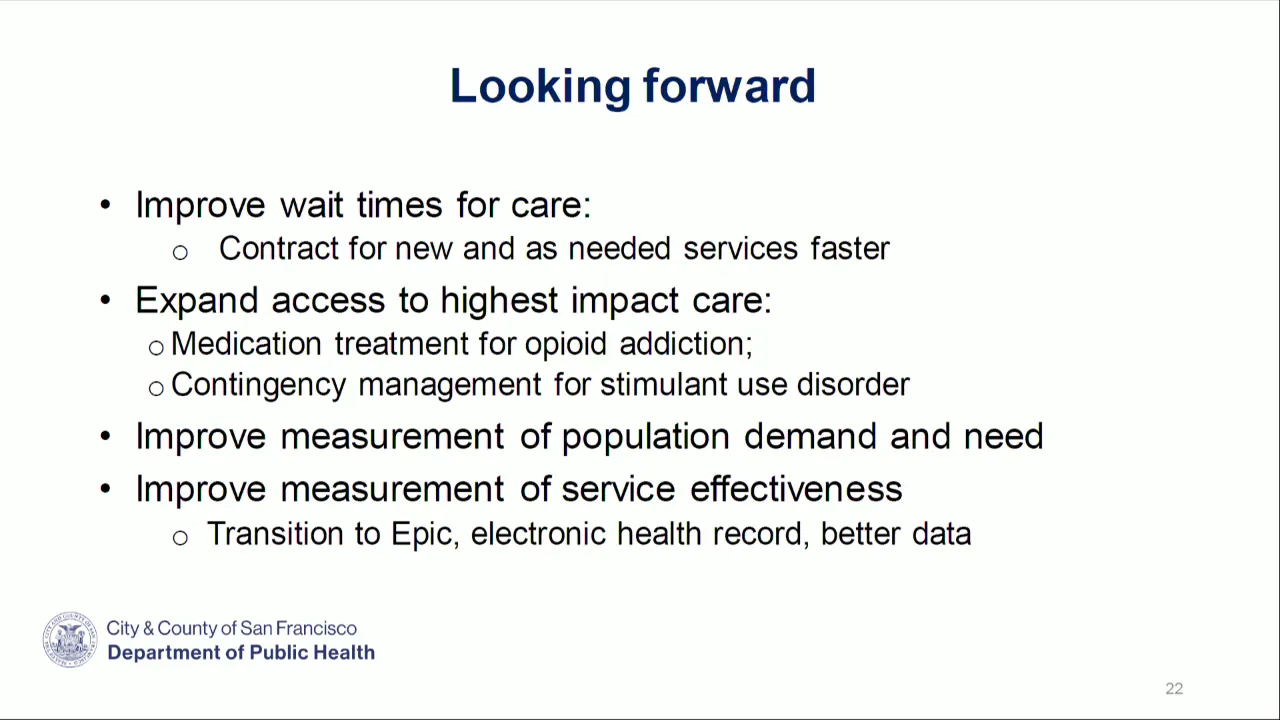
- Department of Public Health (DPH): Hillary Cunnins, director of Behavioral Health Services, reported that the specialty substance use services budget is about $91 million (34% general fund, 14% Prop C, 52% state/federal). In FY 2022-23, approximately 4,600 unique individuals were treated in licensed programs; about two-thirds (3,000) were experiencing homelessness, and about 2,100 also had a mental health diagnosis. Opioids, stimulants (mainly methamphetamine), alcohol, cannabis, and cocaine were the top substances. DPH said median wait time for residential treatment rose to five days in the last fiscal year. She acknowledged the city is "falling short" of treatment on demand and is working with providers on data, workforce, and capacity, including adding five dual-diagnosis beds and contracting for out-of-county medically supported withdrawal management beds. Interim Medical Director David Pating cited workforce shortages, state/federal regulations on methadone, and the need for better population-level demand measures. In response to questioning, DPH said demand appears to be rising and that it is working with UCSF on prevalence estimates. Regarding HR360, Cunnins said the widely reported claim that half of those seeking detox were not served was based on data depicting "half got in that same day," with reasons ranging from higher levels of care to voluntary departure; she said that data is being refined.
- Fire Department: Assistant Deputy Chief Simon Pang presented first-responder data. In six months, 53% of street crisis engagements chose to remain in the community (an improvement from 70% in 2020). In a seven-day straw poll, only six out of about 210 engagements (2%) "said I want treatment now." He said 90% of overdose victims are transported to emergency rooms, but hospital follow-through is weak; 6% of Narcan-reversed patients are seen again within 72 hours. 25% of all ambulance patients are homeless, and 58% of re-engagements within 72 hours are homeless. He recommended more stabilization capacity, minimized transfer points, and better consumer knowledge of services.
- District Attorney's Office: Assistant DA Susan Christian said the office needs a full-time behavioral health clinician due to a 600% increase in mental health diversion petitions since 2022. She cited gaps in jail discharge planning, a need for more licensed clinicians, a shortage of psychiatric and residential beds (especially for sex-offender registrants and arsonists), and a lack of state funding for diversion programs. She also noted that 17% of jail residents are from out of county, 41% are unsheltered/transient, and 41% identify as San Francisco residents.
- Public Defender's Office: Licensed clinical social worker Fatima Aveyan reported improvements in wait times for some English-speaking residential programs (e.g., HealthRight 360, Salvation Army's Harbor Lights), and noted St. Anthony's now has a Spanish-speaking counselor. But many clients still wait weeks or months in jail, influencing their decisions to accept pleas, and there are insufficient services for Spanish speakers, transitional-age youth, and people with sex- or arson-related charges. She urged funding for community-based case management and peer workforce development.
- Pretrial Diversion Project: Directors Tiara Sims and Key Bernard said the in-custody referral (ICR) program had 104 referrals in September, and 64% still needed additional services or faced barriers. They described a new Pretrial Treatment Project, funded for only one fiscal year through June 2024, that pays directly for residential treatment, overcoming insurance and out-of-county issues, but noted persistent barriers including language, MAT acceptance, dual diagnosis, and lack of aftercare. They also highlighted cases where clients rejected treatment because they feared losing a shelter bed.
- Treatment on Demand Coalition: Vitka, a former drug user and HealthRight360 leader, emphasized staffing as the central crisis, with 75 vacancies at HealthRight360 alone. She said HealthRight360 served 14,000 people in residential treatment over the last decade, with a national average of 50% leaving prematurely. She called for wage parity for nonprofit staff, direct contracting that reflects true costs, and a redefinition of "treatment" to include a continuum of services that keeps people connected.
- Recovery Coalition: Steve Adami, executive director of The Way Out and former adult probation re-entry director, presented data: 19,000 people cycle through homelessness annually; 8,000 are homeless on any given night; 4,000 are on the streets; 70% are addicted to drugs; and there is one detox bed per 100 homeless people struggling with addiction. Craig Johnson and Tom Wolf described the "revolving door" and urged a stabilization center, direct access to providers (bypassing bureaucratic assessments), wage parity, and funding for faith-based and abstinence-based programs. They also criticized the current system for enabling open-air drug scenes.
- Human Services Agency (HSA): Director Trent Rohr outlined the proposed March 2024 ballot initiative (Substance Use Screening, Evaluation, and Treatment Initiative) for County Adult Assistance Program (CAP) recipients. He said CAP has about 5,300 single adults without children; 20% are homeless, 30% formerly homeless; 13% of CAP clients died of overdose in a 12-month period; and over 20% of DMAC arrests were people on public assistance. The initiative would require screening and, if needed, treatment for those reasonably believed to use illegal drugs, with cash assistance discontinued only after willful failure. HSA would directly pay landlords to avoid homelessness, and savings would go into a treatment fund. Rohr said the city would contract for treatment slots and provide same-day transportation.
Key Outcomes
- Item 1 (The Stud): The committee unanimously moved to prepare a resolution finding that issuance of the type 48 license serves public convenience/necessity, and referred it to the full board with a positive recommendation. Vote: 3-0 (Engardio, Dorsey, Stefani).
- Item 2 (Cannabis events): The committee unanimously passed the ordinance to extend the pilot program through December 31, 2026, and sent it to the Board of Supervisors with a positive recommendation. Vote: 3-0.
- Item 3 (Treatment on Demand): The committee heard and filed the hearing by unanimous consent. DPH's next treatment on demand report is expected in February 2024, and Supervisor Mandelman indicated the committee would hold another hearing to review progress.
Note: The meeting agenda and transcript indicate all item actions are expected to appear on the Board of Supervisors agenda of November 28, 2023.
Meeting Transcript
This meeting will come to order. Welcome to the November 9th, 2023 regular meeting of the Public Safety and Neighborhood Services Committee. I am Supervisor Catherine Stephanie, Chair of the Committee, and to my right is Vice Chair Anguardio, and to my left is Supervisor Dorsey. The clerk is Mr. John Carroll. And also I would like to thank Tom Loftist at SFGov TV for staffing this meeting. Mr. Clerk, do you have any announcements? Yes, thank you, Madam Chair. Public comment will be taken on each item on today's agenda when your item of interest comes up on our agenda and public comments is called. Please line up to speak along your right hand side here in the board chamber. Alternatively, you may submit public comment in writing. I invite you to email your comment to me. I'm the Public Safety Neighborhood Services Committee Clerk, and my email address is J-O-H-N, period C A R R O L L at S F G O V dot O R G. Or you may send your written comments by U.S. Postal Service to our office in City Hall. The address is one Dr. Carlton B. Goodlit Place, room 244, San Francisco, California 94102. If you submit your public comment in writing, I will forward your comment to the members of the public safety committee, and I will add your commentary to the file upon which you are speaking. Please make sure that you silence your cell phones and other electronic devices. If you have any documents here in the chamber that you wish to add to the file, please hand them to me over the rail up at the front of the meeting room. Items acted upon today are expected to appear on the Board of Supervisors agenda of November 28th, 2023, unless otherwise stated. Thank you, Mr. Clerk. Will you please call the first item? Agenda item number one is a hearing to consider that the issuance of a type 48 on sale general public premises liquor license to Universal Life Corral LLC to do business as the stud located at 1123 Fulsom will serve the public convenience or necessity of the city and county. Thank you. And I see Supervisor Dorsey on the roster. Great. Thank you so much, Chair Stephanie. And I just wanted to just mention before uh that this uh this has been a long time coming, and I am incredibly gratified to see this step in the uh long journey for the stud to reopen. Um, and this is part of what we're gonna be see hearing today. Um this is one of the most uh storied and uh famed queer spaces in San Francisco. Um it goes back, you know. I remember this from my drinking days, that's how long ago that was. And um it's loss was a uh it was a setback for our community for the LGBTQ community. Um this is one of the nation's most famed drag bars and one of the city's oldest LGBTQ plus establishments. So I want to do everything that I can to um support this. This is obviously in my district. I know that the neighborhood is excited, I'm excited. Um the modest changes we have legislated to make this possible was a collaborative effort uh between stakeholders that came together in a very productive and meaningful way. So I want to thank all the people who made this possible. And in particular, I really want to make um express my gratitude to um the stud collective for keep keeping this um alive and uh for doing everything we can to enrich our LGBTQ plus community and our city. Thank you, Supervisor Dorsey, and I believe we have Officer Salmussen from the SFPD ABC Liaison unit with us today. Thank you. Good morning, members of the board. Uh you have before you PCN report for Universal Life Corral LLC operating as the stud. They have a applied for a type 48 license, and if approved, this would allow them to operate in the on-sale general public premise. I have zero letters of protest, zero letters of support.
openpublica.com