SFPUC Special Meeting on Alternative Water Supply Planning - September 17, 2021
STREAMING COPY IN PREPARATION — RECORDING AVAILABLE FROM THE ORIGINAL SOURCE
SFPUC Special Meeting on Alternative Water Supply Planning - September 17, 2021
This special meeting of the San Francisco Public Utilities Commission (SFPUC) was a workshop focused on alternative water supply planning. Presentations covered the SFPUC's Alternative Water Supply Program, a case study from the San Diego County Water Authority, San Diego's Pure Water project, and recommendations from non-governmental organizations (NGOs). Commissioners discussed the need to balance obligations, projected demands, and environmental flows, and emphasized the urgency of advancing projects despite uncertainties.
Public Comments & Testimony
- Francisco DeCosta urged the commission to read the Raker Act and conduct a needs assessment for leaking pipes, citing millions of gallons lost. He opposed making San Jose and Santa Clara permanent customers without addressing leakage.
- Martin Galvas emphasized the importance of first determining the river's carrying capacity, noting the Bay Delta plan already provides a number.
- John Rose of Pepe over Oakland encouraged the commission to consider the health of the river as part of its obligations, urged withdrawal from the lawsuit against the Delta plan, and highlighted the fate of salmon.
- Regina Chicazola (Safe California Salmon) thanked the commission for the workshop and urged diversification of water supply, noting the disappointment in the recent lawsuit against curtailments. She emphasized the importance of protecting salmon and the fishing community's heritage.
- Tom Francis (BAWSCA Water Resources Manager) spoke on behalf of BAWSCA, supporting the alternative water supply program but urging additional staffing and an executive-level manager to ensure prompt results. He also noted BAWSCA's appreciation for the increased communication.
Discussion Items
SFPUC Alternative Water Supply Program (Manisha Katari)
- Manisha Katari, program manager, presented the program's objectives, needs, and planning priorities through 2045.
- Demand projections: Retail demands of 82.3 MGD in 2045, with retail allocation of 81 MGD. After conservation (0.4 MGD), on-site recycling (1.3 MGD), and local supplies (6.9 MGD), the retail need from the regional system is 73.7 MGD. Wholesale demands are projected at 153.7 MGD, with a supply assurance of 184 MGD. San Jose and Santa Clara's potential permanent demand of 9 MGD is included for planning, pending a 2028 commission decision.
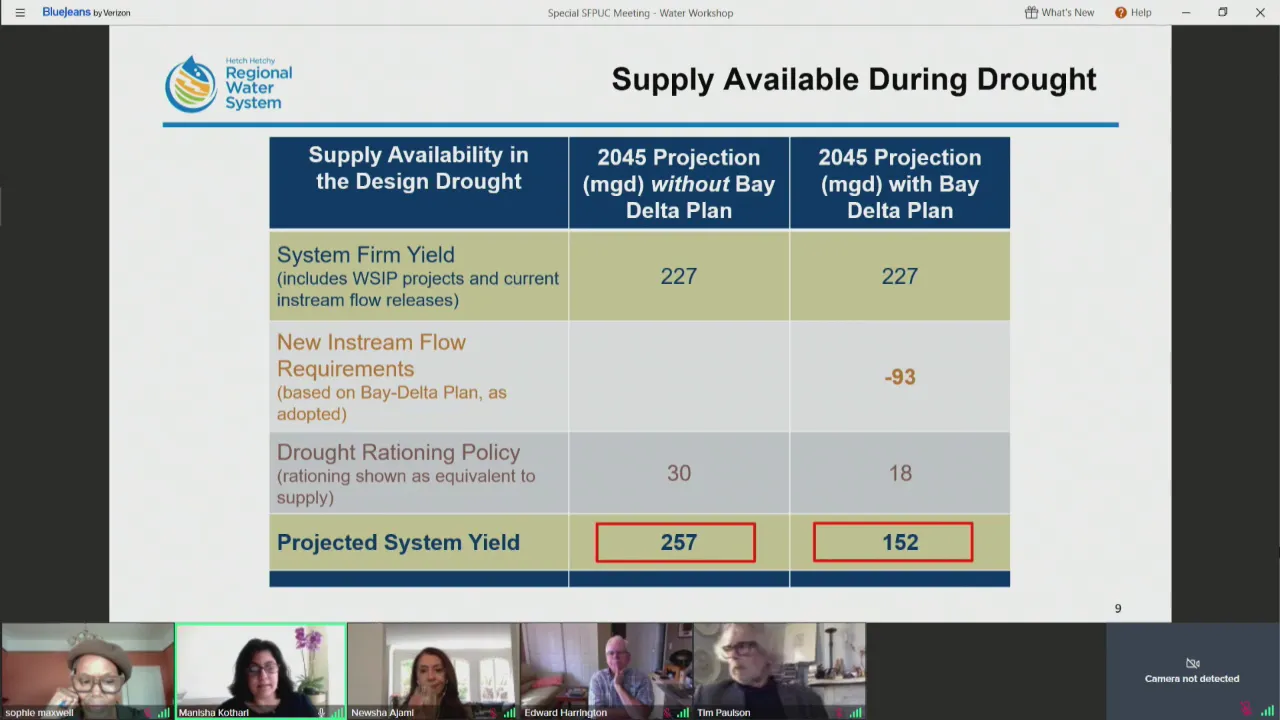
- Supply scenarios: System firm yield with WSIP is 227 MGD. Without the Bay Delta plan, a 93 MGD shortfall is projected; with the Bay Delta plan, 122 MGD shortfall. Drought rationing (20%) adds 30 MGD (without) or 18 MGD (with).
- Planning priorities: Offset in-stream flow needs, meet existing obligations, then projected demands. Two policy decisions: interruptible customers (San Jose/Santa Clara) by 2028, and increased demands.
- Projects: 35 MGD identified from projects like Los Vaqueros, Crystal Springs, ACWD, Calaveras, etc. Another 49 MGD needed to meet projected demands. The program is studying upcountry groundwater banking, San Francisco purified water, and other options.
- Alternative Water Supply Plan: To be completed by July 1, 2023, will include project sequencing, modeling, cost analysis, and guiding principles.
San Diego County Water Authority Diversification (Kelly Gage)
- Kelly Gage, director of water resources, presented the San Diego region's 30-year diversification journey since the 1991 drought.
- Current portfolio: 66% Colorado River, 10% State Water Project, 24% local supplies (including desalination, recycled water). Per capita water use reduced 50% over 30 years; indoor use is 48 GPCD, overall 120 GPCD.
- Key projects: Imperial Irrigation District water transfer, Carlsbad Desalination Plant (8% of supply), and increasing potable reuse. The region now has sufficient supplies through 2045.
- Future: Over 100,000 acre-feet of new potable reuse by 2035, plus partnerships for Lake Mead storage and regional conveyance.
San Diego Pure Water Project (John Stufflebean)
- John Stufflebean, assistant director, described the city's Pure Water program, which will provide half of San Diego's potable water supply by 2035.
- Phase 1: 30 MGD under construction, $1.5 billion, completion by 2025. Phase 2: 53 MGD, completion by 2035.
- The project treats wastewater to advanced purified water using reverse osmosis and other processes, then discharges into a reservoir for natural treatment before drinking water plant.
- The program is funded one-third by sewer customers and two-thirds by water customers, and is cheaper than building secondary treatment and buying imported water.
NGO Recommendations (Peter Drekmeier and Chris Shultz)
- Peter Drekmeier (NGO representative) argued that determining the Tuolumne River's carrying capacity is the first step. The Bay Delta plan's 40% unimpaired flow is a compromise; the voluntary agreement proposes ~25%.
- He presented a water supply calculator showing a 25 MGD deficit under a scenario with current demand and Bay Delta plan flows, versus the SFPUC's 35 MGD figure.
- He criticized the slow pace of recycled water in San Francisco (0.1 MGD), noting that Valley Water is moving forward with 9 MGD from Palo Alto, a missed opportunity for SFPUC.
- Chris Shultz emphasized the need to act now on opportunities like Los Vaqueros expansion, groundwater banking, and regional cooperation. He recommended financing evaluation of groundwater recharge in MID and TID service areas, and executing contracts for drought reserve storage.
- They urged the commission to include alternative supplies in the 2025 Urban Water Management Plan and to increase staffing for the program.
Key Outcomes
- Commissioner Moran stressed the need to resolve the unknown river obligation (carrying capacity) and to start projects despite imperfect information, noting that opportunities can pass by.
- Commissioner Ajami requested a broader analysis of demand uncertainty, including scenarios with significant per capita reductions (e.g., 10 GPCD less) and their impact on project needs. She also suggested diversifying the program team with finance, demand, and wastewater expertise.
- Commissioner Paulson asked about the status of Los Vaqueros expansion; Steve Ritchie confirmed the JPA is formed and substantive agreements are expected within 1-1.5 years.
- Steve Ritchie noted that the SFPUC's water supply task force includes diverse expertise and that the next workshop in late October will focus on the long-term vulnerability assessment and climate change.
- The commission heard public comment and will continue discussions at future meetings. No formal votes were taken; the workshop was informational.
Meeting Transcript
Workshops that we are um wonderfully engaging right now. So I'm gonna call the meeting to order and uh Madam Chair, can you uh or Madam Secretary, can you do a roll call, please? President Vice President Morant. Commissioner Paulson? Here. Commissioner Harrington. Here. Commissioner Jamy. Yeah. You have a quorum. Due to the COVID-19 health emergencies, and given the public health recommendations issued by the San Francisco Department of Public Health, and that Governor Newsom and Mayor Breed have lifted the restrictions on teleconference. This meeting is being held via teleconference and is being televised by SFG TV. For those of you watching the live stream, please be aware that there's a brief time lag between the live meeting and what is being viewed on SFGTV. On behalf of the commission, I would like to thank our I would like to extend our thanks to SFG TV staff and SFPUCIT staff for their assistance during the meeting. Since this is a special meeting in the SFPUC, there will be no general public comment period. Public comment will only be called for for the item noted on the special meeting agenda by dialing one 415-655-0001, meeting ID 146-63892 pound pound. So raise your hand to speak, press star three. Please note that you must limit your comments to the topic of the agenda item being discussed and remind you if you do not stay on the topic. The chair can interrupt and ask you to limit your comment to the agenda item topic. We ask that public comment be made in a civil and respectful manner and that you refrain from the use of profanity. Please address your remarks to the commission as a whole, not to in the individual commissioners or staff. So thank you, Donna, um, for that. Um and I'm just gonna say, as you know, this is a special meeting, which I indicated in when we convened, and um and there are going to be some presentations, and I think this is very exciting and um that we're indulging in being able to listen to those that you know do this for a living to help guide us as commissioners, you know, to move forward on our on our policies, and there are presentations that are gonna be done today. And Steve Ritchie, um, you know, who is the um you know the um assistant chair, assistant general manager um in this department. I'm gonna defer to him to do the introductions on the presentations that we're gonna have. And so um we are going to move forward and we will have commission discussion as well as public comment, you know, as we move through this uh particular meeting. So um so Donna, um can you read the first item please? Yes, the first item is uh our item today is item number three, presentations on alternative water supply planning. Mr. Ritchie, Mr. Carlin. All right, uh thank you very much. Uh good afternoon, commissioners. Um looking forward to this workshop uh because we have uh not just staff presenting but also uh some guests from the San Diego area who've done a lot of similar work uh to what we're uh working on at this time uh and be interesting to get uh hear what they've got to say uh and to hear their perspectives as well as uh presentation by the NGOs. Um so I think our expectation today is that uh we'll go in deeper into what we've been talking about for alternative water supplies, um, what the individual projects are a bit, and also uh our roadmap to get to the plan that we're obligated to put together by July 1st of 2023. Um with that, Lee, can I have the slides? And then one other quick thing I would say is that the uh you know we obviously wanted to have uh much dialogue with the commission, so you can let the presentations go. But if you need something clarified, uh feel free to ask. Uh and then uh certainly at the conclusion of each presentation, uh plenty of questions that do as many of you as well as you would like to ask of each of the presenters would be great. So we're gonna start off with the alternative water supply planning uh uh on behalf of the PUC. I'm gonna give a brief introduction and then turn it over to Manisha Kotari, our alternative water supply program manager to handle the bulk of the presentation. Next slide, please. Um so one of the key things we want to make sure comes clear in this presentation is uh we get a lot of questions about uh well, gosh, you know, you have so many projects uh you don't want to overbuild. Uh and I have to keep saying no, we're not gonna overbuild. So I think we've hit on a good phrase to keep that in mind that we have obligations and we have our actual demands. And we're planning for all of our obligations, but we're only going to propose building for the demands. So that's that's the theme that I'm bringing to this as we move forward. With that, I'd like to turn it over to Manisha to cover the agenda and move through the presentation. Thank you, Steve. Good afternoon, Commissioners.
openpublica.com