Special SFPUC Meeting on Climate Change & Regional Water System – October 29, 2021
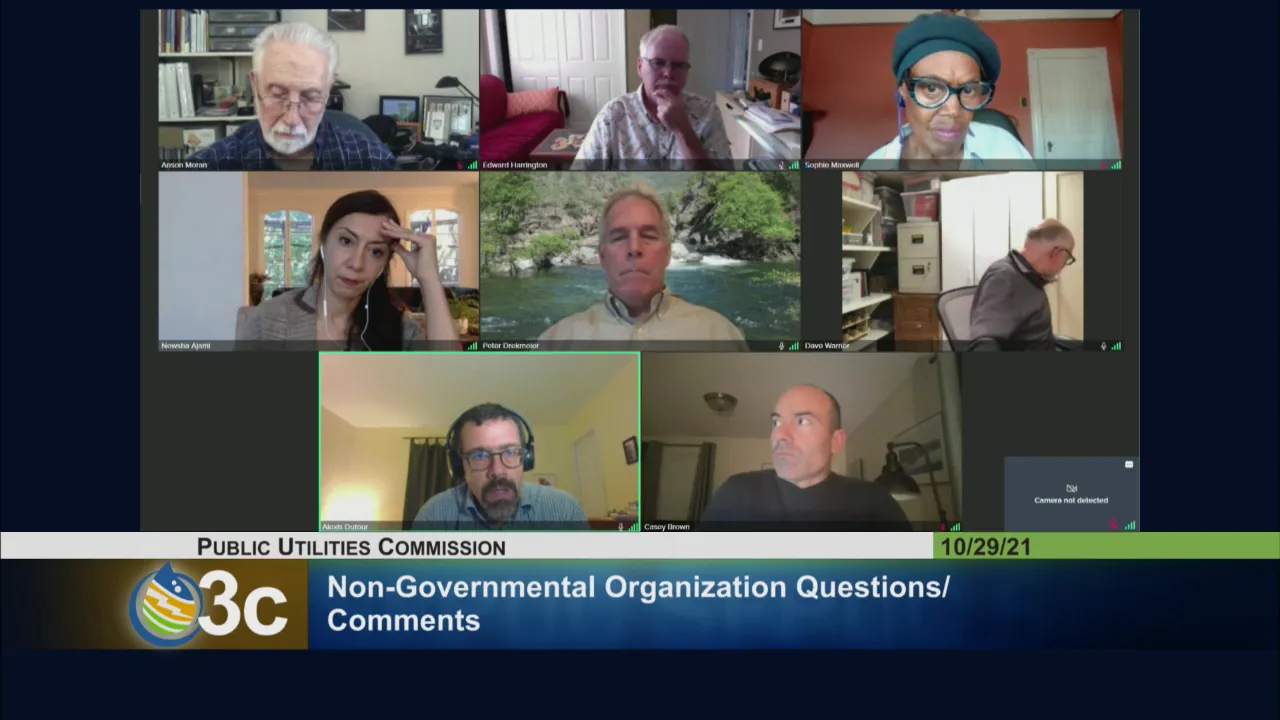
STREAMING COPY IN PREPARATION — RECORDING AVAILABLE FROM THE ORIGINAL SOURCE
Special Meeting of the San Francisco Public Utilities Commission: Climate Change and the Regional Water System (October 29, 2021)
On October 29, 2021, the San Francisco Public Utilities Commission (SFPUC) held a special meeting via teleconference to discuss climate change impacts on the regional water system. Commission President Moran presided, with Commissioners Ajami, Harrington, Maxwell, and Paulson (who joined later). The agenda included a staff presentation, expert analysis from Dr. Casey Brown of the University of Massachusetts Amherst, stakeholder comments from BAWSCA and non-governmental organizations, and public comment. There were no formal votes; the meeting was informational and focused on enhancing shared understanding of climate risks and tools for planning.
Staff Presentations & Analysis
- History of Climate Analysis: Ellen Levin, Deputy Manager of the Water Enterprise, reviewed nearly 15 years of SFPUC climate work, including the PEIR for the Water System Improvement Program and a 2012 joint study with Turlock Irrigation District that evaluated 18 climate scenarios (up to 5°C warming and 15% precipitation decrease). The 2012 study projected earlier snowmelt and increased runoff in winter/early spring, with the most severe effects when temperature rose and precipitation fell.
- Observed Climate Trends: Alexi DeFour, Water Resource Engineer, presented observed data from SFPUC watersheds (upcountry, Peninsula, East Bay). Key findings include: warming in all regions, with the East Bay showing a ~2°C increase in daily minimum temperature since the 1950s; no statistically significant trend in annual precipitation; snowpack disappearing 15–20 days earlier over the last 30 years; and a shifting distribution of runoff, with a greater portion of annual water available to the city occurring before June 15. DeFour also highlighted an extreme event at Moccasin Reservoir in 2018 where inflows exceeded the probable maximum flood.
- Climate Tools and Collaboration: Dave Bihar, SFPUC Climate Program Director, described ongoing collaborations such as the Water Utility Climate Alliance (WUCA), Bay Area Climate Adaptation Network (BayCAN), and the citywide sea level rise guidance. He noted the SFPUC’s role in developing hydraulically sophisticated inundation maps and the use of a 'likely/unlikely but possible' uncertainty framework for sea level rise projections.
- Long-Term Vulnerability Assessment (LTVA): Dr. Casey Brown presented the forthcoming Water Research Foundation study. The analysis used a stress test approach with over 1,000 climate scenarios, covering temperature changes up to +7°C and precipitation changes from -40% to +40%. Findings: the system is resilient to changes in mean climate at a baseline demand of 227 million gallons per day (MGD), but vulnerability emerges with a 20% reduction in precipitation, a level that is at the low end of climate projections. Climate change exacerbates other vulnerabilities, such as increased demand and infrastructure failures. Drought recurrence intervals shorten under drier scenarios; e.g., a 100-year drought (1976–77) becomes a 25-year event under a 20% precipitation decrease. The system’s reliability falls below the 90% threshold at about 20% precipitation reduction. Demand increases significantly reduce reliability; at 265 MGD, the system is vulnerable unless precipitation increases. Infrastructure failures related to upcountry water imports are most impactful. Water quality (turbidity, total organic carbon) was not a major concern, though modeling had limitations. Financial analysis showed that major capital investments would require substantial water price increases if demand does not grow.
Commission Discussion
- Commissioner Ajami raised concerns about interannual variability (e.g., snow events followed by warm periods) and the implications for reservoir operations, and called for building in-house capacity for climate and hydrologic modeling. She praised the partnership with UMass and the co-development of tools.
- Commissioner Moran asked whether the study considered multi-year droughts and how storage was accounted for. Dr. Brown confirmed the analysis included 500-year plausible hydrology and multiple multi-year drought realizations, and that the reliability results reflect those. Moran also questioned how the study might inform the current planning process, which is historically based.
- Commissioner Maxwell asked about the relationship between temperature and precipitation, and whether earlier runoff would affect San Francisco’s water rights under the Raker Act. Dr. Brown and Alexi DeFour clarified that annual precipitation changes are uncertain, but warmer temperatures increase precipitation intensity and reduce snowpack, leading to greater variability in water available to the city.
- Commissioner Ajami also noted her concern about the water bank’s operational limitations, and staff agreed that operators will face more complex conditions.
Stakeholder Comments
- BAWSCA (Bay Area Water Supply and Conservation Agency): Nicole Sandkuhla expressed strong support for the LTVA and thanked the Commission for the presentation. She asked how the study’s tools would be used to evaluate the design drought and alternative water supplies, and specifically whether the analysis addresses interconnected vulnerabilities, such as climate change increasing wildfire risk and affecting water quality.
- Tuolumne River Trust: Peter Drekmeier raised several points: the baseline demand used (227 MGD) is ~12% higher than actual current demand (~200 MGD); he argued that earlier runoff under the Raker Act could benefit San Francisco significantly (citing a calculation that moving runoff three weeks earlier could yield an additional 217,000 acre-feet). He also suggested the report should include additional model runs (e.g., with current or reduced demand, or with improved water rights). Dave Warner asked about the data used for drought recurrence intervals and the confidence in those figures, and suggested adding the design drought to the table. He noted the expert elicitation ranged from -30% to +30% precipitation, which is a very wide range for planning.
Public Comment
- Caller 1: An unidentified member of the public criticized the Commission for not strictly following the Raker Act, accused members of greed, and called for acknowledgment that water was taken from Indigenous peoples. He also warned about salmon extinction.
- Caller 2: Professor Iris Stewart of Santa Clara University, a hydrology expert, appreciated the modeling and results but asked how in-stream flow requirements were represented relative to demand increases, and noted that demand growth and infrastructure weaknesses also increase rationing frequency. She emphasized the ecological importance of in-stream flows for salmon.
Key Outcomes
- No formal votes were taken; the meeting was informational and educational.
- The final LTVA report will be published by the Water Research Foundation in mid-November 2021; it is about 600 pages long.
- SFPUC staff will continue using the tools developed for the LTVA to evaluate alternative water supplies, update planning, and refine forecasts.
- Commissioner Ajami’s call to build in-house capacity for climate modeling was acknowledged by staff, who noted existing expertise and training efforts.
- The Commission plans to incorporate the study’s findings into future policy decisions and to engage stakeholders further as the report becomes available.
- No minutes were available for this meeting; the transcript served as the primary source.
Meeting Transcript
Uh Madam Secretary, please call the roll. President Moran. Here. Vice President Ajami. Commissioner Maxwell. Commissioner Harrington. Here. And Commissioner Paulson will be joining the meeting in progress. And we have a quorum. Due to the ongoing COVID-19 health emergency, and given the public health recommendations issued by the San Francisco Department of Public Health and the emergency orders of the governor and the mayor concerning social distancing and lifting the restrictions on teleconference. This meeting is being held via teleconference and is being televised by SFGTV. For those of you watching the live stream, please be aware that there's a brief time lag between the live meeting and what is being viewed on SFGTV. On behalf of the Commission, I would like to extend our thanks to SFGTV staff and SFPUIT staff for their assistance during this meeting. Since this is a special meeting of the SFPUC, there will be no general public comment period. Public comment will only be called for the item noted on the special meeting agenda, which is item number four. By dialing one, 415 65501, meeting ID 2493, 1196853 pound pound. To raise your hand to speak, press star three. Please note that you must limit your comments to the topic of the agenda item being discussed, and remind you if you do not stay on the topic, the chair can interrupt and ask you to limit your comment to the agenda item. We ask that public comment be made in a civil and respectful manner and that you refrain from the use of profanity. Please address your remarks to the commission as a whole, not to individual commissioners or staff. Mr. President. We started these workshops back in, I think March, uh, at the suggestion of Commissioner Harrington. I think we've covered a lot of very important ground. There's probably no area that is of greater significance or concern to us than the effects of global warming. Uh, not only to our water supply, but to society as a whole. And it's appropriate that we have uh Commissioner Harrington to guide us through this discussion as well. And I thank you for being willing to do that and take it away. Thanks so much, President Moran. Um, you know, as a people and as a government, we often are focusing on what's right in front of us, usually what's happened yesterday, maybe next week, maybe ultimately maybe next year. But one of the most fun things about being involved in the public utilities commission is that we're looking way out in the future. We're looking 10 years, 20, 50 years out. We know that there's going to be things that affect this organization for years to come, and that it takes a long time to get ready for those things and make the changes we need to make. But as we've looked at climate change, um, it's what it's one of the things that has been one of the larger unknowns. You know, we we get severe weather events. We're having them. We understand that. We get that there's sea level rise. But things like precipitation, is it going to come as rain? Is it going to come as snow? Is it going to come earlier? Is it going to come later? Will there be more of it or less of it? And which of the watersheds? Those kind of things have made us at times I think be more conservative in our planning because we just don't know what's happening. So the more we know and learn about these items, the better decisions we can make as we go towards the future. And so that's the reason for having these kind of a conversation and this workshop today. Um, it's the purpose is to have the commission and the public get a common understanding of what we know, perhaps what we don't know about climate change and its effect on the regional water system. And we realize that climate change also affects wastewater. We're not ignoring that, but we're not going to focus on that today.
openpublica.com