Rules Committee Meeting - October 23, 2023: Police Staffing, Community Policing, SFMTA Oversight, and Emergency Management Charter Amendments
STREAMING COPY IN PREPARATION — RECORDING AVAILABLE FROM THE ORIGINAL SOURCE
Rules Committee Meeting - October 23, 2023: Police Staffing, Community Policing, SFMTA Oversight, and Emergency Management Charter Amendments
The Rules Committee of the San Francisco Board of Supervisors met on Monday, October 23, 2023, at 6:15 PM (UTC) to consider four major items: a charter amendment to set minimum police staffing levels, an ordinance on community policing foot and bike patrols, a charter amendment requiring mayoral approval for certain SFMTA budget proposals, and a charter amendment to formally establish the Department of Emergency Management in the city charter. The meeting included extensive public testimony and debate.
Public Comments & Testimony
- Item 1 (Police Staffing): Over 30 public speakers. A majority expressed strong support for the charter amendment, citing concerns about crime, slow response times, and the need to recruit and retain officers. Several speakers (e.g., representatives from SEIU Local 1021, building trades) opposed the amendment, arguing it was unfunded (estimated cost up to $300 million over five years) and would divert resources from other public safety services like 911 dispatch, mental health, and firefighting. A few speakers called for continued defunding of police or criticized the measure as a step backward. Supporters included neighborhood associations, small business owners, and victims of crime.
- Item 2 (Community Policing): A handful of speakers supported foot and bike patrols, emphasizing community engagement and deterrence. A few speakers opposed, arguing that increased police presence does not improve safety and leads to surveillance and harassment.
- Item 3 (SFMTA Oversight): Several speakers (primarily from SEIU Local 87 and janitorial workers) supported the charter amendment, stating that parking meter extensions and fare increases hurt low-wage workers who work evening shifts. One speaker opposed, arguing it would politicize transit funding and lead to service cuts.
- Item 4 (Emergency Management): No public comments were offered.
Discussion Items
Item 1: Charter Amendment - Minimum Police Department Staffing and Five-Year Annual Funding Requirement
Chair Matt Dorsey (sponsor) presented the amendment to re-establish a minimum staffing level of 2,074 full-duty sworn officers within five years, with graduated annual targets (1,700 in FY24-25 to 2,074 by FY28-29). The measure creates a Police Full Staffing Fund set at $75,000 per officer short of the minimum (up to 400 positions), allows a temporary freeze during budget emergencies (deficit >$250 million), and permits philanthropic donations. San Francisco Police Chief Bill Scott, Commander Nicole Jones, and Deputy Chief Peter Walsh detailed staffing crises: current full-duty sworn officers at 1,475 (down from ~1,800 in 2019), retirement eligible officers at 391, and increased response times (e.g., A-priority calls from 7 to 9 minutes). They highlighted recruitment challenges, lack of competitive bonuses (only $5,000 for laterals vs. $75,000 in Alameda), and the need for better outreach and support programs. Vice Chair Shimon Walton raised concerns about the feasibility of guaranteeing minimum numbers and equity in distribution of officers. Supervisor Asha Safai supported the intent but called for a comprehensive safety approach and a dedicated funding source. Public comment was heard.
Item 2: Administrative Code - Community Policing and Foot and Bike Patrols
Supervisor Safai (sponsor) introduced an ordinance requiring the chief of police to adopt a foot and bike patrol strategy for each district, with annual police commission hearings on community policing. Chief Scott expressed support but cautioned that staffing shortages make it difficult to prioritize patrols over 911 response. The item was continued to October 30, 2023, because amendments from the department were not yet ready.
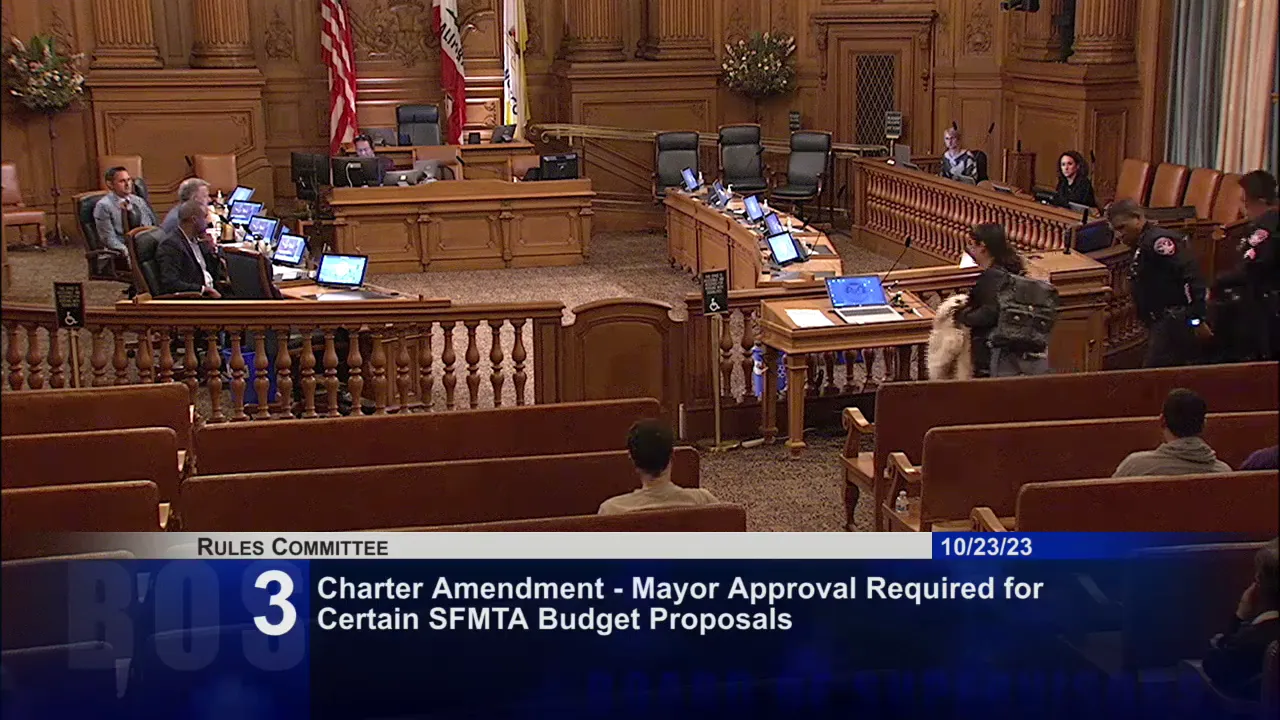
Item 3: Charter Amendment - Mayor Approval Required for Certain SFMTA Budget Proposals
Supervisor Safai (sponsor) proposed that the mayor must affirmatively approve in writing any SFMTA budget proposals that change fares, parking meter rates, or hours/days of operation. The amendment aims to create accountability for decisions that impact working families. Director of SFMTA (Jeffrey Tumlin) opposed, warning it could lead to service cuts and politicize transit funding. Chair Dorsey expressed concern about politicizing MTA, noting previous voter measures (Prop A 2007, Prop E 1999) intended to insulate transit from politics. The motion to recommend to the full board passed 2-1, with Dorsey voting no.
Item 4: Charter Amendment - Establishing the Department of Emergency Management in the Charter
Supervisor Safai (sponsor) presented a charter amendment to formally establish the Department of Emergency Management (DEM), set qualifications for its director (to match current Director Mary Ellen Carroll's expertise), and codify the director's appointment authority. No public opposition was voiced. The motion passed unanimously.
Key Outcomes
- Item 1 (Police Staffing): Charter amendments were adopted in part (lowering staffing targets and clarifying fund use). A proposed amendment to allow the Board of Supervisors to override police commission staffing reductions was rejected. The item was continued as amended to the October 30, 2023 Rules Committee meeting (vote: 2-1, Walton no).
- Item 2 (Community Policing): Continued to October 30, 2023, without a vote on the merits (unanimous).
- Item 3 (SFMTA Oversight): Recommended to the full Board of Supervisors with a positive recommendation (vote: 2-1, Dorsey no).
- Item 4 (Emergency Management): Recommended to the full Board of Supervisors unanimously.
Meeting Transcript
Calvo down. Okay. This meeting will come to order. Good morning, everyone, and welcome to the Monday, October 23rd, 2023 meeting of the Rules Committee of the San Francisco Board of Supervisors. I am Supervisor Matt Dorsey, Chair of this committee, and I am joined today by Vice Chair Shimon Walton and Committee Member Asha Safai. Together, we'd like to express our gratitude to our committee clerk today, Mr. Victor Young. Thanks also to the team at SFGov TV for facilitating and broadcasting today's meeting, and in particular today, our producer, Mr. Jason Goldhammer. Mr. Clerk, do you have any announcements? Uh, yes. I'd like to remind the audience to make sure to silence all cell phones and electronic devices. Uh documents uh provided to me today will be included as part of the file and should be submitted to myself. Items acted upon today are expected to appear at the Board of Supervisors' agenda on October 31st, 2023, unless otherwise stated. That completes my initial announcements. Thank you, Mr. Clerk. Uh, would you call, please call item number one? Item number one is a charter amendment to amend the charter of the city and county of San Francisco to establish minimum staffing levels for sworn officers of the police department requiring for a period of five years that the mayor and the board of supervisors appropriate funds to meet staffing levels, establishing a police full staffing fund for a period of five years for the purpose of facilitating minimum police staffing and allowing for a temporary freeze on appropriations to the police full staffing fund in the budget and economic emergency and an election to be held on March 5th, 2024. Thank you, Mr. Clerk. Uh colleagues, item number one is the police full staffing charter amendment that we first began working on last March. Uh some of you may recall that I announced this publicly last April. That was the day after San Francisco's flagship Whole Foods Supermarket and Civic Center in my district shuttered following only a single year in operation. Their stated reason for the closure was safety concerns both for their employees and their customers. That cite safety concerns for reasons that they have closed. We know too that safety has been a pervasive concern in fewer conventions and diminishing tourism in ways that hamstring San Francisco's post-COVID economic recovery and our long-term economic employment outlook. Many of these businesses, though certainly not all of them, struggle in the district I represent. After a nearly a year and a half serving on this board of supervisors, I can say that probably 90% of the complaints I hear from my constituents boil down to a difficult truth, that we don't have enough police officers to address the concerns they have every right to be voicing objections about. I have never believed more strongly than I believe today that San Francisco can no longer afford not to have a fully staffed police department. And this charter amendment endeavors to give voters the opportunity to accomplish that. While San Francisco has experienced police staffing shortfalls in past decades, never in our modern history has our police understaffing crisis been as serious as it is today. Now, as we will discuss in this hearing, we have a newly updated recommended police staffing level that is somewhat lower due to a drop in calls for service last year. The new recommended staffing level is 2,074 full duty officers. That developed a workload-based data-driven, independently recommended methodology that was guided by outside experts. It also reflects a much needed improvement over the prior staffing minimum once enshrined in our charter, which was there since uh 1994 up to 2020, which for 25 years froze the minimum staffing level at 1,971 full duty police officers. Unfortunately, San Francisco today is nowhere near our recommended staffing level. For that matter, we're nowhere near the old minimum staffing before it was repealed in November 2020 as proper. Our actual number of full duty sworn officers, as currently defined, is just 1475 police officers. That means we are about 600 full duty officers short of where we should be. Nearly 30% of the police department we are supposed to have isn't there. And most worrisome to me, more than 350 current police officers are eligible for retirement right now. If we don't act boldly, and with a mandate from voters, I believe we face the prospect of a police force that could soon be at half strength. This proposed charter amendment endeavors to prevent that. And here's how it will work. First, it will re-establish a minimum police staffing level of 2074 full duty officers in five years. And unlike the 1994 Charter Amendment, which for a quarter century enshrined a sh a static number, it will enable periodic adjustments to minimum staffing levels in years to come. Second, it will give us um get us to full staffing in a way that is incremental and doable over time, with graduated targets over five years. The amendments I will read into the record today lower those targets by 100 officers, making this approach more affordable and more workable.
openpublica.com