San Francisco Rules Committee Hearing on Family Homelessness and Newcomer Crisis – April 22, 2024
STREAMING COPY IN PREPARATION — RECORDING AVAILABLE FROM THE ORIGINAL SOURCE
San Francisco Rules Committee Hearing on Family Homelessness and Newcomer Crisis – April 22, 2024
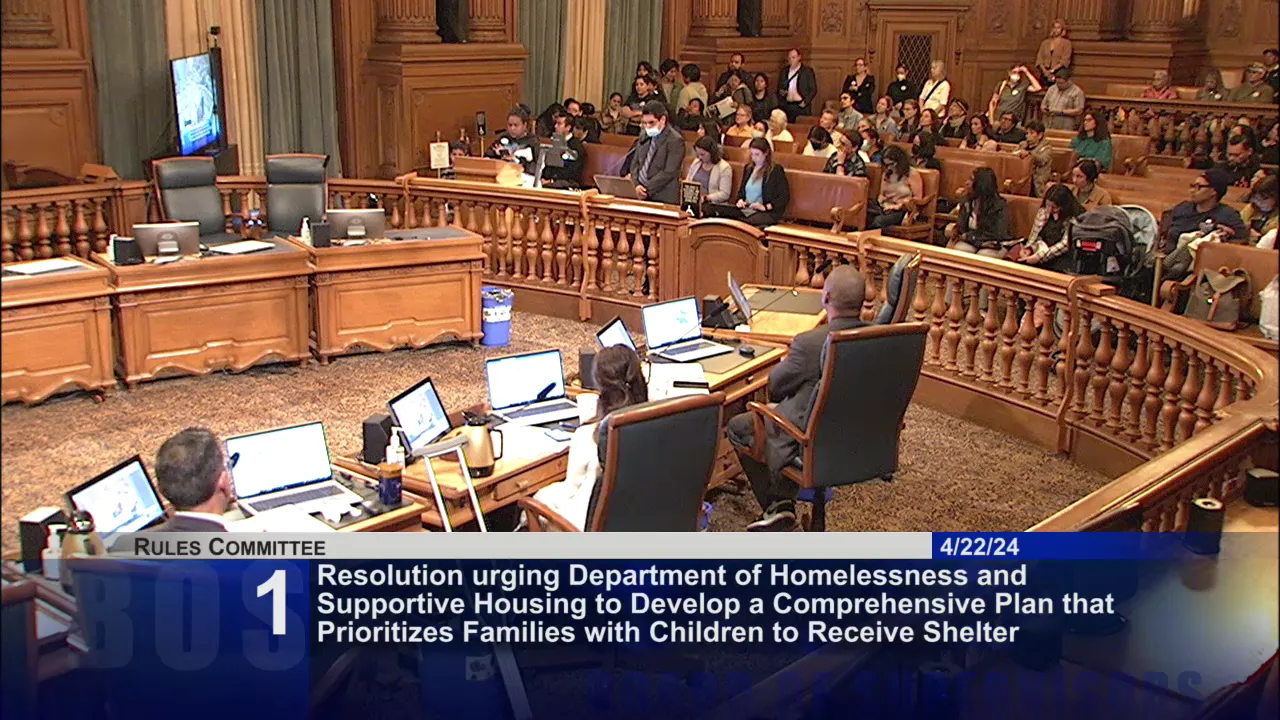
The Rules Committee of the San Francisco Board of Supervisors held a hearing on April 22, 2024, to discuss a resolution (240239) urging the Department of Homelessness and Supportive Housing (HSH) to prioritize families with children for shelter, develop a comprehensive plan, and create a multilingual public dashboard. The hearing featured presentations from the Office of Civic Engagement and Immigrant Affairs (OSIA) and HSH, extensive questions from supervisors, and over an hour of public testimony from families, advocates, and service providers. A key point of contention was the lack of a formal emergency declaration to address the growing crisis of newcomer and homeless families with children.
Public Comments & Testimony
- Families and advocates (over 25 speakers) overwhelmingly expressed that the current system is failing. Many described sleeping on streets, being turned away from shelters, and experiencing trauma. Speakers called for an immediate declaration of emergency, increased funding for shelters, hotel vouchers, legal services, and affordable housing.
- Faith-based groups (Faith in Action, Calvary Presbyterian, St. Mark’s Lutheran) emphasized the moral urgency and noted that the city has not fully utilized budget allocations for housing subsidies.
- Service providers (Compass Family Services, Latino Task Force, La Raza Community Resource Center) reported being over capacity and seeing a high volume of newcomer families. The Latino Task Force serves an average of eight migrant families per week across three hubs.
- Educators (United Educators of San Francisco, retired teacher) described children coming to school hungry, exhausted, and anxious due to housing instability, and advocated for immediate shelter and supportive services.
- Several speakers challenged the city’s definition of emergency, stating that children sleeping on the streets constitutes an emergency.
Discussion Items
- OSIA Presentation (Director Jorge Rivas): Provided data showing a surge in newcomer families. SFUSD reported 1,566 newcomer students enrolled (3% of total enrollment), the highest in a decade. The legal services wait list grew from 100–200 to over 900. OSIA noted that the city’s emergency plan is only triggered by a mass arrival (e.g., a busload), not by the steady stream, and that no emergency declaration has been made. OSIA is exploring hosted housing and a summer dormitory agreement with USF for up to 12 people. They emphasized the need for better data collection while honoring sanctuary city policies.
- HSH Presentation (Deputy Director Emily Cohen): Detailed the family homeless response system. There are 375 families on the shelter wait list, with 60 in temporary emergency shelter. 41% of families request services in English, 46% in Spanish. The leading cause of family homelessness is job loss (23%). HSH described reforms (same-day shelter offers, self-reported unsheltered status) and announced a $1 million expansion of hotel vouchers (35 slots) and a proposed 85–100 five-year rapid rehousing subsidies (20M from Prop C). However, they acknowledged capacity is strained and that newcomer families often lack long-term housing options.
- Emergency Declaration Discussion: Supervisors pressed OSIA and HSH on who can declare an emergency. Kim Bowman from DEM explained that DEM would not initiate a declaration; rather, the interdepartmental group (DEM, HSA, HSH, OSEA, etc.) would discuss and recommend to the mayor. That group has not been formally convened to assess the current situation. Supervisors expressed frustration that no department had taken the lead to recommend an emergency declaration despite the obvious crisis.
- Supervisor Questions:
- Supervisor Safai highlighted the trauma of families, the lack of transparency, and the need for better coordination and data.
- Supervisor Ronin noted that the system is not designed for newcomers and that prioritization for permanent housing disadvantages them due to shorter homelessness duration.
- Supervisor Walton emphasized the need to recognize the crisis and adequately resource OSIA.
Key Outcomes
- Motion to continue the matter to the call of the chair: Proposed by Supervisor Safai to allow time to gather more information on emergency declaration, voucher numbers, shelter capacity, and coordination. The motion passed unanimously (3-0).
- No formal emergency declaration was made; the interdepartmental group has not yet been convened to recommend one.
- The resolution (240239) remains pending and will be revisited at a future meeting.
Meeting Transcript
The meeting will come to order. This is the April 22nd, 2024 Rules Committee meeting. I'm Hilary Ronin, Supervisor, or Chair of the Committee, and I am joined by committee vice chair, Supervisor Shimon Walton, and Supervisor Asha Safai, a committee member. Our clerk is Victor Young, and I'd like to thank Corwin Cooley at SFGov TV for broadcasting this meeting. Mr. Clerk, do you have any announcements? Yes, public comment will be taken on each item on this agenda. When your item of interest comes up and public comment is called, please line up to speak on your right. Alternatively, you may submit public comment in writing in either of the following ways. Email them to myself, the rules committee clerk at VICTOR.yo N G at SFgov.org. If you submit public comment via email, it will be forwarded to the supervisors and also included in the file. You can also send your written comments via US mail to our office in City Hall when Dr. Carlton B. Goodlit Place, Room 244, San Francisco, California 94102. Please make sure to silence all cell phones and electronic devices. The documents to be included as part of the fire should be submitted to the clerk. Items acted upon today are expected to appear on the Board of Supervisors' agenda on April 30th, 2024, unless otherwise stated. Yes, item number one is a resolution urging the Department of Homelessness and Support of Housing to prioritize families with children to receive shelter or hotel vouchers the same day that they arrive at uh access point to develop comprehensive plans that focuses on children and families to prevent child children from living on the streets and develop uh a multilingual access public dashboard where families can monitor the wait list and the progress of moving families into permanent housing. Thank you so much. And I'd like to turn this over to the sponsor of this hearing, Supervisor Safai. Thank you, Chair Ronin. Um really appreciate you making the time to schedule this hearing today, and thank you, Supervisor Walton and Ron, and both of you for co-sponsoring this really, really important hearing. I'm sure like I'm sure that like myself, many of you are aware of the scathing reports and the experiences that we've heard from unhoused families seeking refuge in our city. I've been really horrified by these experiences of these families here today, and many others who have not been able to come forward publicly that have reported to me and my staff. And we definitely spent time listening on going out and visiting and hearing firsthand, not just uh in official government settings, but in community in churches and different places, hearing directly from people about the experiences that they're having with our city, a city with tremendous resources. Um this is not just a lack of transparency, uh an inadequate response on information that they encounter, but serious the the serious languishing conditions of the shelter that's made available to them when it's made available, and many times threats that are thrown their way if they speak up or speak out. The limited at times uh expired food that they're offered, uh at times the lack of compassionate response in their situation when they report medical conditions or the stress is so overwhelming that some have ended up in the hospital. And I think uh one of the days we had a uh a meeting, one of the individuals had to go to the hospital, and the teenage daughter had nowhere to go. Uh, we have babies that have not been able to access child care, making it different difficult for their parents to navigate uh the bureaucracy that they have to go through, uh traveling all over the city to get answers from different partners. Uh when children are in low enrolled in school from these families, uh they're often falling asleep in class because they're not getting access to the appropriate rest and food that they need at very critical developmental stages in their life. And uh, you know, I've walked away, you know, obviously tremendously shocked at these circumstances, as I said, in a city as as resourceful as we are to be thinking about small children with their families in these conditions. It really is unconscionable and breaks my heart. Many of them are immigrant families, newcomers to our city. Um, and just from my own, you know, personal experience, being someone that was not born in this country, having fled violence, had family members that were killed. Um, many of these families are leaving and leaving trauma to only come here in our city and experience more trauma. Uh there's another thing that we want to hear more about, and that's the actual number of families that are on the wait list. The number keeps moving. Um it said it's around 400, but we're not exactly sure if that's actually the right number. Uh we'd like to see how the you know the wait list is managed, how they're processed, and we don't have clarity on how a family moves through the system with any uh demonstrable success. So we'd like to know what the metrics are and how the outcomes are being measured. I'm hoping that we can get clarity from departments that are going to present today, and we're gonna listen, learn and improve our system to ensure that families are provided what they need to exit home the homelessness system. I'd like to know the network in the city building or supporting and that that the city is building to support in order to ensure that the safety net for unhoused families with children do not fall into chronic homelessness and suffer long-term harm that we know are likely the consequences of chronic homelessness. And then for children who are being reported being tired, falling asleep in class, um, not getting the appropriate food that they need, all of this is really, really important to address and understand how we're going to improve on. And we're entering a difficult budget year. We all know that. We know that this is a difficult, difficult time, uh, but we need much more reliable data so that we can come up with better solutions. We have the resources. We have the resources in our city. We just don't have the coordination and the leadership on this issue. We need to understand that how we're going to better address this firsthand.
openpublica.com