San Francisco Rules Committee Meeting – November 18, 2024
STREAMING COPY IN PREPARATION — RECORDING AVAILABLE FROM THE ORIGINAL SOURCE
San Francisco Rules Committee Meeting – November 18, 2024
The Rules Committee of the San Francisco Board of Supervisors convened on Monday, November 18, 2024 at 9:45 AM (actual start after roll call). Chair Walton presided, joined by President Peskin, Supervisor Ronan (sitting in), and Supervisor Safai (later excused). The committee heard seven agenda items: amendments to the Administrative Code on rapid rehousing, shelter monitoring, Mental Health SF, AI inventory, and surveillance technology; plus appointments to two advisory bodies. Several items passed to the full Board with positive recommendation; one was continued to a future meeting due to substantive amendments.
1. Administrative Code – Rapid Rehousing Policy (File 241038)
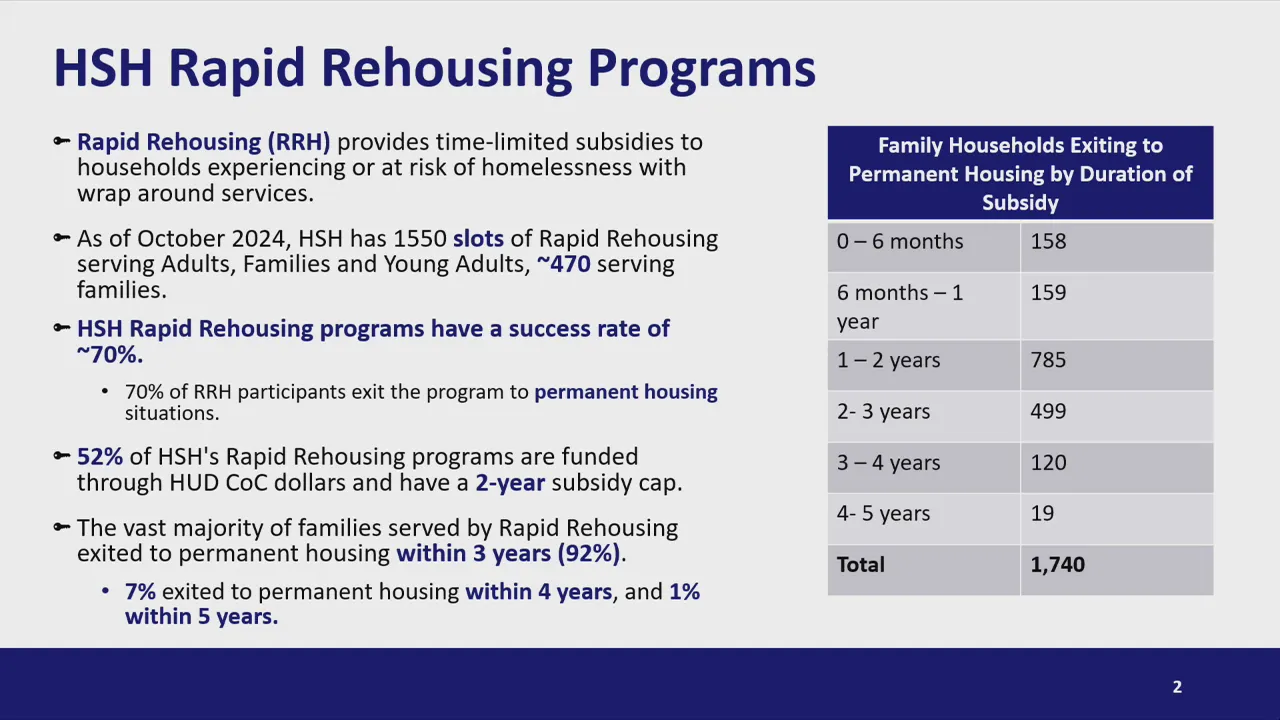
Supervisor Ronan introduced an ordinance declaring city policy to provide up to five years of rapid rehousing assistance to families assessed as at risk of returning to homelessness if given only a short-term subsidy. She offered minor, non-substantive amendments (e.g., changing the initial eligibility window from three years to two years based on data, clarifying scope and assessment triggers). Emily Cohen (HSH Deputy Director) presented, noting a 70% success rate for current programs, that 92% of successful exits occur within three years, and that extending all families to five years could cost up to $32 million annually if every household took the full extension. Chair Walton and Supervisor Ronan criticized that figure as inflated, noting that very few families currently reach five years and that the estimate assumed no families would exit early. Public comment was overwhelmingly in favor: speakers shared personal stories of struggling with short subsidies, argued that longer subsidies prevent the revolving door of homelessness, reduce trauma for children, and make landlords more willing to participate. Data from Compass Family Services showed families receiving 25+ months of support had an 86% chance of stable housing vs. 50% for shorter terms. The committee accepted the amendments and voted unanimously to send the amended ordinance to the full Board with a positive recommendation.
2. Administrative Code – Shelter Monitoring Committee and Standards (File 240871)
Dylan Schneider (HSH) presented amendments to reduce the frequency of shelter monitoring site visits, clarify complaint procedures, expand eligibility for seat one on the committee, and establish new minimum standards (e.g., shower stalls with working hot/cold water controls, minimum passing space). No public comment was offered. The committee voted unanimously to send the item to the full Board with positive recommendation.
3. Administrative Code – Mental Health SF Implementation Working Group (File 240984)
Supervisor Ronan introduced an amendment to sunset the working group upon the effective date of the ordinance (early January 2025) instead of July 2025, citing completed work and quorum challenges. The amendment was deemed substantive by the City Attorney, requiring continuance to the next Rules Committee meeting. No public comment. The committee voted unanimously to continue the item.
4. Administrative Code – Artificial Intelligence Inventory (File 241022)
Supervisor Ronan presented an ordinance requiring the Chief Information Officer to compile a publicly available inventory of AI systems used by the city, including 22 questions covering purpose, accuracy, bias, and impact on workers. She offered minor, non-substantive amendments recommended by civil liberties experts (e.g., replacing “efficiencies” with “internal administration”). CIO Michael Maxman gave a presentation on the city’s AI guidelines, staff training partnerships, and a three-month ChatGPT pilot with over 1,500 participants. One public commenter raised concerns about algorithmic bias, environmental impact, and the need for human staffing instead of AI replacement. The committee accepted the amendments and voted unanimously to send the amended ordinance to the full Board with positive recommendation.
5. Administrative Code – Surveillance Technology Ordinance Amendments (File 240983)
President Peskin presented amendments to streamline the existing surveillance technology ordinance (Chapter 19B), reducing reporting burdens, clarifying exemptions, and allowing departments to submit policy changes directly to the Board without COIT review. Julia Crushell (COIT privacy analyst) provided details. No public comment. The committee voted unanimously to send the item to the full Board with positive recommendation.
6. Appointments – Citizen’s Committee on Community Development (File 230892)
The committee considered reappointing Clinton Loffman (seat two) and appointing Linnell Sulligan (seat three). Both applicants briefly described their experience with HUD programs and community development. No public comment. The committee voted unanimously to approve the appointments.
7. Appointment – SOMA Community Stabilization Fund Community Advisory Committee (File 241034)
The committee considered seven members: reappointments of Misha Olivas, Raquel Redondiez, Norman Lind, Christian Martin (with a residency waiver), Janetta Johnson, and new appointments of Henry Karnilowitz and Tanya Reyes. Norman Lind and Henry Karnilowitz spoke. Brian Chu (MOHCD) confirmed the other applicants’ willingness to serve. No public comment. The committee voted unanimously to approve all appointments and the residency waiver.
Key Outcomes
- Item 1 (Rapid Rehousing): Amended and sent to full Board with positive recommendation.
- Item 2 (Shelter Monitoring): Sent to full Board with positive recommendation.
- Item 3 (Mental Health SF): Continued to next Rules Committee meeting due to substantive amendment.
- Item 4 (AI Inventory): Amended and sent to full Board with positive recommendation.
- Item 5 (Surveillance Technology): Sent to full Board with positive recommendation.
- Item 6 (Citizen’s Committee on Community Development): Appointments approved.
- Item 7 (SOMA Community Stabilization Fund): Appointments approved with residency waiver.
Meeting Transcript
San Francisco Government Television. SF Gov Cheesy. San Francisco Government Television. Good morning and welcome to this November eighteenth, twenty twenty-four rules committee meeting. I am joined here by President Peskin and Supervisor Safai will be here shortly. And we do have Supervisor Ronan as well sitting in on committee this morning. Our clerk is Victor Young, and I would like to thank James Kawana from SFGov TV for making sure that this meeting is televised for all of us this morning. Yes, public comment will be taken on each item on this agenda. When your item of interest comes up and public comment is called, please line up to speak on your right. Alternatively, you may submit public comment in writing, either the following ways. Email them to myself, the rules committee clerk at VIC T-O-R.gov.org. Items act upon today are expected to appear on the board of supervisors' agenda on December third, two thousand twenty-four, and let's otherwise state it. That completes my uh announcements. Item number one is the ordinance mining. The administrative code declare that it's the city's policy to provide up to five years of rapid rehousing assistance to an eligible household where the city has assessed that the household circumstances and concluded that a shorter term subsidy will create a risk of returning to homelessness. And I will pass this over to Supervisor Ronan to get us started. I want to thank you for scheduling this item today and to President Pasken for waiving the 30-day rules so that we could move this legislation through the process before I leave office. I also want to thank the Department of Homelessness and Supportive Housing, the San Francisco Human Services Agency, the Advocates, and our city attorney for working so cooperatively with us to craft a policy on which we can all agree. As we know, San Francisco has seen a doubling of the number of families experiencing homelessness. Our wait list for shelters has surpassed 500 families. Many of those families were able to exit homelessness in private market rental housing with assistance from a short-term rental subsidy program, but then return to homelessness when their housing subsidy expired. This ordinance, amending the administrative code, declares that it is the policy of the city and county of San Francisco to provide up to five years of rapid rehousing assistance to an eligible household where the city has assessed the household circumstances and concluded that a shorter term subsidy will put them at risk of return to homelessness. This legislation also requires the homelessness oversight commission to hold an annual hearing and issue an annual report analyzing the city's implementation of the rapid rehousing program. While we added trailing legislation in July that extended HSH rapid rehousing programs for up to five years for eligible families, this included only the 180 subsidies funded in this budget process. It excluded programs such as those receiving CalWork subsidies through HSA with limits of one to three years. We know that some families will not be able to become self-sustaining and pay their full rent within one year of a program. Some can do it in two and three, while others need a little more time to off-ramp and address the multiple barriers to achieving this goal. Regardless of the funding source or program in which resident is enrolled, we want rapid housing extension for up to five years to capture families who might fall through the cracks and would otherwise return to homelessness if not for this extension. We have to stop the revolving door of poor families in San Francisco going from shelter to shelter to finally being housed, only to return to homelessness again. This negatively impacts children, creating adverse childhood events that will haunt them for a lifetime. The goal of this legislation is to give families the time and support to help them transition to become stable and successfully housed. Before we go to a brief presentation from the departments, I also have a few minor amendments to the legislation today that we we have discussed with HSH and HSA that are clarifications of policy and non-controversial. They will not uh delay this legislation today. Uh very briefly, and I passed out the amendments to you on page two, line 10, changing the number of years from three to two to reflect the data. On page two, lines 19 through two through line two on page three, clarifying the scope of time limited subsidies. Page two, line three, line eight. Uh page two line three to line eight, removing coordinated entry because these families are already in the system and increasing the number of months in advance. They are alerted to this option. Page three, line 15, including the line to ensure that every household that receives quote the maximal allowable rent subsidy is assessed to determine whether the household is at risk of returning to homelessness. Page three, line 21, add the word every and rent. Page three, line 24, add the line, maximize and exhaust all available federal and state funds that may be used to provide rent subsidies before expending general funds to comply with this Article 20. And with that, we will hear a short joint presentation put together by the Department of Homeless and Support of Housing and the San Francisco Human Services Agency. We will be hearing from Emily Cohen, Deputy Director of Communications and Legislative Affairs at HSH, and also here and um and is available for questions. Yanni Tai, CalWorks program manager for ACHSH and expert on CalWorks Housing Support Program. Thank you for your presentation. I just wanted to ask the city attorney to confirm that these amendments we are submitting. Are they substantive? Good morning, Supervisors, Deputy City Attorney Brad Russian. These amendments are not substantive. Thank you so much.
openpublica.com