San Francisco Rules Committee Meeting - June 16, 2025
STREAMING COPY IN PREPARATION — RECORDING AVAILABLE FROM THE ORIGINAL SOURCE
San Francisco Rules Committee Meeting - June 16, 2025
The San Francisco Board of Supervisors Rules Committee met on June 16, 2025, at 6:15 PM to consider four items: an ordinance approving the Municipal Transportation Agency's (MTA) surveillance technology policy for red light and no-turn enforcement cameras, two appointments (Entertainment Commission and Police Commission), and an appointment to the Enhanced Infrastructure Financing District. The meeting featured extensive public testimony on the Police Commission appointment, with seven candidates and over 60 public speakers.
Item 1: Surveillance Technology Policy – Red Light and No-Turn Enforcement Cameras
- The MTA presented its automated red light and no-turn enforcement camera program, operating since 1996 as part of Vision Zero. The system uses 3D radar and cameras at 19 cameras across 13 intersections. It captures three images and a 12-second video of each potential violation. Two human reviews (contractor then SFPD) occur before a citation is issued. Data is stored up to 30 days; if no citation, destroyed after 15 business days; if cited, up to 5 years. Only SFPD, Superior Court, and vendor have access without a warrant. The program issues approximately 1,000 citations per month (10,000–11,000 per year).
- Supervisor Mandelman asked about citation rates and aging out of violations. The MTA manager stated some events expire due to limited SFPD review capacity (one officer). A report on events vs. citations will be provided.
- No public comment.
- Motion: Forward to full board with positive recommendation. Passed unanimously (Walton, Sherrill, Mandelman all aye).
Item 2: Appointment, Entertainment Commission
- Laura Thomas, current public health seat holder (appointed 2016), reapplied. She holds a Master's in Public Health and has HIV/AIDS experience.
- No public comment.
- Motion: Forward to full board with positive recommendation. Passed unanimously.
Item 3: Appointment, Police Commission – Seat Three (Term Ending April 30, 2029)
Seven applicants were considered: Albert Mayer, Franco Sorrelli, Haseeb Imran, Marjan Philhour, Meredith Osborne, Pratiba Techie, and Patrick Hallanan (not present). Each applicant gave opening statements and answered questions from the committee on police policy, pretextual stops, accountability, engagement with the Board, and selection of a new police chief.
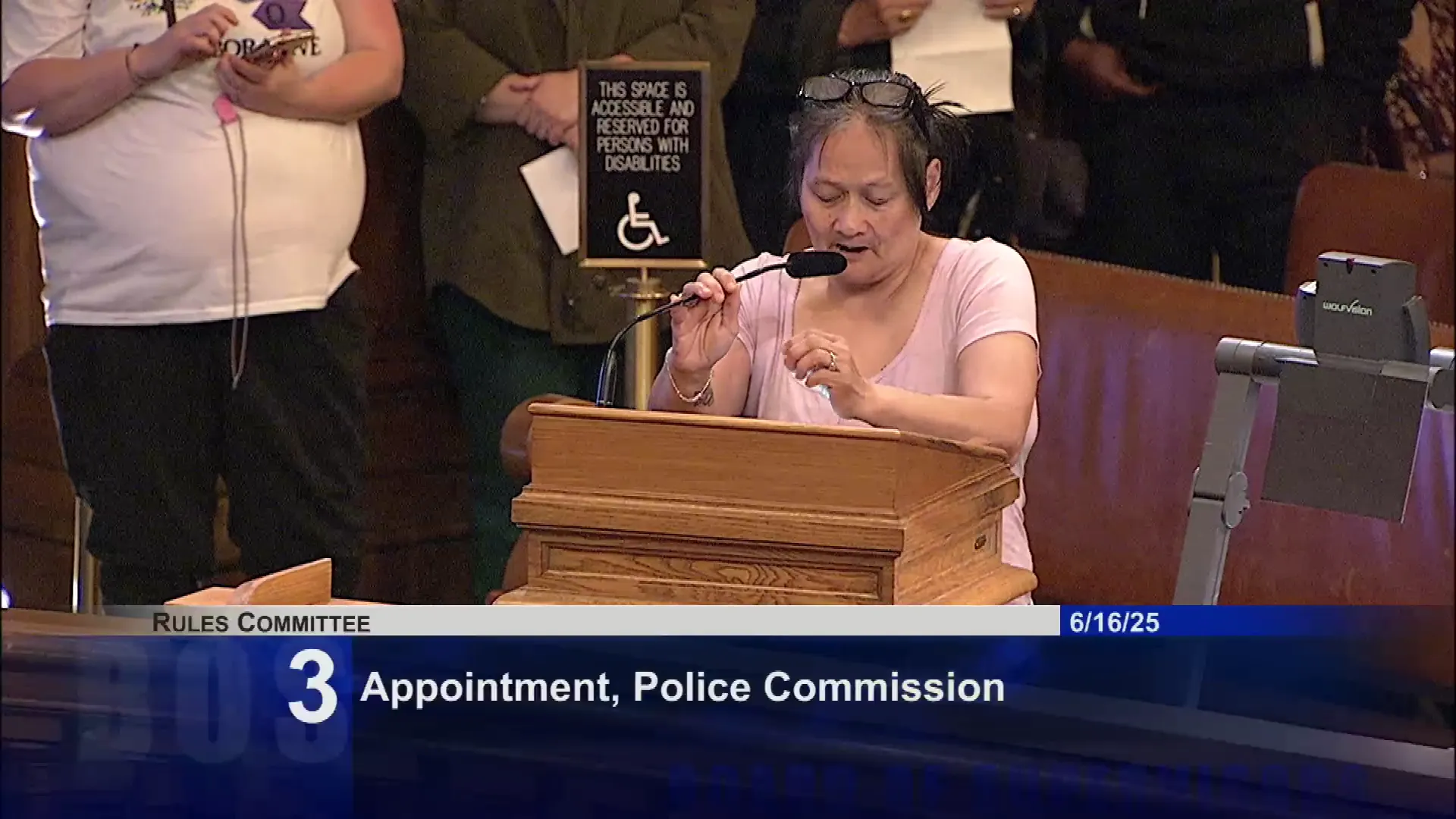
Public Testimony: Over 60 speakers, with strong support for Pratiba Techie (from Tenderloin community, tenant advocates, labor unions) and Marjan Philhour (from small business owners, Asian American community, police rank-and-file supporters). Several speakers also supported Haseeb Imran (from Muslim community, former police deputy chief).
Discussion: Supervisor Mandelman emphasized the seat's history as a community seat (previously held by Petra de Jesus and Jesus Yanez) and the need for a candidate committed to both public safety and reform. He expressed support for Pratiba Techie, noting her deep roots in the Tenderloin and daily work on open-air drug markets. Supervisor Sherrill thanked all applicants but noted a slight difference of opinion. Supervisor Walton commended all candidates.
Motion: Supervisor Mandelman moved to forward Pratiba Techie's appointment to the full board with positive recommendation.
- Vote: Mandelman aye, Walton aye, Sherrill no. Motion passed 2-1.
Item 4: Presidential Appointment, Enhanced Infrastructure Financing District Public Financing Authority No. 1 – Supervisor Stephen Sherrill
- Motion to approve Supervisor Sherrill as an alternate to seats one, two, and three. Supervisor Sherrill was excused from the vote.
- No public comment.
- Motion: Amend to strike "rejecting" and replace with "approving", then forward to full board. Passed unanimously (Mandelman and Walton aye, Sherrill excused).
Key Outcomes
- Item 1 (Red Light Cameras): Forwarded to full board with positive recommendation (unanimous).
- Item 2 (Entertainment Commission): Forwarded Laura Thomas's reappointment (unanimous).
- Item 3 (Police Commission): Forwarded Pratiba Techie's appointment (2-1, Sherrill dissenting).
- Item 4 (EIFD Authority): Approved Supervisor Sherrill's alternate appointment (unanimous, Sherrill excused).
Meeting Transcript
Good morning, everybody, and welcome to our June 16th, 2025 Rules Committee meeting. I am your Chair of Supervisor Walton, joined by Vice Chair Supervisor Shiro and President Mendelman will be here in a second. Our clerk this morning is Victor Young, and I would like to thank Jamie Escherberry from SFGov TV for broadcasting this meeting and making sure it is available to the public. Mr. Clerk, do we have any announcements? Yes. Public comment will be taken on each item on this agenda. When your item of interest comes up and public comment is called, please line up speak on your right. Alternatively, you may submit public comment in writing in either of the following ways. Email them to myself, the rules committee clerk at VICTOR.yo-ng at sfgov.org. If you submit public comment via email, it will also be included as part of the file. You may also send your written comment via US mail to our office in City Hall. One, Dr. Carlton B. Good place, room 244. San Francisco, California 94102. Please make sure to silence all cell phones and electronic devices. Documents to be included as part of the file should be submitted to the clerk. Items acted upon today are expected to appear on the Board of Supervisors' agenda of June 24th, 2025, unless otherwise stated. That completes my initial announcement. Thank you, Mr. Clerk. Would you please call item number one? Item number one is it ordinance approving the surveillance technology policy from the municipal transportation agencies. Continued use of existing automated red light and no-turn enforcement cameras. Okay, seeing no comments or statements by colleagues, we will go to public comment on item number one. Good morning, Chair Walton. Yes. Uh my name is Nabeel Arne, and I am here from the MTA to present our automated red light cameras and no-turn enforcement. Are you able to see the presentation? Ah, yes. There it goes. Thank you. So this program has been running since 1996. The overall goal is to reduce collisions and other problems from running red lights and making illegal turns. It is part of Vision Zero, so we're trying to make the streets safer. We have support from the SFPD Superior Court and the City Attorney's Office, and we work with a contractor named Vera Mobility to maintain the equipment and help with citations. So quick summary of the way that it works. We use 3D traffic radar to track cars, and we are also monitoring traffic lights as they change color. So the system does not enter enforcement mode until the light changes from yellow to red. If a car goes through on yellow or green, it will not be triggered. We will not capture those those cars. And once it is detected, a possible violation, we go ahead and capture some photos and a short video clip. So a little bit more detail about the way that we capture information. The first image that we take is before the vehicle enters the red light. The second shows it actually going through on the red light. And then the third, taken by a separate camera, takes a picture of the driver of the vehicle. We also capture the license plate, data about when it happened, any 12-second digital video of the violation or potential violation. For the illegal turn violation, it's very similar, only we are using a video stream to capture vehicles making the turn. And again, we will not activate it unless there is a turn made.
openpublica.com