Shoreline City Council Regular Meeting - May 4, 2026
STREAMING COPY IN PREPARATION — RECORDING AVAILABLE FROM THE ORIGINAL SOURCE
Shoreline City Council Regular Meeting - May 4, 2026
The Shoreline City Council held a regular meeting on Monday, May 4, 2026, at 7:00 PM in Council Chambers. The meeting included proclamations recognizing Asian/Pacific American Heritage Month, National Bike Month, and Mental Health Awareness Month, as well as a public hearing and discussion on the 2027-2032 Transportation Improvement Plan (TIP). Key topics included staffing shortages affecting project delivery, a returned grant for Meridian Avenue bike lanes, and the city's reliance on grant funding for capital projects.
Consent Calendar
- Approved by unanimous 7-0 vote:
- Approval of March 6-7, 2026 Strategic Planning Workshop Meeting Minutes
- Approval of March 9, 2026 Workshop Dinner Meeting Minutes
- Authorization for City Manager to execute a construction contract with Laser Underground and Earthworks, Inc. in the amount of $3,477,833 for the 2026 Sewer Pipe Repair and Replacement Project
Public Comments & Testimony
-
General Public Comment (before public hearing):
- Gordon Black, North Sound Bicycle Advocates Boardmember, expressed gratitude for the city's biking progress and urged council not to remove the Meridian Ave N bike lane project (N 175th to N 200th) from the TIP.
- Norbert Steele, Shoreline resident, questioned why the bike lane project was removed due to staffing shortages. He noted Shoreline is 41% below the average full-time employee per 1,000 residents compared to comparable cities and suggested hiring more staff. He also asked staff to study the cost of establishing a city police department instead of contracting with the King County Sheriff’s Office, noting a 20% cost increase this billing cycle.
-
Public Hearing on Resolution No. 561 – Transportation Improvement Plan:
- Lee Lambert, Shoreline resident and Executive Director of Cascade Bicycle Club, expressed concern about the removal of the Meridian Avenue bike lane project. He cited USDOT studies showing bike lanes reduce crashes for all users and asked questions about the amount of grant funding returned, why other projects were prioritized, and whether the loss was solely due to staffing.
- Oliver Moffat, Shoreline resident, raised concerns about cyclist safety and questioned the high costs and staffing issues. He noted that the Meridian bike lanes were simply paint on pavement yet cost nearly a million dollars, and questioned why the city cannot complete such projects despite returning grant funding.
Discussion Items
- Public Hearing and Discussion of Resolution No. 561 - 2027-2032 Transportation Improvement Plan (TIP)
- Staff Presentation: Senior Transportation Planner Alan Budde explained the TIP is a six-year plan required by state law, setting priorities and informing the Capital Improvement Plan. Adoption is required by end of June 2026; formal adoption is scheduled for June 1.
- Funding Summary (presented by Kendra Dedinsky, Transportation Planning Manager):
- Total six-year annual programs: $18.9 million
- Fully or partially funded projects: $124.4 million
- Projects beyond 2033: over $148 million
- Approximately 45% of 2027-2032 funding is non-local (primarily grants)
- Preservation programs (pavement, sidewalk, signal rehab) are underfunded; only $1.2 million annually ($11 million over six years)
- Grant market is unpredictable due to federal climate initiatives and economic fluctuations.
- Council Discussion:
- Councilmember Scully expressed frustration that staff did not alert council earlier about the Meridian bike lane project cancellation due to staffing. He requested future heads-up before projects with dedicated grant funding are abandoned.
- Councilmember Snider asked for clearer budget detail on REET and VLF allocations. She suggested pursuing smaller, more feasible projects (MVPs) rather than large, unfunded corridors.
- Councilmember Roberts supported breaking large projects into smaller phases, noting the city has done great work but should consider available resources.
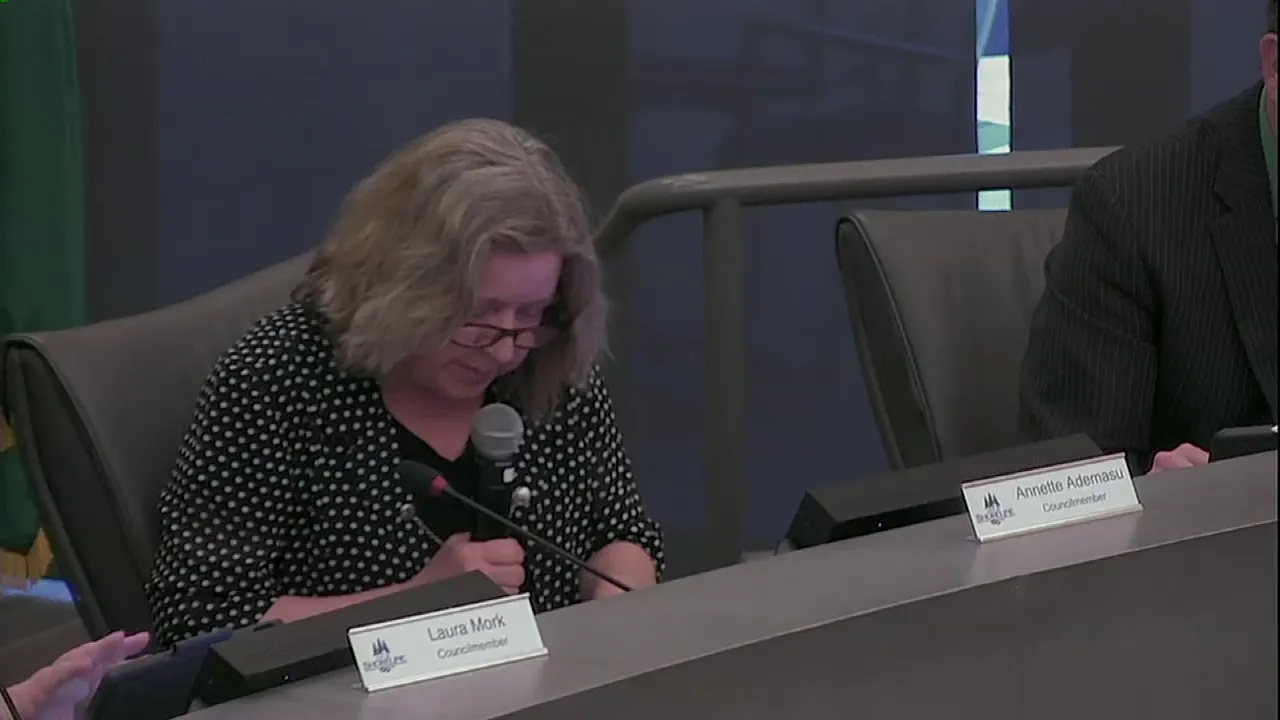
- Councilmember Ademasu requested staff separate Segment E (180th Street) from the North City Light Rail Connector and prioritize it as a standalone phase due to public safety concerns. She also asked about sidewalk rehabilitation program costs ($460,000 annually) and explored tree preservation techniques like permatrack.
- Deputy Mayor Pobee discussed the challenge of hiring for limited-term grant-funded positions and suggested internally funding projects if external grants are too restrictive.
- Mayor Robertson asked why the Meridian bike lanes were removed entirely rather than moved to the unfunded category. She expressed support for grouping projects for efficiency and for future staffing discussions.
- Councilmember Scully opposed artificially elevating the Meridian project in the prioritization matrix due to the grant mishap, noting other network gaps exist.
- Councilmember Ademasu and Deputy Mayor Pobee supported adding the Meridian bike lanes back as an unfunded project.
Key Outcomes
- The public hearing was held; formal adoption of the TIP is scheduled for June 1, 2026.
- Council directed staff to consider adding the Meridian Avenue bike lane project back to the TIP as an unfunded project for future funding opportunities. A final decision will be made at the June 1 adoption meeting.
- Staff will evaluate breaking the North City Light Rail Connector project into phases, particularly Segment E (180th Street), as requested by Councilmember Ademasu.
- Council requested improved communication from staff when projects with dedicated grant funding are at risk of cancellation.
- Staff will include a budget request to convert a limited-term position to full-time in the engineering capital delivery group to address staffing shortages.
- No formal vote was taken on Resolution No. 561; final action is scheduled for June 1, 2026.
The meeting was adjourned at 8:10 PM.
Meeting Transcript
Good evening, thank you all for being here. I now call to order the Shoreline City Council regular meeting for Monday, May 4th, 2026. Will you please stand and join counsel for the flag salute? Oh, wait, to the Republic for which it stands one nation under God. Thank you. Would the clerk please call the roll? Mayor Robertson. Here. Deputy Mayor Covey. Here. Councilmember Snyder. Here. Council Member Scully. Present. Councilmember. Present. Councilmember Automassi? Present. Council Member Roberts. Here. This month marks Asian Pacific American Heritage Month, National Bike Month, and Mental Health Awareness Month, each one highlighting a vital part of our community's story and well-being. Asian Pacific American Heritage Month invites us to honor the rich histories, cultures, and contributions of Asian Americans and Pacific Islanders across the United States. It's an opportunity for all of us to learn more about the impact these communities have made and continue to make and to reflect on how we can support and uplift their ongoing work. May is also National Bike Month, and here on Shoreline, we proudly recognize both national and local efforts to make bicycling accessible, safe, and enjoyable. Our city continues to invest in a bicycle network that serves riders of all ages and abilities. And finally, we observe Mental Health Awareness Month, a time dedicated to promoting mental well-being and reducing stigma nationwide. This month reminds us that mental health is essential to our overall health and that supporting one another strengthens our entire community. So at this time, I would like to invite Charity Mendenhall, Executive Director of Charmed, to come forward and accept the proclamation. Whereas Mental Health Awareness Month was established in 1949 to promote mental health and reduce stig stigma nationwide, and whereas mental health includes our emotional, psychological, and social well-being and affects how we think, feel, act, and live our lives. And whereas everyone knows someone who has been affected by mental health or substance use issues at some point in their lives, and whereas people of color, LGBTQ, low-income communities, and other marginalized groups have additional challenges to mental health due to racism, homophobia, and other systemic barriers. And whereas Mental Health America's latest report found that 24% or 60 million adults in the United States experience a mental illness, 17% or 46 million adults had a substance use disorder, and 5.5% or 14 million people reported thoughts of suicide. And whereas in King County, 25% of teens experienced serious symptoms of depression, and six percent of teens attempted suicide in the past year. Thank you again for being here, Charity. As it truly matters to see local leadership acknowledge the importance of mental health. As the executive director of Charmed Behavioral Health, I have the privilege of overseeing our work with individuals and families across the community and from disadvantaged backgrounds. What we are seeing reflects broader national trends, but also highlights unique cultural and excess related needs. Many individuals are navigating anxiety, depression, trauma, and major life transitions. In many cases, mental health is still heavily stigmatized, which can delay people from seeking the care that they um that they need until they have a crisis. At the same time, access to uh mental health, mental health mental health, the help from mental health is a challenge with long wait lists and insurance barriers. But there is also something encouraging happening. More people are opening up, more families are having the conversations about mental health, and more individuals are seeking support earlier, which is a hopeful shift. At Charmed Behavioral Health, we are working to meet that need by providing behavioral health services through providing behavioral health education and support in ways that are accessible and culturally relevant. We offer classes for both individuals and groups and youth and adults alike. These classes focus on practical tools for managing stress, for understanding mental health, and for building resilience and navigating life's challenges. When people feel seen and understood and equipped with tools, they begin to thrive. So what we can do as a community is that we can normalize conversations about mental health in our homes, in our workplaces, and in our schools. We can support programs that increase access to care, especially for those in the unserved or underserved communities. And we can invest in prevention, making mental health wellness part of everyday life, not just something that we address in moments of crisis. When people are supported and when families um when people are supported, families are stronger, and the communities are more connected because of that, and then our entire city benefits. Thank you again for your continued commitment to mental health.
openpublica.com