Shoreline Planning Commission Meeting on Housing Action Plan Prioritization - January 21, 2021
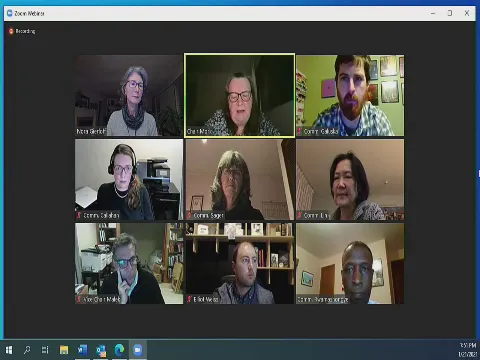
STREAMING COPY IN PREPARATION — RECORDING AVAILABLE FROM THE ORIGINAL SOURCE
Shoreline Planning Commission Meeting on Housing Action Plan Prioritization - January 21, 2021
The Shoreline Planning Commission met on January 21, 2021, to review and prioritize actions from the city’s Housing Action Plan toolkit. The meeting included a presentation from consultant Elliot Weiss, extensive discussion among commissioners on housing needs, regulatory barriers, and affordability, followed by a structured prioritization vote. The commission identified a set of high-priority toolkit items to recommend to the City Council.
Consent Calendar
- Approval of minutes from November 18, 2020 and December 17, 2020 meetings was moved forward with no changes.
- No other consent items.
Public Comments & Testimony
- No public comments were made. Darren Hyde had signed up but was not present.
Discussion Items
- Housing Action Plan Overview: Laura (staff) presented the plan’s components: a housing needs assessment, toolkit of policy actions, and alignment with the comprehensive plan. The consultant Elliot Weiss reviewed 25 toolkit options grouped as existing tools (e.g., ADU regulations, density bonuses, multifamily tax exemption), new zoning/regulatory tools (e.g., missing middle zoning, cottage housing), funding tools (local levy, real estate excise tax), and displacement minimization tools (down payment assistance, homeowner stability, partnership with affordable housing providers, community land trusts).
- Commissioner Positions:
- Vice Chair Mellon expressed skepticism about the effectiveness of the multifamily tax exemption given lengthy permitting timelines and rising costs; he urged focus on zoning and regulatory reforms to reduce developer uncertainty.
- Commissioner Callahan raised interest in surplus city land for affordable housing, noting the city’s limited inventory but potential synergy with other projects (e.g., Kennedy Recreation Center). She also proposed including car-sharing incentives in parking reduction regulations.
- Commissioner Sager emphasized minimizing displacement and supporting pathways to homeownership, particularly through community land trusts and education about ADUs and land subdivision.
- Commissioner Malik (spoke extensively) highlighted that 92% of middle-class net worth is in home equity, arguing that homeownership is critical to breaking poverty cycles. He noted that 50% tariffs on lumber and permitting delays are driving up costs, squeezing small builders, and pushing townhome projects to neighboring Mountlake Terrace. He called for metrics on ownership vs. rental and on who is building in Shoreline.
- Commissioner Garuska asked about distinguishing between missing middle zoning and small-lot single-family; Elliot Weiss explained the former includes duplexes/triplexes and requires deeper code audit, while the latter focuses on detached homes.
- Commissioner Wama Sanjay proposed encouraging existing property owners to build ADUs or secondary units on their land as a way to increase housing supply without requiring new land.
- Commissioner “Ma” (likely Commissioner Malik) stressed the importance of deep green incentives being integral to any affordable housing development.
- Commissioner Claw questioned whether individual incentives can be evaluated in isolation; staff responded that incentives are finite and must be prioritized to avoid diluting their effect.
- Commissioner Lynn suggested removing items that are clearly low priority to simplify the list.
Key Outcomes
- Prioritization Exercise: Each commissioner selected their top six actions. First-round results (items with 4+ votes):
- Deep Green Incentive Program (item 2)
- Cottage Housing Regulations (item 13)
- Down Payment Assistance (item 21)
- Homeowner Stability Program (item 22)
- Partner with Affordable Housing Providers (item 23)
- Support Community Land Trusts (item 24)
- Second-round from remaining items (with 2–3 votes each): Top three were:
- Identify surplus city property for affordable housing (item 12) – 5 votes
- Update residential zone density bonus regulations (item 3) – 5 votes
- Density bonus for additional houses on single-family lots (item 14) – 4 votes
- Additional Considerations:
- Commissioners emphasized the importance of tracking metrics (e.g., ownership vs. rental, who builds) and integrating deep green and community land trust concepts into broader policies.
- A motion to remove the real estate excise tax and the local housing levy from consideration was supported by some members; the final list will be presented to Council with a note that these were discussed but not prioritized.
- Next Steps: Staff will package the prioritized actions into a final Housing Action Plan document and bring a recommendation to the City Council by June 2021. The comprehensive plan housing element update will follow separately, aligned with countywide planning policies expected in 2022–2024.
- Director’s Report: Ken Read noted that permit revenue recovered in 2020 despite COVID, with townhome permits generating the most revenue. The Point Wells Hearing Examiner decision is due January 29, 2021.
Meeting Transcript
Yes. So it's 11 o'clock. And so I would like to open our January 21st, 2021 farming commission meeting. First item on the visit of business is roll call. Can you help us with that? Alison, please. Yes. Commissioner Callahan. Commissioner Garuska. Commissioner Lane. Chair Moore. President. Commissioner Wana Sanjay. I see him here. Yeah, he was here. And Commissioner Sega. Next item of business. Yeah, I I assume when Commissioner Wama Sanjay resolve whatever issue it is that we'll be joining us. Can everybody hear each other? Yeah. Okay. Is there any change to the agenda that any of the members would like to make? Hearing none, we're on approval of minutes, both for the Wednesday, November 18th meeting and the December 17th meeting. Are there any changes? Hearing none. Moving on to general public comment. Is there anybody who would like signed up to make a comment? Yes, Darren Hyde has signed up to make public comment, but I'm not seeing him in our attendee list. Darren, if you are there, please press Sarah 9 to raise their hand. Would you like me to keep an eye on him for a little later on again? Okay, thank you. Thank you. So then we are on the study items. Oh no. So it's a pleasure to be here this evening. We're here again to talk about housing ash plan, and we're learning uh forward on this. We're getting close to the end. Uh let me just start this up. And so just to give a brief overview, a refresher for you and um for anyone in our audience who uh needs a little background on what we're doing. So uh Shoreline is uh developing a housing action plan, has a couple different components that we've been reviewing over the last um close to a year, eight months, something like that. So there's been uh a housing needs assessment to look at uh what kinds of housing we have in the city, where are the gaps are what we need. There's a housing toolkit, which is identifying housing-related policy actions, spending, new tools, uh, what are other ways that we can affect housing in a way to meet the gaps that we find. Uh making sure that what we're doing is in alignment with our comprehensive plan housing element and setting ourselves up for the update of the comprehensive plan that's required over the next couple of years. And this evening trying to come up with a priority prioritized list of recommendations that we can take forward to the city council and will help guide which of the many things that we think is the most important for us to move forward on. Who are we now? Who are we going to be in the future? What do we need to get there? Um obviously we're in a regional housing crisis. Um there's not enough of the right types of housing, the right types of um cost to go around. And so this is the challenge that we're dealing with, you know, on a regional basis, and how can the city help to do our part to try and address those issues?
openpublica.com