Shoreline Planning Commission Meeting - February 18, 2021: Enhanced Shelter Zoning Code Study Session
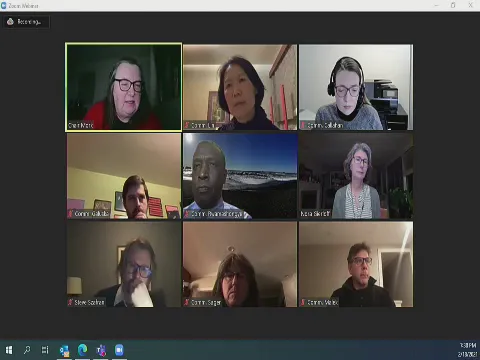
STREAMING COPY IN PREPARATION — RECORDING AVAILABLE FROM THE ORIGINAL SOURCE
Shoreline Planning Commission Meeting - February 18, 2021: Enhanced Shelter Zoning Code Study Session
The Shoreline Planning Commission held a study session on February 18, 2021, to review proposed zoning code amendments to allow enhanced homeless shelters in the Neighborhood Business (NB) zone. The meeting included a presentation by Planning Manager Nora Gurloff, public testimony, and commissioner discussion on the definition and criteria for enhanced shelters. No formal action was taken; the commission provided feedback for staff to refine the proposal ahead of a public hearing scheduled for March 18, 2021.
Public Comments & Testimony
- Renee Billing expressed concerns about the lack of transition or buffer between the proposed shelter site and adjacent residential properties, noting that the site is currently zoned R-48 and R-18, not mixed business.
- Nancy Seale (representing an unnamed neighborhood group) argued that the presentation was incomplete. She stated that residents are not required to seek help, that the shelter operator (Catholic Community Services) has no experience running a 24/7 shelter, and that the building lacks a functioning kitchen and is in poor condition. She also warned that King County Housing Authority intends to convert the property into permanent supportive housing after the grant funding expires in 2023, citing the Morrison Hotel as an example of such a facility with high rates of police calls.
- Jennifer (unable to read her full comment due to hearing difficulties) submitted a written objection to the project.
- Stacey Siles (owner of a nearby business) described existing problems with people using drugs and leaving needles in the area, arguing that an enhanced shelter would worsen conditions for neighbors.
Discussion Items
- Nora Gurloff presented the enhanced shelter definition and proposed index criteria: operation by a government or nonprofit with capacity; life safety inspections; prohibition of criminal activity and drug/alcohol use on site; location on a principal arterial with frequent transit; minimum one-mile spacing between shelters; maximum 100 residents; six-foot fence along property lines adjacent to residential zones; a parking plan; and a three-party memorandum of agreement between the city, county, and operator covering staffing plans, regular reports, police coordination, a good neighbor plan, performance metrics, and provisions for discontinuing the use.
- Commissioner Callahan requested more detailed metrics and reporting requirements, including both program success indicators and community impact measures (e.g., police calls, complaints).
- Commissioner Malik emphasized the need for proactive neighborhood outreach, possibly including weekly briefings for residents within a quarter-mile of a shelter, building on existing public notice practices.
- Commissioner Wanasande supported transparency through neighborhood briefings and suggested that allowing neighbors to see the facility could reduce biases.
- Commissioner Minn questioned whether a working kitchen should be a required amenity, noting that the current building lacks one.
- Commissioner Gallian (likely Commissioner Callahan) asked about other jurisdictions' approaches and whether the criteria would limit shelters only to Aurora.
- Commissioner (unidentified) raised concerns about the selection process for shelter operators and insurance requirements.
- Staff clarified that the proposal is limited to the NB zone initially but could be expanded later, and that specific operational details like kitchen facilities are left to performance standards rather than prescriptive requirements.
Key Outcomes
- No motions or votes were taken. The commission directed staff to incorporate feedback on metrics, neighborhood notification, operator experience, and operational capacity into the enhanced shelter criteria before the public hearing.
- The next meeting on March 18, 2021, will include a public hearing on the proposed code amendments and the Housing Action Plan. The commission will then make a recommendation to the City Council.
Meeting Transcript
I'd like to call the order to order the February 18th Planning Commission meeting. First item on the agenda is roll call. Could you help us with that in the vote from? Yes, thank you. Commissioner Callahan. Yeah. Commissioner Balista. Thank you. Commissioner Minn. Thank you, Vice Chair Mallet. Chair Moore. Commissioner Woman Sunday. Thank you. And Commissioner Sanger. Thank you. Thank you. Next item on the agenda is the approval of the agenda. Are there any changes anybody would like to make? Hearing none. The next item is approval of minutes from January 20th, the special joint meeting draft minutes. Are there any changes that would like to be made to those? Moving on to the next item is general public comment. Has anybody signed up for general public comment? I have some people that are going to be speaking, but I believe it's under the 6A agenda item regarding the enhanced status. So I is that's the next item. So if there's no general public comment, then could we go to public comment regarding item 6A? Well let's maybe do that after the presentation and after your clarifying questions. Okay, this one is that works, right? Okay. Hi, Nora Gurloff. I'm the planning manager here with Shoreline, and I'm here to talk to you about our agenda then tonight. So let me share my screen. Okay, so we're here to talk about some zoning code changes to uh enhance shelters in Shoreline. This is just a study session, and then we'll come back later for a hearing. So I'd like to just give you some general background on this project, talk about the code changes. We'll kind of walk through all of those things and then talk a little bit about the next steps. So for some background, um at the end of 2019, council had you know, council has um various action goals, and they talked about asking staff to begin working with um our neighboring cities and creating some partnerships around citing a 24-7 shelter to serve home to single adults in North King County. So this was a gap that had been identified in the social services that there were shelters in Seattle and in South King County, but North King County really didn't have options for single adults. And so what also came into play was the city does a um a resident survey every two years, and they talk about what are all the different things that the city could be working on and trying to identify what are the priorities for our residents so that we can you know align what we're working on with the priorities of the community. And the top item from that survey result, you know, and by kind of a uh a large margin was overall response to homelessness, and then the second item in that survey was overall quality of human services. So the takeaway from that was that the city in coordination with of course state and county uh levels of government um to really prioritize how we were responding to the homelessness situation in our region. And so this is also part of that survey talking about satisfaction rating and talking about what was important to people. And again, under this very high priority category was overall response to homelessness and overall quality of human services, talking about support for people in times of need offered by the city. And our whole polling company had identified that as the two top opportunities for improvement in city services. So that's sort of the context for what happened last June. This is the Oak site that was the subject of the neighborhood meeting that is currently under a rezone proposal, and which Lucy Affron had discussed earlier. And so this is a picture of that site. So it's the southwest corner of 165th in Aurora. The existing building is a one-story building with a basement. You can see that the main portion of the building that's along Aurora is zoned R48, and that's kind of lag off to the west is zoned R18.
openpublica.com