Shoreline Planning Commission Meeting on MUR70 Amendments - January 20, 2022
STREAMING COPY IN PREPARATION — RECORDING AVAILABLE FROM THE ORIGINAL SOURCE
Shoreline Planning Commission Meeting on MUR70 Amendments - January 20, 2022
The Planning Commission met on Thursday, January 20, 2022, at 3:00 PM to discuss proposed amendments to the MUR70 development code, focusing on parking reductions and height adjustments to facilitate compact growth near light rail stations. Commissioners also heard public comment on tree code revisions and deliberated on alternatives for development agreements.
Public Comments & Testimony
- Rebecca Jones, a 16-year former Shoreline resident, spoke during general public comment in support of robust tree code revisions. She emphasized that the Pacific Northwest is part of a carbon sink and that mature, significant trees sequester 70% of their lifetime carbon in the last half of their natural life. She stated that to replace the benefits of one 47-year-old Douglas fir, it would require immediate planting of 13 six-year-old Douglas firs. She urged the commission to act now and not "kick the can down the road."
Discussion Items
-
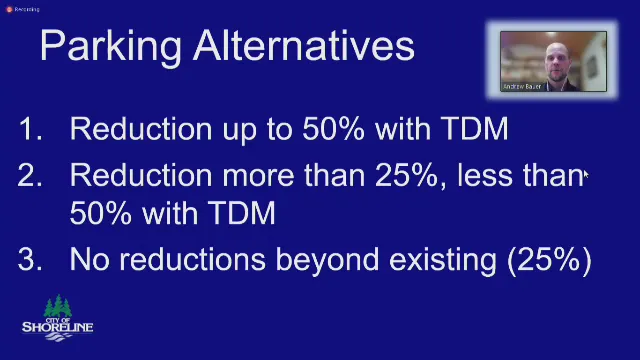
Parking Reductions in MUR70 Zone: Staff presented three alternatives: (1) allow up to 50% parking reduction for projects with ≥100 units or ≥10,000 sq ft commercial, with a Transportation Demand Management (TDM) plan approved by the director; (2) allow a reduction between 25% and 50% with similar conditions; (3) take no action. Commissioner Malik initially expressed concern about underparking but later shifted, noting the trend toward lower parking and citing examples from Capitol Hill and the Emerald Building. Commissioner Callahan suggested exploring a 65–75% reduction if car-sharing is provided. Commissioner Lynn asked about updating TDM strategies administratively. Staff clarified the TDM plan is project-specific and the strategy list would be maintained outside the code. The commission held an informal poll by showing fingers: all five commissioners (Malik, Galusca, Callahan, Lynn, Chair Sager) indicated support for Alternative 1 (unanimous consensus).
-
Height and Development Agreement Amendments: Staff proposed increasing the base height from 70 feet to 80 feet (but no more than 7 stories), with bonus stories for tree retention (8 stories for 10% retention, 9 stories for 20% retention), a new 100-foot height step without a development agreement (requiring 20% affordable units at 60% AMI plus either 10,000 sq ft commercial or 30% ground floor neighborhood amenities), and a 140-foot maximum with a revised development agreement. Three alternatives were presented: (1) as described; (2) increase base to 80 feet, allow 10+ stories with development agreement; (3) increase base to 80 feet, require development agreement for any height above base. Commissioner Malik argued strongly for eliminating the development agreement entirely, stating it adds time and cost (24 cents of every development dollar goes to soft costs). Commissioner Galusca questioned the likelihood of high-rise (concrete/steel) construction in Shoreline and suggested specifying "retail" instead of "commercial" and being more specific about affordability by unit size. Commissioner Lynn proposed a fourth alternative: base height to 80 feet and up to 140 feet without a development agreement, using a flexible mechanism similar to TDM to secure public benefits. Chair Sager supported exploring a no-development-agreement option. The commission agreed to gather more information: visuals of building heights, comparisons with other cities regarding development agreement requirements, and feedback from a developer stakeholder group.
Key Outcomes
- Parking: Unanimous consensus (5-0) to move forward with Alternative 1: allow up to 50% parking reduction for qualifying projects with a TDM plan. Staff will refine amendments based on this direction.
- Height/Development Agreement: No formal vote. The commission directed staff to:
- Provide visual aids comparing building heights.
- Research maximum heights and development agreement requirements in comparable cities (e.g., Lynnwood, Seattle).
- Engage with the developer stakeholder group to explore the attractiveness of a no-development-agreement path to higher heights.
- Consider a fourth alternative: base height to 80 feet, with heights up to 140 feet achievable without a development agreement (subject to meeting specified requirements).
- Next Steps: Staff will present updated proposals and engagement results at a future meeting, tentatively the February 3rd meeting, which also includes a public hearing on development code batch amendments and a presentation on the 2022 Comprehensive Plan docket.
Meeting Transcript
Good evening. I'd like to call to order the Thursday, January 20th, 2022 Planning Commission meeting. First item on our agenda is roll call. Could you do that for us, Ms. Hokchma? Yes, Commissioner Callahan. Here. Commissioner Galusca. Present. Commissioner Lynn. Here. Thank you. Chair Sager. Here. Commissioner Malik. I don't see him at the moment. And Vice Chair Wama Shonja is absent with notice. Okay, thank you. Next item on the agenda is approval of the minute. I'm sorry, approval of the agenda. Are there any changes to the agenda? Seeing none, next item is approval of minutes from January 6th. Does anybody have any changes? All right. Next item is general public comment. Do we have anybody signed up for general public comment? I do. I have a uh where did it go? Sorry. I just need to find the attendees. Hold on. There you go. I have one that wanted to speak during general public comic. That's Rebecca Jones. Ms. Jones, you are unmuted. Thank you. Good evening. I'm Rebecca Jones, previous resident of Shoreline of 16 years. I'm speaking to provide some information for context of a detailed tree code revision requests. Number one, your role in revising the tree codes is vital and significant. It in fact is critical to ensure the codes the city defers to are made with consideration of tree benefits and the current realities of our environmental crisis. Number two, the Pacific Northwest is part of a carbon sink and shoreline significant tree codes contribute. Carbon sinks are areas with trees that take in more carbon than they release. The trees that do a great job at this are the significant trees that can be found in shoreline. Number three, mature and significant trees or carbon sequestering powerhouses. Large established trees sequester 70% of the carbon they are able to in the last half of their natural life. Conservatively, they can live 100 years or more, working smarter and harder at the older they are. That's why keeping these established large trees is so important. Trees are not a one-to-one replacement.
openpublica.com