Shoreline Planning Commission Meeting - August 18, 2022: Climate Action Plan Briefing and Transportation Element Update
STREAMING COPY IN PREPARATION — RECORDING AVAILABLE FROM THE ORIGINAL SOURCE
Shoreline Planning Commission Meeting - August 18, 2022
The meeting was called to order at 15:00. All commissioners except Commissioner Brinson were present. The agenda and minutes from July 7, July 21, and August 4, 2022 were approved unanimously without amendment. No public comments were made.
Consent Calendar
- Approval of the agenda and the amendments from the July 7, July 21, and August 4 meetings were approved by voice vote without dissent or changes.
Public Comments & Testimony
- No members of the public signed up to speak or were present for general public comment.
Study Item: Climate Action Plan Update
Cameron Reed, Environmental Services Program Manager, presented a briefing on the Climate Action Plan (CAP) update. Key points included:
- Near-term climate impacts for Shoreline: hotter temperatures, extreme heat, wildfire smoke, and flooding.
- A Climate Impacts and Resiliency Study (2020) identified vulnerable areas including stormwater systems, ecosystems, heat-related illness, and air quality.
- The city’s updated science-based targets require a 60% community-wide emissions reduction by 2030 (from 2019 levels) and net zero by 2050, aligning with the Paris Agreement.
- Emissions are primarily from transportation (gasoline/diesel) and buildings (natural gas). Emissions have decreased 5% since 2009 despite population growth, but current trends are insufficient to meet targets.
- The CAP will focus on three main pathways: electrification of buildings, reducing per capita driving, and electric vehicle adoption.
- Strategies relevant to land use and development code include increasing density and walkability, enhancing EV-ready ordinances, tree retention and replacement, and requiring climate resilience practices in new development.
Commissioner discussion included:
- Commissioner Lin expressed strong support for the walkability focus.
- Commissioner Galluska raised a concern about balancing tree retention goals with the need for urban density, noting that new development often conflicts with tree preservation.
- Commissioner Callahan praised the integration of climate goals and later asked about red light/speed enforcement cameras as a safety strategy, not just a funding tool.
- Commissioner Mosier questioned the magnitude of the required reductions, noting that the 60% target must offset projected population growth. Staff confirmed the difficulty but highlighted that existing state/federal policies and Seattle City Light’s carbon-free grid provide a viable path.
Staff responded that tree retention strategies will also include education and resources for private property owners, and that the tension between density and tree canopy will be addressed through parks and open space restoration.
Study Item: Preliminary Draft Transportation Element Update
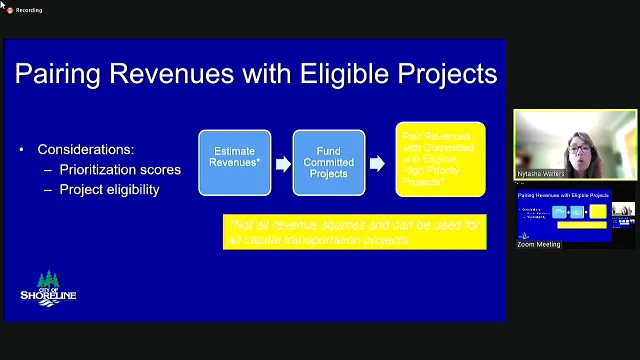
Natasha Walters presented the draft Transportation Element (TE) update. Key elements included:
- A project timeline aiming for adoption by end of 2022, with the transportation master plan finalization in early 2023.
- New policies emphasizing climate resiliency, community vibrancy, equity, safety (Vision Zero), and shared-use mobility hubs.
- A prioritization process: 175 projects were identified from modal gaps, scored using criteria including climate resiliency, multimodal connectivity, and built environment metrics.
- A financially constrained list is being developed: estimated revenue from REET, grants, transportation benefit district sales tax, and transportation impact fees totals about $130 million in committed projects, leaving $90 million for new high-priority projects over 20 years.
- Next steps include public hearing on September 15, 2022, and council adoption by end of 2022.
Commissioner comments:
- Commissioner Callahan reiterated support for the TE’s climate focus and asked about red light/speed cameras as a safety measure. Staff noted the cameras are not a major revenue source but could be explored further for safety benefits.
- Commissioner Galluska observed that pedestrian and bike improvements are often tied to major arterials, but in his neighborhood, people walk on quieter parallel streets. He suggested considering improvements on lower-volume roads rather than solely on arterials. Staff explained that the prioritization focuses on connecting destinations and building a basic network with limited funds, and that lower-volume streets are already safe for walking.
Staff (Kendra Breland) added that the sidewalk prioritization process (2018) used a citizen advisory committee to identify urgent needs, focusing on streets without any facilities.
Key Outcomes
- The Planning Commission provided feedback on both the Climate Action Plan strategies and the Transportation Element draft. No formal votes were taken.
- Staff will consider the feedback as they refine the CAP (draft release in September) and finalize the TE’s financially constrained project list.
- The next meeting (September 1, 2022) will discuss the 2022 Comprehensive Plan docket amendments, which include the Transportation Element.
Meeting Transcript
Recording in progress. Good evening. I'd like to call to order the August 18th, 2022 Planning Commission meeting. First item on the agenda is roll call. Commissioner Brinson is not here at the moment. Commissioner Callahan. Present. Commissioner Galluska. Present. Commissioner Lin. Here. Commissioner Mosier? Here. Vice Chair Wamishon Jay. Present. And Chair Sager. Here. Thank you. All right. Thank you. Next item is approval of the agenda. Is everybody approve? Any changes? Seeing none. Next on the agenda is approval of the amendments from three meetings, July 7th, July 21st, and August 4th. Do we have any amendments to anything? Great. All right. Next item is general public comment. Ms. Hoxma, do we have anybody signed up for general public comment? I do not have any signed up or that have indicated that they want to speak. Great. Thank you. All right, that brings us to our first study item, which is the briefing on the climate action plan update. Okay. Good evening, commissioners. My name is Cameron Reed. I'm the environmental services program manager. And just sharing my screen here. Can you all see that okay? Yes. Okay. Great. So I'm here to provide a briefing on the climate action plan update and to get some high level feedback on some of the proposed strategies in the climate action plan relating to land use and the development code in advance of presenting the draft climate action plan to council in October. So first off, just wanted to highlight uh some of the near-term impacts of climate change in shoreline and the Puget Sound region. So these are things that we are already experiencing and that are projected to worsen in the coming decades. For shoreline, some of the primary near-term impacts include hotter temperatures and more frequent extreme heat events, air quality impacts from more frequent wildfire smoke, and increased risk of flooding from higher intensity short duration precipitation events, uh primarily in the winter months. Also want to highlight uh that we completed a climate impacts and resiliency study in 2020 to identify key areas of vulnerability for uh city infrastructure and the shoreline community. Some of those key areas with particularly high vulnerability were the stormwater system, sensitive ecosystems, heat-related illnesses, buildings and development, and air quality.
openpublica.com