Planning Commission Regular Meeting - October 20, 2022: TDR and LCLIP Program Discussion
STREAMING COPY IN PREPARATION — RECORDING AVAILABLE FROM THE ORIGINAL SOURCE
Planning Commission Regular Meeting - October 20, 2022
The Shoreline Planning Commission held a regular meeting on October 20, 2022, primarily to discuss the Transfer of Development Rights (TDR) program and the Landscape Conservation and Local Infrastructure Program (LCLIP). Staff and a consultant presented an overview, followed by commissioner questions and discussion. The meeting also included reports from a recent conference and updates on local development projects.
Consent Calendar
- The agenda was approved without amendment.
- Minutes from the October 6, 2022 meeting were approved as presented.
Public Comments & Testimony
- No members of the public signed up for general comment.
Discussion Items
-
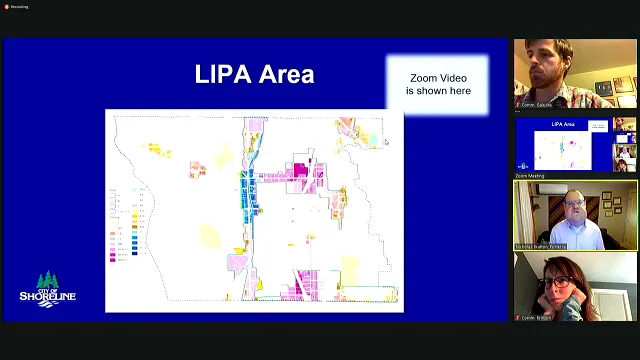
TDR and LCLIP Program Implementation – Steve Zafron (City Staff) and Nick Bratton (Senior Director of Policy at Fortera) presented an overview of the TDR program and LCLIP, a state program that allows cities to capture a portion of future property tax revenue from new construction to fund public improvements, in exchange for conserving rural land through TDR. Shoreline received a grant in 2014 and updated the feasibility study in 2020. The city would aim to place 231 TDR credits (reflecting its share of regional growth targets) and could generate an estimated $19-25 million in nominal revenue over 25 years. Possible incentives to encourage developers to purchase TDR credits include added building height, parking reductions, fee reductions, multifamily tax exemption (MFTE), tree removal incentives, and expedited permit review.
-
Commission Discussion: Commissioners raised several concerns:
- Vice Chair Wamishon Jay asked for a clearer projection of revenue flow over time and the trade-off between incentives and net revenue, noting that bonding against future revenue carries risk.
- Commissioner Callahan expressed concern about incentives potentially conflicting with other city goals (e.g., affordable housing) and requested a systematic table showing current allowances, required incentives, and proposed changes.
- Commissioner Brinson asked for concrete examples of how many square feet of bonus space or parking reductions a TDR credit would buy, and whether incentives would be calibrated to current market conditions.
- Commissioner Galusca questioned whether MFTE (which exempts property taxes for 12–20 years) would undermine the tax increment financing mechanism of LCLIP. Bratton responded that even with MFTE, the program is net revenue positive, but the explanation was acknowledged as complex.
- Commissioner Mosier raised concerns about MFTE durations already being requested by developers and whether adding TDR incentives would further complicate the code. She also questioned whether a contiguous upzone along 145th could maximize program potential, but staff said no rezoning is part of this program.
- Commissioner Brinson added that MFTE is already an incentive for affordable housing, and layering TDR on top could feel like "double dipping." He urged careful thought about combining incentives.
- Commissioner Galusca noted that TDR imposes an additional cost on development, and the city should first evaluate all existing incentives (green building, affordable housing, parking) to avoid conflicts before adding new ones.
- Vice Chair Wamishon Jay asked if code could be written to prevent unintended consequences (e.g., foreign ownership of conserved land, or development not meeting community needs). Staff confirmed that the TDR code can be tailored to specific zones and conditions.
- Ultimately, commissioners expressed general support for moving forward with drafting code amendments, but requested a comprehensive table of current zone regulations and existing incentives before finalizing the options.
-
Commissioner Brinson also suggested considering ground floor commercial/restaurant-ready space as an additional incentive, and whether short plats or long plats could generate TDR credits.
Key Outcomes
- Direction to Staff: Prepare a detailed table showing existing zone regulations, current incentives, and potential TDR incentives to help commissioners evaluate trade-offs.
- Next Steps: Staff will bring back a revised scope of code amendments for further discussion. The commission generally supported moving forward, contingent on having a clearer picture of how incentives interact.
- Other Updates:
- The Fircrest Master Development Permit (including behavioral health and nursing facilities) is working through intake.
- A new mixed-use building application (228 units) was received for 15th Avenue NE (near 177th St), the first under new ground-floor commercial rules.
- The MUR70 amendments (recommended by the commission) were adopted by Council on September 12, 2022, with minor changes.
- Outdoor seating regulations were also adopted on September 12, unchanged from the commission's recommendation.
- Conference Reports: Vice Chair Wamishon Jay and Commissioner Mosier shared insights from a planning conference, including lessons on middle housing and climate change communication (e.g., avoiding the term "climate change" in some communities).
- Next Meeting: The November 17, 2022 meeting was cancelled due to lack of items; December 1 will feature a presentation on the comprehensive plan update scope, and December 15 will include a cottage housing code update.
Meeting Transcript
October 20th, 2022, Planning Commission regular meeting. First item is roll call. Ms. Hoaxma, please. Commissioner Brinson. Here. Commissioner Callahan. Here. Commissioner Galusca. Present. Commissioner Mosier? Yeah. Vice Chair Wamishon Jay. Present. Chair Sager. Here. And Commissioner Lynn. Okay, thank you. Thank you. Next item is approval of the agenda. Does anybody wish to amend the agenda? All right. Approval of the minutes from uh the October 20th, I'm sorry, October 6th meeting. Anybody have any changes to those? Great. Next item then is general public comment. Ms. Hoaxman, do we have anybody signed up for general public comment? I do not have anyone signed up. Thank you. Great. Thank you. That brings us to our study item. A long title. Transfer of development rights program and landscape conservation and local infrastructure program implementation discussion. That's it. Yeah. Easy. Thank you. Yeah, we are here to inform the commission of TDR and L Clip for short as we begin working on development code amendments to implement a TDR program, which council has directed staff to look at and go through the planning commission for comment and consideration of those batch of uh development code amendments. So I'll do a quick introduction and background of how we've gotten to this point so far, and then hopefully our consultant for Terra will join us and run the commission through kind of the what TDRs are and the background of L Cliff and how that can potentially work in the City of Shoreline. And then we have a couple questions for commission after we we discuss and asking any clarifying questions and then kind of going to the next steps. So the city looking back in incorporation, we've always had a land use policy to support TDRs in the in the city. So we've had this policy since the first call plan in 1998 up and through today. So based on that uh direction from the comprehensive plan, Shoreline applied for and received about a 42,000 dollar grant from commerce in 2014 to study TDRs and if L Clip would work within uh the city of Shoreline. Umterra and uh Eco Northwest uh conducted the study, those uh findings were presented to the city council in 2015, which um kind of outlined an implementation strategy and um revenue projections if we did do this um project in 2019. Um since the study was kind of sitting there dormant for four or five years, um the council revisited the study, um gave some money to the consultant to update um in light of changing conditions, mainly the light rail station sub-areas came into effect, and then um so the um financial um uh portions of the plan were were um studied again to see if it was uh reasonable to continue with the um pursuing L CLIP and um again a study was updated in 2020 um and based on that updated study council did direct staff to create a T TDR program to um implement the L Clip program is our oh great so this is the point where I turn it over to Nicholas Bradden from Fortera who will go into much more detail than I can about the program. Thanks, Steve. Thanks for that great overview. That's really helpful context, great background.
openpublica.com