Shoreline Planning Commission Meeting: Comp Plan Engagement and Cottage Housing, December 1, 2022
STREAMING COPY IN PREPARATION — RECORDING AVAILABLE FROM THE ORIGINAL SOURCE
Shoreline Planning Commission Meeting - December 1, 2022
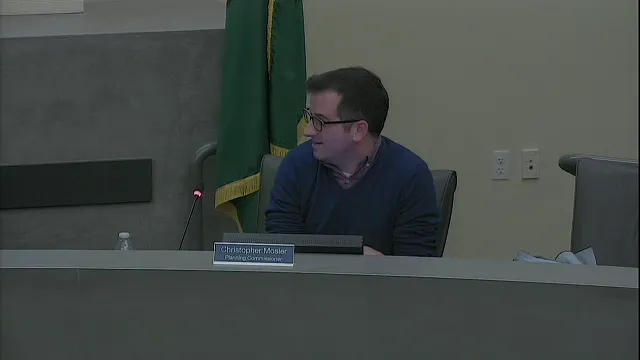
The Shoreline Planning Commission met on Thursday, December 1, 2022, with Chair Sager presiding. All members were present: Vice Chair Wamishon Jay and Commissioners Brunson, Callahan, Galuska, Lynn, and Mosier. The commission approved its agenda and the October 20, 2022 minutes, received no public comment, held study sessions on the 2024 Comprehensive Plan update engagement strategy and on cottage housing code amendments, and closed by canceling the December 15, 2022 meeting.
Agenda Approval and Minutes
- The commission approved the meeting agenda as presented.
- The October 20, 2022 meeting minutes were approved without changes.
Public Comments
- No general public comment was offered.
Study Item 6A: 2024 Comprehensive Plan Update - Scope and Community Engagement Plan
City staff and consultants from Stepherson and Associates (Franna Miller and Colleen Toomey) presented the scope of the 2024 Comprehensive Plan update. The plan will extend the city's 20-year vision through 2044, implement Growth Management Act requirements, and align with Puget Sound Regional Council Vision 2050 and King County countywide planning policies. The City Council passed a resolution in November 2022 approving the update's key themes: climate, equity and social justice, and housing.
- Other scope topics include vision and framework goals, middle housing, planning for 10,000 new jobs by 2044, four candidate countywide centers (148th Street, 185th Street, Shoreline Place, and the Aurora corridor town center), utilities, livability, and development regulation consistency.
- The city hired an engagement consultant before the technical consultants to emphasize equity-centered engagement. The proposed approach includes a community liaison coordination plan, translation support through Avent Page, virtual and in-person outreach, and phased work: visioning in early 2023, topic-specific engagement and concept prioritization in fall 2023, and draft plan and public hearings in spring 2024.
- Middle housing engagement will be emphasized in early 2023 because federal grant funding supporting that work runs through June 2023.
Commissioners offered feedback on audiences, barriers, and engagement methods:
- They emphasized reaching residents whose voices are not typically heard: renters, workers, future residents, youth, east-of-I-5 residents, faith communities, people with limited time, and people not already involved in city planning.
- Barriers identified included lack of time, limited broadband and technology access, language, formal meeting culture, and the tendency for vocal groups to dominate meetings.
- Several commissioners supported compensating community organizations and residents for participation, and using community liaisons rather than requiring residents to come to city-led meetings.
- Commissioners asked for clear outcomes, forced-priority questions, and more specific climate-related engagement questions rather than general support for climate goals.
- One commissioner cautioned that decisions about the proposed centers must be examined through an equity lens, including how census tracts and resources are distributed, to avoid making communities feel excluded.
Study Item 6B: Cottage Housing Development Code Amendments
City planner Alice Kime presented an existing conditions report, summer 2022 public outreach results, and initial code questions for cottage housing. Cottage housing is currently not a legal use in Shoreline; the 2021 Housing Action Plan and a Department of Commerce grant are driving the code update.
Key data included:
- Shoreline's population is just over 60,000; the fastest-growing cohorts are adults 25-34 and 65-74.
- 61% of households have one or two people, and 45% of single-person households are age 65 or older.
- 67% of the housing stock is detached single-family homes, while 80% of residential developable land is zoned R4 or R6.
- Home values rose 84% since 2015, while wages rose about 29% over the same period.
- Public outreach included 325 online survey responses; 72% of respondents were interested in living in cottages.
- Outreach themes included protecting trees, especially large conifers; interest in single-level and accessible living; sustainable design; clarified affordability expectations; front porches; privacy; and varied opinions on parking.
On code topics, the commission gave initial guidance:
- Location: Commissioners generally preferred allowing cottages in low- to medium-density residential zones (R4 through R12) rather than high-density zones, and considered incentives for walkable locations near amenities and transit.
- Density and unit count: Commissioners agreed densities above base zone density are likely needed for financial feasibility. They were skeptical of hard minimums and maximums, suggesting lot size and density should govern, though a minimum around four units was mentioned.
- Minimum lot size: Commissioners leaned toward using the underlying zone's minimum lot size rather than creating a separate cottage standard, and supported exploring unit-lot subdivisions so cottage units can be owned fee-simple.
- Unit size and height: Commissioners supported maximum unit sizes and/or building footprints, with flexibility for single-story units, a required mix of single-story and accessible units, and a dedicated cottage height limit around 20-25 feet rather than matching abutting properties.
- Setbacks and development standards: Commissioners generally opposed the current 15-foot setback for developments with three or more units abutting R4/R6 lots, because it can compress the common open space that defines cottage housing. They favored underlying zone standards or flexible/averaged setbacks, and asked that cottages not be treated more strictly than conventional single-family homes.
- Trees: There was strong support for incentives to retain large conifers and significant tree stands, with flexibility in siting and counting preserved tree groves as common open space. One commissioner warned that the code definition of "significant tree" might allow developers to retain smaller trees while removing larger landmark trees, so incentives should target larger trees.
- Parking: Commissioners generally favored parking ratios based on unit size, with lower overall parking levels rather than two stalls per unit. They supported reductions near transit and amenities and for tree preservation. Several did not support counting on-street parking as guest parking, and most opposed requiring dedicated guest parking.
- Landscaping: The commission supported a light-touch approach, with a perimeter buffer and some common open space, but wanted flexibility so cottage residents can decide how shared outdoor space is programmed and maintained.
- Design standards: Commissioners did not favor heavy design mandates. Practical concerns such as communal solid waste storage and front porch/stoop spaces were discussed. Internal architectural consistency was seen as more important than matching surrounding neighborhoods.
- Process: Commissioners generally favored treating cottage developments like detached single-family homes in standard building, site, utility, and right-of-way permit reviews, without special neighbor-notice thresholds.
Key Outcomes
- The commission approved the agenda and the October 20, 2022 minutes.
- The commission provided staff and consultants with input on both the Comprehensive Plan engagement plan and cottage housing code direction.
- Staff expects to return with revised cottage housing regulations in early February 2023.
- The commission canceled the December 15, 2022 meeting by consensus.
- The next meeting is set for January 5, 2023, with a presentation by Kathleen Hosfeld of Homestead on community land trusts.
Next Meeting and Adjournment
- With no unfinished business or new business remaining, the meeting was adjourned.
Meeting Transcript
Good evening. Recording in progress. Good evening. I'd like to call to order the Thursday, December 1st, 2022 Planning Commission meeting. First item is roll call, Ms. Hoxma. Commissioner Brunson. Here. Commissioner Callahan. Here. Commissioner Galuska. Present. Commissioner Lynn. Here. Commissioner Mosier. Yeah. Vice Chair Wamishon Jay. Present. Chair Sager. Here. Thank you. Thank you. Next item, approval of the agenda. Does anybody wish to make any changes to the agenda? Great. Approval of minutes from October 20th. Does anybody have any changes to those? Okay. At this time it we are up to general public comment. Ms. Hoxma, is there anybody signed up for general public comment tonight? I had a request for public comment, but I don't have anybody in the attendees. And I think that she emailed me later and took care of it. So I think, and it wasn't regarding tonight's meeting. So no no public comment that we have at the moment. Oh wait, hold on. Somebody just added. Nope, that's not the same person. So thank you. Okay. Thank you. That brings us to tonight's study items. 6A, we will start with the scope of work and discussion of community engagement plan for the 2024 comprehensive plan update. We have three presenters tonight. Excellent. All right, thank you. So we'll be talking tonight, um, getting the planning commission up to speed on the scope of work and then also soliciting your input on the community engagement plan for the 2024 comprehensive plan update. Um so I have with me tonight um two representatives from the city's consultant team, Stepherson and so and associates. Um they'll introduce themselves here at the tail end, but it's Franna Miller. Milan, I'm sorry, um, and then uh Colleen to me.
openpublica.com