Shoreline Planning Commission Meeting - February 2, 2023
STREAMING COPY IN PREPARATION — RECORDING AVAILABLE FROM THE ORIGINAL SOURCE
Shoreline Planning Commission Meeting - February 2, 2023
The Shoreline Planning Commission met on February 2, 2023, at 3:00 PM UTC to discuss two major study items: an overview of the middle housing work plan and a detailed review of proposed cottage housing development code amendments. The meeting included public comment, staff presentations, and commissioner discussion on density, tree preservation, parking, and site design.
Public Comments & Testimony
- Suzanne Soming, a Shoreline resident and property owner, spoke in support of a proposed development code amendment to incorporate cottage-specific tree preservation language. She stated that Shoreline is approximately 80% residentially zoned (based on the 2021 zoning map) and that reintroducing cottage housing will lead to more removal of established trees. She urged the commission to study the proposed cottage-specific tree code to minimize tree canopy loss.
Discussion Items
- Middle Housing Work Plan Overview: Staff presented a comprehensive overview of the middle housing study, funded by a Washington State Department of Commerce grant. The work plan includes a demographic and policy analysis, a racial equity analysis (required by the Growth Management Act), and community engagement through compensated participation from community-based organizations. The work is scheduled to be completed by June 2023. Commissioners discussed the need to engage landlords, the potential impact of pending state bills, and the importance of framing middle housing benefits beyond density—such as property tax implications, support for neighborhood businesses, and sidewalk improvements. The commission expressed interest in a presentation from the Department of Commerce on racial equity analysis.
- Cottage Housing Development Code Amendments: Staff presented a draft code for cottage housing, which is a priority from the Housing Action Plan. Key discussion points included:
- Location: The commission opposed exploring cottages in the MUR-35 zone, citing that it would disrupt the intended transition between higher and lower density zones.
- Density: The draft code allows double the underlying zone density (e.g., 12 units/acre in R6) without requiring additional bonuses. Commissioners discussed potential density bonuses for affordable housing or community land trusts but leaned toward keeping the code simple and exploring such incentives separately.
- Development Size: The proposed maximum of 24 units was debated; commissioners preferred not to over-restrict but suggested clustering could be encouraged for larger developments.
- Tree Preservation: The commission generally opposed a separate cottage-specific tree code, favoring the existing tree code (25% retention of significant trees) with added incentives for preserving large trees (e.g., counting drip lines as open space). They supported the incentive approach.
- Parking: The commission opposed requiring garages, preferring to let the market decide the form of parking (surface, garage, or carport). They noted that garages can complicate HOA issues and that storage for bikes or strollers could be a better use of space.
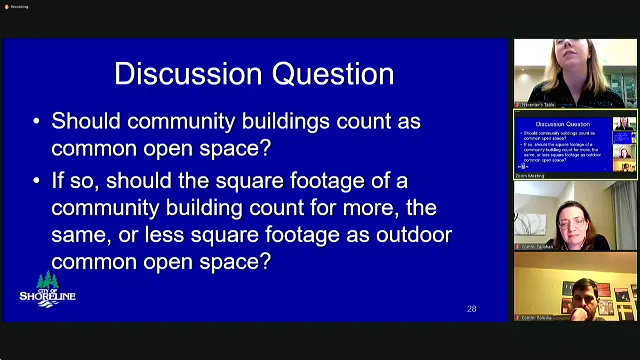
- Open Space: The commission agreed that community buildings should not count as open space, though covered bike storage could be considered. They also discussed the need for porches to face common open space and the street to foster community interaction.
- Infill Development: The commission was hesitant to allow cottages on lots with existing homes, suggesting that such infill might be better addressed through accessory dwelling unit or middle housing policies rather than the cottage code.
Key Outcomes
- Direction on MUR-35: Staff will not explore cottages in the MUR-35 zone.
- Tree Preservation: Staff will develop incentive-based tree retention measures for cottages, not a separate tree code.
- Parking: The code will allow flexible parking design (no mandatory garages).
- Unit Lot Subdivisions: Staff will explore allowing unit lot subdivisions for cottages, which could facilitate community land trust ownership and easier financing, but this will be addressed under subdivision code updates.
- Infill: The commission directed staff to focus on redevelopment scenarios rather than infill on existing lots for now.
- Next Steps: The draft code will be revised based on commission feedback and brought back for discussion at the March 2, 2023 meeting. Staff will also prepare illustrative graphics to help visualize concepts.
- Future Meetings: The commission will hold a joint dinner meeting with city council on May 8, 2023, and will continue work on the comprehensive plan update, with public engagement launching mid-March.
Meeting Transcript
Recording in progress. I would like to call to order the meeting of the planning commission meeting of February 2nd, 2003. Ms. Hoxmer, could you please assist with raw roll call? Thank you. Commissioner Brinson? Here. Commissioner Callahan. Here. Commissioner Mosier. Here. Vice Chair Wama Shonjay. Present. Thank you. Commissioner Lin and Commission and Chair Sager are absent with notice. January 5th, 2003. Can you turn on your mic, please? Thank you. So any changes to the draft meeting for January 5th, 2003. Okay. Um Ms. Hoxman, any general public comment. Yes, right now I will um uh call on Suzanne Soming. Suzanne, you are um unmuted. Good evening. Um Suzanne Soaming. I'm a shoreline resident and property owner, and my statement is about agenda item 6b of tonight's agenda. I'm a member of the tree preservation code team, which submitted the proposed development code amendment regarding cottage housing, the goal design as shown on attachment C of the city staff study. Its purpose is to direct an owner slash builder to design cottages on lots around any established trees that remain after permitted tree removals. On page five of the city staff study, it poses the question should staff study the proposed cottage specific tree code recommended by TPCT. My answer is yes, because shoreline's tree canopy will be affected. Simply looking at Shoreline's 2021 zoning map, it shows that shoreline, originally a suburb of Seattle, is approximately 80% residentially zoned. The reintroduction of cottage housing, a type of middle housing, will incur more removal of established trees in our single family residential areas. By stating the design goal of cottage housing in the SMC Shoreline municipal code, it will guide planning and placement of cottage housing on suitable building lots to minimize and control the loss of our urban tree canopy. Thank you for considering this proposed development code amendment. Thank you. Anyone else? anybody else? I did have another person um email that they wanted to speak tonight. They're not there yet, and I I wonder if they're gonna speak uh were uh planning to speak after the um agenda item. I also have two others in attendance, so um I would like to have know if if either of them want to speak, if they would raise their hand. So with your permission, um, or maybe you can check back and see if uh Miss Russell is in attendance after your presentation for yeah, would that be okay? Okay, thank you. That's all for right now. Okay, then we'll proceed with um the study items. All right, can proceed. Good evening, commissioners. Here to talk on this agenda item about middle housing. As part of the city's 2024 comprehensive plan, City Council has directed planning staff to evaluate policy and code amendments to allow middle housing in low density residential zones. I'll be presenting an overview of the middle housing work plan tonight.
openpublica.com