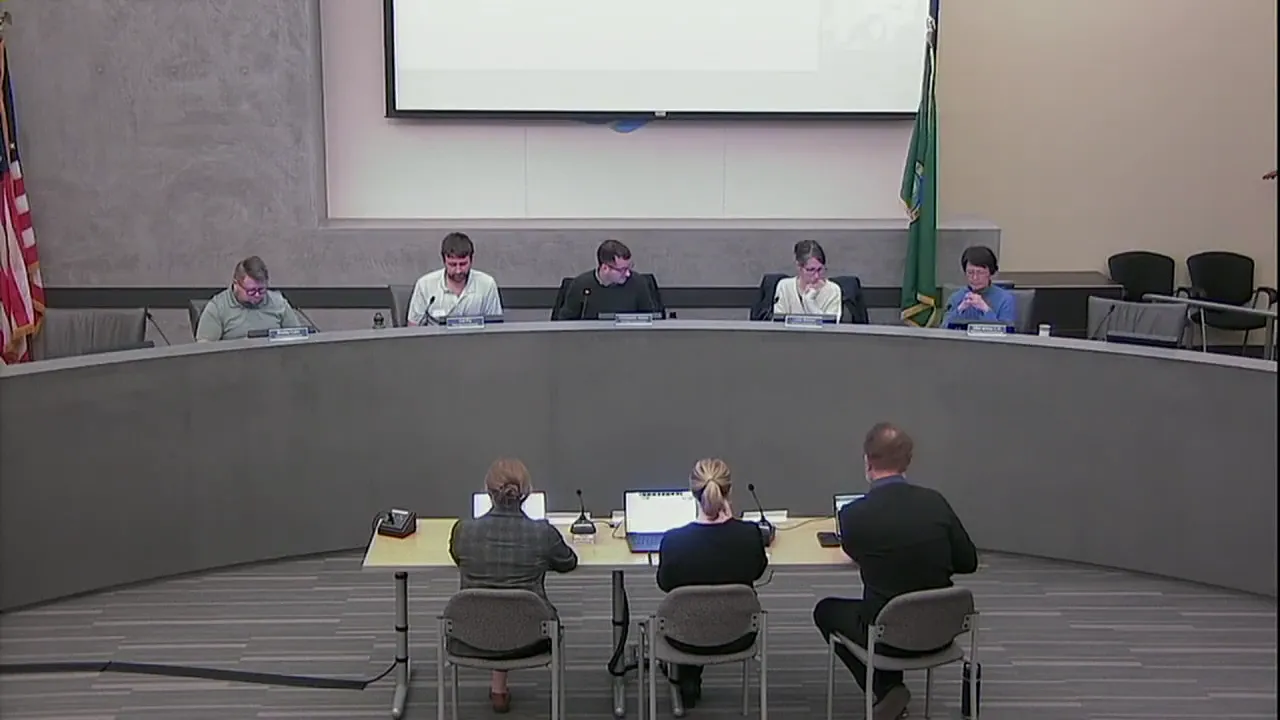
Shoreline Planning Commission Regular Meeting - November 7, 2024
STREAMING COPY IN PREPARATION — RECORDING AVAILABLE FROM THE ORIGINAL SOURCE
Shoreline Planning Commission Regular Meeting - November 7, 2024
This regular meeting of the Shoreline Planning Commission focused on the first public hearing for the 2024 Comprehensive Plan update, specifically the draft Development Code Amendments. The meeting included approval of previous minutes, a staff presentation, commissioner questions, and oral and written public testimony. No formal recommendation was made; the commission will hold a second hearing and vote on November 21, 2024.
Consent Calendar
- Approval of the agenda as presented.
- Approval of the October 24, 2024, regular meeting minutes as presented.
Public Comments & Testimony
- Kim File (Shoreline) asked how a 1952 R1 restriction in her Sky Acres neighborhood could be invalidated without involving residents, and why the area is proposed as NR2 rather than NR3. Planning Manager Keim agreed to follow up.
- David Stygstra (Shoreline) thanked staff and proposed three changes: retain existing height limits in NR2 and NR3 zones (currently 30/35 ft, proposed 23/30 ft) to encourage building up rather than out; allow expansion of existing buildings for neighborhood commercial in all zones; and allow on-street parking to count toward required parking for neighborhood commercial.
- Kathleen Russell (Shoreline, Save Shoreline Trees) noted that residents’ top climate priority is preserving the tree canopy. She urged extending the existing middle housing tree code (35% retention of non-exempt trees) to all middle housing areas until an updated tree code is implemented in 2026–2027.
- Jill Chapman (Shoreline) requested that the Sky Acres neighborhood retain low-density zoning (R6 → NR3) rather than the proposed NR2, citing significant conifers and wildlife. She questioned the half-mile transit proximity justification.
- Written testimony was submitted by Lewis Brown, Allison Luzader, Marc Mignogna, Boni Biery, Jill Chapman, Anonymous, Kathryn Chapman, Kim File, and Kathleen Russell.
Discussion Items
- ADU Amendments: Senior Planner Steve Szafran clarified that ADUs will not count toward unit lot maximums in NR zones, consistent with HB 1337.
- Permit Streamlining: Senior Planner Sierra Carson reviewed amendments to the project review act, including new permit review timelines (65–170 days based on complexity) and measures to avoid penalties. Proposed removing city council approval for formal subdivisions and zoning map amendments consistent with the comprehensive plan.
- Parking, Supportive & Emergency Housing: Planning Manager Elise Keim reviewed state-required changes: allowing grass block pavers, prioritizing tree preservation over parking, allowing emergency housing/shelters in commercial zones, and allowing transitional/permanent supportive housing in residential zones.
- Middle Housing: Keim presented the history since 2021, state requirements (at least 2 units/lot citywide, 4 near transit or with affordability), and responses to prior commission questions:
- Eaves discounting: Staff proposed excluding eaves up to 18 inches from hardscape and allowing them to project into setbacks.
- Affordability rates: Staff recommended staying with state-defined levels (four-sale and four-rent units) rather than lowering them, pending an affordable housing study starting in 2025.
- Neighborhood commercial location: Staff revised to allow any street classification except dead-end or cul-de-sac streets, per commission direction.
- Draft Zoning Map: Consolidation of seven residential zones into three (NR1, NR2, NR3) based on density and transit proximity. Staff noted minor corrections still in progress.
Commissioner comments included:
- Commissioner povick asked about Shoreline’s minimum wage ($16/hour) and its relation to affordability; Planning Manager Keim noted affordability rates are within the commission’s purview but the minimum wage would inform context.
- Vice Chair Brinson emphasized that funding sources are critical for deeper affordability, not just land-use requirements.
- Chair Mosier requested wording to exclude the first 18 inches of eaves or overhang from hardscape calculations, noting that a 36x36 inch entry coverage is required.
Key Outcomes
- No formal vote was taken; this was the first of two public hearings.
- Chair Mosier directed staff to adjust the eaves language to exclude the first 18 inches projecting from the wall.
- Staff will continue refining the zoning map and code language based on feedback.
- The next meeting on November 21, 2024 will include a second public hearing on both the Comprehensive Plan and Development Code Amendments, with a recommendation to City Council.
The meeting adjourned at 7:29 p.m.
Meeting Transcript
Good evening. I'd like to call to order the Thursday, November 7th meeting of the Shoreline Planning Commission and public hearing. First would be roll call. Carl Vice Chair Brinson. Present. Commissioner Cape. Present. Commissioner Fry. Present. Commissioner Hadley. Present. Commissioner Lynn. Here. Chair Mosier. Yeah. And Commissioner Povick. Yeah. Thank you. All right. Next is approval of the agenda. Any changes or revisions to the agenda? No one on the screen. Excellent. Next, approval of our meeting, excuse me, approval of our minutes from our meeting on October 24th. Any revisions, comments on that. No. Excellent. All right. Next would be. Could you speak up, please? Please clearly. Do my best to inform my base. Okay. Next would be public comment. This is public comment not related to the public hearing. So not related to agenda item six. Is there any general public comment? We have no one signed up for general public comment. Okay. Excellent. That brings us to our public hearing. Tonight's public hearing is regarding the 2024 comprehensive plan update. Tonight we are looking at the draft to development code regulations. Purposes of this hearing is to obtain public testimony on the topic. This is our first of two meetings. We are not, we are just taking comments tonight and asking questions. We are not recommending anything. Okay. The way it'll go is the staff will present the report and then the commission will ask questions and then we'll give the public an opportunity to testify and give their comments. And everyone will be getting.
openpublica.com