Shoreline Planning Commission Regular Meeting – May 21, 2026: Tree Code Update Briefing
STREAMING COPY IN PREPARATION — RECORDING AVAILABLE FROM THE ORIGINAL SOURCE
Shoreline Planning Commission Regular Meeting – May 21, 2026: Tree Code Update Briefing
The Shoreline Planning Commission held a regular meeting on Thursday, May 21, 2026, beginning at 7:00 p.m. in the Council Chamber at City Hall. Chair Leslie Brinson presided. Commissioners present: Bradley Cabe, Julie Povick, Katie Lorah, Matthew Souza. Vice Chair Christopher Mosier and Commissioner Hadley were absent with notice. Staff in attendance: Andrew Bauer, Hayley Barnett, and Sierra Carson. The meeting focused on a briefing of the ongoing Tree Code Update, including discussions from the Community Advisory Group (CAG), and included public comments on the topic. The meeting was adjourned at 8:33 p.m.
Consent Calendar
- The agenda was accepted as presented.
- The regular meeting draft minutes of April 2, 2026, were accepted as presented.
Public Comments & Testimony
Four members of the public delivered oral comments; five additional written comments were submitted (by Claudia Turner, Kathleen Russell, Jonelle Kemmerling, Boni Biery, and Lance Young).
- Kathleen Russell, Shoreline resident, expressed concern that the proposed tree density credit program may be insufficient to maintain the existing 37.1% tree canopy and achieve the goal of 40% by 2050. She suggested increasing the multipliers to at least 1.0 in MUR-35’, MUR-45’, and MUR-70’ zones and other areas that have lost the greatest percentage of canopy.
- Lance Young, Shoreline resident, emphasized the importance of trees for a livable city, citing research on crime reduction near trees. He distributed and described Kenmore’s exceptional tree removal notice process (including a 21-day public comment period, mailed notices to neighbors, and plot plans) as a model for Shoreline.
- Jonelle Kemmerling, Shoreline resident, expressed strong concern about whether Shoreline can meet its goals to preserve and increase tree canopy while providing a livable city. She noted that the staff report indicates the city is still evaluating whether to require tree retention in MUR-35 and MUR-45 zones, which she called a grievous error that would disproportionately impact disadvantaged neighborhoods. She urged the city to balance housing and tree preservation without placing the burden solely on homeowners.
- Boni Biery, Shoreline resident, recommended that shrubs not be counted as trees for tree density credits, that the city provide a list of banned noxious trees (including birch and Bradford pear), and that existing noxious trees not be counted. She also urged the city to offer guidance on tree species most likely to succeed in a changing climate.
Discussion Items
Tree Code Update Briefing #2
Senior Planner Sierra Carson presented a detailed briefing on the ongoing Tree Code Update, summarizing the work of the Community Advisory Group (CAG) over its first five meetings.
Key topics covered:
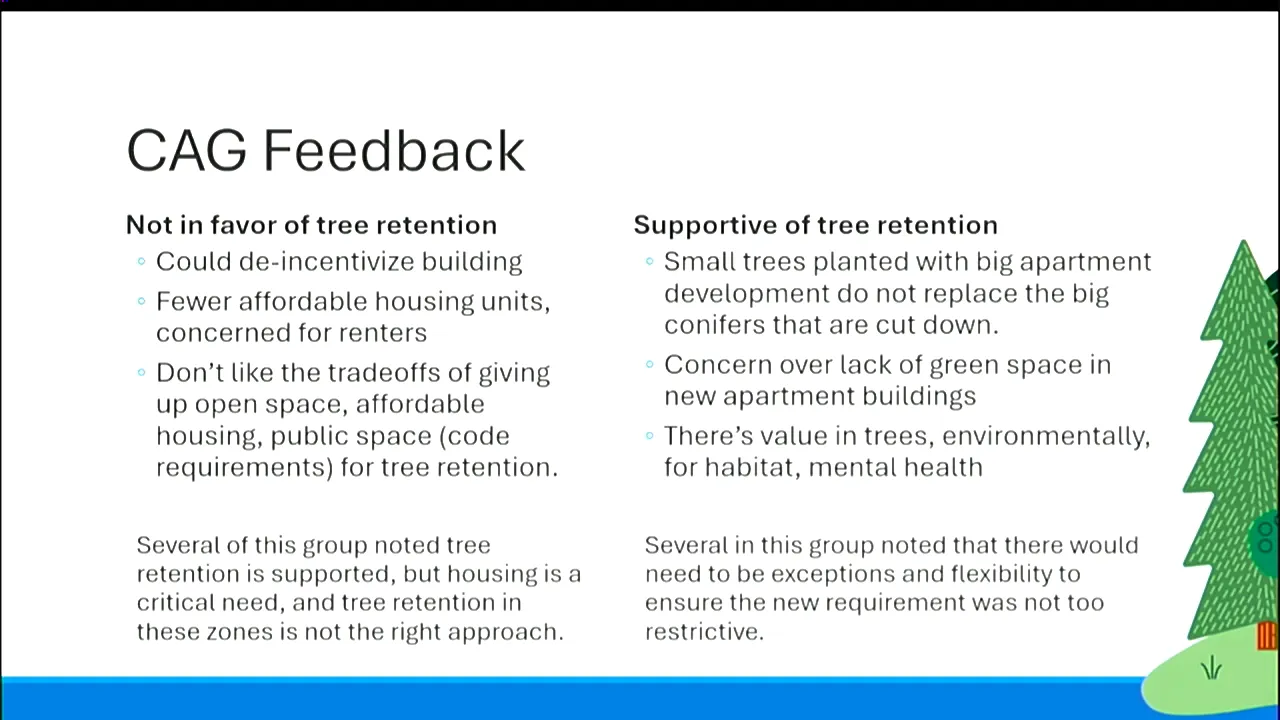
- Community Advisory Group feedback: The CAG supported giving more credit to high-value trees (large, native, groves), scaling requirements by zone, prioritizing retention, and requiring planting.
- Tree regulation landscape: Carson outlined how trees are regulated across city departments: Planning & Community Development (tree code, landscaping, critical areas), Public Works (street trees, right-of-way), Parks (urban forest management), and Stormwater (native vegetation programs). The Tree Code Update focuses on private property tree removal and development.
- Tree density approach: The group chose a tree density method (based on diameter at breast height) because it is objective, scaleable by zone, administratively efficient, and gives more credit to larger, mature trees. The goal is to create a minimum tree density per zone, not a percentage of existing trees.
- Retention-first approach: For Neighborhood Residential (NR) zones (80% of the city), the proposal is to require retention of as many trees as possible, up to a point where development potential is limited. The rule: no retention requirement shall reduce development potential below 90% of the maximum allowed hardscape. Properties with high tree density must retain above the minimum; properties with low density must plant to meet the minimum. Trees are credited based on DBH, with a maximum credit at 24” DBH. Larger trees and groves are prioritized.
- Mixed-use and commercial zones (MUR, station areas): The CAG was split on whether to require retention in these zones. Trade-offs include loss of open/public space, added complexity, and potential reduction in housing units and affordable housing, especially on small infill sites. The CAG will continue discussion at its next meeting.
- Private property tree maintenance: Staff proposes moving from a three-year removal allowance to an annual allowance (number of trees per calendar year) with a permit, but not allowing speculative clearing. Minor development (e.g., decks, small additions) may not trigger the full tree density requirement.
- Next steps: CAG final meeting on June 16, 2026; open house part of City Learn series; draft code presented to Planning Commission on July 16, 2026; summer engagement; public hearing August-October.
Commissioner Discussion/Questions
- Chair Brinson asked about the intersection between Planning and Public Works regulations regarding right-of-way trees and noted that setbacks flexibility was discussed but not currently in the code. She also clarified open space vs. public space definitions.
- Commissioner Povick raised concerns about wildlife impacts from upcoming Public Works projects on Meridian and urged coordination between departments.
- Commissioner Souza asked how the 90% hardscape number was determined (staff cited benchmarks from Bothell (85%) and Kirkland (max FAR)). He inquired about the requirement for an arborist (for any development triggering minimum tree density, before permitting). He also asked about the justification for a 24” DBH credit cap (to encourage planting by not allowing one very large tree to satisfy all credits).
- Commissioner Lorah asked about the negotiation process between applicant and staff for tree retention (e.g., relocating utilities, shifting building footprint), and whose call it is ultimately. She expressed concern that retention requirements could disproportionately impact small infill sites, which are critical for middle housing, and potentially price out small developers. She asked whether analysis has been done on interaction with the state Transit-Oriented Development (TOD) bill (staff stated tree regulations are allowed but more guidance is expected summer 2026). She requested more rigorous cost-benefit analysis (units lost, project viability) when the draft code returns.
- Commissioner Cabe asked if property owners are required to replace trees that naturally die (currently not required; may be discussed at next CAG meeting).
- General stance: Commissioners were generally supportive of the retention-first approach and the move away from percentage-based requirements.
Key Outcomes
- No votes or formal decisions were taken. The meeting was purely informational, providing an update on tree code development.
- The next Planning Commission meeting is scheduled for Thursday, June 4, 2026, at 7:00 p.m., featuring a public hearing on the Ching Gardens public benefit rating system and the first study session on 2026 development code amendments.
Meeting Transcript
Good evening. It's been a while. I would like to call to order the Thursday, May 21st, 2026 regular meeting of the Shoreline Planning Commission. Haley, will you call roll, please? Yes, I will. Let's start with Commissioner Susa. Here. And Commissioner Povik. Here. And Commissioner Laura. Here. Commissioner Cabe. Here. And Chair Burnson. Here. Adjusting my chair because I'm very short. And I know Vice Chair Mosier is absent with notice. Oh, yes, I'm sorry. And uh Commissioner Hadley and Commissioner and Vice Chair Mozart excuse with notice. Great. Thank you. Approval of the agenda. All good. Excellent. Approval of last meeting, April 2nd's minutes, which had all of out of sentence. Excellent. We shall move on to public comments. Haley, do we have anyone signed up? We do. We have four people signed up for in-person comments. Great. So welcome y'all. We will also do our best to speak into microphones tonight. So I'm going to ask the folks in the audience if you can't hear us at any point. Please just like raise your hand and wave at us. Sometimes we know it's hard to hear. So tonight, public comments are limited to three minutes per person. This public comment period will be no more than 30 minutes. When the clerk calls your name for either in-person or remote comment, please state your name and city of residence for the record before you begin. And we have a fancy timer on the screen tonight. Haley. All right, so we have four people signed up, so I'm going to call you up in pairs. So the first will be Kathleen Russell and Lance Young. Kathleen Russell, resident of Shoreline. Good evening, Planning Commissioners. Using 2021 data, the tree canopy was measured at 37% coverage, and the intention to increase the canopy to 40% by 2050 is a goal set by staff. A 3% increase in 30 years. This is not too much to ask. On March 7, Kevin Hickenbottom, urban forester, informed council that to increase the tree canopy to 40%, 12,000 trees would have to be planted. Kevin concluded staff believe focusing near-term efforts to preserve and maintain our existing tree canopy has the greatest potential benefit for our urban forest.
openpublica.com