Sitka Assembly Interviews Municipal Attorney Candidate Anne Marie Billingsley - May 9, 2024
STREAMING COPY IN PREPARATION — RECORDING AVAILABLE FROM THE ORIGINAL SOURCE
Sitka Assembly Interviews Municipal Attorney Candidate Anne Marie Billingsley - May 9, 2024
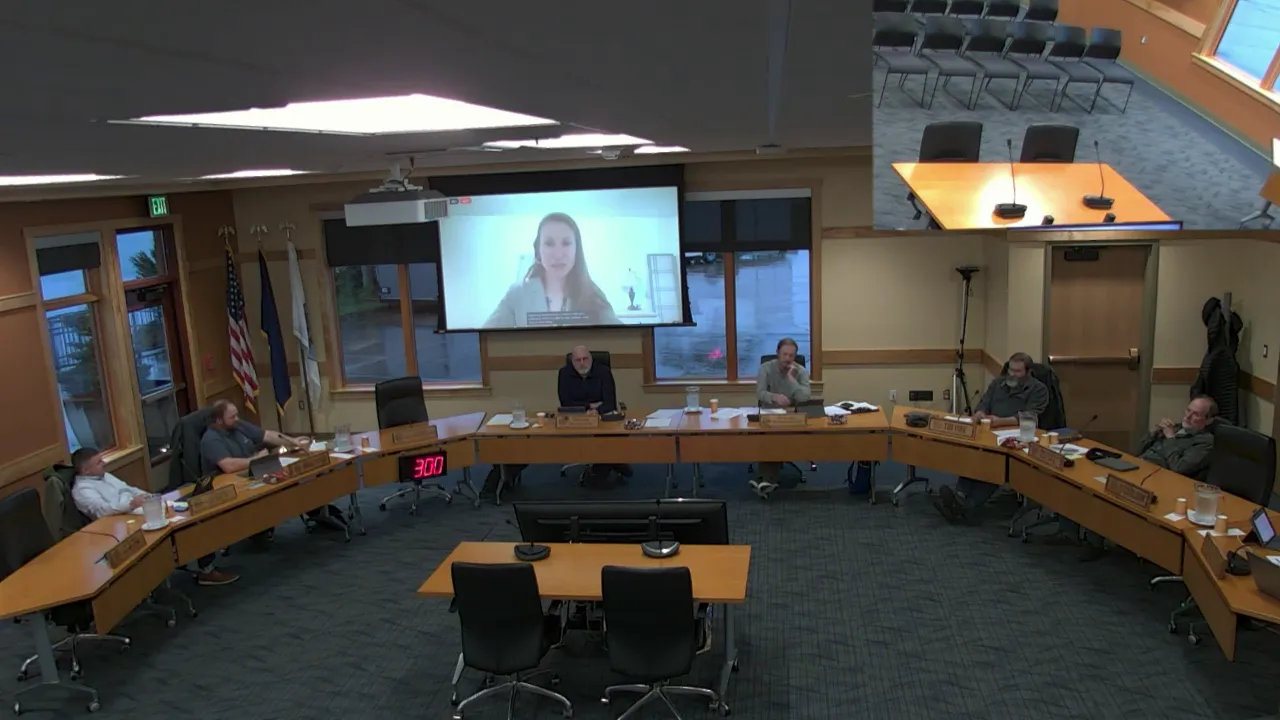
The Sitka Assembly conducted a special meeting on May 9, 2024, to interview Anne Marie Billingsley, a candidate for the position of municipal attorney. The interview lasted approximately one hour, followed by a 10-minute break, then resumed for additional questions. The assembly questioned Billingsley on her experience with municipal code, land use, procurement, public safety, constitutional law, fire and EMS contracts, union negotiations, and her approach to community relations. After the interview, the assembly met in executive session and voted to invite Billingsley for an in-person interview and community meet and greet.
Public Comments & Testimony
- A public member (identified as Chris) raised concerns about the four-year closure of the sidewalk on Catleyan Street, calling it a "big zit on the tail of two cities for Sitka." He also referenced the Alaska Native Land Claims Act, Catleyan Bay being awarded to the Shiatica Native Regional Corporation, and efforts to build a road there since 1971. He questioned how the city could zone sovereign land and mentioned concerns about immunity granted to the native regional health care corporation and tax exemptions.
Discussion Items
- Code Interpretation and Community Needs: Billingsley emphasized that when code conflicts with community desires, the proper process is for elected officials to sponsor an ordinance to change the code. She noted that reviewing legislative history can clarify the intent of provisions. She advised against overly specific code provisions and stressed the importance of general applicability.
- School Funding and BSA (Base Student Allocation): Billingsley expressed familiarity with the BSA issue, noting that Fairbanks recently held a special election to raise the tax cap for schools, which failed. She stated that the state legislature should address school funding rather than leaving it to municipalities, and she personally supports adequate school funding due to having school-aged children.
- Land Use and Leases: Billingsley described her experience advising the Fairbanks North Star Borough on land leases, including financing agreements, defaults, and evictions. She also discussed lease negotiations for the Birch Hill ski trails on military land and the airport land lease negotiations.
- Federal and State Land Use Law: She noted experience with preemption issues, such as whether the borough could impose zoning on railroad land or airport land, but said her primary expertise is in local zoning rather than federal land use law.
- Procurement Process: Billingsley identified risk at every stage of procurement, from RFP development to bidder disqualification and public records requests. She had experience handling procurement disputes and evaluating whether sole sourcing could bypass the RFP process.
- Public Safety and Risk Mitigation: She discussed body cameras as a risk management tool, noting associated lawsuits over footage and policies. She also referenced debates about arming animal control officers with tasers and emphasized presenting risk-reward analyses to the assembly for decision-making.
- Constitutional Law and First Amendment: Billingsley highlighted her work with library display cases, book bans, and public forum restrictions. She stressed the importance of having content-neutral policies in place ahead of time to handle challenges, and noted that municipalities across the country face similar constitutional issues.
- Fire and EMS Contracts: She described extensive experience negotiating fire service contracts with independent contractors, including insurance requirements, training levels, and service revisions. She advised the emergency operations department and attended regional service area advisory committee meetings.
- Union Contracts: Billingsley stated that collective bargaining negotiations were her favorite part of the job. She served on bargaining teams, drafted language, and focused on making contracts accessible to employees. She also handled interpretation and enforcement.
- Press Releases and Social Media: She considered it part of the municipal attorney's role to review press releases and social media posts for legal implications. She helped develop guidelines for department Facebook pages and drafted or edited sensitive press releases.
- First Priorities if Hired: Billingsley said she would focus on understanding the workflow, culture, and key players, building relationships with assembly members and staff, and learning how the assembly wants to utilize the attorney. She noted that different attorneys have different styles (e.g., waiting for assignments vs. interjecting in meetings) and would adapt to the assembly's preferences.
- Remote Work: Billingsley asked about the possibility of a hybrid remote arrangement initially, as she cannot move her family to Sitka by July 1. She proposed spending the first month in person, then returning home to wrap up, and later coming back. The assembly indicated they would discuss this in deliberations.
Key Outcomes
- The assembly moved into executive session to discuss the candidate's interview, inviting human resources and the candidate when desired. The motion passed 6-0.
- After reconvening, the assembly voted unanimously (5-0) to direct staff to schedule a community meet and greet and in-person interview with Anne Marie Billingsley.
Meeting Transcript
Times and things like that. And so I've dealt with those those things as well. And a lot of it is just like, let's flag it and fix it. You know, sometimes that doesn't help you in your immediate issue, but once you identify it, easy enough to say, okay, this is an issue, this is outdated. We need an ordinance to propose a change, and you all need to vote on what you want that change to look like if everybody agrees that it's outdated. What to do when it's outdated and you have something pending right in front of you, I think that's really sort of case specify it's context specific. You know, it really would depend on what the issue was that you were dealing with, where you had an outdated code provision. But my overall answer is you need to fix your code. You need to get an ordinance out there that that would enable you to get with the times. Okay. Thank you. So I'm gonna ask the easiest question and the hardest question you've ever been asked, all in the same one. And if you've been to newly elected officials training, you've undoubtedly heard the varying opinions and the strong opinions on this one. Do you take minutes in executive session and why or why not? And then what is your personal stance on it and how would you advise this assembly? So I don't take any minutes. I don't, I don't usually uh, but that's also not my role as the attorney. I don't take minutes, it's not not my uh not my role. We we we record our executive sessions, um, and then what we do with those recordings and who has access to them, and you know that that also is a well that's that's not tricky. That's they've made that decision and and that's set, but um, in terms of taking minutes and who's available to them. I I don't do it. I I haven't done it, but we also have recordings. So um, and those recordings are locked, and only certain people have access to them. And if we needed to get minutes to to create minutes for a very specific um uh instance, they could do it. Um so I guess minutes and or recordings or or you know, does anything come out of executive session? And and what would be your your stance on advising this assembly how to move forward. Um tip typically uh after the executive session, there's some response about, you know, we met in executive session, and here's the the snippet of you know what we discussed and what the outcome is, or or we came out of executive session, and then you go into a vote so that the vote and maybe some of the deliber deliberations then could be could be public. Um but it in the municipality that I work for, they did record them and had very specific provisions on what what happened to those recordings and where they went and and who had access to them. And so my personal feelings is well, I I mean, I guess I could envision a time when I would say, uh, you're really gonna want something. It depends on if um, you know, you were getting I mean, the things that I go into executive session for, it's it's a lot of this is attorney client privileged stuff, and I don't think there needs to be a it's not like somebody could uh I guess somebody could waive the privilege, but that's certainly not what I would advise. Um so yeah, I'm I'm I'm accustomed to working in a in a municipality where we do record, but it's my preference to not. Understood, thank you. Uh hello again. So um school funding. Uh, I don't know how familiar you are with all the ins and outs of this wonderful BSA conversation that keeps being had. I understand Fairbanks has been struggling with it. We have as well, and we do fund to the cap. And you know, the cap um, if you're as you're familiar with it, I think the question is um we all got a letter from the State Department of Education saying be very careful about what goes in and outside the cap. What is your familiarity with school um cap, I guess, legalities, law how yeah, this is uh been a struggle. They had a special election on Tuesday to try to raise the tax cap with the hope of getting the ability to um raise 10 more million dollars to give to our schools because the Fairbanks School District is struggling with this exact BSA issue that many school districts across Alaska are are are faced with the election failed, so that um borough is unable to increase its tax cap to try to give more funding to the schools, and it's a difficult situation about trying to figure out how to fund the schools in a sustainable way. Um, you know, it there's ways to move money around and things, but it's none of that is gives the stability and the consistency that the schools are looking for. Um and then there's also this issue of well, this should really happen and it at the legislature and it shouldn't be up to the local municipalities to get the schools where they need to be or where the schools are saying they need to be. Um so I'm I guess your question is what's my familiarity with it? I I'm pretty familiar with it because it's really been such a big issue here in Fairbanks, and I also have school-aged children uh that are in uh Fairbanks public schools, and so it's also an important issue to me because it directly affects, you know, not only my kids, but also the the children of all the rest of the their friends, their peers, you know, and everybody else in the schools. Thank you. I didn't have any more questions, but what Chris brought up the risk deal. Um, I can't wait for you to get here and defend the city keeping the sidewalk closed on Catleyan and try to explain to me and my constituents how that risk factor weighs out with buses going by, fuel trucks, grammas with baby carriages going by everybody right out of bottleneck, and it's going on four years now. It's kind of like uh a big zit on the tail at two cities for sitka. Uh JJ, again, um uh extrapolating on kind of land use, um, your experience with land use law with zoting, litigation permits, that's great. Um let's talk a bit about leases.
openpublica.com