Sitka Coast Guard Town Hall on Awaken Sinking Investigation - May 16, 2024
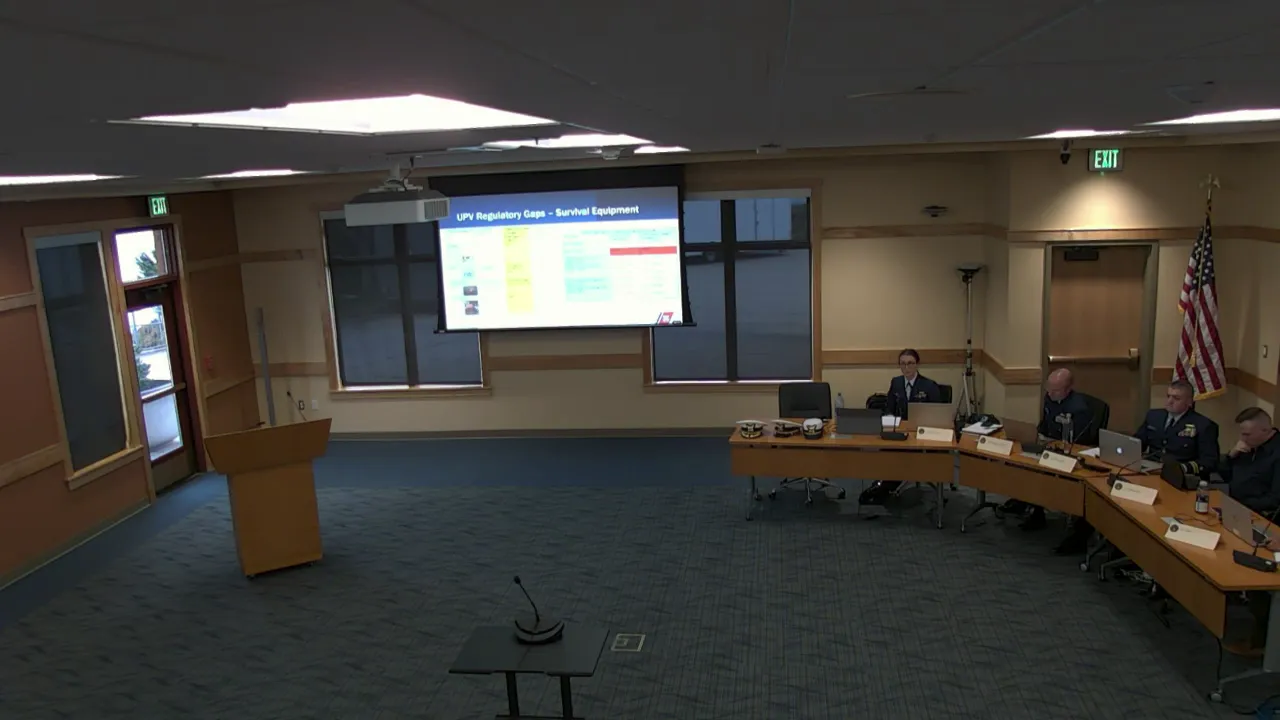
STREAMING COPY IN PREPARATION — RECORDING AVAILABLE FROM THE ORIGINAL SOURCE
Sitka Coast Guard Town Hall on Awaken Sinking Investigation - May 16, 2024
Note on Agenda Conflict: The City and Borough of Sitka Special Assembly Meeting scheduled for this date had a published agenda to deliberate on the Tourism Task Force Final Recommendations. The raw transcript provided for this event does not contain any tourism-related discussion. It fully records a United States Coast Guard Town Hall convened to present the Marine Board of Investigation (MBI) findings into the March 2024 capsizing of the uninspected passenger vessel Awaken off Low Island, which resulted in multiple fatalities. The summary below documents the Coast Guard presentation, public comments, and leadership statements as captured in the transcript.
Marine Board of Investigation Presentation
- Causal Factors: The initiating event was sudden flooding of the Awaken's well deck by a large swell. A major causal factor was the master navigating the vessel too close to Low Island in shallow water at low tide, encountering hazardous breaking surf. The vessel's freeing ports provided only 14.25 square inches of drainage, compared to 401 square inches required for inspected small passenger vessels. The master's likely position at the aft operating station contributed to distraction and loss of situational awareness.
- Loss of Life: The master and two passengers drowned and were not wearing life jackets. Two passengers became trapped inside the submerged cabin. The investigation noted the likely rapid progression from flooding to capsize prevented life-saving actions. The lack of a float-free EPIRB prevented automated distress notification.
- Regulatory Gaps: Uninspected passenger vessels (six-packs) are the only commercial vessel class completely exempt from mandatory carriage of survival craft and EPIRBs, regardless of route or operating area. No stability or flotation standards exist for outboard-powered vessels over 20 feet.
- Response Timeline: The Coast Guard was not notified until 2 hours and 45 minutes after the estimated casualty. The Air Station launched 58 minutes after crew notification, failing its 30-minute B0 launch standard due to fueling system malfunctions. The investigation recommended a review of SAR command center processes for evaluating overdue cases.
- MBI Recommendations: The investigation formally recommended rulemaking to mandate survival craft and regulate minimum stability criteria/freeing port capacity for these vessels. The team noted the Coast Guard had previously declined similar NTSB recommendations in favor of voluntary programs like Rescue 21 and the 5-Star Safety Exam. The team strongly encouraged operators to voluntarily carry Type 1 float-free EPIRBs, register DSC radios, and check their vessel's drainage.
- Navigation Software: Depth discrepancies were noted in the Time Zero Bathy Vision feature vs official NOAA charts, which were not causal to the incident but reported to the developer.
- Medical Protocols: Differences in resuscitation decisions by the Coast Guard rescue swimmer (withholding CPR per protocol for extended downtime) and EMS (immediately commencing CPR) were noted and deferred to medical authorities.
Public Comments & Testimony
- Janet Reed (Charter Operator): Stated that electronic navigation programs fail to adequately highlight the predictable risks of offshore isolated breakers. She noted the tide was going out against the wind, creating larger breaking waves, and that hazards like Low Island should be dynamically reflected in software.
- Charter Operator: Disputed the investigation's freeing port analysis, stating the vessel's two large deck hatches (with perimeters of roughly 2.5x4 feet) act as additional water evacuation ports, suggesting the calculation should be relooked.
- Audience Member: Expressed concern regarding the SAR command center's overdue vessel evaluation process, which they felt takes too long (15-20 minutes on the phone) to sufficiently prompt a distress declaration for a routine missing operator.
- Q&A Session: Two unaccounted meteor flares were sighted during the search. The Coast Guard acknowledged that an Urgent Marine Information Broadcast (UMIB) to correlate the sighting was not issued. Cost (thousands of dollars plus installation/battery life) was stated as the primary barrier to voluntary EPIRB adoption.
- Steve Ramp (ex-Coast Guard, Licensed Master): Urged a shift in focus from criticizing the response to prevention. "The lesson learned we all in the room that operate out there need to take is that we need to think about what we're doing on the water and operate safely, use judgment, don't take unnecessary risks."
Key Outcomes & Leadership Statements
- Captain Vincent Jansen (CO, Air Station Sitka): Accepted ownership of the fueling system malfunctions that delayed the search helicopter and committed to an internal review of unit norms. He defended the pilot's decision to launch with a partial fuel load for a close-range rescue, stating he stands behind the crew's judgment. He noted his crew typically launches in approximately 13 minutes during exercises against a 30-minute international standard.
- Captain Darwin Jensen (Sector Commander, SE Alaska): Personally thanked community members, particularly the lodge operator who first reported the vessel overdue. He reiterated the significant resource constraints the Coast Guard operates under in Southeast Alaska and publicly advocated for homeporting a response cutter in Sitka. He framed the purpose of the investigation as preventing future tragedies and highlighted the extreme risk of Sitka waters due to their direct exposure to the Gulf of Alaska and open ocean conditions.
Meeting Transcript
Instead deferred to the experience and judgment of the boat operator. There were three freeing ports on the Awaken, providing approximately 14.25 square inches or 91.93 square centimeters of total drainage area. The Marine Safety Center determined that if the Awaken was required to meet subchapter T small passenger vessel inspection standards, it would need 401 square inches of total drainage area to satisfy the applicable requirements for a small passenger vessel on an exposed route. The Marine Safety Center report stated that water on deck could worsen the vessel's stability characteristic, causing a reduction in the range of stability. The investigation determined that the Awaken had insufficient onboard drainage for vessels on exposed routes compared to similar commercial vessels that must comply with drainage regulations to include inspected small passenger vessels and international standards for similarly sized commercial small passenger vessels. Australia specifies that on vessels less than 12 meters in length with a well deck, the minimum freeing port area must not be less than 100 square centimeters for every one cubic meter of water that may be entrapped within the bulwarks. Furthermore, the United Kingdom specifies that vessels less than 12 meters in length with a well deck operating not more than 60 nautical miles from a safe haven must have a minimum freeing port area of 225 square centimeters. So just to kind of pause on this slide real quick. Applying this force would cause a 47.5 degree vessel heal, which would cause the bulwarks to be submerged. If this force were constantly applied, it would cause the vessel to continue healing until it capsized. The total healing moment that would cause the vessel to capsize is 13,400 foot pounds. This scenario could have generated enough force to capsize the awaken as the breaking strength of the nylon anchor line was much greater than the capsizing force, meaning the line would stay intact while the capsizing force continued to be applied to the Awaken's port bow. The investigation determined that the anchor did fall from the awaken at some point. However, the anchor's found location does not necessarily support the theory that the anchor deployed while the vessel was underway. The port anchor line guard on the bow may have been damaged from the anchor line, but the damage likely occurred after the capsizing. On this slide, you can see a timeline of the initial response that occurred on May 28. While Sector Juno requested the launch of a helicopter from Air Station SICA at 1804, that helicopter was not launched until 1855. The Coast Guard did not launch a B0 aircraft within 30 minutes on the initial search for this case. A log from Air Station Fitka indicated that the time to launch the CG 6015 for the first search was 58 minutes from when the crew was notified. Coast Guard policy regarding B0 aircraft launch time is well established. Bravo Zero or B0 means that a Coast Guard unit is capable of launching within 30 minutes of notification. In this case, Air Station Sitka encountered unexpected fueling difficulties, which delayed the launch. This delay could have been prevented by ensuring that the B-Zero aircraft had an appropriate fuel quantity to be immediately ready to proceed on a search and rescue key. So it was fueled for that specific flight, which is not a full load of fuel. It was canceled due to weather, and the amount of fuel remained in that aircraft for that flight. One was via the normal fixed fueling facility. And so he expected probably going offshore, and there's other calculations involved to determine the amount of fuel needed. Ultimately, he took off with the fuel that they had. This slide depicts the search and rescue response process for an overdue case. An overdue case is a situation where a craft or search object has failed to arrive at its intended destination when expected and remains missing. First, the uncertainty phase, second, the alert phase, and third, the distress phase. It is important to note that the successful receipt of an emergency position indicating radio beacon distress signal immediately activates the distress phase of the search and rescue system and results in the immediate launch of rescue assets, unlike the search and rescue system response to reports of overdue vessels. During the course of the investigation, uh we noted differences in how first aid uh was given between the Coast Guard and the EMS and hospital staff for passenger one. When passenger one was recovered, the rescue swimmer relied upon the Coast Guard air station's pre-hospital care protocols, which specify withholding resuscitation if a patient has cardiac arrest accompanied by extended downtime greater than 10 minutes without CPR, an AC stole on the cardiac monitor. This includes drowning victims. The protocols further specify that post-mortem dependent lividity is also a valid indication to withhold resuscitation, which the rescue swimmer stated they observed during their patient assessment. In our review, it appeared that the rescue swimmer in this case was following the the air station's policies. With this, the rescue swimmer decided not to provide CPR to the passenger after the passenger was transferred from the helicopter to EMS. EMS immediately commenced CPR efforts. Furthermore, once at the hospital, uh at further advanced medical life saving efforts were commenced. A detailed investigation of these medical procedures and regulations involved in emergency medical practices outside of our expertise and the outside the scope of a marine casualty investigation, and so we recommend that that be examined by uh authority that has expertise in that uh medical policies and procedures. As an uninspected small passenger vessel carrying six or fewer passengers, including at least one for hire, the awaken was required to comply with 46 CFR subchapter C. The table on the left hand side of the screen compares survival equipment requirements between a recreational vessel, an uninspected passenger vessel, and an inspected small passenger vessel operating on an equivalent route and conditions as the awaken. The table on the right hand side of the screen depicts emergency position indicating radio beacon or e-perb requirements for uninspected vessels in accordance with subchapter C. If the awakened had been equipped with a float-free inflatable buoyant apparatus or IBA or a life raft, it would have provided an additional life-saving resource during a capsize event. These devices could provide refuge from the water. IBAs or life rafts are required for nearly all inspected vessels and commercial fishing vessels operating in a cold water offshore environment. They can be rigged and deployed automatically with a hydrostatic release mechanism or annually. Heavy surf conditions would make using an IBA or life raft difficult, particularly for those trying to access the platform from the water. Only recreational vessels and uninspected passenger vessels are exempt from mandatory carriage of this primary life-saving device in an ocean or a coastal route.
openpublica.com