Spokane Valley Lodging Tax Advisory Committee Special Meeting – October 29, 2025
STREAMING COPY IN PREPARATION — RECORDING AVAILABLE FROM THE ORIGINAL SOURCE
Spokane Valley Lodging Tax Advisory Committee Special Meeting – October 29, 2025
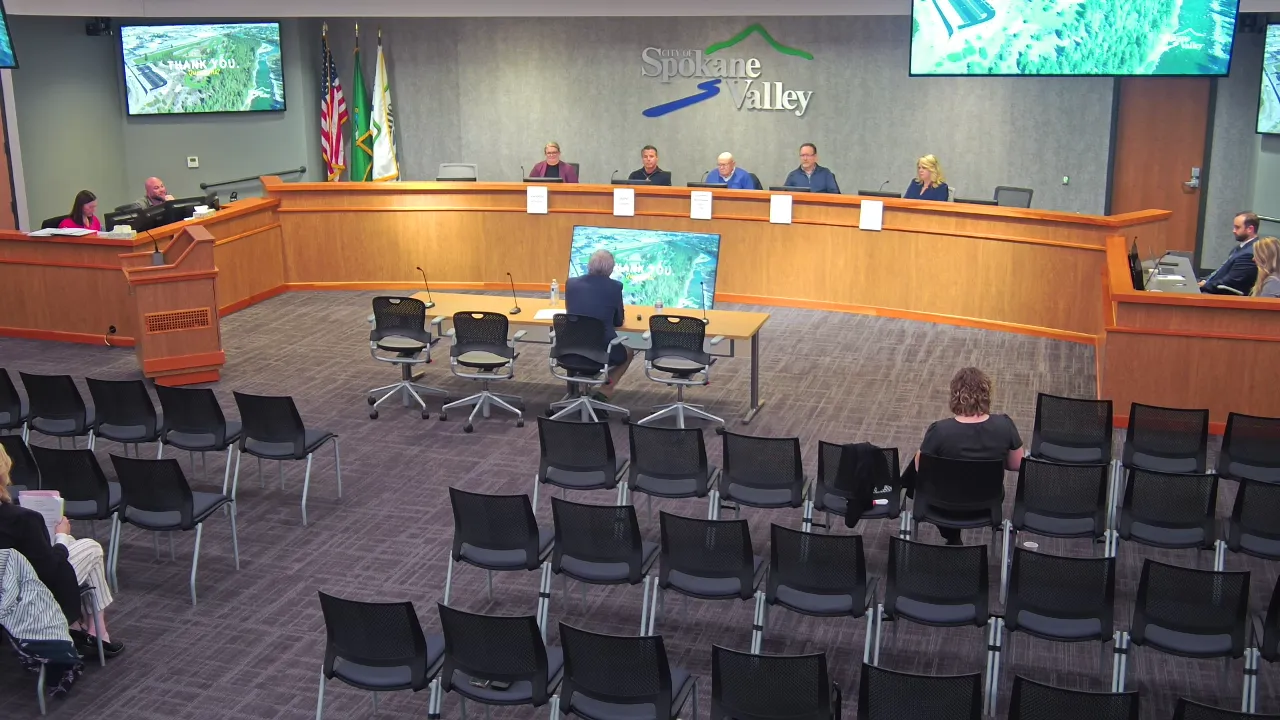
The Spokane Valley Lodging Tax Advisory Committee (LTAC) held a special meeting on October 29, 2025, from 8:00 a.m. to approximately 11:30 a.m. at City Hall Council Chambers. The meeting included mandatory Open Public Meetings Act (OPMA) training, an overview of the 2026 grant process and revenue forecasts, applicant presentations from nine organizations, individual project ranking, and committee discussion leading to funding recommendations and motions for future action.
OPMA Training (8:00 – 8:30 a.m.)
- Senior Deputy City Attorney Tony Beattie conducted annual training on the Public Records Act (PRA) and OPMA, emphasizing transparency, retention schedules, and penalties for violations.
- Committee members were reminded that all deliberations and rankings must occur during open public meetings, not via serial communications or private discussions.
Opening Comments (8:30 – 8:45 a.m.)
- Councilmember and LTAC Chair Rod Higgins opened the public comment period; no members of the public offered comments in person or via Zoom.
- Sarah Farr, Accounting and Finance Program Manager, presented the 2026 funding process, including state law requirements, revenue projections, and City Council goals.
- Available revenue: approximately $930,000 in the 2% Fund 105 (tourism marketing, operations, and non-capital facility uses).
- Capital Fund 104 (for municipally-owned tourism facilities) projected at $1,618,211.
- Based on a five-year average, staff recommended transferring $447,000 from Fund 105 to Fund 104 to support capital expenditures, leaving $483,000 for awards from Fund 105.
Applicant Presentations (9:00 – 10:40 a.m.)
Each applicant gave a 10-minute presentation followed by committee Q&A. One applicant (Spokane Valley Summer Theatre) withdrew prior to the meeting. The remaining nine applicants presented:
- City of Spokane Valley (John Batelli, Parks & Recreation Director) – Requested $260,000 for first-year maintenance and operations of the new Spokane Valley Cross Country Course. Estimated 30,000 visitors and 7,600 room nights in 2026. The course will host the WCC Cross Country Championships (November 2025) and the Nike Cross Regionals and Bob Furman Invitational in 2026.
- Spokane Conservation District (Lisette Walser) – Requested $37,000 for marketing of the Scale House Market, including billboards and collateral materials. Projected 250,000 visitors in 2026, 17,500 overnight guests, and $14.3 million economic impact. Staff adjusted the request to remove $8,000 for ineligible signage.
- Cody Productions (Chris Cody) – Requested funding to promote the Spokane Motorcycle Show (March 13–15, 2026) to audiences 50+ miles from Spokane Valley. Emphasized that advertising is exclusive to out-of-region audiences.
- CNC Productions – Requested funding for the RV Show (January 22–25, 2026), using the same out-of-region marketing approach as Cody Productions.
- Washington State Quilters – Spokane Chapter (Cheryl Clos) – Requested funding for the 48th Annual Quilt Show (October 16–18, 2026). Reported 500 paid lodging nights from the 2025 show and 31% out-of-state attendance. A portion of the request was for quilt-hanging system upgrades (fire-code compliance); staff noted capital expenditures are ineligible unless deemed operational equipment.
- Spokane County Fair & Expo Center (Erin Gertell) – Requested $80,000 for marketing and security for the 10-day Interstate Fair. Reported 27,000 out-of-town attendees, 1,500 hotel room nights, and a $24.1 million economic impact from fair visitors. Half the request would support safety and security.
- Spokane Valley HUB Sports Center (Phil Champ) – Requested funding to support 87 overnight-stay events in 2025. Reported 63% of teams traveling >50 miles. Requested an allocation change to increase marketing spending to $25,000.
- Spokane Valley Heritage Museum (Jane Singleton and Tom MacArthur) – Requested funding for marketing (print and digital), website enhancements, and upcoming exhibits tied to the 250th anniversary of the Declaration of Independence and a Smithsonian exhibit on women’s suffrage. Reported direct counts of visitors and room nights from guest logs.
- Inland NW Wildlife Council (Melanie) – First-time applicant, requesting $75,000 for the Bighorn Outdoor Adventure Show (third weekend in March 2026). Funds would support a new website, online advertising, and speaker/influencer fees. Noted the March date coincides with high hotel occupancy, making partnership tracking difficult.
Funding Allocation & Ranking (10:40 – 11:00 a.m.)
- Committee members submitted individual priority rankings (1–9) on paper, which were tallied by staff and displayed on a screen.
- Motion to transfer $447,000 from Fund 105 to Fund 104 (capital) passed unanimously.
- After ranking, the committee discussed the displayed recommendations. The default allocation funded some applicants fully and others partially. Several applicants, including the Fair & Expo Center ($27,000 partial) and the Quilters, received partial funding; others received no funding.
- Motion to approve funding recommendations as displayed was made and seconded. After discussion, the motion passed on a 4–1 vote. The dissenting member stated they would have preferred either fully funding or not funding certain applicants rather than partial allocations.
Key Outcomes
- Approved: Transfer of $447,000 from Fund 105 to Fund 104 for capital projects.
- Approved: Funding recommendations as displayed, committing $483,000 from Fund 105 to selected applicants (list of specific award amounts not read into the record but adopted by the committee).
- Approved: Motion to invite city staff to a special LTAC meeting to present a proposal for using up to $2 million in Fund 104 money to support a proposed two-sheet ice rink facility on Sullivan Road. The motion also requested a formal application and presentation. Motion passed unanimously.
- Adjourned: Meeting concluded at approximately 11:30 a.m.
Meeting Transcript
I think we could keep going. Yeah, we need to. So a lot of times I'm just right around the corner here over at the shed. Yeah. So it's kind of meeting will come back to order. Oh, I understand. Yes. And we will continue with our lodging, excuse me, with our mandatory training on the open public meetings act by Mr. Beatty. Thank you, Chair Higgins. Um, committee members, Anthony Beattie, Tony Beattie, Senior Deputy City Attorney for Spokane Valley here for the um the moment everyone's been waiting for the uh public records act and OPMA Open Public Meeting Act training, the annual training. Um this is just background information we've gone through before, but this is a long-standing statute for the public records act. Uh it was adopted in 1972, and we always start with this strongly worded mandate. Um essentially, the the people do not yield their sovereignty to the agencies that serve them. That's important because you know, when we're dealing with the public records act and you're dealing with litigation and the public records act, that's what the courts are going to look to. They they view this very this mandate very broadly, and so when we discuss this, I will discuss it in very broad terms. The the right of the people to obtain public records is is very broad. So, what is a public record? It's um any writing containing information relating to the conduct of government or the performance of any governmental or proprietary function that's owned, used, or retained by any state or local agency, regardless of the physical characteristic of that record. Okay, so we're we're talking about any writing uh information relating to the conduct of government and the that stuff that is uh prepared, owned, used or retained by the local agency. So writing again, emails, text messages, posts on social media, metadata, police security video, anything that we use that we have a physical form of is essentially a writing. Okay. Um we'll get into whether or not those are available for the public depending on the um uh retention schedule that the state has adopted. But if we have it and they ask for it, we have to provide it unless there's a an exemption. Information is not a record, so as I just noted, you know, if we have a physical form of a record or of information, then certainly that's a record. But if we just have if we know information and they're asking for information, what's the you know, what's your population? We don't have to provide that. Of course, we will provide that if someone asks that information, or if they ask who the mayor is or whatever. Um we we just as a public service, uh, we want to we want to provide as much information as possible to the public. With regards to relating to government, so it's anything that impacts the actions, processes, and functions of government. So it's a very broad net. So that's why you know we start with that broad mandate. Um anything that we utilize uh to conduct our uh affairs, uh internal, external, those are public records that are relating to government. Um this includes personal devices, anything on personal devices uh that was created within the scope of employment. So even if you have a personal cell phone and you're texting someone, or um you have a voicemail for someone relating to city business, that is a public record. Whether or not you have to retain that public record for any period of time is determined by the retention schedule. So we'll go over that again later. Uh there's no constitutional right uh to privacy for public records on par private devices. Uh we you have to conduct a reasonable search. If we get a request saying, hey, I want um, you know, uh someone's uh text messages that they've sent about city business, then that person needs to conduct a search on their device, and then we would have them actually sign a declaration saying, I conducted a search, this is how I did the search, this is what I found, I did not find anything, or whatever, and then they sign it. The best uh practice obviously is do not use your personal phone in connection with city business, don't use personal email, don't use personal computers to draft records and then save them on your personal computer. Um don't use personal devices to run internet searches for information related to city business. Anything that we do on those personal computers or devices and that we save and you know we we keep and we've used that's you would have to go back and do a search. Uh this is mostly related to the city council. They have a social media policy in their governance manual that encourages council members to communicate directly with citizens, but of course a court could find council member posts regarding city business to be in furtherance of city business, so we you know adhere to that social media policy. Obviously, LTAC does not have one of those. I don't think that's gonna be a problem for you all. We're mandated to adopt rules and enforce those rules related to public records. Uh the city clerk is our designated public records officer. Uh online records processing through we we do that through our uh internal or external GovQA system on our website.
openpublica.com