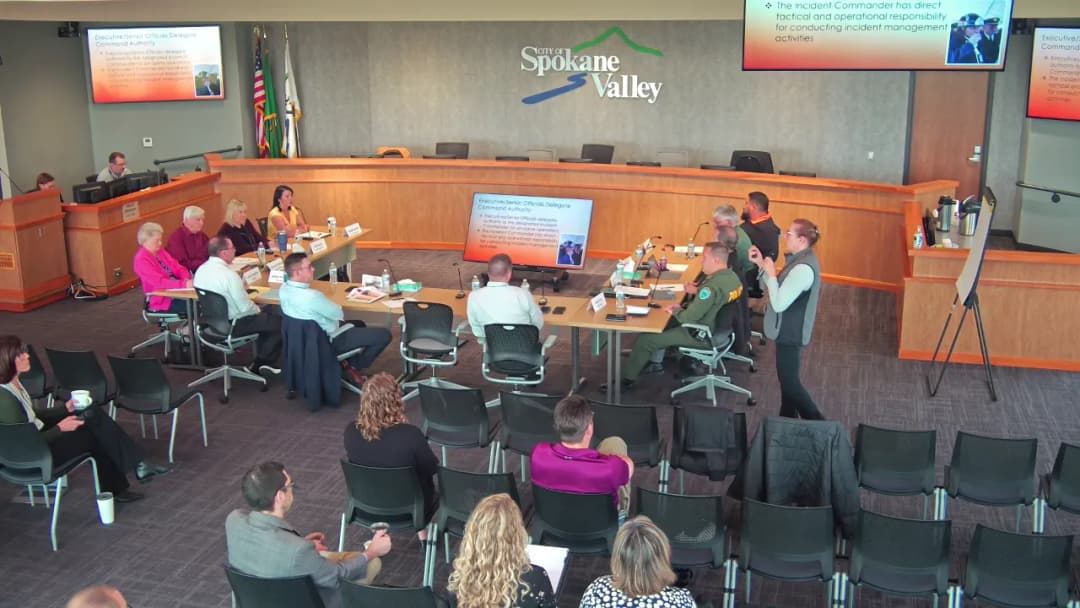
Spokane Valley City Council held a special meeting on Tuesday, November 3, 2026, beginning at 8:30 a.m. at City Hall for a day-long emergency management training workshop. All council members were present. The agenda listed Mayor Padden as presiding; the transcript repeatedly refers to 'Mayor Patton.' No formal public comments or testimony were accepted. Department of Emergency Management personnel Chandra Fox and Mark Conrad, joined by Police Chief Dave Ellis, led the training, which covered the Incident Command System (ICS) and National Incident Management System (NIMS) in the morning and two tabletop exercises in the afternoon. The session was intended to inform the city's forthcoming Comprehensive Emergency Management Plan. Public Comments & Testimony - None were accepted; the meeting agenda stated that no formal public comments or testimony would be taken. Discussion Items - Opening and purpose: City Manager Hohman (addressed as Eric in the transcript) introduced the training, noting the city has adopted a continuity of operations plan and a hazard mitigation plan and is beginning work on the Comprehensive Emergency Management Plan. - Morning ICS/NIMS training: Chandra Fox explained that ICS is a standardized framework for managing unplanned incidents and that NIMS grew out of Homeland Security Presidential Directives 5 and 8. She described incident command roles, command vs. coordination, unified command, incident management teams, joint information centers, and after-action reviews. She emphasized that life safety is always the top priority, that individuals and households are responsible for personal preparedness, and that jurisdictions have about 72 hours to demonstrate to the public that they can manage an incident. - Training statistics and examples cited: Speakers cited the COVID-19 pandemic, the Freeman School shooting, the 2023 Gray and Oregon Road fires, the 2026 Upriver fire (14 homes lost), and the Spokane Complex fires. Chandra Fox noted the county's Emergency Operations Center had 41 partner organizations during the fires, more than 70 agencies contributed communicators to the pandemic joint information center, and roughly 95% of the improvement-plan items from the 2023 fires had been completed. - Tabletop exercise 1 (terrorist threat and rail-yard chlorine release): The first exercise scenario involved a credible terrorist threat and a train derailment/explosion at the Union Pacific rail yard releasing toxic inhalation hazards. Council members and staff discussed threat information flow, RIG-9 and the FBI Joint Terrorism Task Force, unified command, evacuation authority, EOC activation, Alert Spokane/reverse 911, the joint information center, and public messaging. Participants also noted potential impacts on Valley Fest, adjacent businesses, hospitals, the fairgrounds, and the regional rail network. Councilmember Yeager said communication is the city's number one role in such an incident, and Councilmember Merkel suggested the city should serve as a credible local messenger supporting the incident commander rather than managing tactical operations. Follow-up priorities included formalizing threat-information handling, improving internal staff alerting, ensuring the mayor is included in public messaging, and determining the city's desired role in EOC/JIC coordination. - Tabletop exercise 2 (cyber/ransomware attack): The second exercise scenario involved phishing, ransomware, failed payroll and bill pay systems, and a vendor cloud-platform outage. IT manager Chad described end-user risk, monthly phishing tests, geolocation filtering, and cyber insurance. Discussion addressed whether to pay the $250,000 Bitcoin ransom, sensitive-data retention, notification laws, vendor management, paper-based backup processes, media response, and incident closure. Participants generally indicated the city should not pay the ransom and should rely on backups and third-party validation. Suggested follow-ups included expanding cybersecurity training to board and commission members, developing backup payroll procedures, reviewing sensitive-information policies related to the new HUD grant, studying other municipalities' ransomware cases, and formalizing cyber incident reporting for end users. - Closing remarks: The Mayor and City Manager Hohman thanked the trainers, said the city was fortunate to have time during the fall and winter to prepare, and stated they would coordinate with fire districts and incorporate the day's findings into the Comprehensive Emergency Management Plan. Key Outcomes - The council unanimously approved the agenda by voice vote; no other formal council votes or policy decisions were taken. - The training and tabletop exercises produced a working list of priorities and potential improvements to inform the city's Comprehensive Emergency Management Plan. - Identified next steps included formalizing law-enforcement and cyber threat-information sharing, developing a citywide staff alerting system, expanding cyber training beyond staff, developing backup payroll and paper-based processes, reviewing sensitive-information and data-retention policies, and continuing coordination with fire districts and the county before the 2027 fire season.
Public Meetings - Spokane Valley, Washington
Public Meetings - Spokane Valley, WashingtonThe meeting was scheduled for November 3, 2026, at 14:00 UTC. No agenda or minutes were available, and the raw transcript did not contain discernible discussion, staff reports, public testimony, or formal actions. The transcript consisted mostly of repeated or unclear phrases, including fragments such as “la forma de la comunidad,” “mayor parte,” and “vida,” with no coherent business identifiable. Agenda & Minutes - No agenda was provided. - No minutes were provided. Transcript Content - The raw transcription was largely unintelligible and did not permit identification of agenda items, speaker positions, proposals, or questions. - No clear statements of support, opposition, or concern from council members or members of the public could be identified. Key Outcomes - No motions, resolutions, votes, referrals, or next steps were identified in the available source material.
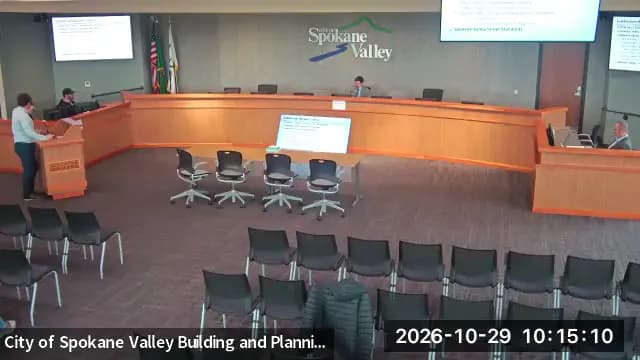
The Spokane Valley Land Use Hearing Examiner, Jay Istone, convened a public hearing at 9:02 AM on October 29, 2026, to consider four subdivision applications: Cooper Subdivision (SUB-2026-0005), Peak Homes Subdivision (SUB-2026-0008), Evergreen Road Subdivision (SUB-2026-0009), and 12th Avenue Subdivision (SUB-2026-0010). The examiner reviewed staff reports, applicant testimony, and public comments for each proposal. Written decisions will be issued within 20 calendar days following the hearing. Cooper Subdivision (SUB-2026-0005) - Project Description: 30-lot subdivision on 1.94 acres in the multifamily residential zone, featuring townhouses and duplexes accessed by two new private streets. Applicant: Matt Kelly (Simpson Engineers, Inc.) on behalf of Cooper Living Trust. - Staff Presentation: Adam Knight (City Planner) recommended approval with conditions, noting the project is consistent with zoning and comprehensive plan requirements. A mitigated determination of non-significance (MDNS) was issued on September 23, 2026. He clarified a setback discrepancy (flanking street setback should be 5 feet for private street, not 15 feet). - Applicant Position: Mr. Kelly expressed full support, emphasizing the project provides affordable ownership opportunities (condos/duplexes) rather than apartments, aligning with community housing needs. - Public Comments: One written comment from Todd Ziff raised concerns about traffic at the Sprague & Tschirley intersection and safety for the Spokane Valley Trail crossing. He noted 400+ apartments being built nearby, adding up to 800 cars. The applicant responded that traffic concurrency was issued, and a sidewalk connection to the Appleway Trail is proposed. - Examiner Questions: Inquired about traffic concurrency (7 net new PM trips reserved) and the city’s housing need (planning for 16,600 new units over 20 years). Staff indicated the project is in a fee impact area. The evidentiary record was kept open until end of day for a clarifying note from traffic engineering. Peak Homes Subdivision (SUB-2026-0008) - Project Description: 11-lot subdivision on 1.63 acres in single-family residential zone (R3), with two new private roads (East 7th Lane and South Donwood Court). Owner/Applicant: Peak Homes and Development LLC (Daniel Stefaglo). - Staff Presentation: Adam Knight recommended approval. The project density is 7 dwelling units per acre (max allowed: 8). A portion of the site was acquired for the 8th & Barker roundabout project. No public comments were received. - Applicant Position: Engineer Mamdouh Elarag testified on behalf of the owner, confirming agreement with staff’s factual statements and conditions of approval, and requesting approval. - Examiner Questions: Confirmed the city’s 20-year housing plan (16,600+ units) and the city’s role in zoning, not building. No further issues raised. Evidentiary record closed immediately. Evergreen Road Subdivision (SUB-2026-0009) - Project Description: 17-lot subdivision on 2.47 acres in single-family residential zone (R3), with two new private streets (South Davis Lane and East 11th Lane). Applicant: Matt Kelly for owners Zac Scott & Brian Offield (B&Z Design Group). - Staff Presentation: Brannon McNellis recommended approval with conditions, including a voluntary mitigation agreement for a rectangular rapid flashing beacon at Evergreen & 12th (60% contribution). A public comment during SEPA led to this mitigation. - Applicant Position: Mr. Kelly supported the project, stating it meets code and addresses housing needs. He defended the private street design to achieve desired density and community feel. - Public Comments: - Svetlana C. (written) opposed the density (17 lots on 2.5 acres), citing concerns about increased traffic, taxes, water pressure, and loss of neighborhood spaciousness. - Lindsay Taylor (oral) testified that traffic on 12th & Evergreen has significantly increased over her 18 years living nearby, and a nearby active fire station adds to the issue. - Examiner Questions: Confirmed housing need figures and the role of the voluntary mitigation agreement. No rebuttal requested. Evidentiary record closed. 12th Avenue Subdivision (SUB-2026-0010) - Project Description: 12-lot subdivision on 2.36 acres in single-family residential zone (R3), with one public street (South Mamer Road stub and cul-de-sac) and one private street (South Mamer Lane). Applicant: Matt Kelly for owners Zac Scott & Brian Offield. - Staff Presentation: Brannon McNellis recommended approval with conditions, noting a voluntary mitigation agreement for 40% contribution to the same rectangular rapid flashing beacon. Development engineering raised multiple design issues (e.g., 15-degree skew at intersection, cul-de-sac radius, fence line alignment, side lot lines not radial). Staff believes these can be resolved in final plat. - Applicant Position: Mr. Kelly expressed confidence in working with engineering to address all conditions, stating the 15-degree skew is within design standards (up to 15 degrees allowed). He explained the private street allows for better lot utilization in a narrow parcel. - Public Comments: - Mark & Stephanie Felgenhauer (written and oral) expressed concerns about loss of mature trees (chain-link fence from 1974), privacy, potential two-story homes, and property line accuracy. They requested a one-story height limit adjacent to their property. The applicant noted the fence is about 6 inches inside the development side and that trees may not be preserved. - Hal & Charlotte Mullah (written) opposed the subdivision due to increased traffic, privacy loss, garbage pickup, and lack of a traffic light at 12th & Evergreen. Applicant cited traffic concurrency and stop sign plans. - Examiner Questions: Discussed engineering conditions in detail, including the requirement for the public street to be perpendicular to 12th Avenue and the need for a full cul-de-sac. Applicant believes modifications will be minor (e.g., reducing skew to 10 degrees). The examiner noted the applicant does not agree with the condition prohibiting the 15-degree skew but is open to negotiation. Evidentiary record closed. Key Outcomes - No final decisions were made at the hearing. The hearing examiner will issue written decisions for each subdivision within 20 calendar days (by approximately November 18, 2026). - For SUB-2026-0005, the evidentiary record was kept open until the end of the day to receive a written clarification from traffic engineering regarding the concurrency certificate and reserved trips. - All other records were closed at the hearing. - Appeals of the examiner’s decisions may be filed with Spokane County Superior Court within 21 days after issuance.
The Spokane Valley City Council met on Tuesday, October 27, 2026, at 6:00 p.m. at City Hall. The meeting included a public hearing on the 2026 budget amendment, first readings of ordinances for the 2026 and 2027 budgets, a motion on holiday city closures, and non‑action reports on the Tourism Promotion Area (TPA) 2027 budget and a Multifamily Tax Exemption (MFTE) residential target area. Council also discussed a draft letter to the county regarding urban growth area (UGA) expansions. The meeting was marked by procedural disputes over a $90,000 item for Councilmember Merkel’s appeal, leading to a 6‑1 vote to recuse him from that discussion. Consent Calendar - Claim Vouchers (Oct. 27, 2026): $2,223,286.36 approved. - Payroll (period ending Oct. 15, 2026): $769,218.60 approved. - Council Meeting Minutes (September 1, 2026): Approved. All consent items were approved unanimously without removal. Public Comments & Testimony First General Public Comment: - Thomas Quinlan read excerpts from the Washington and Georgia constitutions, stating that the rights of the people have been violated by the city government. - Jonathan Plum (Spokane Valley resident) criticized council infighting and inconsistent enforcement of the governance manual. He cited a review of 138 meetings dating back to January 2024 that identified at least 38 apparent violations. He warned that voters are paying attention and that the mayor’s conduct could cost him his council seat. - Keith Clark invited the council to a ribbon‑cutting ceremony for the “Giving Machines” on December 11, 2026, from 11:00 a.m. to 11:30 a.m. Public Hearing on 2026 Budget Amendment: - Ben Lund (Spokane Valley resident) expressed support for the city manager form of government and economic development, then criticized Councilmember Merkel’s conduct, claiming the total cost associated with his tenure has reached approximately $713,000 ($623,000 already reported plus $90,000 in the budget amendment). He urged Merkel to voluntarily forgo salary and benefits as a demonstration of accountability. Public Comment on Holiday Closures: - An audience member (not named) praised staff and supported the closures, thanking them for their work. Discussion Items 2026 Budget Amendment (Ordinance 26‑010) & Procedural Dispute - Finance Director Chelsie Walls presented the amendment, affecting 16 funds with revenue increases of $6.8 million and expenditure increases of $5.6 million. Major changes included updated capital project timing and cost estimates, a $540,000 increase in catering commissions (due to a revised contract), and a $619,000 increase in the public safety equipment fund for police vehicles. - Councilmember Merkel moved to separate the $90,000 increase for contract attorney services related to his appeal from the rest of the amendment. The motion passed on a voice vote (no tally recorded). - A subsequent motion to recuse Councilmember Merkel from discussing the $90,000 item, citing a conflict of interest, passed 6‑1. Merkel objected, stating the action was illegal and that conflicts are self‑recognized. The mayor ordered his microphone turned off. - The $90,000 item was then advanced to a second reading by a 6‑0 vote (Merkel recused). - The remainder of Ordinance 26‑010 was advanced to a second reading 6‑1, with Merkel voting against. 2027 Budget (Ordinance 26‑011) - Chelsie Walls presented the 2027 budget: total appropriations of $163 million across 31 funds; general fund $73.4 million; capital expenditures $51.4 million (57.3% grant‑financed). Recurring revenues exceed recurring expenditures by about $59,000 in the general fund. Full‑time equivalent employees increase by two to 121.25. The projected general fund ending balance is $40 million (55.7% of recurring expenditures). - Council discussed minor errors in the document and the inclusion of Councilmember Merkel’s email as an attachment to the public record. - Councilmember Merkel urged tax cuts and opposed the budget. The ordinance was advanced to a second reading 6‑1, with Merkel opposing. Holiday City Closures - John Whitehead (HR Director) proposed closing City Hall and CenterPlace at noon on Wednesday, November 25, 2026; all day Thursday, December 24; and at noon on Thursday, December 31, 2026. The closures are paid non‑working time for staff and align with past practice and federal holidays. - Council expressed appreciation for staff. The motion passed unanimously on a voice vote. Tourism Promotion Area (TPA) 2027 Budget & Work Plan (Non‑Action) - Teri Stripes (Economic Development Manager) reported that the TPA commission unanimously recommended a 2027 budget of $1.4 million: $500,000 for destination marketing, $700,000 for sports recruitment (Spokane Sports), $170,000 to replenish the opportunity fund grant, and $30,000 for Placer AI year‑two contract. The total is lower than the $1.7 million allocated in 2026. - Council debated the value of the Spokane Sports contract. Councilmember Merkel questioned the return on investment, calculating $140 per room night based on 7,000 participants in a recent event. Councilmember Haley and others noted broader economic benefits (retail, restaurants, sales tax). City Manager noted that a full analysis is forthcoming and that hoteliers will have an opportunity to speak at the next meeting. - No action taken; item will return for ordinance adoption. Multifamily Tax Exemption (MFTE) Residential Target Area (Non‑Action) - Teri Stripes presented the MFTE program as a voluntary incentive to help meet state‑mandated housing targets. The program offers property tax exemptions for new multifamily construction (4+ units) in exchange for income/rent restrictions. Stripes recommended a valley‑centric approach, tying the target area to zoning rather than a specific geographic boundary, and proposed requiring 20‑25% of units at specific area median income (AMI) levels to avoid concentrated poverty. - Council discussed blight concerns, the need for homeownership options, and lessons learned from Kendall Yards and other Spokane projects. Councilmember Merkel expressed hesitation, citing potential long‑term blight and police service costs. Councilmember Wick asked about annual compliance audits; Stripes estimated one‑and‑a‑half staff at scale. Deputy Mayor Hattenberg emphasized the ability to tailor the program to local priorities. - No vote taken; further details will be presented in a future ordinance. City Manager Comments – UGA Expansion Letter - Eric Lamb (Deputy City Manager) presented a draft letter to Spokane County supporting the city’s requested industrial/commercial UGA expansion east of the city, but opposing proposed residential expansions north and south. The letter asks the county to instead fill in an “island” of residential properties adjacent to the city’s requested area, which would create more logical boundaries. - Council discussed adding language about a land swap as a last resort and about designating a future joint planning area east of the city (Otis Orchards area). Consensus was reached to incorporate those comments. Key Outcomes - Consent Agenda: Approved unanimously. - Ordinance 26‑010 (2026 Budget Amendment): The $90,000 contract attorney services item was separated and advanced to a second reading (6‑0, Merkel recused). The remainder of the ordinance was advanced 6‑1 (Merkel opposed). - Ordinance 26‑011 (2027 Budget): Advanced to a second reading 6‑1 (Merkel opposed). - Holiday Closures: Approved unanimously. - UGA Letter: Council directed staff to add swap and future joint planning area language and to send the letter to the county by the October 30 deadline. - Advance Agenda Items: Council agreed to place on the advance agenda: discussion of the Washington State Supreme Court’s proposed cash bail rule changes (Councilmember Merkel) and review of ordinances related to public emergency declarations (Councilmember Yeager) – the latter to be addressed in an upcoming emergency management training session.
Date: October 27, 2026 Time: Convened at 4:45 p.m., adjourned after approximately 45-minute executive session Location: Spokane Valley City Hall, 10210 E Sprague Ave, Spokane Valley, WA The City Council held a special meeting solely for an executive session to review a public employee under RCW 42.30.110(1)(g). The meeting included roll call, a motion to excuse a councilmember, entry into and return from executive session, and final adjournment. No formal public comments were accepted, and no action was taken following the closed session. Council Attendance - Present: Mayor Patton, Deputy Mayor Hattenberg, Councilmembers Haley, Yeager, Kelly, Merkel - Excused: Councilmember Wick (motion to excuse carried unanimously) Executive Session - Motion: Council unanimously moved to adjourn into executive session for approximately 45 minutes under RCW 42.30.110(1)(g) to discuss the review of a public employee, with no action to be taken upon return. - The session occurred as scheduled; upon return to open session, no action was reported. Key Outcomes - Councilmember Wick was excused from the meeting by unanimous vote. - Council entered and completed the executive session as planned. - The meeting adjourned without any formal action or public discussion of the executive session topic.
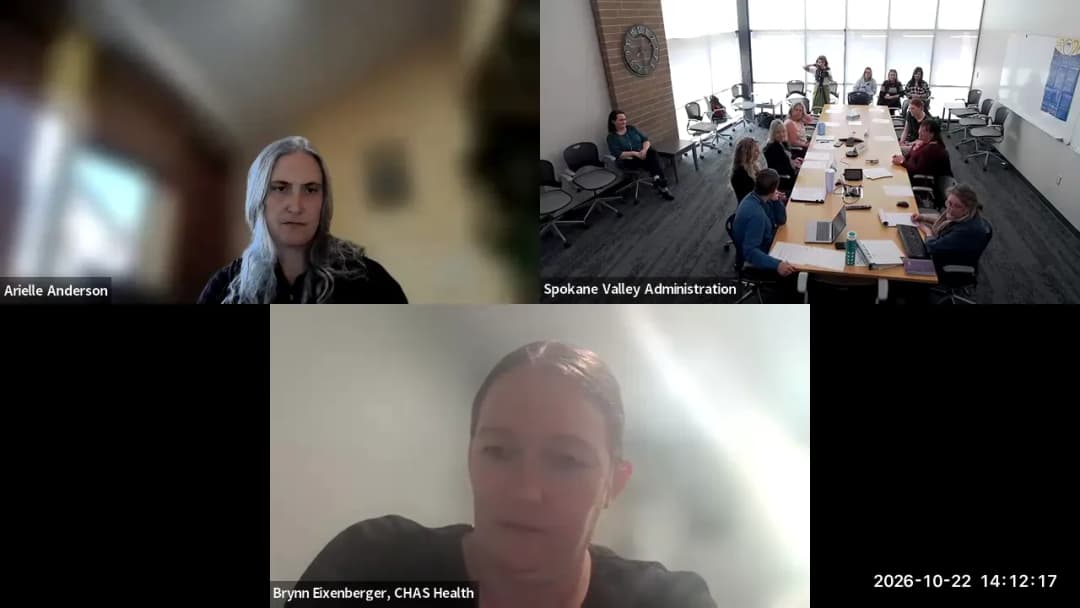
The Spokane Valley Homeless Housing Task Force met to receive updates on two forthcoming RFPs and the regional Point-in-Time Count, welcome two new members, and approve the July 2026 meeting minutes. The agenda lists the meeting date as October 22, 2026, while the source metadata indicates October 26, 2026; this summary uses the metadata date. Consent Calendar - The July 2026 meeting minutes were approved unanimously by voice vote after the task force reached a quorum. Public Comments & Testimony - No public comments were offered during the general public comment opportunity. New Member Introductions - Bryn/Brent Eichenberger, a registered nurse and Director of Utilization and Care Management at CHAS Health, introduced themselves and expressed excitement about aligning their work with the task force. They noted that CHAS has a clinic in Spokane Valley and mobile outreach teams that work alongside the city’s team. - Jessica Lowry, the new CEO of the Spokane Valley Chamber of Commerce, was welcomed. She shared her six months with the Chamber and prior nonprofit experience with Hutton Settlement Children’s Home and Joya Child and Family Development. Housing and Homeless Program RFPs Update - Staff reported that the City Council approved the task force’s recommendation to move forward with the Affordable Housing and Supportive Sales Tax RFP. Funding may be used for rental assistance, new affordable housing units, operational assistance for affordable housing, and some administrative costs. - The RFP is expected to offer up to $1 million. The task force was told the fund balance is approximately $1.4 million, with another $200,000 expected in early 2027, and annual revenues are roughly $200,000. - Staff noted contracts could be multi-year, possibly up to two years, depending on the project type, with construction projects requiring more time. - The Homeless Outreach Services RFP was also discussed. The current contract with Frontier Behavioral Health expires June 30, 2027, and competitive bidding is required. The RFP is expected to be released before the end of the year, possibly in November, with a special task force meeting likely in the spring to meet the timeline. - Eric and Gretchen described the co-deployment model where case managers and social workers work alongside two dedicated homeless outreach deputies. For 2026, the team has helped 60 households into permanent housing, including 20 households in the last quarter, and was described as very strong compared with county-funded outreach performance metrics. - Several members expressed support for potentially expanding the number of dedicated homeless outreach deputies, but noted budget limitations. Public safety already makes up about 65% of the budget, and the expected public safety contract increase is approximately 20%, prompting one member to say “math gets in the way of communication." - A member asked Frontier about TrueBlood-eligible clients in the valley. Frontier representatives said there are only a handful in the valley, though more are on downtown caseloads, and that TrueBlood resources are not reported to HMIS. Discussion included interest in better communicating TrueBlood eligibility to shelters and outreach teams. Point in Time Count Update - Staff explained that the Point-in-Time Count, which counts sheltered and unsheltered people on a single night in January, will now be conducted every other year because federal and state guidelines aligned and the local CoC voted for that change. The next PIT Count will be in January 2028. - The single-night PIT Count was compared with other data sources: the PIT Count is closer to 2,000, the HMIS-based LSA report showed about 7,000 people over the year, and a state Department of Commerce report estimated about 17,000 people in the county are homeless or unstably housed. - Ariel Anderson added that improved HMIS data entry by street outreach teams provides a more accurate and useful picture than the one-night count. A member expressed relief and agreed the data point was not worth the annual effort. Key Outcomes - The task force approved the July 2026 meeting minutes unanimously. - No other action items were taken. - Next steps include releasing the two RFPs, likely before the end of the year, and continuing to review proposals through the task force before recommendations go to City Council.
The Spokane Valley Planning Commission met at City Hall on Thursday, October 22, 2026, at 6:00 p.m. to review the draft 2026-2046 Comprehensive Plan and Development Regulations. The public hearing was opened at approximately 6:07 p.m. After staff presentations, public testimony, and deliberation, the commission voted 7-0 to recommend approval to the City Council with amendments. Consent Calendar - Agenda approved 7-0. - Minutes of the October 8, 2026 meeting approved 7-0. Commission Reports & Administrative Report - Vice Chair McKinley reported attending the Tuesday City Council open house and meeting, noted shared issues, and commented that the city should reduce its reliance on grants and trim government. - City planner Steve Roberge said a possible additional meeting is targeted for November 5, 2026, if needed. Public Comments & Testimony - William Medge, a Spokane Valley property owner living just outside the city, said the draft’s ban on short-term rentals in ADUs while allowing them in the main house is overly restrictive; he asked the commission to consider allowing one short-term rental per property regardless of which structure is used. He also voiced concern that a hilly residential neighborhood south of the freeway near Argonne is zoned RC/commercial, which discourages homeowners from investing in improvements. - Steve Burks, owner of the Treehouse Club, a licensed cannabis retailer operating in Spokane Valley since December 2014, thanked the commission for reconsidering cannabis relocation but argued the proposed restrictions could make relocation practically impossible. He questioned why Pines, Evergreen, and Sullivan were excluded while Sprague, Argonne, Mullen, and Trent were included, why Trent Avenue sites must be directly on the highway, and why the MU zone was excluded. He noted state law already imposes nine 1,000-foot restricted-entity buffers, while the proposal adds seven more, and he requested a parcel-level analysis showing how many sites remain available. He urged adoption of state regulations without the additional city restrictions. Discussion Items - Staff, led by city planner Steve Roberge and staff member Tony, presented draft development code changes, including: making final plats a Type 1 permit; removing courtyard apartments, sixplexes, and stacked flats as middle housing types; adding flexibility for battery energy storage systems in industrial zones and at hospitals/911 dispatch centers; counting accessory structures toward maximum residential lot coverage; allowing existing cannabis retailers to relocate under specified conditions; incorporating Department of Ecology-required wetland and stream changes; and removing obsolete pre-1991 setback language. - Staff explained the battery energy storage changes keep the 2 MWh exemption, allow up to 10 MWh systems as accessory uses in industrial zones and at state-licensed hospitals and 911 dispatch centers, and add a 100-foot residential setback, screening, and regulatory compliance requirements. - The cannabis proposal would allow existing licensees as of the expected December 15, 2026 adoption date to relocate in CMU, IMU, and RC zones, subject to location and buffer requirements, including reducing the Centennial/Appleway trail buffer from 1,000 to 500 feet. Staff estimated more than 150 parcels could be available under the proposed regulations, though site-specific review would be required. - Commissioner discussion addressed shared parking for commercial uses with complementary hours, with staff noting that the exemption from parking requirements for commercial uses under 3,000 square feet is state-mandated. The commission agreed to ask staff to draft shared-parking flexibility for compatible, non-conflicting uses. - Staff reviewed six individual zoning/land use amendment requests. Staff recommended five: a two-parcel request near Evergreen north of Broadway to CMU; a request at Broadway and Marguerite to CMU; two Barker-area parcel requests from R3 to CMU; and a city-requested IMU-to-mixed-use change near Trent/Millwood. Staff did not recommend the sixth request near the Mullan/Argonne interchange, citing spot-zoning concerns and impacts on commercial capacity. After discussion, the commission chose not to rezone that RC area, noting the new code would allow middle housing in RC zones. - Comment letters were discussed: Washington Department of Fish and Wildlife comments were generally treated as suggestions rather than requirements, while Department of Ecology comments led to code changes. Fire district comments on street standards were largely deferred to a future street standards review. Key Outcomes - The commission voted 7-0 to move the draft 2026-2046 Comprehensive Plan and Development Regulations forward to the City Council with amendments. - Cannabis amendment (7-0): add relocation eligibility within 300 feet of Pines from Sprague to Trent, Sullivan from Sprague to Trent, and the one-way portion of Appleway Road. - Short-term rental amendment (7-0): allow only one short-term rental per lot, whether in the primary dwelling or an ADU; short-term rental defined as a stay of fewer than 30 consecutive nights. - Shared parking direction (7-0): staff will prepare flexibility for shared parking among multiple commercial uses with compatible, non-conflicting hours and bring it back for the next meeting. - Staff will prepare revised code language, findings of fact, and conclusions for the November 5, 2026 meeting. If completed then, the November 12 meeting would not be needed.
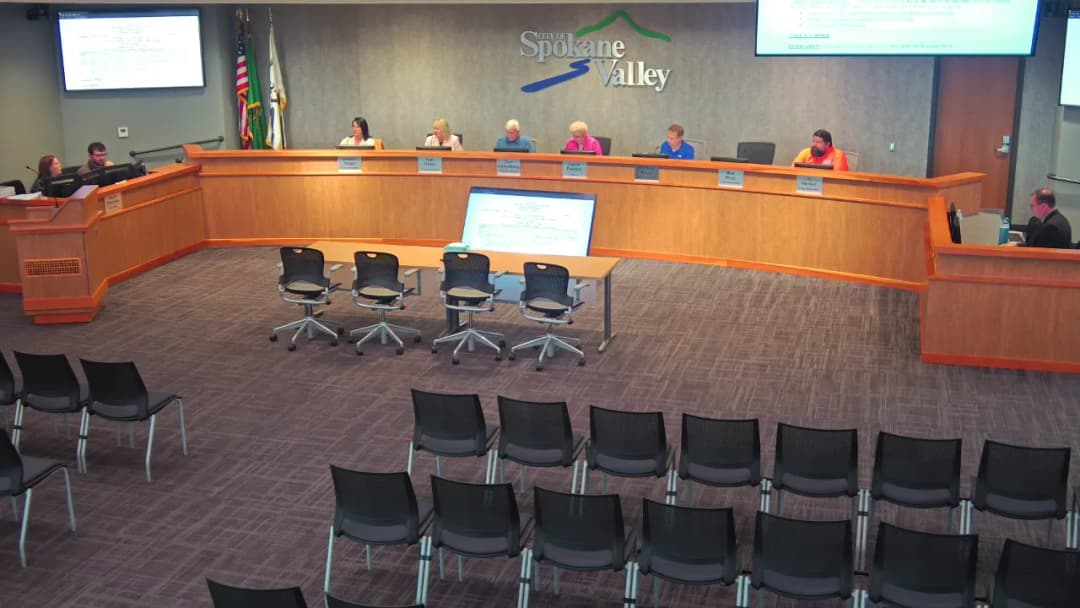
The Spokane Valley City Council met at 6:00 p.m. on Tuesday, October 20, 2026, at City Hall. The meeting included a special presentation honoring Bob Boyle, action on the property tax levy, a lodging tax application for golf course maintenance, and an amendment to the homeless outreach services contract. Public comments addressed helicopter patrols and AI efficiency tools. All action items passed 6-1 (Councilmember Merkel dissenting). Council also received reports on comprehensive plan code updates, an IT staffing request, and the 2026 budget amendment. Consent Calendar - Approval of Agenda: Moved by Councilmember Wick, seconded by Councilmember Merkel. Unanimously approved. Special Presentation: You Rock Recognition - Bob Boyle (President of Hanson Industries, retiring at year-end) was recognized for decades of community development, including transforming Indiana Avenue into a retail hub, contributing to the Valley Mall and Evergreen interchange, and partnering with the city on traffic mitigation. Multiple council members praised his vision and collaboration. Boyle thanked the city and highlighted Raymond Hanson's original vision. Public Comments & Testimony - Jonathan Plum (Spokane Valley resident): Advocated for using AI to reduce time on public records requests and city operations. Offered to help explore AI tools to save costs and improve efficiency. - Taylor Hershey (homeowner near South Evergreen/12th): Requested a report on Sheriff’s helicopter patrols, citing noise, cost (estimated $2,500/hour, over 300 hours/year), and low crime rates in the area. Called the patrols police overreach and urged alternative patrol methods. Action Items Ordinance 26-009: Property Tax Levy for 2027 - Second reading. Proposed levy of $14.6 million (no 1% increase; includes $250,000 from new construction). Rate: $0.79 per $1,000 assessed value. - Councilmember Merkel moved to amend to reduce levy by 10%—failed for lack of a second. - Discussion: Mayor Patton listed upcoming cost pressures (law enforcement contract increases of 16-29%, detention services, street preservation). Councilmember Haley noted $34/household savings is minor compared to long-term infrastructure costs. Councilmember Wick emphasized stability and predictability. - Vote: Motion to approve ordinance passed 6-1 (Merkel opposed). Motion: City LTAC Application for Golf Course Maintenance - Authorization to apply for $125,000 in lodging tax funds for 2027 operating and maintenance costs. Councilmember Merkel opposed, stating poor return on investment and suggesting alternative program restructuring. - Supporters noted hoteliers report full occupancy during events and early revenue exceeding projections. Councilmember Kelly cited 14 scheduled events, five large draws. - Vote: Passed 6-1 (Merkel opposed). Contract Amendment for Homeless Outreach Services - Amendment to reallocate $20,000 from pet boarding to discretionary funding and add $40,000 for housing assistance, increasing the contract total to $586,000 (including indirect costs). - Statistics: Frontier Behavioral Health assisted 37 households into permanent housing in 2025 and 60 in 2026 so far. The $30,000 housing allocation from November 2025 was fully expended. - Councilmember Merkel questioned lack of outcome data and whether housing was sustained. Councilmember Yeager supported based on ride-along experience. - Vote: Passed 6-1 (Merkel opposed). Discussion Items Draft Comp Plan & Development Regulations - Staff presented state‑mandated code updates (Steve Roberge, Mike Basinger; Ethan Spoo online). Key changes: - Accessory Dwelling Units: Two per lot, allowed as attached/detached; owner occupancy requirement removed. - Middle Housing: Up to 4 units on all residential lots; up to 6 if two are affordable. - Co-Living Housing: Allowed in multifamily zones; parking limited to 1 space per 4 sleeping rooms. - Step Housing: (shelters, transitional housing) now a Type 1 permit (no public notice); must treat like other housing in zone. - Unit Lot Subdivision: Allows subdividing units without increasing density; requires HOA management considerations. - Council questions focused on notification for step housing, hotels in industrial zones, and property management for subdivisions. Staff will investigate and return with further recommendations. Local Recording Fees RFP for Homeless Services - Consensus to proceed with issuing an RFP for homeless outreach services (current contract expires June 2027). Councilmember Merkel requested output‑based performance measures (e.g., long‑term housing stability). Staff will draft RFP for council approval. IT Position Discussion - Deputy City Manager Eric Lamb reported a rising workload: 2,077 help desk tickets in 2025 (8.8/day) vs. 2,541 YTD 2026 (11/day). The city’s ratio of IT staff to supported employees (1:44) far exceeds recommended 1:18. Requested a new IT support assistant ($121,366) to handle basic requests and allow senior staff to focus on cybersecurity, camera systems, and SharePoint implementation. - Councilmember Merkel questioned justification and suggested outsourcing. City Manager Holman noted past outsourcing was unsuccessful. Councilmember Wick supported based on IT complexity. Councilmember Kelly flagged overall staffing increase but acknowledged the need. - No formal action; discussion only. 2026 Budget Amendment - Finance Director Chelsie Walls presented proposed amendments affecting 16 funds: revenue increases of $9.5 million (including $2M sales tax, $540K catering accounting changes) and expenditure increases of $8.6 million (including $90K for litigation, $2.1M transfer to capital reserves, street and park project adjustments). - Council consensus to return on October 27 for public hearing and first reading. A point of order raised conflict of interest for Councilmember Merkel regarding the $90,000 litigation item; City Attorney noted no action taken tonight and minimal risk. Councilmember Merkel declined to recuse. Key Outcomes - Property Tax Levy (Ordinance 26-009) approved 6-1 for 2027 at $14.6 million. - LTAC Application for golf course maintenance approved 6-1. - Homeless Services Contract Amendment approved 6-1, adding $40K for housing and reallocating $20K. - Consensus to proceed with homelessness services RFP and 2026 budget amendment to public hearing. - No action on IT position; discussion will inform budget decisions. - Council directed staff to explore industrial zone hotel restrictions and step housing notification options within the comprehensive plan process. Council Comments - Councilmember Kelly: Acknowledged Councilmember Merkel’s budget email effort but disagreed; cautioned against personal attacks. - Councilmember Wick: Praised the Pine’s grade separation project; suggested roundabout education. - Councilmember Merkel: Defended his 10% tax cut proposal and rejected recusal. City Attorney warned against serial communications and clarified the public records litigation. - Councilmember Yeager: Criticized Merkel’s conduct and called the email proposal “nuts.” - Exchange regarding decorum and potential OPMA violations. Adjournment - Motion to adjourn passed unanimous.
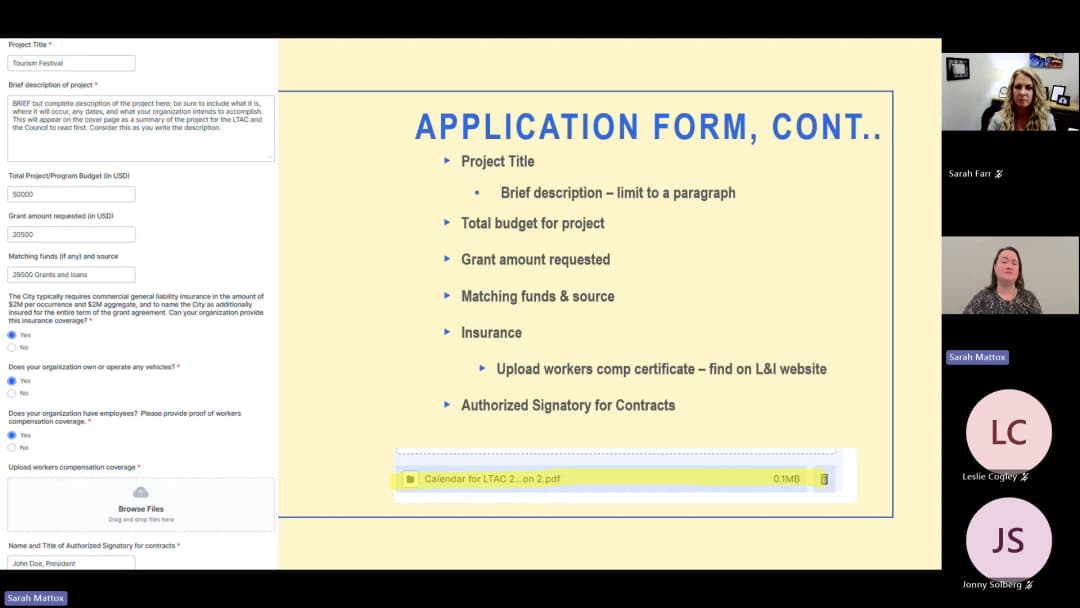
The City of Spokane Valley’s Accounting and Finance Program Manager, Sarah Farr, and Accountant Sarah Maddox hosted a technical assistance meeting on October 20, 2026, for prospective applicants to the 2027 Lodging Tax Grant program. The meeting provided an overview of the legal framework for lodging tax revenue, eligible uses, the competitive application process, and key deadlines. The City plans to award approximately $250,000 from the general 2% portion of the lodging tax for the 2027 cycle, prioritizing continued support for legacy organizations and alignment with the city’s tourism strategic plan. Public Comments & Testimony - A representative (Leslie) asked how to track hotel stays if their organization currently lacks a method. Sarah Farr advised that applicants must provide estimates at application using a defined methodology (e.g., direct count, surveys, registration) as outlined in the JLARC guidelines, with a concrete plan for tracking actuals for post-event reporting. Discussion Items - Legal Framework and Eligible Uses: Sarah Farr summarized Washington state law permitting the city to impose a 3.3% lodging tax, split into a 2% portion for general tourism purposes (operations, marketing, events) and a 1.3% portion restricted to capital expenditures for municipalities or public facility districts. The 2027 grant funding draws exclusively from the 2% portion. - Lodging Tax Advisory Committee (LTAC): The statutorily required LTAC, composed of two hoteliers, two representatives from eligible agencies, and chaired by Mayor Laura Patton, reviews applications and makes funding recommendations to the City Council. Applicants must present their proposals to the LTAC on November 18, 2026. - Available Funding and Council Priorities: The City Council’s goals prioritize building the capital (1.3%) fund, leading them to offer only the 2% portion for 2027, with approximately $250,000 anticipated. The Council directed the LTAC to prioritize continued support for legacy organizations and projects aligned with the city’s tourism strategic plan. - Application Requirements and Process: The application portal closes strictly at 4:00 PM on October 30, 2026. It cannot be paused or saved mid-application. Eight mandatory documents in PDF format are required, including a Business Statement, Project Summary, Detailed Project Budget, Scope of Work, Impact on Tourism estimate template, Goals and Metrics, Project Authorization, and Board of Directors list. Optional documents include an operating budget, presentation materials, and prior tourism impact reports. Funding is disbursed on a reimbursement basis. Applicants must confirm their ability to meet insurance requirements ($2M general aggregate and per occurrence commercial general liability, plus auto and workers' compensation). - Impact on Tourism Template: Sarah Maddox explained the mandatory Impact on Tourism form, emphasizing that “paid lodging nights” track room nights, not total attendees. Applicants must provide estimates using JLARC-approved methodologies. - Application Portal Demonstration: Sarah Maddox walked through the online portal, showing how to upload documents, view error notifications, and certify required statements. She strongly warned against starting the application without having all documents saved locally, as the system will not allow progress to be saved. Key Outcomes - Vote/Decision: No formal votes were taken at this technical workshop. The application parameters and directions were presented as established by City Council policy. - Key Dates Announced: - Application Submission Deadline: October 30, 2026, at 4:00 PM. - Applicant Presentation to LTAC: November 18, 2026. - Staff Presentation of LTAC Recommendations to City Council: December 8, 2026. - City Council Final Award Determination: January 2027. - Contract Execution: Expected within weeks of the January council decision. - Directives for Applicants: - Develop a clear methodology for tracking visitor estimates and actuals. - Confirm insurance coverage capability at the time of application. - Save all application materials locally before opening the online portal.
The Spokane Valley Tourism Promotion Area (TPA) Commission met on October 16, 2026, at 6:45 PM to review the annual tourism summary, discuss the 2027 budget, and receive presentations from contracted service providers Spokane Sports (sports recruitment) and 116 & West (destination marketing). The commission ultimately approved a motion to allocate $700,000 for sports recruitment, $500,000 for destination marketing, and up to $170,000 to replenish the opportunity fund, with further adjustments to the 116 & West work plan to follow. Annual Summary & Financial Report - Terry Stripes presented tourism data for Spokane County and the 16 TPA properties: $1.55 billion in visitor spend, 10.2 million visitors, $2.44 billion in economic impact, $242 million in local and state taxes, $151 per person spending, and over 17,000 tourism-supported jobs. - Hotel performance metrics (occupancy, average daily rate, revenue) were reviewed for the past year. - TPA revenues are tracking 7% year-to-date over last year (up from 3.7% in June). - The 2027 budget was presented: total available revenue approximately $1.3 million (later adjusted to $1.4 million to maintain a $325,000 fund balance). Key considerations included maintaining 25% reserves, $30,000 for Placer AI data (two-year contract), and a $170,000 opportunity fund. Discussion Items 2027 Budget Framework - Commissioners discussed the potential sunset of the additional $2 TPA tax (currently $4 per room night) in June 2027, which could cut funding in half. Options included a legislative fix or increasing the TPA to $5 per room night. - The commission agreed to adjust the total budget to $1.4 million, keeping the fund balance above $325,000. Spokane Sports Presentation (Ashley Blake) - Spokane Sports requested $700,000 (flat commitment) for 2027 to deliver nine committed events at the cross-country venue in Spokane Valley, projecting 6,925 hotel room nights. - Key costs: $420,000 in direct event commitments (timing, security, officials, etc.) and parking/transportation (a new challenge due to higher-than-expected attendance). The remaining $280,000 would support sustaining the calendar (pipeline building, site visits, hotel relations, third-party impact analysis). - Discussion focused on the difficulty of converting one-night event stays to multi-night stays (only 5% possible for youth/collegiate events), the need for multi-year funding stability, and potential for parking infrastructure investment through LTAC or state grants. - Commissioners expressed concern that the parking/transportation costs may be ongoing and questioned whether some expenses should be covered by other city funds. 116 & West Presentation (Callie Mendoza and Jessica Jackson) - 116 & West proposed a 2027 strategy shift from “win the booking” to “win the extra night,” requesting $1 million to fund a three-pronged campaign: Convert (maintain lower-funnel conversion), Extend (target audiences before trip length is set), and Inspire (creative assets showcasing Spokane Valley as a home base for regional exploration). - They highlighted a pilot Expedia program that generated $227,100 in net hotel revenue from a $50,000 investment (April–August 2026), attributed directly to their ads. - Discussion included concerns about sending travelers to OTAs (vs direct hotel bookings), the inability to separate attribution from hotel-owned marketing, and the value of AI/search platforms (e.g., ChatGPT) for future marketing. - Commissioners questioned the $125,000 course event targeting component given that sports events largely generate one-night stays; higher priority was placed on AI and overall booking conversion. Public Comments & Testimony - No public comments were made; no attendees signed up for comment. Key Outcomes - Motion (made by Commissioner Stripes, seconded): Recommended that city council authorize contracts of $700,000 with Spokane Sports for 2027 sports recruitment, $500,000 with 116 & West for 2027 destination marketing, and replenishment of the 2027 opportunity fund with up to $170,000 from TPA revenues. The motion passed unanimously (all present in favor, none opposed). - Next Steps: 116 & West will revise their work plan to align with the reduced budget ($500,000) and present revised priorities to the commission. The commission emphasized priorities: retaining lower-funnel conversion and AI marketing over course event targeting. - The commission noted the possibility of increasing the TPA rate from $4 to $5 per room night, contingent on state legislative decisions on the $2 sunset, which is expected by June 2027.