Spokane Valley City Council Special Meeting: OPMA/PRA Training – January 13, 2026
STREAMING COPY IN PREPARATION — RECORDING AVAILABLE FROM THE ORIGINAL SOURCE
Spokane Valley City Council Special Meeting – January 13, 2026
This special meeting of the Spokane Valley City Council convened at 5:15 p.m. on January 13, 2026, with Mayor Patton presiding. The sole agenda item was a non‑action training session conducted by City Attorney Kelly Konkright covering the Washington State Public Records Act (PRA) and the Open Public Meetings Act (OPMA). No formal public comments were accepted, and no votes or decisions were taken.
Discussion Items
Public Records Act (PRA) Training
- City Attorney Konkright explained the PRA’s scope, including definitions of public records, the requirement to disclose records (not information), and the obligation to preserve records on personal devices if they relate to city business.
- He emphasized that text messages, social media posts, and emails on personal devices discussing city business are public records and must be retained.
- Best practices were outlined: avoid using personal devices for city business; if unavoidable, retain records; use official council social media accounts for city business (per Appendix H of the governance manual).
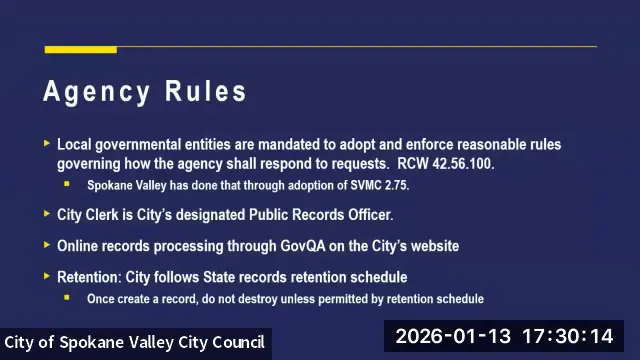
- The city’s PRA response process was described: the city clerk is the records officer; requests can be verbal; a response is due within five days; exemptions (e.g., attorney‑client privilege, personal identifying information) are common.
- Penalties for violations were discussed: one‑way attorney fees for prevailing requesters, daily per‑page penalties, with mitigating (good faith) and aggravating (reckless) factors.
Open Public Meetings Act (OPMA) Training
- Konkright defined a “meeting” as any gathering of a quorum (four or more council members) where action (including discussion) on city business occurs. Serial meetings among fewer members can also violate the OPMA.
- He cautioned against replying to all on council‑wide emails and against discussing city business at social gatherings with three or more council members.
- Meetings must be noticed and open to the public; secret ballots are prohibited; attendees cannot be forced to provide names to attend, but may be required to speak.
- Executive sessions are allowed for specific purposes (e.g., personnel, litigation) but no final action may be taken in closed session.
- Penalties include invalidation of actions taken in violation.
Councilmember Merkel’s Questions
- Councilmember Merkel questioned the attorney’s reference to a city policy on providing information when known or accessible. Attorney Konkright stated he would check and could not immediately cite a specific policy number.
- Merkel also asked why the PRA training did not address campaigning as a non‑public record. The attorney declined to answer, citing pending litigation between Merkel and the city.
- Merkel disputed a statement he attributed to the attorney about not being able to conduct city business without a quorum; the attorney denied making that statement and suggested Merkel’s quote was incorrect.
Key Outcomes
- No decisions, votes, or directives were made. The meeting was purely informational and adjourned after the training.
- Councilmembers were reminded to comply with the PRA and OPMA, and to use official channels for city business.
Meeting Transcript
Okay. Now we're good. Mayor Patton, it is 5 15 PM when you're ready to begin. Thank you. Good evening. The Spokane Valley City Council special council meeting of January 13th, 2026 is now. Not convened. Councilmember Haley. Here. Councilmember Yeager here. Councilmember Kelly. Present. Councilmember Wick. Here. And Councilmember Merkel, are you with us? Could you unmute your mic and ah, I am here. It's coming in a little bit choppy. Are you guys able to see me? Uh we don't have your visual up because we will be running a PowerPoint presentation. Perfect. Okay, thank you very much. Yep. Thank you. All right. We have one item on the agenda, and that is a non-action item, which is the uh open public meetings and public records access trainings uh with city attorney Kelly Conkrite. All right. Well everybody's favorite part of the year. Get some training here. Um I'm joking, of course. Um, but it is an important um subject. No, we don't have a ton of time, so I'll just jump into it and get through it and uh hopefully have some time for for questions at the end. Um so public records act has been with us for a long time, well over fifty years. It's older than me. Um codified in the RCW at Title 42, Chapter 56. Applies to all uh government agencies within the state of Washington or except for federal governments that are subject to the uh federal uh open open records act. Um so it applies to state agencies, local agencies, quasi-governmental entities, um, and some other uh entities, but for your purposes, you just need to know that it applies to the city of Spokane Valley. It's a strongly uh worded mandate. Um as you can see here, uh the people of the state do not yield their sovereignty to the agencies that serve them. People in delegating an authority do not give their public servants the right to decide what is good for the people to know and what is not good for them to know. The people insist on remaining informed so that they may maintain control over the instruments they have created. So that the public can maintain control over government. So this is a policy of transparency so that the voting public um knows what government is doing and not doing because all government uh in course in the United States uh exists to serve the the public. So what is covered under the public records act? Well, it's not all records, it's only public records. So a public record is I've broken down the defin the legal definition. It's any writing that contains information relating to the conduct of government or the performance of any governmental uh or proprietary function, which record is prepared, owned, used, or retained by any state or local agency. So for any document to be a public record subject to the requirements that we're gonna talk talk about a little later, it needs to satisfy all of these requirements. Um in addition to you know, traditional physical documents like what I have here. It does it can include posts on social media, even metadata and video or audio recordings also come within the definition of a of a record or of a writing. The uh public records act only requires agencies to maintain and disclose records.
openpublica.com