Spokane Valley City Council Special Meeting – Comprehensive Plan & HCDAC Grants – March 10, 2026
STREAMING COPY IN PREPARATION — RECORDING AVAILABLE FROM THE ORIGINAL SOURCE
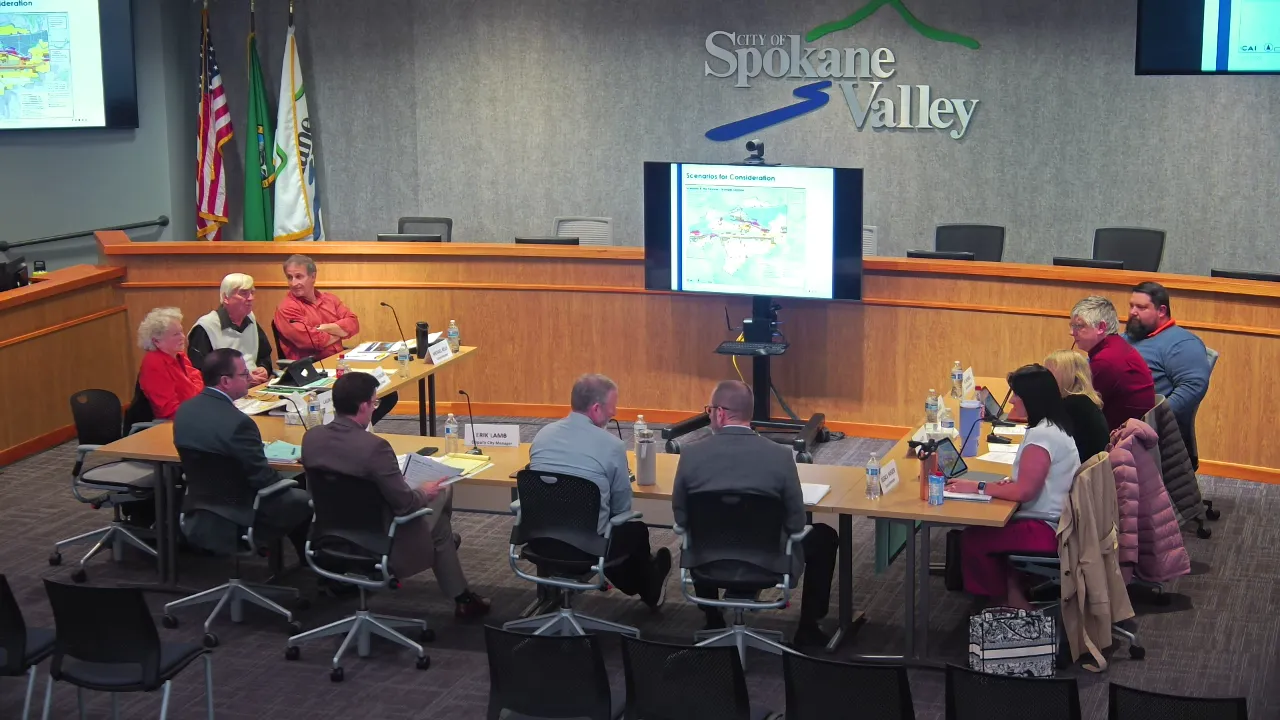
Spokane Valley City Council Special Meeting – March 10, 2026
The Spokane Valley City Council held a special meeting on Tuesday, March 10, 2026, at 5:00 p.m. at City Hall to discuss the Comprehensive Plan Update and review HCDAC grant applications. The meeting featured presentations from staff and a consultant, extensive council deliberation on land-use scenarios, and input on proposed allocations for affordable housing and community development grants.
Discussion Items
Comprehensive Plan Update (Non-Action Item)
- Overview: Mike Basinger reviewed the 2016 comprehensive plan history, highlighting the creation of corridor mixed-use zones, elimination of ineffective designations (e.g., garden office), and changes to address state mandates. Steve Roberge noted two deadlines: a draft submission to the Department of Commerce by end of June 2026 and full adoption by end of 2026.
- Consultant Presentation: Elliot from Community Attributes presented three land-use scenarios for the update:
- No Action: Only state-mandated changes (ADUs, middle housing) take effect; city would likely be non-compliant.
- Scenario A: Rezone a strip of R4 land north of Sprague to multifamily (MFR) or corridor mixed use, with density capped at 32 dwelling units per acre (du/ac) in multifamily and mixed-use zones. Includes a UGA expansion for commercial/industrial in the northeast.
- Scenario B: Keep R4 as is, but raise density caps to 40 du/ac in mixed-use and regional commercial (RC) zones to meet housing allocation.
- Key Council Discussion:
- Members debated adding multifamily as a permitted use in RC zones (e.g., mall, auto row). Councilmember Merkel expressed concern about losing sales-tax-generating uses; others suggested requiring ground-floor retail to preserve commercial activity. Councilmember Yeager and Wick favored vertical mixed-use near strategic investments.
- Councilmember Merkel criticized state mandates that tie affordability to housing type, arguing single-family homes should not be excluded from lower-income allocations.
- A majority of council expressed preference for Scenario A (32 du/ac, rezone north of Sprague). Mayor Patton, Councilmembers Haley, Wick, Kelly, and Deputy Mayor Hattenberg supported A; Councilmember Yeager preferred B; Councilmember Merkel leaned toward A but with caveats.
- Council discussed potential expansion of MFR zoning south of Sprague. Mayor Patton and several members opposed; staff will analyze options and report back.
- Parking Study: City Manager Holman and Public Works Director Blagan introduced a proposal to spend up to $100,000 on a parking study to seek a state exemption from new parking-requirement preemptions. The study would help mitigate the impact of scattered parking from dense development. Council provided unanimous consensus to proceed, with funding to be included in a future budget amendment.
HCDAC Grant Applications (Non-Action Item)
- Overview: Eric Robison (Housing & Homeless Coordinator) and Gloria Mantz (via Zoom) presented the Housing Community Development Advisory Council (HCDAC) grant slate. The city has four voting members on the HCDAC board. The council was asked to provide input to the voting members before the March 12 HCDAC meeting.
- Affordable Housing (8 applications, ~$3M available):
- Categories: Home (350k), Document Recording Fees (DRF), Sales/Use Tax.
- Committee members (Deputy Mayor Hattenberg, Councilmember Wick) shared their recommendations:
- Home Fund: Both recommended $350k to Habitat for Humanity for 12 new homeownership units in Spokane Valley and Airway Heights (the only project eligible solely for Home funds).
- DRF: Contributions varied. Hattenberg recommended funding projects like Chalice Place ($900k for land acquisition) and others; Wick argued DRF should be reserved for future homeless services (outreach, rapid rehousing) and recommended no allocation to these projects. The county previously indicated a preference for using DRF for these specific applications, but Commissioner Brooks suggested flexibility.
- Sales/Use Tax: Both recommended the River Walk Point modernization ($1M) for senior/disabled housing.
- Council discussion: Councilmember Kelly questioned Habitat for Humanity's eligibility criteria regarding citizenship; no definitive answer. Councilmember Kelly also questioned the for-profit developer (Cochrane) in the Threshold apartments project, but noted the mixed-income approach.
- Community Development (7 applications + disaster recovery):
- Capital/Public Works ($1M):
- City of Spokane Valley requested $698,000 for sewer connection assistance for up to 25 low-income households in a last unsewered area. Supported by all.
- Town of Fairfield requested $253,000 for collapsed sewer line repair. Supported by committee.
- Salvation Army Stepping Stones ($100k for rehab of 30 transitional housing units in Spokane) – less priority given the other projects.
- Public Services ($50k): Four applications. Committee recommended Lutheran Community Services ($40k) for victim advocacy and SNAP/Meals on Wheels ($10k) for emergency meal kits. Salvation Army's new youth program was not prioritized.
- Disaster Recovery ($8.4M): Single applicant, Gray-Orion Recovery Group (new nonprofit), to rebuild 6–12 homes/year in Gray and Oregon road fire areas. Council expressed concern about oversight but acknowledged need; committee will monitor compliance.
- Capital/Public Works ($1M):
- Outcome: No formal vote; council input will guide the HCDAC voting members at the March 12 board meeting. Final approval rests with the Board of County Commissioners (May 12).
Key Outcomes
- Land Use Direction: Staff to focus on Scenario A (32 du/ac cap, rezone north of Sprague) and explore potential expansion of multifamily zoning south of Sprague for further council consideration.
- Parking Study: Unanimous consensus to proceed with a $100,000 parking study; budget amendment to be brought forward in April.
- HCDAC Input: Council provided guidance to voting members, including support for Habitat for Humanity (Home fund), River Walk Point (Sales/Use Tax), sewer projects (Spokane Valley and Fairfield), Lutheran Community Services (Public Services), and careful oversight of the disaster recovery grant.
- Next Steps: Council will receive further updates on the Comprehensive Plan (additional elements in later meetings) and the budget amendment for the parking study.
Meeting Transcript
Mayor Patton, it's five o'clock when you're ready. All right. Okay, I think we're ready to bring this special meeting to order on Tuesday, March 10th, 2026. So if you stand for the Pledge of Allegiance. So the clerk will call the roll. Thank you. Mayor Padden. Here. Deputy Mayor Hattenberg? Here. Councilmember Kelly. Present. Councilmember Yeager? Here. Councilmember Haley. Councilmember Wick? Here. And Councilmember Merkel. Here. Thank you. We have the approval of the agenda. Move to approve the agenda. All those in favor? All right. Opposed. The agenda is approved. We have non-action items. The first is a review or report on the comprehensive plan. With Steve Roberts and Mike Basinger. And I will like to say, just to begin, first of all, I appreciate the approach that has been used. The state is mandating that we make these changes, and we want to make them in the best way possible. We're not dotting the I's and crossing the Ts on this yet. We have a lot more discussion to have. So if we can kind of keep it, you know, at that higher level and not delve into the super detailed level. So if you would like to proceed. Actually, I just follow up on the mayor's comment there. Um so as we get into this, Mike's gonna talk about how did we get here, what did we do in 2016? Um the one thing uh about tonight, we want to be able to have a good discussion following up on uh what Mayor Patton said, keep it at high level, but please if you see something in the document that you want to make note of or change, please feel free to mark that up and get comments over to Mike and Steve. That's one of the things if you remember Mike, I'm sure you do, um, that we received lots of input from the council in 2016, uh, written all kinds of stuff. So then we were able to compile those and make a really good document out of those. And uh some of the council members actually had meetings with constituents at McDonald's and did all kinds of zoning stuff, if you remember that. Um so yeah, please please feel free if you have a question or a concern or you don't like the way the language says, mark it up and provide that uh for staff so we can we can work that out for you. Yeah, so um as John mentioned, uh I was gonna provide a little context on how we got to the map that's uh right behind us here, which is our existing comprehensive plan. I went back, I was telling some of the council members at the advanced agenda meeting. I went back and looked at the video in 2016 and listened to it, and I'll say uh John and I we we looked a lot younger. Um my goatee was brown, it wasn't a beard, uh my hair was thicker, so yeah, exactly. But it it really was um telling for me to go back and and watch those videos just uh um see what we talked about. Um I think the biggest thing is is when we started out last time through this effort in 2016, we had a lot more comprehensive plan designations, and a lot of that was based on Euclidean zoning and Euclidean zoning. What you would do is you'd say have a higher intensity uh zoning classification, you would then buffer that with a lower intensity zoning classification. So for instance, in all of the north-south corridors, Argonne, Pines, Evergreen, Sullivan.
openpublica.com