Spokane Valley Planning Commission Meeting - March 26, 2026
STREAMING COPY IN PREPARATION — RECORDING AVAILABLE FROM THE ORIGINAL SOURCE
Spokane Valley Planning Commission Meeting - March 26, 2026
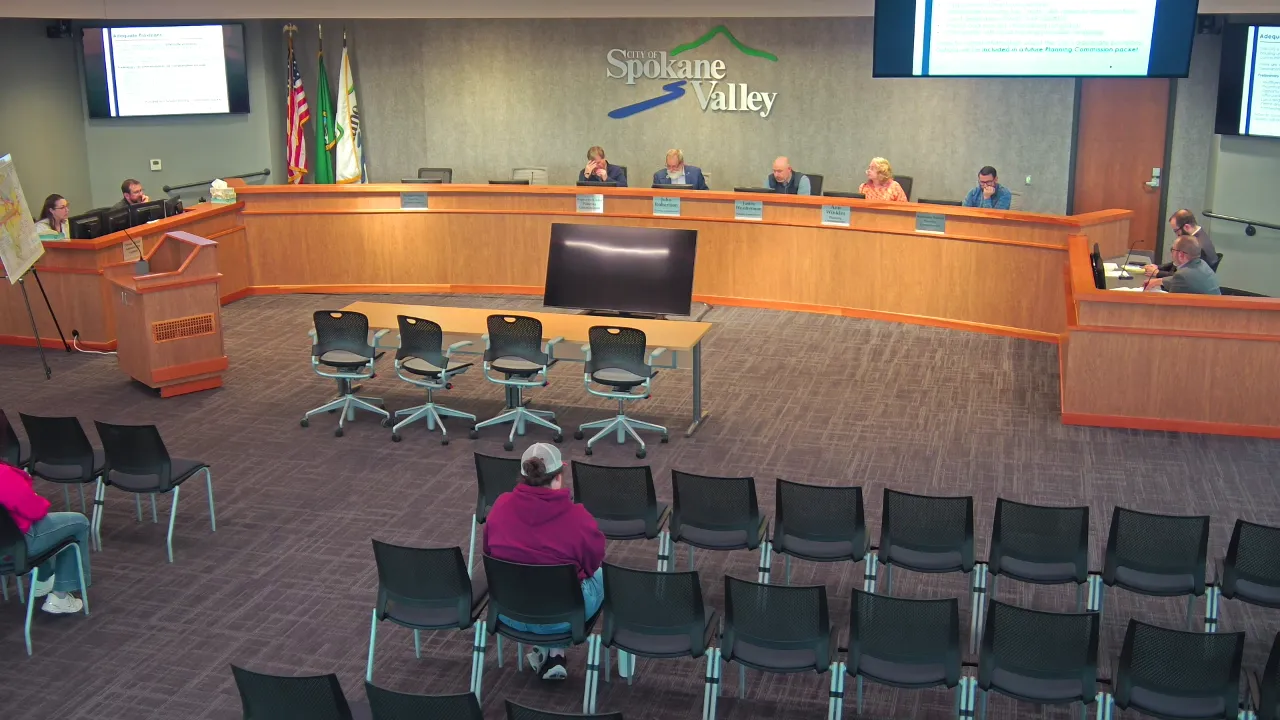
The Spokane Valley Planning Commission met on Thursday, March 26, 2026, at 6:00 p.m. in City Hall. Commissioners unanimously approved the agenda and the minutes from the February 26, 2026 meeting. The primary business was a presentation from consultants on three draft elements of the Comprehensive Plan: Housing (including the Racially Disparate Impacts Analysis), Utilities, and Climate & Resiliency. The commission discussed policy language, data accuracy, and alignment with state mandates. Public comment addressed cannabis equity licensing.
Commission Reports & Administrative Update
- Commissioner Winkler reported that the city approved funding for a parking study (requested earlier) and thanked staff. He noted public support via Facebook.
- Mr. Raver (staff) provided an administrative update: City Council expressed appreciation for the Comprehensive Plan approach, did not request modifications to policies, and identified Scenario A (which includes a rezone between Valleyway and Sprague) as their preferred land use alternative. Council also supported the parking study by consensus, with a likely budget amendment.
- The schedule was revised: next meeting on April 2 (roundtable), then cancel April 9 and April 23, hold a special meeting on April 30, and resume regular meetings on May 14. Commissioner Winkler noted he cannot attend the April 30 meeting.
Public Comments & Testimony
- Victoria Raminson spoke in support of allowing one additional social equity cannabis retailer in the city, citing state programs to increase minority-owned businesses and tax revenue. She suggested locating it in a light industrial zone and noted the city currently has only three cannabis stores while alcohol is widely available.
- A written comment from Justice Bryant was received and will be included in the minutes.
Discussion Items
1. Housing Element & Racially Disparate Impacts Analysis
- Elliot Weiss (Community Attributes) presented key themes: accommodating housing growth per state allocation, aligning with HB 1220 (affordability segments), HB 1110 (middle housing), and HB 1337 (accessory dwelling units). The Racially Disparate Impacts Analysis found that 15% of residents identify as BIPOC, with higher housing cost burdens and lower homeownership rates among BIPOC populations, and increased displacement risk in higher-concentration neighborhoods.
- Commission Discussion:
- Commissioner Winkler noted that policy H8 (page 28) is too vague ("work with service providers to bring additional resources to valley residents") and needs more specificity. Chairman confirmed consensus to revise.
- Commissioner Dingus raised concerns that policy HP6 (preserve and enhance established single-family neighborhoods by minimizing impacts of denser housing) conflicts with state requirements for middle housing. Elliot explained it was carried forward from the 2016 plan and agreed to reevaluate. Commissioner Weatherman defended the policy, noting many residents value neighborhood character. After discussion, consensus emerged to refine the language to clarify intent.
- Commissioner Dingus also noted that Exhibit 3 (income distribution) appears to compare 2015 and 2024 dollars without inflation adjustment, making it misleading. Consultants agreed to verify and adjust if needed.
- Commissioner Dingus suggested adding age demographics to the disparate impacts analysis to capture fixed-income residents. Consultants agreed if the commission desires; they noted it is not state-required but data is available.
- Commissioner Dingus and others noted the Sprague corridor is not pedestrian-friendly and that the plan should address walkability. Staff acknowledged this is a cross-cutting issue that could be taken up in the Capital Facilities element.
- Chairman asked for consensus on modifications: (1) revise H8 for specificity, (2) reevaluate HP6 language, (3) adjust Exhibit 3, (4) consider adding age demographics. Commissioners voiced general agreement.
2. Utilities Element
- Jen Dial (SCJ Alliance) presented an inventory update for electricity, natural gas, telecommunications, and broadband. Water, sewer, and stormwater are covered in a separate Capital Facilities element. Maps of cell towers and utility providers were included. New goals emphasize coordination with utility purveyors and utility corridor planning.
- Commission Discussion:
- Commissioner Dingus noted that language about "neighborhood character" in the utilities chapter (pages 10-11) could be more specific to avoid pitting neighborhoods against each other; suggested referencing existing code for siting utility infrastructure. Jen agreed to revise.
- Commissioner Weatherman pointed out that the scope description on page 2 includes water, sewer, and stormwater, but that information is not in this chapter. Jen agreed to remove that reference and add a hyperlink to the Capital Facilities element.
- Commissioner Winkler noted that Figure 2 (cell tower map) shows no towers in Spokane Valley, which appears incorrect. She also flagged a paragraph about Vera Water and Power’s solar project that implies only 65 customers signed up; she stated the program is fully utilized with thousands of customers but limited capacity. Jen agreed to correct both items.
- Commissioner asked about grid-scale power storage as an emerging trend; Jen agreed to add it.
- No concerns about capacity to meet future demand.
3. Climate & Resiliency Element
- Nicole Gutierrez and Megan Horst (Cascadia Consulting) presented the two sub-elements: greenhouse gas (GHG) emissions reduction and resilience. Key climate hazards for Spokane Valley by 2100 include a 13°F increase in average summer temperature, 86-100% decline in snowpack, 14% decrease in summer precipitation, increased wildfire risk (62% higher than U.S. average), and 18% increase in winter precipitation with more rain than snow. Emissions targets: 30% reduction by 2030, 70% by 2040, net zero by 2050 (from a 2022 baseline of 766,700 metric tons). Largest emissions sources: on-road vehicles (63%), natural gas buildings (24%). The vulnerability assessment highlighted low tree canopy in areas with vulnerable populations and older housing stock lacking energy efficiency.
- Commission Discussion:
- Commissioner Dingus observed potential conflicts: the plan promotes diversity and income equity, but climate policies (e.g., requiring electric vehicles) may be economically infeasible for low-income residents. Staff noted they are cross-referencing elements.
- Commissioner asked for clarification on policy CE-P27 (incentive-based commute trip reduction). Nicole explained it would expand current city employee programs to support local businesses in promoting carpooling, telework, etc.
- Commissioner Winkler requested access to the greenhouse gas inventory report and climate vulnerability assessment. Consultants said they will provide updated copies to staff for distribution.
- Commissioner Winkler expressed concern about tree canopy loss in older neighborhoods (south of I-90) and encouraged incentives for tree replacement. She noted the tree canopy map (Figure 3) shows areas where vulnerable populations coincide with low canopy.
- Commissioner Winkler also asked about historical emissions data; consultants stated no prior inventory exists for Spokane Valley.
- Commissioner asked how to reduce waste-related emissions; Nicole cited diversion and recycling policies in the element.
Key Outcomes
- Consensus decisions on Housing Element modifications:
- Revise policy H8 for greater specificity.
- Reevaluate policy HP6 (preserve neighborhood character) to align with state middle housing mandates.
- Adjust Exhibit 3 income distribution data for inflation.
- Consider adding age demographics to the disparate impacts analysis (to be confirmed at next meeting).
- Utilities Element revisions requested:
- Refine neighborhood character language.
- Remove scope reference to water/sewer/stormwater (redirect to Capital Facilities).
- Correct cell tower map and Vera solar project description.
- Add grid-scale power storage as an emerging trend.
- Climate Element: No formal votes; commissioners requested access to technical reports and noted need to ensure equity across elements. Staff and consultants will incorporate feedback and return with updated drafts at the next meeting (April 2, 2026).
- Next steps: The commission will hold a roundtable discussion on the same elements on April 2, followed by cancellations on April 9 and 23, a special meeting on April 30, and resumption on May 14. Ongoing public input is encouraged via the city website.
Meeting Transcript
And we're live. All right. I'd like to welcome everybody to the Spokane Valley Planning Commission meeting. Today is Thursday, March 26th, and it is now six o'clock. If everybody would please stand for the Pledge of Allegiance. One nation under God in the United States. In the visible with liberty of justice referral. Mrs. McLean, do we have a roll call, please? Chairman Robertson. Here. Vice Chairman McKinley. Here. Commissioner Weatherman. Here. Commissioner Winkler. Here. Commissioner Pokal? Here. And Commissioner Dingus is with us via Zoom. Here. Thank you. First thing on our agenda this evening would be to approve the agenda. Do I have a motion? So move uh move to approve the agenda as stated. Second. All those in favor say aye. Aye. Aye. Aye. All opposed. Looks like five. Yes, it'll be five. Yep. Okay, thank you. The second item on the agenda would be to approve the minutes from our last meeting of February 26. By the motion. I move to approve the uh minutes from February 26th. Second. Is there a second? Second. Is there any discussion? All those in favor say aye. Aye. Aye. Aye. Any opposed? Uh would be five zero. Um the next item on the agenda would be uh planning commissioners' reports. And Kinney.
openpublica.com