Spokane Valley Homeless Housing Task Force Meeting – April 29, 2026
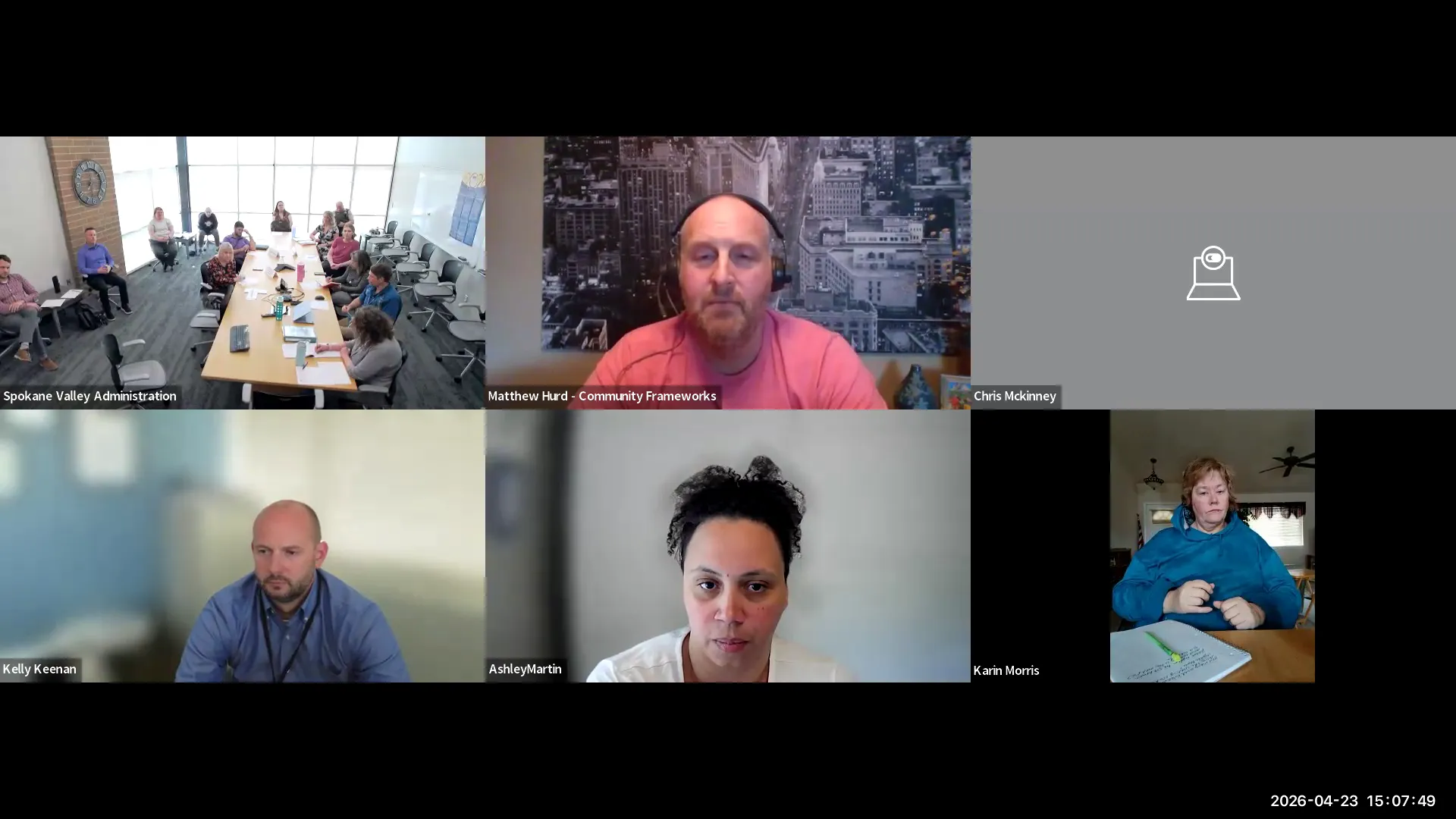
STREAMING COPY IN PREPARATION — RECORDING AVAILABLE FROM THE ORIGINAL SOURCE
Spokane Valley Homeless Housing Task Force Meeting
On April 29, 2026, the Spokane Valley Homeless Housing Task Force held a regular meeting to hear presentations from partner organizations on potential uses of sales and use tax (1406) dollars for affordable housing, rental assistance, and related services. The task force then discussed and unanimously voted to recommend issuing a Request for Proposals (RFP) with broad categories for funding.
Partner Presentations
- SNAP (Spokane Neighborhood Action Programs): A representative described the planned Broadway property inside Spokane Valley city limits, noting existing transit access and programs like Neighbors on the Go volunteer drivers. Volunteer driver Jen Bird (retired teacher) expressed strong support for the program, emphasizing the importance of serving elderly residents and the need for community investment in their well-being.
- Habitat for Humanity Spokane: Daniel LeRoy, Director of Government Affairs, presented four uses for 1406 dollars: land acquisition, rehabilitation/acquisition of existing properties, new construction, and down payment assistance. He noted that subsidies typically range from $50,000 to $100,000 per household, and that homes are sold at $200,000–$300,000 with permanent affordability through a land trust. LeRoy emphasized that flexible local dollars help unlock state and federal funding.
- Community Frameworks: Ashley (Asset Management Director) and Matthew (Development) proposed three funding methods: (1) small annual grants ($20,000–$50,000) for rental assistance and minor rehab to keep households housed; (2) single larger annual allocations ($200,000) for new construction gap funding; and (3) pooled multi-year funds (up to $1 million) for land acquisition for rental housing. They stressed that local seed capital is critical for leveraging other sources. Matthew noted a potential 50–70 unit family site near Broadway, with land costs over $2 million.
Discussion
- Task force members discussed the flexibility of an RFP, the inclusion of innovative models like housing cooperatives, and the importance of broad categories over overly specific requirements. City staff clarified that the RFP process would include technical assistance to help applicants navigate zoning and building codes.
- A motion was made and seconded to recommend issuing an RFP that solicits applications for rental assistance, down payment assistance, affordable housing projects (including land acquisition), and operations & maintenance. The motion passed unanimously with all members in favor.
Key Outcomes
- Unanimous Recommendation: The task force voted to recommend that the Spokane Valley City Council issue a Request for Proposals (RFP) for the expenditure of 1406 dollars. The RFP will be broadly scoped to include rental assistance, down payment assistance, affordable housing construction/acquisition, land acquisition, and operations and maintenance. This recommendation will be forwarded to the City Council for final decision.
Meeting Transcript
Property located inside of the city limits of Spokane. It is the Broadway property will be inside the city of Spokane Valley. Okay. So that would be the county meals on wheels, which you guys which you people could reach out to your tenants there. We heard here with the city a lot. And I brought it out to elderly homes around the county as well. Yeah, we're hoping to bring in a silver cafe once the property is built. So yeah. And the other one is uh do you think you guys would be able to work in with Spokane Transit Authority to get you guys uh set up on a bus stop right outside that can bring that basically has a direct route from the property to a grocery store and then that? Uh yeah, that is definitely possible. Uh there's a bus stop right outside of that location right now. Um the other thing that we already do are community health workers that we have are already providing tenant services, and we have a fleet of vehicles that they use to provide that transportation. We also have a program called Neighbors on the Go that is staffed with volunteer drivers, and we happen to have one of them with us today. Uh just by chance. Um, and they do the same thing. They will transport people primarily to medical appointments, um, helping fill that gap between you know what SMS can provide, and you know, not everyone can afford private transportation or Uber. Um, so our volunteer drivers help fill that gap as well. Um, and they have been a part of um you know providing transportation for our tenants for the community at large um for I think since probably 2019 we've had neighbors on the go up and running. So um, yeah, we got a lot of great resources that are gonna come together for the for the Broadway um property, but a little bit of funding for that community health worker would be really would be really helpful in making sure that we can continue to provide those services into the future. Yep, so I would like to speak to our Jen Bird and uh retired teacher, but now volunteer SNAP driver. And uh we use our own cars, although we do get uh reimbursement uh from uh SNAP or uh gas and expenses like that. Uh and I meet so many people uh during that time. I pull up to their house, they see the magnets on the side of my car. Uh they they are they're so appreciative of the service. And for many of them, it's the only way they consider uh they're not the number of cannot just go in there with us. That's just uh the wheelchair walker pain, uh some perfectly ambulatory. But uh I just try to think of the individuals that I take and how they so appreciate this service, it really is important to it. And I would just have to say that uh I feel that the elderly in our community are not served as well as I wish they were, just in general. It just feels like in general, our society uh doesn't uh put the the effort in to make sure that their lives are uh livable. And so uh I just would encourage you any chance you get to uh to feel somebody can support towards uh that segment of our thing for your insight on that's free for anything else, any questions online comments, comments. Okay, thank you. Thank you very much. Thank you. And next, uh Daniel, uh Habitat, please. Wonderful. Well, my name is Daniel LeRoy. I am the director of government affairs for Habitat for Humanity Spokane, and we're gonna be going over um some different uses that we uh have been successfully using with 1406 dollars. Um but just a little bit, you know, it's easy for me to assume that everyone understands what HabTet does, so I want to take a step back. Um HabTet for Humanity is an affordable homeownership organization. We have an awesome sampling of all the different spectrum of affordable housing providers in the room, and we're sort of on that one end, which is focused sort of on the affordable homeownership. So the last stop on the affordable housing spectrum. Um our affiliate uh is specifically serves all Spokane County. And then we work with individuals and families that are at 80% of the area of median income or below to purchase those homes where they're like mortgage payment and tax and insurance payment. That monthly payment is below 30% of their income. So it's a long-term homeownership program, but then results in sort of a manageable affordable ownership product in the end. So that's a little bit about sort of back on what we do. We really love 1406. It's been a really successful funding source for us. We use it across the county and with the city's location as well. Part of why it's it's uh why we like it so much is it's really really flexible.
openpublica.com