Spokane Valley City Council Special Meeting - Comprehensive Plan Update - June 2, 2026
STREAMING COPY IN PREPARATION — RECORDING AVAILABLE FROM THE ORIGINAL SOURCE
Spokane Valley City Council Special Meeting – Comprehensive Plan Update
The Spokane Valley City Council held a special meeting on June 2, 2026, at 5:00 p.m. The primary agenda item was a non-action work session on the Comprehensive Plan Update, covering the final three required elements: Transportation, Capital Facilities, and Parks and Recreation/Open Space. Council members provided extensive feedback and direction to staff, who will revise the draft before submitting to the Washington State Department of Commerce by mid-June. No formal votes were taken; the meeting adjourned without an executive session.
Approval of Agenda
- The agenda was unanimously approved. The proposed executive session was removed by consensus after staff indicated they were not prepared for it.
Comprehensive Plan Update – Presentation and Discussion
The update is required under the Growth Management Act (GMA) and must be adopted by the end of 2026. Presenters included Mike Basinger (Community & Economic Development Director), Steve Roberge (consultant), Cole Grisham (Dowell, for Transportation), and Jen Dial (SCJ Alliance, for Capital Facilities and Parks).
Transportation Element (Cole Grisham)
- Approach: Updated data, laws, and policies since the 2017 plan; added multimodal level of service (MMLOS) standards; aligned with SRTC Horizon 2050 goals; used 2022 traffic data.
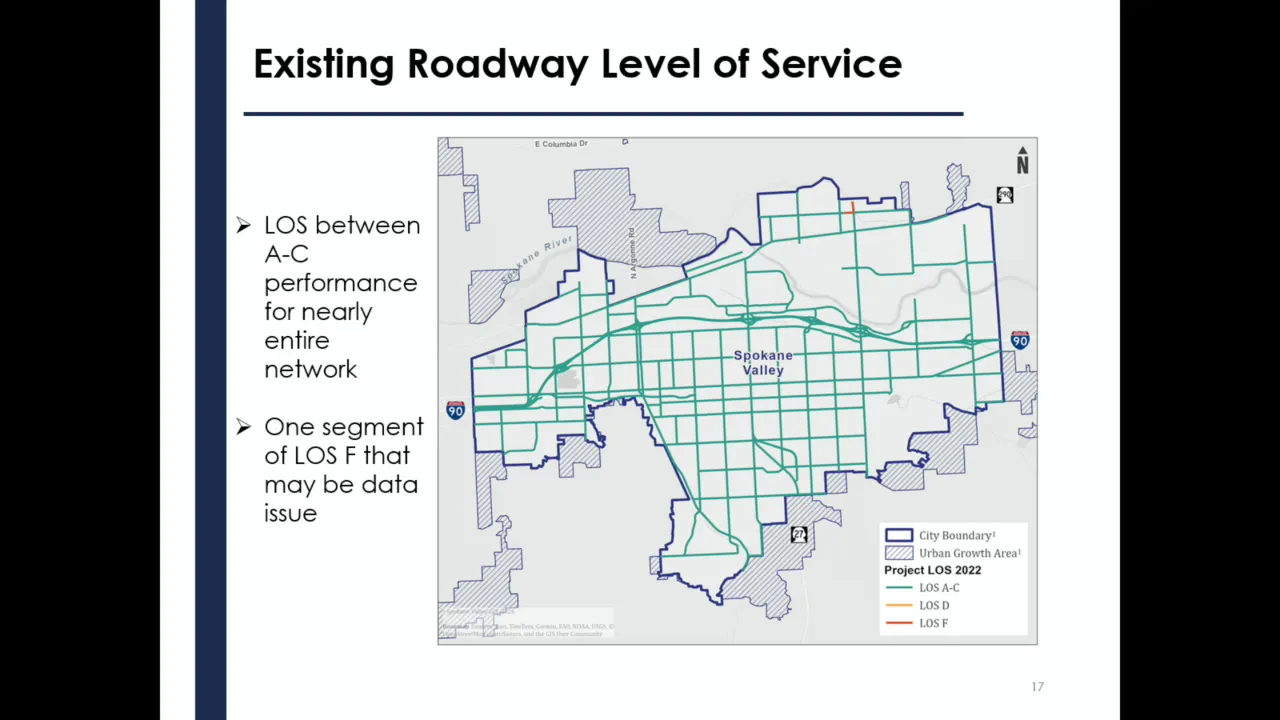
- Key findings: Most of the network currently operates at LOS A–C at the segment/corridor level; one segment reported LOS F (likely data anomaly). Forecast to 2050 shows most segments remain at LOS A–C, with a few dropping to D (acceptable) or F at specific ramps and Dishman Mica Road (also possibly a data issue).
- Council concerns and positions:
- Councilmember Wick urged retaining the “Bridging the Valley” policy, arguing that major projects like Sullivan Road and railroad realignment remain uncompleted. The consultant had removed it because SRTC indicated it may not move forward and cited completed projects.
- Several council members questioned the accuracy of 2022 data, noting major projects (Barker grade separation, Bigelow Gulch realignment, Northeast Industrial Area development) completed after 2022 that would affect traffic. They requested updated data.
- Councilmember Merkel opposed language that aims to reduce vehicle trips, calling for “provide options” instead, and objected to wording (p.33) that prioritizes transit/ITS over adding lane capacity for single-occupancy vehicles, calling it “unfair.”
- Councilmember Yeager noted that freight and package delivery impacts should be integrated more prominently.
- Councilmember Kelly requested clarification on the “complete streets” policy (adopted 2021 via Ordinance 21-012).
- Mayor Patton and Councilmember Merkel opposed a sentence on planning for electric vehicle adoption (p.35), arguing the city should not provide charging infrastructure and that the language could be used against the city. Councilmember Haley defended keeping the sentence as broad to satisfy the state; Councilmember Kelly suggested editing to clarify it only “allows” charging. City Manager John Holman agreed the language needed cleaning up.
- Other comments: update transit maps (new STA route near Wellesley/Evergreen), incorporate destination development/tourism impacts, and clarify level of traffic stress measurement.
- Outcome: Staff and consultants will incorporate council’s edits, update data where possible, and meet with city staff later that week.
Capital Facilities Element (Jen Dial)
- Approach: Minor updates for GMA compliance; reorganized inventory tables; added references to other plans; included a project table placeholder.
- Key topics:
- City Manager Holman clarified that the maintenance facility and cross-country field house in the project table are placeholders and not real current priorities.
- Councilmember Merkel requested a definition between irrigation and water districts, noting the map had “large holes” not covered by any district. Staff will explore and add context.
- Councilmember Wick noted water service areas have changed and asked for updated maps, including City of Spokane water lines within Valley.
- Councilmember Kelly and Councilmember Merkel expressed concern about terms like “green infrastructure” and “low impact development (LID)” being too broad or weaponizable; the city manager agreed to replace them with more neutral language.
- Councilmember Merkel opposed a policy supporting conversion of irrigation rights to municipal water rights, calling it “choosing a side” on a heated issue. The city manager noted this issue was a decade old and staff would research current status.
- Councilmember Kelly asked about an “asset management working group”; city manager said it is aspirational and unfunded.
- Councilmember Merkel asked about protecting citizens from excess taxation by the wastewater district; staff will consider a policy.
- Outcome: Staff will refine language, update maps, and coordinate with water districts and the library on service levels.
Parks, Recreation, and Open Space Element (Jen Dial)
- Approach: Simplified inventory, added maps and graphics, aligned with the Parks Master Plan and GMA requirements.
- Key topics:
- New policies added for shade/tree canopy, system-wide maintenance assessment, aquatics feasibility study, and regular coordination with programming partners (e.g., YMCA).
- Council discussed how to handle “strategies” (detailed action items from the previous plan). Councilmember Wick and Councilmember Haley favored keeping a visible list in the plan to guide staff and be accessible to the public. Councilmember Kelly preferred referencing by link to separate plans for easier updating. Councilmember Merkel argued some strategies are outdated (e.g., whitewater course) and should be moved to the master plan. The city manager suggested an appendix or middle-ground approach.
- Councilmember Merkel questioned mailing 2,500 postcards for outreach; staff explained it was a budget-driven decision.
- Staff noted that the North Loop Trail and river access remain viable long-term ideas, but work with Kaiser Aluminum proved difficult.
- Outcome: Staff will explore formatting options for strategies and bring back a revised approach based on council’s discussion.
Key Outcomes
- The revised draft Comprehensive Plan will be submitted to the Department of Commerce by mid-June 2026.
- A full corrected draft will be available for public review by June 18, 2026.
- The Planning Commission will hold an open house and public hearing on July 23, 2026.
- Council adoption is anticipated in November or December 2026.
- Staff and consultants will incorporate all council feedback from this work session into the plan before submission and continue to accept additional comments.
- No executive session was held; the meeting adjourned at an unspecified time after concluding discussion.
Meeting Transcript
Mayor Patton, it's five o'clock when you're ready. Thank you. Um, the Spokane Valley City Council special meeting is now convening at 5 p.m. Tuesday, June 2nd, 2026. Um, if you want to stand for the Pledge of Allegiance, will the clerk call the roll, please? Certainly. Mayor Patton here. Deputy Mayor Hattenberg. Here. Councilmember Yeager. Here. Councilmember Kelly. Present. Councilmember Haley. Here. Councilmember Wick? Here. And Councilmember Merkel. Here. Thank you. We now have the uh approval of agenda. Move to approve the agenda. Second. All those in favor? Aye. Aye. Opposed. The agenda is unanimously approved. That brings us to our first non-action item. It's the comprehensive plan update. Uh with Steve Robert, Mike Basinger, Basinger, and guests. Good evening, Mayor, City Council members, Mike Basinger, Community and Economic Development Director. I thought I'd just kick things off tonight and then we'll turn it over to Steve and the consultants. So tonight we're looking at the last batch of our required elements for our parade update. No excuses, but just wanted to let you know it was challenging to take these different documents and incorporate it into our elements. But we did do that, and we'll continue to review and improve them as we move forward. And I've seen some of the fruit from those efforts. And so I know some of these requirements are coming from the state to have these level of services for other modes. But you know, multimodal options in our city really do improve the livability, and they do provide independence for like elderly teenagers, people with disabilities, and lower income families. And one of the things I was mentioning at the advanced agenda meeting is the Appleway Trail. And I say it all the time, but I do walk it every day at lunch. And I see so many different people using the Appleway Trail as a mode to get from wherever they're at to the transit station. And half the time it seems these days it's on scooters. A lot of them are owned by the individuals because I think they've become more and more affordable. I've seen sit-down ones, I've seen stand-up ones, I've seen unicycle, you name it. But they are using it. And I've also seen people with disabilities using the trail as well to get out and just have fresh air and sit on our benches. So these modes do serve our community. Um I think there's always a balance, but I wanted to mention that. Um I also wanted to emphasize that this plan is a work in progress.
openpublica.com