Stamford Planning Board Regular Meeting: Vision Zero Presentation - May 22, 2024
STREAMING COPY IN PREPARATION — RECORDING AVAILABLE FROM THE ORIGINAL SOURCE
Stamford Planning Board Regular Meeting: Vision Zero Presentation - May 22, 2024
This summary is based solely on the available transcript, which covers only the Vision Zero action plan presentation and discussion. The agenda also included a consent calendar item (Terry Conners Rink upgrades) and a public hearing on a master plan amendment and companion zoning referral, but no transcript for those portions was provided. The meeting date from the agenda is May 21, 2024, but the instruction specifies May 22, 2024; this discrepancy is noted.
Discussion Items
- Vision Zero & Parking Study Presentation: Luke Buttenwieser, Transportation Planner, and Frank (Transportation, Traffic & Parking) presented the Vision Zero Action Plan and provided an update on the city's parking study. Key findings from the parking study included: substantial underutilized parking in municipally-owned garages (10,000–12,000 spaces downtown), current parking requirements for multifamily residential buildings leading to oversupply, and opportunities to streamline operations. Recommendations included: updating parking ratio requirements, encouraging shared parking, protecting neighborhoods from parking intrusion, increasing garage utilization, replacing payment-in-lieu with a mobility fee, and investing in new technologies. Action items for zoning involved promoting shared parking, expanding parking category zone 1 to areas within half a mile of the Stamford train station, right-sizing multifamily parking ratios, and implementing a mobility fee. Operations action items included increasing on-street parking turnover, expanding residential parking permit programs, optimizing enforcement with license plate readers, and enhancing city garages.
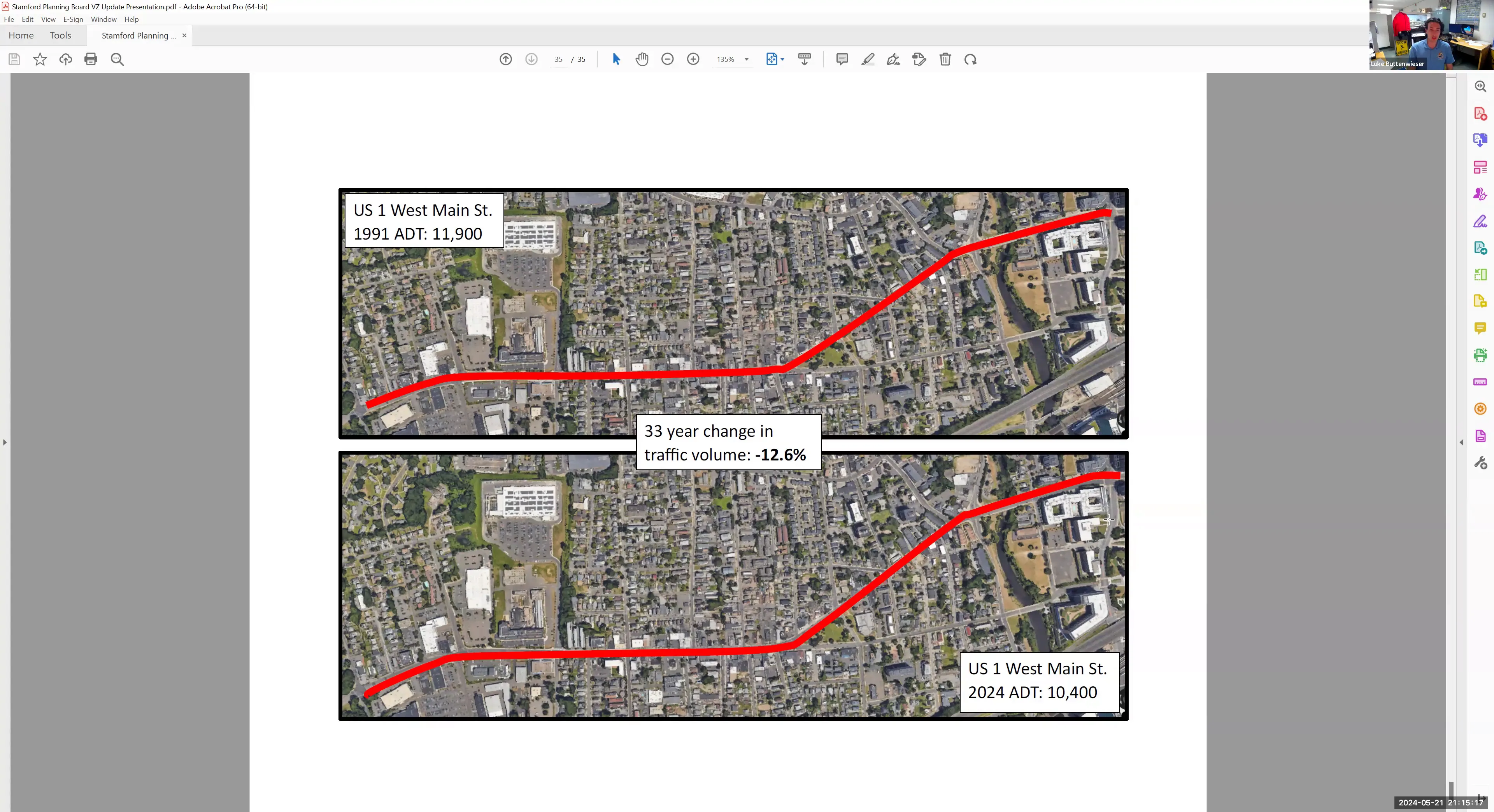
- Traffic Data Analysis: Luke presented citywide traffic data from CONNDOT count stations (1991 vs. 2024). Average daily traffic (ADT) on major arterial roads has decreased: Broad Street (-16%), High Ridge Road (-17%), Stillwater Road (-24%), Washington Boulevard South (-30%), East Main Street (-10%), and Tresser Boulevard (-35%). Long Ridge Road north of the Merritt Parkway increased 8.5%. Reasons cited included: decline in office use (offices generate more trips than residential), generational changes in car ownership, transit-oriented development near the train station, remote work (25% of Stamford workers), and navigation apps redirecting traffic. Luke noted that peak-hour congestion remains but overall volumes are lower.
- Discussion on Traffic Management: Board members raised concerns about congestion on Hope Street (double-parked delivery trucks, traffic light timing) and lack of bus service to North Stamford/Westover. Luke responded that the city is working on commercial loading zones, adaptive traffic signals (e.g., an EPA grant for East Main Street), and a microtransit program. Frank mentioned CT Transit's new crosstown bus route from Springdale to Cove, and the city is exploring additional cross-town connections. The board also asked about liability for shared parking arrangements; Luke stated the city is working with a consultant and the law department to address insurance and lease agreements.
Key Outcomes
- The Planning Board received the presentation and thanked staff. No formal votes or decisions were taken on the Vision Zero or parking study items. The board noted that the information will inform future application reviews.
- Upcoming meetings: June 11, 2024 (Regular Meeting), June 25, 2024 (Regular Meeting), and a summer hiatus in July.
Meeting Transcript
Looking at other development in the area. And then, you know, the other thing too is I mean, the cases you uh mentioned is that historically, you know, more office use, the traffic is more concentrated. You know, you have people coming to work and leaving work all at the same time. Whereas when you have residential, um, there's typically less traffic generated in the peak hour for that reason because people come and go and they leave their houses at different times. So, you know, that's one way that we see less of an impact on the system. Okay. And then I think as Luke mentioned later, we have uh, you know, we have another section with some of the data we've we've seen and how it affects what we're looking at today. Okay. Um does anyone have any further questions before they can uh you have more of the presentation to show us, Luke? Yeah, there's two more sections to go through. Okay. Anyone have any further questions on this before we go on to the next section? No, okay. Look, you can go to the next section. All right. Wonderful. Thank you. So next section is going over the um our parking study. So um, as you know, this was adopted by your board back in January. And we want to go through some just key highlights of um recommendations and findings, um, which I know we talked about um at length, but also some of the action items that we're pursuing. Um I know this board wants us to come back with that. So um I'll kind of breeze through this because I know we talked about it um previously before, but some of the key findings of the study is that there's substantial amount of underutilized um parking and municipally owned garages and facilities, you know, there's no 10 to 12,000 publicly available parking spaces in downtown. Current parking requirements um for multifamily residential buildings appear to result in an oversupply of parking. There's options and abilities to clarify parking regulations, our access to our train station, um, really presents an opportunity for reducing car ownership. Some of our engagement sessions found that there's a tension between you know new uh residential developments as well as some existing more historical residential developments and on street parking. I don't think that would be surprised to any of us. And then there are opportunities for the city to streamline parking operations and procedures with new technologies. And then these are some of the recommendations of the study. So it's updating our parking requirement ratios and the zoning code, encouraging shared parking, um, working on protecting residential neighborhoods for parking intrusion, um, increasing utilization of our underutilized municipal garages, um, changing the payment in lieu of parking options, some more of a mobility in lieu of parking um fee, some more of a quote unquote mobility fund. Um, and then again, continuing to invest in cost effective parking management practices to enhance our parking operations. So these are some of our city action items. So agile kind of broken up in two parts. And we've been working with the land use bureau on this, um, really trying to set out some key action items for us here. So um some action items for zoning and the numbers on the left, the five uh 5.2, et cetera, those are uh tied back to the recommendations in the uh parking study. So if you flip back through the parking study, you'll see where these came from. So zoning is promoting shared parking amongst uh different new developments. So for instance, let's say that there's an existing office building and someone wants to build a new residential building um right next door. That office building's not gonna have um have its parking be used overnight, right when the residential um building sees its max demand. So is there an ability for that office building to um you know actually create um uh revenue for itself by you know loaning um renting out its parking spaces for that residential development to have the parking uh parked in the office building overnight? So actually by having the parking off site, for instance, next door can reduce the cost of construction for that development, lowering the overall housing costs and addressing our housing crisis. So we're seeing how you know these different policies and planning tools that we have are beginning to intersect with one another, right? So shared parking, utilizing some of the existing supply that we have already right now can reduce the cost of construction or reduce our housing costs. Um that goes within you know, increasing the use of municipal owned garages. So same deal said maybe next uh next to a private garage and next to a city-owned garage, right? So get a private developer utilize and rent out parking spaces in a city garage, which would actually you know increase revenue for the city, for instance, um, which you know we certainly would not say no to. Um so you know, but it also again lowers that cost of construction um and overall the cost of housing for that developer. Um some of the other recommendations that we're looking for that we'll be coming forward with um for your board's um deliberation and discussion is expanding parking category zone one to all areas within half a mile of the Stanford train station. So right um people can take advantage of the Stanford train station by walking there. We're working on a significant amount of capital improvements to enhance the walking and biking connections. South end, downtown, as well as the west side and water side really to enhance access for multimodal users to the train station.
openpublica.com