OPENPUBLICA · PUBLIC MEETING RECORD
Record of Proceedings
City of Saint Paul Budget Committee Meeting - November 4, 2026
Budget Committee — Wednesday, November 4, 2026
BodySt Paul, Minnesota
SessionBudget Committee
DateWednesday, November 4, 2026
StatusNEW · FILED
Video Record
STREAMING COPY IN PREPARATION — RECORDING AVAILABLE FROM THE ORIGINAL SOURCE
Transcript — Verbatim
Speaker numbers apply only to this recording. Names come from transcript evidence. “Possibly” marks uncertain attribution.
Discussion Breakdown — Share of Meeting
Budget35%
Taxation26%
District Council Operations17%
Public Engagement14%
Administrative Citations4%
Personnel Matters2%
Technology and Innovation2%
Summary of Proceedings
City of Saint Paul Budget Committee Meeting - November 4, 2026
The Budget Committee of the Saint Paul City Council met on November 4, 2026 to continue its 2027 budget series. The meeting included presentations on Ramsey County property tax trends, the proposed budget for the Department of Human Rights and Equal Economic Opportunity (HREEO), and supplemental requests from the Office of the City Council. Chair Cheniqua Johnson presided, with Councilmembers Bowie, Coleman, and Jost present, and Council President Naker arriving later. No consent calendar or public testimony items were on the agenda.
Discussion: Ramsey County Tax Valuation Trends
Ramsey County Director Chapman and County Auditor Tracy West presented the 2026 property valuations (which set 2027 taxes). St. Paul's total assessed value is approximately $36.5 billion out of the county's $78 billion total. The overall change in St. Paul property values was about 2%, described as a flat year. Residential values rose 1.5%, while industrial and apartment properties saw higher increases (5% and 4.5% respectively).
The combined levy for the county, city, and school district is increasing by 6.8% to a total of $730 million. The city's share of the levy is increasing by 6.8%, while the county's St. Paul share is up 8.9%. The proposed tax rate for St. Paul is 56.6%. For the median single-family home in St. Paul (valued at $290,300), the estimated tax increase is $172 (3.7%). West 7th saw the largest tax increase by planning district (6.6%), while Downtown values decreased by 6.3%, driving a decrease in property taxes of 5.3%.
West noted that outreach for the state's Property Tax Refund (PTR) program is largely limited to mentions in presentations and on tax statements, with no formal county coordinated education or partnership outreach efforts. Several councilmembers inquired about the significant amount of PTR funds left unclaimed annually.
Discussion: HREEO 2027 Budget
Interim Director Andrea Letcher presented the HREEO budget, highlighting the department's focus on fiscal sustainability through vacancy management. The department is proposing a reduction from 33.1 FTEs to 30 by eliminating two positions (Contract Compliance Coordinator and Labor Standards Investigator 1) to meet budget targets. The department ended its work-share agreements with HUD and the EEOC over concerns about protecting sensitive resident data.
The most contentious topics were the long-vacant Director of HREEO position and a proposal to increase the Police Civilian Internal Affairs Review Commission (PCARC) commissioner stipend.
PCARC Stipend: The budget includes $27,000 for a potential increase to the $50 commissioner stipend, which has not been changed since 1993. Councilmembers Johnson and Bowie criticized the timing of the proposal and the lack of prior consultation with the full council. Councilmember Coleman explained her office was involved in the early timing to align with the budget process and required ordinance amendments. Letcher noted the work involves significant emotional labor for the volunteers.
HREEO Director Vacancy: The director position has been vacant since late 2022. Chair Johnson and Councilmember Bowie expressed strong frustration that a requested timeline for filling the position was not provided in the meeting materials, despite being raised in the pre-meeting. Letcher stated the hiring process is a mayor's office decision. Councilmember Jost urged directing concerns to the mayor's office. Ms. Mitchell from the Office of Financial Services confirmed the mayor's office intends to fill the position in 2027, having prioritized the Fire Chief search. Bowie criticized the ongoing allocation of over $200,000 in salary for an unfilled role without a defined plan to fill it.
Discussion: Office of the City Council Supplemental Requests
Director of Operations Jay Welms presented two supplemental funding requests.
-
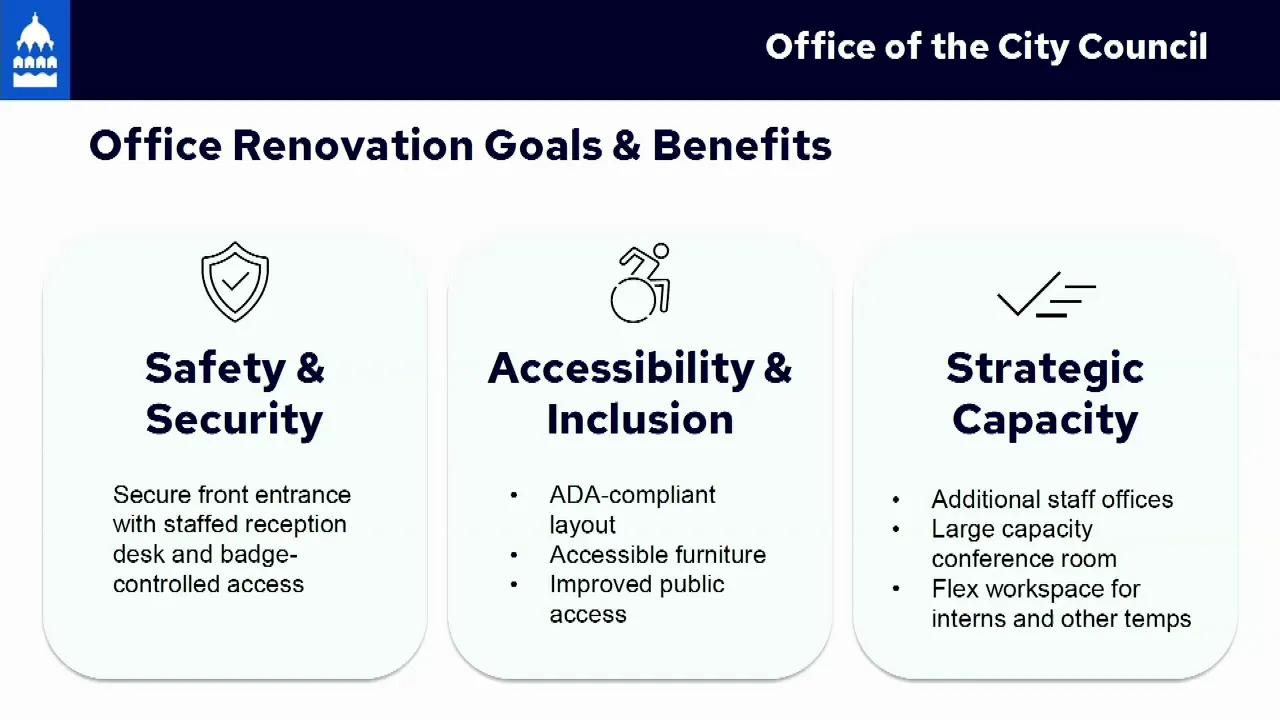
Office Renovation Interfund Loan Repayment: The renovation project initially had a $1.95 million budget from ARP funds. A funding gap of approximately $360,000 led to an interfund loan approved in August 2026. Welms requested $120,000 per year for three years (FY27-FY29) to repay the loan. Chair Johnson and Councilmember Bowie questioned the mechanism of an interfund loan and requested a full accounting from OFS of all interfund loans citywide and the precedent for their use.
-
Administrative Citations Implementation: Welms requested one-time funding for a technology and workflow consultant to ensure the council's role in the forthcoming administrative citations program is seamless, specifically regarding the handoff from the administration's Pauly system. Council President Naker asked if the work could be done internally by the Office of Technology and Communications (OTC). Welms confirmed he had reached out to OTC but noted external consultants may be needed to align with existing city technical service agreements.
Key Outcomes
- No formal votes were taken on the substantive budget items presented during the meeting.
- PCARC Stipend: Scheduled for a first reading at the following City Council meeting to align with the budget timeline.
- Budget Amendments: The committee is scheduled to consider budget amendments on November 18, 2026.
- Follow-up Items: Chair Johnson committed to sending a follow-up email to gauge interest in formally adding the Office of the City Council requests to the budget conversation. A comprehensive list and explanation of all current interfund loans was requested from the Office of Financial Services.
- HREEO Director: The mayor's office was identified as the lead on the hiring process, with an informal target for filling the position in 2027.
Meeting Transcript
Order. Roll call, please. Vice Chair Yang. Councilmember Bowie? Here. Council Member Coleman. Councilmember Kim. Councilmember Jost. Council President Naker. Chair Johnson. Here. Four present, three absent being Vice Chair Yang and Councilmember Kim, who are both excused, and Council President Naker, who is expected shortly. So we are continuing on with the final part of our budget series before we get into budget amendments and budget conversations. We are going to do a little bit of a switch on the agenda, just an order, um, by taking Ramsey County's tax valuation trends presentation first, and not second, um, just so we can make sure that our Ramsey County partners are able to come in, present and then be able to um take get on with their uh day for today. We do appreciate having folks come in from Ramsey County to be part of it. We do this every year. Um, but it's honestly really great to have you here. It's always really important to talk about our property values and property taxes and the trends that we're seeing. It, you know, people feel it, we feel it, and ultimately it's really an important presentation, so we always try to make time for it. Um so I'll turn that over uh to you. Um, Mr. Chapman and uh West. Uh good morning. Uh Chair Johnson, esteemed members of the uh St. Paul board here. Um, first of all, congratulations uh to um council member Naker. Let's talk my favorite thing. Values. He's honestly serious, it's probably his own thing. Um let's talk about two trends uh for 26. This is uh the 26 valuations, which were set in January this year for taxes next year. We're gonna talk a little bit about market values, tax capacity, a little bit of a market summary. Uh understanding property tax, historical tax rates, and some of the impacts. So just a level set. This is kind of how the system works. The state sets class rates, says who's eligible for exemptions and exclusions, determines the process and rules for uh valuation and taxation. The assessor, we set our values on uh January 2nd of each year. City um schools, counties set their levies, and then the auditor divies it up by what is set. Let's talk some historical values. You can see the county is about 78 billion, with the city of St. Paul being about 36 billion, almost 36 and a half billion of that um historical assessed value. That translates into tax capacity numbers, and you can see the historical tax capacity of uh the whole county is right around 900 million, and you can see that the tax capacity of St. Paul, about 408 of that aggregate changes in the 26th value from 25.
SUMMARIZED BY OPENPUBLICA AI
TRANSCRIPT VIA PUBLIC VIDEO
openpublica.com
openpublica.com