OPENPUBLICA · PUBLIC MEETING RECORD
Record of Proceedings
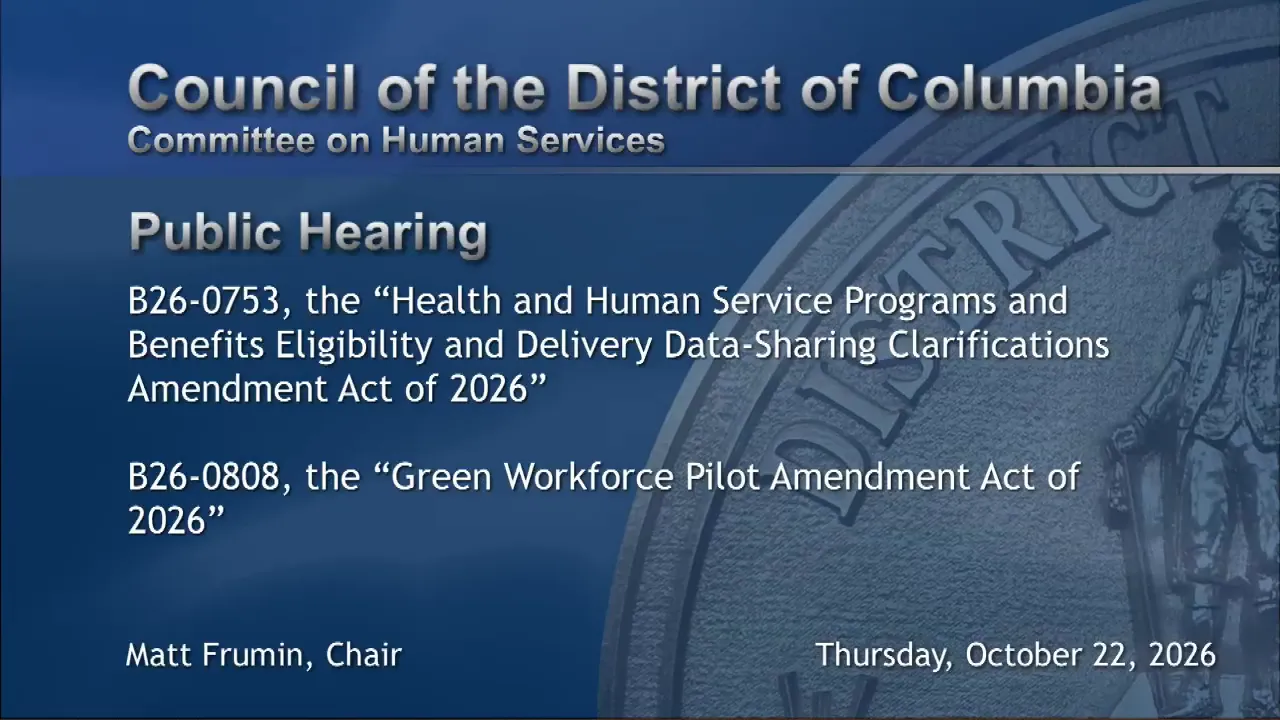
Committee on Human Services Public Hearing on Benefits Data Sharing and Green Workforce Pilot – October 22, 2026
Council of the District of Columbia — Thursday, October 22, 2026
BodyWashington, District Of Columbia
SessionCouncil of the District of Columbia
DateThursday, October 22, 2026
StatusNEW · FILED
Video Record
STREAMING COPY IN PREPARATION — RECORDING AVAILABLE FROM THE ORIGINAL SOURCE
Transcript — Verbatim
Speaker numbers apply only to this recording. Names come from transcript evidence. “Possibly” marks uncertain attribution.
Discussion Breakdown — Share of Meeting
Public Benefits51%
Workforce Development27%
Data Management12%
Procedural3%
Public Health2%
Environmental Protection1%
Community Engagement1%
Procurement1%
Budget1%
Summary of Proceedings
Committee on Human Services Public Hearing on Benefits Data Sharing and Green Workforce Pilot – October 22, 2026
On Thursday, October 22, 2026, the DC Council Committee on Human Services, chaired by Ward 3 Councilmember Matt Freeman, held a public hearing in Room 500 of the John A. Wilson Building and via Zoom. The hearing began at 11:18 a.m. and adjourned at 1:41 p.m. It considered Bill 26-0753, the Health and Human Services Programs and Benefits Eligibility and Delivery Data Sharing Clarifications Amendment Act of 2026, and Bill 26-0808, the Green Workforce Pilot Amendment Act of 2026, both responding to new federal SNAP and Medicaid work requirements under HR 1. No agenda or minutes were available in the source record.
Public Comments & Testimony
- Jen Jenkins, Senior Policy Attorney at Legal Aid DC, testified in support of the Green Workforce Pilot bill, calling it an important step. She urged the Committee to expand the pilot beyond 250 participants, clarify how DHS would select participants, set a firm launch date, and make participants eligible by October 1, 2027 at the latest. She cited DHS data indicating over 66,000 individuals are subject to ABOD work requirements; the transcript records that 45,000, or 35%, meet an existing exemption; over 16,000 still need screening; and almost 4,000 SNAP recipients are known non-exempt. She also cited about 257,000 Medicaid enrollees, 79,000 subject to work requirements, and 53,000 exemption notices (transcribed as '53 exempt notices') for good cause, leaving 26,000 people potentially subject without an exemption.
- Joe Liu, Ward 3 resident and Director of Advocacy and Public Policy at the Capital Area Food Bank, supported both bills. He cited the food bank's hunger report finding 39% of DC residents food insecure in the past year, and its delivery of 10.7 million meals in DC last year. He said HR 1 cut SNAP by $186 billion and USDA data show nearly 10,000 fewer DC residents receiving SNAP since HR 1 was passed, with DC's 6.9% decline lower than the national 13.9% decline. He encouraged focusing the pilot on permanent, higher-wage employment and a whole-of-government response.
- LaMonica Jones, Director of DC Hunger Solutions, supported the data-sharing bill. She cited national SNAP declines of approximately 6.3 million since January 2025 and 5.5 million since July 2025, close to 10,000 fewer DC residents, and an estimated 17,000 DC residents at risk of losing food assistance. She noted ABOD work requirements create a three-month time limit and narrow exemptions for parents of teenagers, veterans, people experiencing homelessness, and former foster youth. She urged the Council to pair the legislation with strong oversight, transparent reporting, adequate administrative capacity, and safeguards against preventable losses.
- Chair Freeman noted written testimony from the DC Sustainable Energy Organization and praised written testimony from STEMPatise International, without endorsing every word. No other public witnesses appeared.
Discussion Items
Bill 26-0753 – Data Sharing Clarifications
- Chair Freeman explained that B26-0753 was introduced July 9, 2026, with an emergency version passing unanimously July 14, 2026. It clarifies DHS's authority to share data within DHS and with other agencies, including allowing the Homeless Services Department to share data with the public benefits department so residents can automatically qualify for exemptions from new federal work requirements.
- DHS Director Rachel Pierre, testifying under oath, said DHS supports the bill. She said the emergency and temporary authority has allowed DHS and DHCF to advance data-sharing agreements, now at their final steps. The bill removes statutory restrictions under the Homeless Services Reform Act, enables FSA-ESA data sharing, prevents eligible residents from accruing countable months, and will be even more important for Medicaid work requirements in January 2027.
- In response to questions, DHS said implementation will require privacy-protecting policies, role-based access, and system integration; it was too early to describe day-to-day mechanics. DHS expects to use existing data to automate some exemptions, such as residents in permanent supportive housing who have documented disabilities. DHS also said it is exploring AI for benefits processing to reduce error rates. Chair Freeman said the Committee will ask for implementation and privacy updates in December and during oversight.
Bill 26-0808 – Green Workforce Pilot
- Chair Freeman introduced the bill as requiring DHS to establish a Green Workforce Pilot Program for public benefits recipients. The bill was introduced September 21, 2026, with Councilmembers Bonds, Lewis George, Allen, and Silverman. DHS estimates 8,500 to 12,900 residents could lose SNAP because of work requirements, and DHCF estimates 56,000 Medicaid beneficiaries will need to demonstrate compliance.
- Director Pierre said DHS supports the bill's intent but has concerns: the pilot is not funded in FY26 or FY27; DHS lacks the infrastructure, staffing, and wage-subsidy mechanism to run it; it would duplicate existing environmental workforce programs; and placing it in the TANF employment program would miss ABODs because TANF participants are already exempt from SNAP work requirements. DHS recommended the Department of Employment Services as the better home because it has workforce expertise and wage-subsidy infrastructure. Pierre noted DHS is already restructuring its workforce model, modifying TEP provider contracts on October 1, 2026, and planning a new solicitation with the Deputy Mayor for Education for contracts effective October 1, 2027.
- Chair Freeman defended the pilot as a different, temporary tool to provide paid work and job coaching, and said some technical issues—including income multipliers, whether program income would be counted for federal benefits, and the start date—need to be worked out with DHS.
Work Requirements, Program Capacity, and Outcomes
- DHS provided early data on ABOD implementation: the October SNAP caseload is about 119,000; about 87% of ABODs qualify for an exemption; among screened ABODs, about 3,800 were non-exempt; about 12,000 recipients had not yet been screened, a figure that differs from public witness Jenkins's earlier 16,000; about 20% of ABODs subject to requirements are expected to be noncompliant; and about 1,000 residents, later described as households, lost SNAP between September and October, with most losing benefits being men over 30. DHS cautioned that these data are early.
- DHS said SNAP Employment and Training has 1,605 total slots, about 59% used, leaving roughly 600 vacant; the workfare program has 1,850 slots, with early fill counts given as about 50 and later 98 at different points in the hearing. Both are federally funded, and SNAP E&T providers are required to bring a match.
- DHS reported 174 SNAP E&T participants gained employment in FY26, about 5% of SNAP E&T participants. Of about 3,800 non-exempt ABODs, 310 were in compliance through work, workfare, or training; DHS could not yet provide the breakdown. DHS does not track EITC filing or receipt, though providers educate clients about the EITC.
Key Outcomes
- No votes or bill markups occurred during the hearing.
- B26-0753 received support from all public witnesses and from DHS.
- B26-0808 received support from public witnesses, with requests to expand capacity, move up eligibility, and set a firm start date; DHS gave qualified support and recommended DOES as the implementing agency.
- DHS will continue implementation of data sharing and report operational and privacy details to the Committee; the chair said the Committee will follow up in December and through oversight.
- Written testimony for the record must be submitted by 5 p.m. Thursday, November 5, 2026, through the Council's online hearing management system.
Meeting Transcript
Good morning. I am Matt Freeman, Ward 3 Councilmember and Chairperson of the Committee on Human Services. Today is Thursday, October 22nd, 2026, and we are meeting in room 500 of the John A. Wilson building and on the Zoom virtual platform. The time is now 1118 a.m. I apologize. I take pride in being relatively punctual, but this morning we had workday in the ward, and people come to talk to me, and they take time out of their day, and so I wanted to talk to everybody, which had me run a little bit late. My apologies to the witnesses. Today we are conducting a public hearing on two measures, Bill 26-0753, the Health and Human Services Programs and Benefits Eligibility and Delivery Data Sharing Clarifications Amendment Act of 2026, and Bill 26-0808, the Green Workforce Pilot Amendment Act of 2026. Both bills strengthen access to public benefits in response to new Federal work requirements for Medicaid and Supplemental Nutrition Assistance Program and the Supplemental Nutrition Assistance Program or SNAP. Chairman Mendelson, at the request of the Mayor introduced B26-0753 on July 9, 2026. An emergency version passed unanimously on July 14th. This bill clarifies when the Department of Human Services or DHS can share certain data within DHS and within with other district agencies. Specifically, it allows DHS's Homeless Services Department to share data with the public benefits department. This helps DHS customers automatically qualify for exemptions from new federal work requirements. As of June, certain SNAP participants known as able-bodied adults without dependents or ABODs must establish that they comply with or are exempt from work requirements when applying for or renewing benefits. For example, a resident might be exempt if they have a disability, are enrolled in school or a training program or are pregnant. DHS can prevent the loss of SNAP benefits by automatically identifying people who qualify for exemptions, reducing the need for individuals to submit burdensome documentation and request third-party verification. This change could also help DHS exempt residents from new Medicaid work requirements that go into effect in January 2027. I'm grateful to the executive for moving this important legislation. The committee's oversight has identified the need for more robust active data sharing within DHS, and this bill is an important first step. Today we are also discussing Bill 26-0808, the Green Workforce Pilot Amendment Act of 2026. I, along with Councilmembers Bonds, Lewis George, Alan, and Silverman introduced this legislation on September 21, 2026. The bill requires DHS to establish a Green Workforce Pilot Program with the goal of empowering public benefits recipients to meet new work requirements while gaining meaningful work experience and individualized job coaching. DHS estimates that between 8,500 and 12,900 residents will lose access to SNAP due to the work requirements. The Department of Healthcare Finance estimates that 56,000 Medicaid beneficiaries will need to remain will need to demonstrate compliance to remain eligible. Recognizing that many residents face imminent risk of losing benefits, this pilot prioritizes keeping residents enrolled through immediate access to paid part-time work in programs already producing positive employment outcomes. Participants will engage in environmental conservation efforts, including stormwater maintenance, combating invasive plants, and improving sustainable energy infrastructure. Participants will also be able to access district and federal earned income tax credits, helping them grow their income and achieve greater family stability. Right now, the district is failing to connect people on public benefits to meaningful work. We must do better. And doing so demands creative solutions. I'm eager to see how providing residents with employment and support through this pilot helps them progress toward longer term opportunities. I look forward to hearing from our witnesses today on this opportunity to support both our residents and the environment. Is there anybody online? No. Okay. Before we hear from public witnesses, I would like to offer a note on logistics. I ask that all witnesses limit their testimony to their allotted time. The first representative to speak on behalf of an organization will have five minutes. All other witnesses will have three minutes. If you're here to testify in person when your name is called, please take a seat at the table in front of me. Before you speak, please make sure you're to turn on the microphone in front of your seat. Our first public witnesses witness is Jen Jenkins. Joseph Liu. Monica Jones. And Salim Adolpho. Is there anyone else here who has come to testify in person? Okay. So with that, uh Jen?
SUMMARIZED BY OPENPUBLICA AI
TRANSCRIPT VIA PUBLIC VIDEO
openpublica.com
openpublica.com