Browse by city
Date range
Search help

Search titles, summaries, topics and stored transcripts together. Keywords may match separately; put the whole query in double quotes for a phrase. Matching follows word analysis, so punctuation is not exact. Both dates are included. Documents are not searched.

SHOWING 1–10 ENTRIES
01
NEWOCT 16, 2026 · WASHINGTON, DISTRICT OF COLUMBIA · COUNCIL OF THE DISTRICT OF COLUMBIA
Council of the Whole Public Hearing on Revenue Proposals for FY2028 Budget - October 16, 2026

The Committee of the Whole of the Council of the District of Columbia held a public hearing on Friday, October 16, 2026, in Room 412 of the John A. Wilson Building to examine revenue proposals for the Fiscal Year (FY) 2028 budget. Chairman Mendelson opened the hearing by noting the district faces an estimated $650 million structural gap due to the use of one-time funds to sustain programs in the FY2027 budget, alongside declining federal revenue. The hearing was designed to thoroughly vet the pros and cons of seven specific tax proposals before the budget season begins. The hearing featured four panels of invited expert witnesses followed by a presentation from the Chief Financial Officer (CFO). The record remains open until October 30, 2026. Opening Statements - Chairman Mendelson framed the hearing as a necessary, pre-budget exploration of revenue options to avoid crisis-driven decisions. - Councilmember Fruman identified a potential $1 billion gap between status quo costs and revenue growth, stating that both spending cuts and revenue increases would likely be needed. - Councilmember Parker advocated for focusing on wealth-based income and closing loopholes, and suggested pairing any income tax increases with a child tax credit to support working families. - Councilmember Nadeau cited the success of the Homes and Hearts Act (which raised taxes on high earners to fund housing) as evidence that progressive taxes do not cause significant tax flight. - Councilmember Pinto called for a rigorous analysis of the $22 billion budget's effectiveness before asking residents for more, pointing to specific inefficiencies in agency spending. - Councilmember Lewis George centered closing the tax loophole for out-of-state business owners (the Bishop decision) as a key priority to fund universal childcare and affordable housing. - Councilmember Allen stressed the need to find savings while also increasing revenue, expressing caution about a sales tax increase but interest in taxing passive wealth income. Panel 1: Former Tax Revision Commission Members - Mayor Anthony Williams strongly cautioned against new tax burdens during an economic downturn, arguing that economic growth historically provided 85% of DC's revenue growth. He urged the Council to first invest in an Expenditure Commission to find savings and improve government efficiency before considering broad tax increases, specifically warning against the Business Activity Tax (BAT). - Yesim Sayan (DC Policy Center) stated she no longer supports the BAT because a surging payroll tax for Paid Family Leave already captures much of the intended base, and the city's weak employment fundamentals make taxing payrolls counterproductive. She also questioned the feasibility of a Land Value Tax. - Gregory McCarthy argued the current tax system lacks fairness, breadth, and resilience. He voiced conditional support for the BAT as an 'alternative minimum tax' designed not to increase taxes on businesses already contributing, but to expand the base to include large, non-resident owned firms. - Nick Johnson (ITEP) strongly advocated for the BAT, calling it economically neutral and more stable than the corporate franchise tax. He argued it would close the loophole for non-resident professionals and estimated a 2% rate could raise over $500 million annually. - Erica Williams (DC Fiscal Policy Institute) supported the BAT and the Wealth Proceeds Tax (based on the Net Investment Income Tax). She argued the Wealth Proceeds Tax targets high-income households (98% from those earning over $1M) and is simple to administer. She urged the Council to reject a sales tax increase as regressive. Panel 2: National Tax Policy Experts - Michael Mazarov emphasized the BAT is a subtraction-method VAT, not a gross receipts tax, and is highly resistant to legal challenges like the Bishop decision. He asserted that out-of-state firms cannot avoid the tax by relocating due to sales-factor apportionment. - Professor Darien Shanske supported the NIT and Land Value Tax as sound policy, suggesting the Council also explore a digital advertising tax. He argued that multiple low-rate taxes can be efficient. - Dr. John Anderson validated the economic theory behind a split-rate property tax (Land Value Tax), stating it encourages development and reduces tax-induced distortions. - Lars Ducey supported the land value assessment reform bill as a crucial step toward better data and accuracy, noting it does not implement the tax itself but ensures the city can make informed decisions. - Joe Bishop Henchman (NTUF) strongly opposed the BAT, calling it a highly risky 'Jenga tower' of legal and administrative compromises. He argued DC already has the most progressive tax system and is experiencing significant out-migration of high-income taxpayers, which new taxes would worsen. - Catherine Lawhead (Tax Foundation) warned the Wealth Proceeds Tax would give DC the highest top marginal rate in the country (13.75%), creating a strong incentive for high earners to move. She argued the Pied-a-Terre tax lacks economic justification. Panel 3: Local Business and Community Stakeholders - Chico Horton (DC Chamber of Commerce) strongly opposed the BAT, stating the city's budget has grown far faster than inflation and that the council should prioritize spending control. He argued the BAT would add a damaging layer onto an already strained and uncompetitive business tax climate. - Catherine Lanfield (Fair Budget Coalition) urged immediate action on the Wealth Proceeds Tax to fund crucial safety net programs. She supported the BAT but called for changes, including exempting direct-service nonprofits. - Sean Townsend (Restaurant Association) argued that adding a BAT or raising the minimum wage ($25 proposal) to thin-margin businesses like restaurants is counterproductive. He advocated for a hospitality growth strategy that grows the sales tax base rather than the burden. - George Jones (Bread for the City) supported the Wealth Proceeds Tax and a well-designed BAT to raise revenue for anti-poverty programs. He urged the council to exempt community-based direct service charities from the BAT. - Malcolm Fox (Opportunity DC) questioned the vitality of the BAT, noting that no other US state combines a gross receipts tax with a personal income tax, corporate income tax, and general sales tax. He warned the Wealth Proceeds tax would make DC the highest tax jurisdiction in the country at the top, risking further tax base erosion. Panel 4: Real Estate and Development Representatives - Yomi Omatosho (former Chief Appraiser) strongly opposed the Land Value Tax provisions of Bill 26-777, citing severe data limitations for land valuation in DC, immense administrative challenges, and the risk of a flood of appeals. He stated the city's assessment system cannot currently support the required valuations. - Alex Baca (Greater Greater Washington) urged support for the bill, clarifying it mandates a study and assessment improvement, not immediate implementation of the tax. She argued better land data is critical for smart growth. - Sean Hilgendorf (DC Realtors) opposed blanket residential property tax increases, pointing to a struggling housing market with high interest rates, falling median values, and rising foreclosures. - Erica Wadlington (DC BIA) argued the Land Value Tax is ill-suited for DC, a largely built-out city with deep zoning and regulatory constraints. She warned it would harm development, penalize existing housing, and accelerate the erosion of the commercial property tax base. - Jack McDougall (Board of Trade) reiterated opposition to the BAT, calling for an 'economic renewal agenda' focused on regulatory reform, spending control, and growing the population and business base. Government Panel: Chief Financial Officer (CFO) - CFO Glenn Lee and Dr. Fitzroy Lee presented the significant challenges of estimating and implementing new taxes for the FY2028 budget. - On the BAT: The CFO stated the city lacks data on the pass-through entities a BAT would target (partnerships/LLCs) and that past revenue estimates are unreliable and outdated. Implementation would take years, not months, due to the need to build a new regulatory, compliance, and audit structure. - On the Wealth Proceeds Tax: The CFO confirmed the tax is extremely volatile due to its reliance on capital gains. Revenue estimates fluctuate dramatically with the stock market. He stated it cannot realistically be implemented retroactively to Fiscal Year 2027. - On the Land Value Tax: The CFO called this a 'fundamental shift' in assessment methodology. Tax Commissioner Skipworth noted it would require a complete overhaul of the Office of Tax and Revenue's (OTR) land values for all 200,000+ parcels, posing significant technical and legal risks. - On Tax Flight: Dr. Lee noted that while aggregate studies show little flight from past changes, the specific elasticity of high-income earners in a post-pandemic, highly mobile environment is difficult to quantify, and behavioral responses pose significant risks to revenue. Key Outcomes & Next Steps - No votes were taken. The hearing was solely for information gathering and discussion. - The official record for written testimony remains open until 5:00 PM on Friday, October 30, 2026. - The CFO's feasibility study on the Business Activity Tax is expected by the end of January 2027. - Major divergence emerged between business groups, development interests, and economists warning of tax flight and implementation risks, versus community advocates and other economists urging the council to adopt progressive revenue measures (Wealth Proceeds Tax, BAT) to sustain vital services. - The council was presented with a stark trade-off between immediately implementable solutions (e.g., rate increases on existing taxes) versus theoretically sound but administratively complex new taxes (BAT, Land Value Tax) that cannot generate revenue in the short term.
TAX POLICY 55% · ECONOMIC DEVELOPMENT 18% · BUDGET 13% · REAL PROPERTY TAX 3%
02
NEWOCT 15, 2026 · WASHINGTON, DISTRICT OF COLUMBIA · COUNCIL OF THE DISTRICT OF COLUMBIA
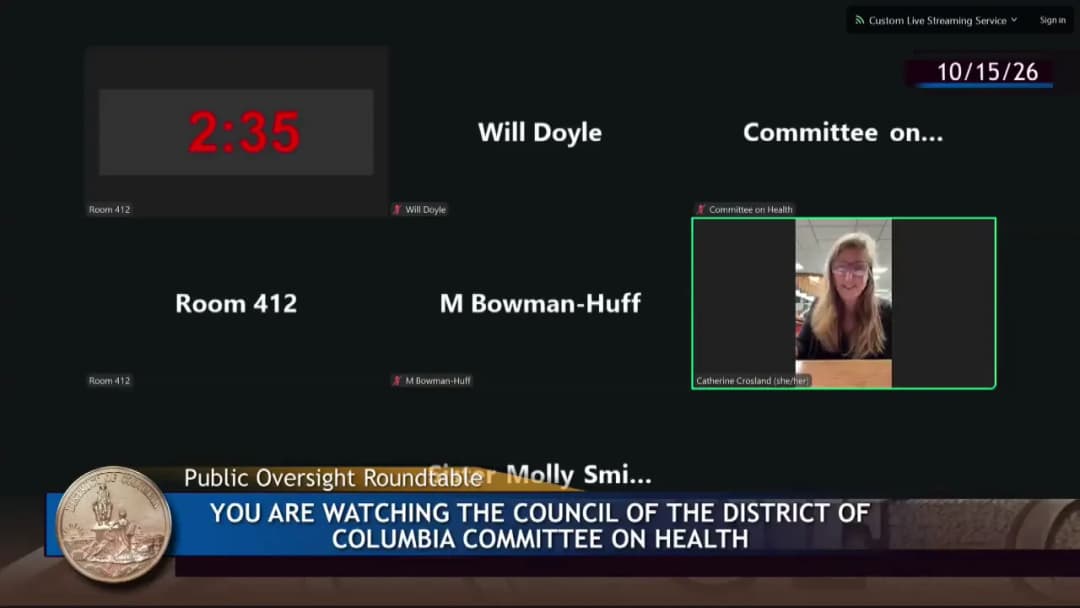
Committee on Health Roundtable on Long-Term Care Gaps and CRF Closures (October 15, 2026)

Chairperson Christina Henderson (At-Large, Committee on Health) convened a public oversight roundtable on October 15, 2026, to examine systemic gaps in the District's long-term care continuum for residents with overlapping health, behavioral health, and support needs. The roundtable focused on placement denials, fragmented agency responsibilities, and the declining capacity of Community Residential Facilities (CRFs). The sole government witness was Dr. Hannah Kaufman, the District's first Age-Friendly DC/Long-Term Care Strategic Coordinator. Public Comments & Testimony - Expert Panel (Virtual): Dr. Mark Salzer (Temple University) argued that community participation is a medical necessity for people with serious mental illness (SMI). Prof. Brian McGarry (University of Rochester) testified that nearly one in five nursing home residents have an SMI diagnosis but facilities lack specialized staff; he supported continued evaluation of DC's 2018 behavioral complex needs add-on. Mark Frederick (Elder Serve Health) described New York's health home and level two supportive housing models for SMI populations. - DC Long-Term Care Ombudsman Office: Nicole Belanis detailed accelerating CRF closures, noting 20 beds lost in 2025 and 55 beds lost through ten closures in 2026, with Supported Rehabilitative Residence (SRR) beds declining from 201 to 138 (2022-2026). Kimberly Walker testified that DBH failed to assess residents before closures, placing them at inappropriate levels of care, leading to mental health crises and homelessness. Holly Eaton criticized DBH for identifying homeless shelters as acceptable discharge destinations and recounted a resident who became homeless after a 7-day closure notice. State Ombudsman Mark Miller noted CRFs make up 12% of beds but generate 23% of complaints; DC has lost 30% of its CRF beds in ten years. The office recommended an independent comprehensive study of the DBH CRF system. - Advocacy & Associations Panel: Jacqueline Verner (Disability Rights DC at ULS) expressed concerns about physically inaccessible CRFs, inadequate housing voucher rental caps (set at 2011 rates), and slow progress on the McDonald v. DC nursing home transition injunction. Elizabeth Davis (DC Hospital Association) reported that in March 2026, 89 patients remained hospitalized beyond medical clearance, accounting for 4,862 excess days; 32 awaiting long-term care stayed an average of 103 additional days. Barriers included guardianship delays and staffing. Dr. Christy Kovax (Behavioral Health Solutions) argued the core issue is long-term care capacity, not just hospital discharge, and the behavioral add-on's 90-day authorization is too restrictive. Andrew Patterson (Legal Aid DC) stated approved PCA hours go unfilled due to staffing shortages and urged a 1915(j) state plan amendment for participant-direction. Kristen Ewing (DC Appleseed / DC Coalition on Long-Term Care) focused on workforce data gaps and the unimplemented Medication Aide Certified (MAC) credential; she offered six recommendations including a workforce gap analysis and funded training plans. - Provider & Resident Panel: Catherine Buell (Wellness Real Estate Innovations) shared personal dementia care costs exceeding $120,000 annually and advocated for memory care regulations and integrating health in the Comprehensive Plan. Dr. Benjamin Aderu (HCS) and Veronica Sharp (DCHCA) testified that the behavioral add-on ($82/day, 90-day authorization) creates a perverse incentive by rewarding documentation of disruptive behaviors over stabilization. Loreline Gregory (Service My Way representative) testified to severe communication delays and a six-month hiring process for PCAs. Sinique Lynn (Community Connections) reported operating CRFs at a 15% financial loss due to unfunded mandates and an absent reimbursement cap (30 days vs. 90-day required bed hold). Sister Melly Smith (Catholic Charities ACT) described a wheelchair-bound consumer with schizophrenia who was denied nursing home care within three hours, despite a waitlist. Judy Ashburn (Nuvaya/Samaritan Inns) highlighted a successful SUD therapeutic housing phase facing a sustainability funding cliff. Will Doyle (Pathways to Housing DC) stated the transition system is not working, noting "no wrong door often feels like no right door." Dr. Catherine Crossland (Unity Health Care) explained that a personal needs allowance of roughly $100/month causes people experiencing homelessness to decline assisted living placements. Discussion Items - Reimbursement & Regulation: Chair Henderson and witnesses consistently identified reimbursement rates as the foundational issue. Dr. McGarry noted rates must be coupled with oversight. Drs. Aderu and Sharp demonstrated how the behavioral add-on penalizes successful stabilization. Chair Henderson compared the lack of regular cost reviews in LTC to annual adequacy studies required in DC education. - CRF Oversight Fragmentation: Chair Henderson expressed deep frustration with DBH's CRF closure process, lack of transparency in level-of-care assessments, and the use of shelters as discharge destinations. She committed to following up on who at DBH makes level-of-care determinations and how the appeals process operates. - Workforce & Data Coordination: Dr. Kaufman identified workforce shortages and fragmentation as primary challenges. Chair Henderson pressed for concrete next steps regarding the Age-Friendly DC survey results, coordination with the Office of Planning on the Comprehensive Plan, and progress toward a multi-sector plan on aging. - High-Need Populations: The discussion covered patients dually eligible for Medicare/Medicaid, undocumented residents, and the systemic barrier of force impoverishment caused by low personal needs allowances. Chair Henderson noted this requires broader cross-committee and federal collaboration. Key Outcomes - Call for Independent Study: The Ombudsman Office, providers, and advocates strongly recommended a comprehensive, independent study of the DBH CRF system to assess bed need, reimbursement adequacy, and oversight. Chair Henderson acknowledged the urgency and explored options including an OIG report. - Behavioral Add-On Reform: Near-universal consensus emerged on the need to redesign the behavioral complex needs add-on. Recommendations included extending the authorization period beyond 90 days, simplifying eligibility criteria, and tying payments to care provided and outcomes rather than the documentation of crisis behaviors. - Discharge Standards: Witnesses and Chair Henderson agreed that DBH must immediately stop using homeless shelters as designated discharge destinations for CRF residents, as shelter operators lack capacity to manage these complex needs. - Regulatory & Policy Priorities: - Develop memory care regulations for assisted living facilities. - Explore a 1915(j) state plan amendment to allow state plan PCA beneficiaries to access participant-direction. - Establish a cost-based review and automatic annual inflation adjustments for LTC and CRF reimbursement rates. - Integrate aging, health, and LTC needs into the upcoming DC Comprehensive Plan update. - Next Steps: The Committee on Health record will remain open until October 29, 2026, for additional written testimony. Chair Henderson committed to continued oversight of DBH, DHCF, and DMHHS. The committee's next hearing is a joint oversight roundtable with the Committee on Human Services on the DC Access System (DCAS) and federal work requirements.

MENTAL HEALTH AWARENESS 36% · LONG TERM CARE 21% · PUBLIC HEALTH 13% · BEHAVIORAL HEALTH SERVICES 5%
03
NEWOCT 14, 2026 · WASHINGTON, DISTRICT OF COLUMBIA · COUNCIL OF THE DISTRICT OF COLUMBIA
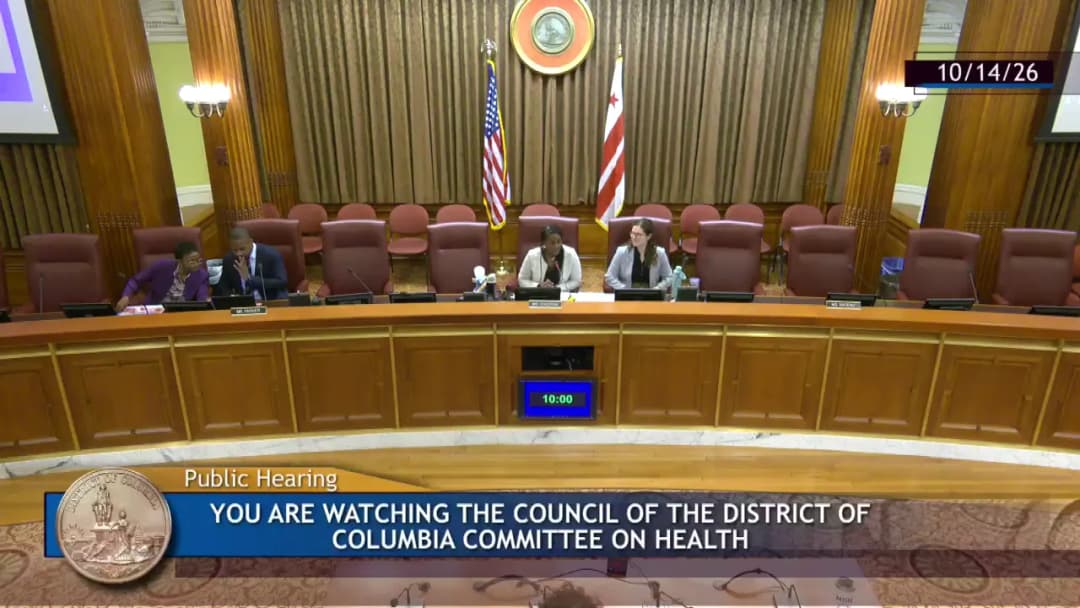
DC Council Committee on Health Hearing on HBX Bill 26-809, October 14, 2026

The DC Council Committee on Health met on October 14, 2026, to hear testimony on Bill 26-809, legislation to update conflict-of-interest, personnel, and governance provisions in the Health Benefit Exchange Authority (HBX) Establishment Act. HBX officials testified in support of the bill and answered committee questions. No vote was taken. HBX Leadership Testimony - HBX executive leadership testified that Bill 26-809 would remove conflicting standards between HBX's enabling legislation and the District's code of conduct. As an example, HBX's enabling legislation prohibits actions with a "foreseeable material financial effect" on an individual or immediate family, while the code of conduct prohibits actions with a "direct and predictable effect" on a closely affiliated person. The bill would strike older provisions in the Establishment Act and make the code of conduct apply to HBX staff and board members. - The testimony said the changes are consistent with recommendations from the HBX Standing Advisory Board, whose members include consumer advocates, insurers, brokers, clinicians, and DC Health Link customers. - The bill clarifies that prohibited affiliations are financial affiliations and that certain professional memberships disqualify only senior members, not ordinary members. HBX leadership pointed to the current plain language, under which no physician who is a member of the American Medical Association would be allowed to serve on the executive board or join the staff, and said that was not intended. - The bill would update HBX's purposes section to reflect responsibilities added since 2013, including the partnership with Massachusetts, Health Care for Childcare, and the Healthy DC plan, and to include authority under the ACA or District law. - The bill adds an information technology requirement for the executive board. HBX leadership supported the proposed requirement that one board member have IT expertise, including artificial intelligence, cybersecurity, and systems architecture, noting that HBX is fundamentally an IT entity. There is currently one vacancy, so the IT seat could be filled without removing a sitting member. - HBX leadership supported removing ambiguous "consistent with" language from HBX's independent personnel authority, similar to the 2019 independent procurement authority clarification. They argued plain language would reduce risk, help HBX recruit and retain talent, and allow it to respond quickly to changes in federal law. Committee Questions and Responses - A committee member asked how the 2019 procurement authority change has worked. The HBX director said the earlier ambiguity made staff uncomfortable exercising their full authority. After the Council clarified independent procurement authority, the board adopted policies based on best practices from the District, federal government, and other states. Contracts over $1 million require Council approval, and the director said the process has worked well, uses competition, exceeds minimum CBE requirements, and uses local CBEs even for Massachusetts partnership work. - On personnel, HBX has a long-standing MOU with DCHR, uses PeopleSoft, and pays DCHR for services. The director said HBX receives resumes directly, DCHR does not participate in screening, and DCHR administers benefits. The director estimated the annual payment as "about 115, maybe 150 a year" (the transcript does not state the unit, such as thousand). - A committee member said the MOU and payment arrangement underscored that HBX has been operating as an independent agency for some time. - The director described board oversight: the board chair and vice chair—two of the three finance committee members—meet monthly to review expenses, contracts, and investments. The board makes major policy decisions, adopts procurement policies, and posts materials on the HBX website. Board meetings are open to the public, and the standing advisory board and working groups provide stakeholder input. - Councilmember Zachary Parker joined the hearing; no questions from him were recorded. - Asked about post-employment restrictions, Deputy Executive Director Pervey Kempf explained that the code of conduct contains permanent, two-year, and one-year restrictions consistent with federal law, while the 2012 Establishment Act separately bars former HBX employees from working for any health carrier offering a qualified health plan through an exchange for one year. HBX officials argued that one-year carrier ban is overly broad, can reach carriers with no D.C. connection, and hinders recruitment. They also said conflicting standards make guidance difficult because BIGA can provide guidance only on the code of conduct and OAG only on the Establishment Act, and OAG is not set up to receive direct employee inquiries. - The director said the bill would not create local costs because HBX is funded through an assessment on health carriers and receives no locally funded operational support. Key Outcomes - No vote was taken on Bill 26-809. - The record remained open for written testimony until 5:00 p.m. on Wednesday, October 28, 2026, through the Council's hearing management system. - The chair said the committee needed more conversations on the Health Care Facilities Regulation Amendment Act, despite some pressing issues, but had what it needed to move forward on the HBX bill this fall, while noting the deadlines in the final months of the two-year Council period. - The Committee on Health will reconvene on October 15, 2026, at 1:30 p.m. in Room 412 of the Wilson Building for a public roundtable on long-term care for District residents with complex needs. Government witnesses were not invited; the roundtable will focus on best-practice frameworks for long-term care, the aging population, and aging in place. - The hearing adjourned at 12:53 p.m. per the transcript.

MISCELLANEOUS 47% · INSURANCE REGULATION 34% · PERSONNEL MATTERS 12% · CONTRACT PROCUREMENT 7%
04
NEWOCT 14, 2026 · WASHINGTON, DISTRICT OF COLUMBIA · COUNCIL OF THE DISTRICT OF COLUMBIA
DC Council Committee on Health Hearing on B26-799 and B26-809 – October 14, 2026

On Wednesday, October 14, 2026, at 11:01 a.m., the Committee on Health, chaired by At-Large Councilmember Christina Henderson, held a hybrid public hearing in Room 500 of the John A. Wilson Building. The committee considered Bill 26-799, the Healthcare Facilities Regulation Amendment Act of 2026, and Bill 26-809, the Health Benefit Exchange Authority Technical Amendment Act of 2026. No agenda or minutes accompanied the transcript; the hearing focused primarily on B26-799. Henderson introduced B26-809 as a technical amendment requested by the Health Benefit Exchange Authority to clarify independent personnel status, purpose and authorities, include an IT expert on the executive board, and reconcile code-of-conduct conflicts; no testimony on B26-809 appears in the supplied transcript before the break for that agenda item. Public Comments & Testimony - Justin Palmer (DC Hospital Association) expressed support for the intent of B26-799 while recommending: keep the current adverse-event definition tied to the 28 National Quality Forum serious reportable events plus four DC-specific events; treat cybersecurity events separately with a risk-based reporting threshold; extend proposed 48-hour reporting to at least 14 days after awareness; tier root-cause-analysis requirements; allow 60 days for root cause analyses or corrective action plans; exempt active criminal investigations from reporting; retain certificate-of-need rules allowing capital expenditure increases up to 25% before triggering a new CON instead of the 10% threshold; and limit licensure fee adjustments to no more than every three years. In discussion, Palmer said DCHA members were comfortable with the current adverse-event definition and that DCHA would submit supplemental testimony. - Andrew Ross (agenda listed Alzheimer's Impact Movement; testimony identified him as Director of State Policy for the Alzheimer's Association) opposed the bill's reduction of assisted living administrator dementia training from 12 hours to 4 hours annually, calling it a two-thirds reduction in ongoing training. He urged the committee to remove those provisions and keep the 12-hour requirement. Ross cited that more than 15,000 DC residents live with Alzheimer's, that DC has the highest prevalence of older adults with Alzheimer's compared with any state or county, and that Medicaid costs for Alzheimer's in DC reached an estimated $153 million in 2025. He also noted that the 2021 dementia training law for direct care workers is still not fully implemented because rules have not been issued more than five years later. Government Testimony - Sam Hurley, Senior Deputy Director of DC Health's Health Systems and Preparedness Administration (HISPA), testified on behalf of Mayor Muriel Bowser in full support of B26-799. He said DC Health licenses over 150 health care facilities and agencies and is creating a registration system for doctor and dentist offices, telehealth providers, and federally qualified health centers. He identified three needs: visibility into ownership changes, stronger patient-safety mechanisms, and flexible enforcement tools. He cited private equity investment in health care rising from $42 billion to $120 billion between 2010 and 2019, and at least 33 health care breach filings since 2009 affecting 685,611 individuals in DC. The bill would raise penalties to up to $10,000 per violation, remove the $100,000 aggregate cap, and tie the framework to federal requirements such as CMS and the Joint Commission. Discussion Items - On adverse-event reporting, Henderson questioned whether the broadened definition was needed. Palmer said hospitals preferred the current definition; Hurley said DC Health was open to conversation and had tried to align the new definition with National Quality Forum and Joint Commission standards. DC Health reported it collected zero dollars from failure-to-report fines in recent years because of transitions in the reporting system; a new electronic reporting system was live at zero cost. - On cybersecurity, Hurley confirmed the district currently has no adverse-event reporting requirement for cyber incidents, though federal requirements may apply. He explained the proposed threshold is meant to exclude routine phishing and focus on incidents that disrupt operations; Henderson noted similar gaps in the insurance sector and supported making reporting expectations explicit. - On assisted living provisions, Renata Cooper, Associate Director for the Office of Health Facilities, said provisional licenses would be 90 days with one renewal, and the full license would run from the initial provisional date. She said assisted living residences are the only residential provider type without a provisional period. Hurley defended the dementia-training reduction as consistency with the four-hour annual standard for direct care workers, while Henderson noted administrators may reasonably be held to a higher standard, a point also made by Ross. - On certificates of need, acquisitions, and real estate investment trusts, Terry Thompson, Director of the State Health Planning and Development Agency, said SHIPTA has reviewed at least 20 transactions since 2025, including for-profit conversions, and that REITs already operate in DC. Thompson said SHIPTA coordinates with the Office of the Attorney General, including mandatory referral of conversions, but acknowledged tracking relies partly on DC's small legal community. - On the clean hands exemption, Hurley said the bill removes the clean hands requirement only for license renewals, not initial licensure, to avoid forcing facility closures over unpaid district bills and strand patients. Henderson expressed concern that financial problems could correlate with quality problems and predicted OTR and healthcare finance officials would have views; Hurley acknowledged council writes the laws. Key Outcomes - No votes, amendments, or markups occurred during the public hearing. - The record remained open for written testimony; DC Hospital Association said it would submit supplemental materials, and other stakeholders unable to attend planned written submissions. - Follow-up conversations were expected between committee staff and DC Health/Stakeholders on adverse-event definitions, cybersecurity reporting timelines, root cause analysis requirements, assisted living administrator training, clean hands renewal provisions, and consistency of definitions with other DC laws.

PUBLIC HEALTH 49% · MEDICAID CREDENTIALING 16% · TECHNOLOGY AND INNOVATION 12% · HEALTHCARE FINANCE 11%
05
NEWOCT 14, 2026 · WASHINGTON, DISTRICT OF COLUMBIA · COUNCIL OF THE DISTRICT OF COLUMBIA
DC Council Committee on Youth Affairs Markup Meeting: Child Custody Amendment Act – October 14, 2026

On Wednesday, October 14, 2026, the DC Council Committee on Youth Affairs convened an additional meeting at 10:40 AM in Room 123 of the John A. Wilson Building and via Zoom, chaired by Councilmember Zachary Parker. The committee had quorum with At-Large Councilmember Alyssa Silverman and Ward 2 Councilmember Pinto, and considered one permanent measure, B26-0071, the Uniform Unregulated Transfer of Child Custody Amendment Act of 2026. Discussion Items - B26-0071 – Uniform Unregulated Transfer of Child Custody Amendment Act of 2026: Councilmember Parker described the measure as addressing violators with criminal penalties and enabling District courts to consider the promotion of uniformity of the Uniform Unregulated Transfer of Child Custody Act across states when applying the legislation. He moved the committee print and report with leave for staff to make technical and conforming changes. Key Outcomes - The committee voted unanimously (three ayes) to approve the committee print and report for B26-0071, with staff authorized to make technical and conforming changes. - The meeting was adjourned at 10:43 AM.

PROCEDURAL 100%
06
NEWOCT 14, 2026 · WASHINGTON, DISTRICT OF COLUMBIA · COUNCIL OF THE DISTRICT OF COLUMBIA
Committee on Health Votes on Three Bills (Remy Act, Medicaid Credentialing, Captive Insurance) on October 14, 2026

The Committee on Health, chaired by At-Large Councilmember Christina Henderson, convened on October 14, 2026, at 10:09 AM in Room 500 of the John A. Wilson Building. The committee voted unanimously to advance three bills: the Rodent Education and Management Yields Results Amendment Act of 2026 (Remy Act), the Streamlining Medicaid Credentialing Amendment Act of 2026, and the Captive Insurance Company Amendment Act of 2026. Members present included Councilmember Brianna Doe (Ward 1), Charles Allen (Ward 6), and Zachary Parker (Ward 5, virtual). Discussion Items Bill 26-707: Rodent Education and Management Yields Results Amendment Act of 2026 (Remy Act) Chair Henderson introduced the committee print combining her legislation with Bill 26-492 by Councilmember Lewis George. She noted that the District has the fastest growing rodent population of major cities despite heavy rodenticide use, citing an estimate of 12 pediatric hospitalizations related to rodenticide in one year and a finding that 85% of autopsied wildlife tested positive for rodenticides. The bill creates a commercial corridor rodent-proof trash receptacle pilot program at the Department of Public Works (DPW), requires a strengthened rodent abatement dashboard from DC Health, clarifies DC Health's authority to require rodent abatement plans and impose financial penalties of up to three times the District's costs for abating harborage conditions, requires DPW to notify ANCs before removing public litter cans from residential blocks, and restricts anticoagulant rodenticides to commercial applicators with enforcement moved to the Department of Energy and Environment (DOEE), which is authorized to add other rodenticides to the restricted list based on evidence of harm. Councilmember Allen expressed strong support and requested clarification on enforcement triggers; Chair Henderson specified that rodent abatement plans can be required on a first visit, while treble damages apply after repeated failures. Councilmember Nadeau praised the collaboration and stressed the need for broader food waste and trash containment strategies to starve the rat population. Bill 26-523: Streamlining Medicaid Credentialing Amendment Act of 2026 Chair Henderson detailed the bill's aim to reduce administrative burdens on providers by requiring the Department of Healthcare Finance (DHCF) to develop a single credentialing application, respond to applicants within 10 days, and issue a determination within 30 days. The bill removes a temporary credentialing provision to mitigate program risk and sets an effective date of January 1, 2028. No members offered additional discussion. Bill 26-588: Captive Insurance Company Amendment Act of 2026 Chair Henderson explained that the bill updates the District's captive insurance regulations to align with national standards. Key changes include updates for protected cell captive insurers related to formation, capital, taxes, and annual reports; granting the commissioner authority to deem entities inactive; increasing the expedited timeline from two to three days; and granting rulemaking authority for risk retention groups. No members offered additional discussion. Key Outcomes - Bill 26-707 (Remy Act): Passed unanimously. Fiscal impact includes $45,000 for DPW, 1 FTE for DC Health, and 2 FTEs for DOEE. - Bill 26-523 (Medicaid Credentialing): Passed unanimously. Fiscal impact is $4 million in FY27 ($2.2 million local) and $16 million over the financial plan ($8.8 million local) for a new vendor contract. - Bill 26-588 (Captive Insurance): Passed unanimously. The Office of the Chief Financial Officer (OCFO) confirmed sufficient funds for implementation. Adjournment The meeting was adjourned at 10:31 AM. The committee announced a public hearing at 11:00 AM on Bill 26-799 and Bill 26-809.

RODENT CONTROL 52% · PUBLIC HEALTH 16% · INSURANCE REGULATION 15% · MEDICAID CREDENTIALING 13%
07
NEWOCT 14, 2026 · WASHINGTON, DISTRICT OF COLUMBIA · COUNCIL OF THE DISTRICT OF COLUMBIA
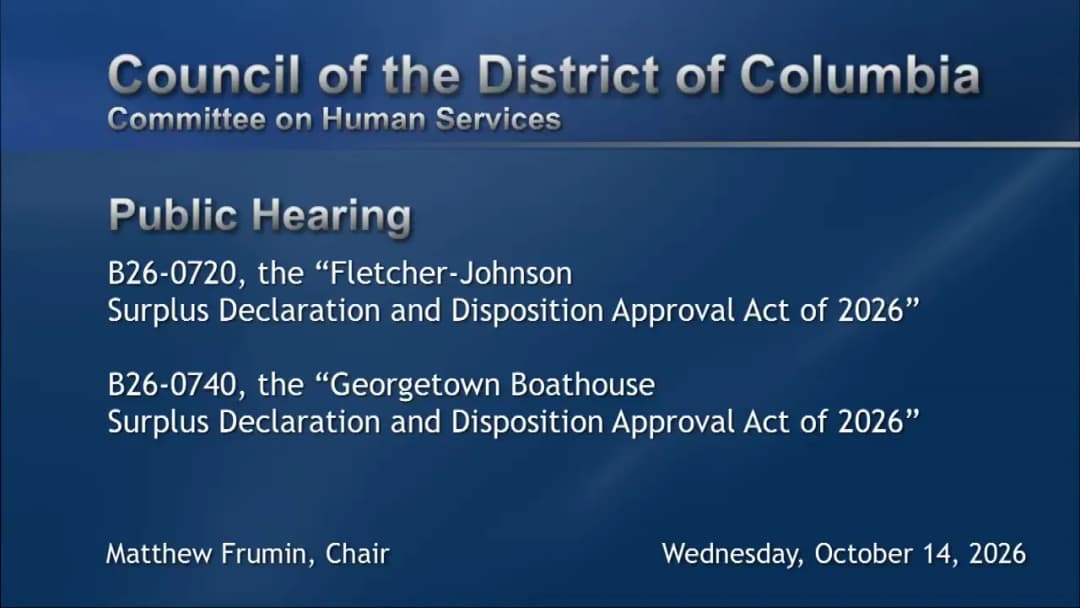
D.C. Council Committee Hearing on Georgetown Boathouse and Fletcher Johnson Surplus Disposition Acts (October 14, 2026)

The Committee on Human Services, chaired by Councilmember Matt Fruman (Ward 3), held a public hearing on October 14, 2026, to consider Bill 26-740 (Georgetown Boathouse) and Bill 26-720 (Fletcher Johnson). The hearing featured testimony from public witnesses, developers, and government officials. Public Comments & Testimony Georgetown Boathouse (Bill 26-740) - Corey Peterson (Georgetown University): Expressed strong support for the project, describing the triparty agreement, boathouse access for students, and public dock access (75% of daylight hours). Noted unanimous support from ANC 2E and 3D. - Councilmember Brooke Pinto: Stated strong support for the decades-in-the-making project. Fletcher Johnson (Bill 26-720) - Ciara Mackey (Ward 7 Resident): Supported the development but expressed concerns about the FED's location across from KIPP DC creating traffic and safety issues. Sought community amenities like an ARC for youth. - TN Tate (Former ANC Commissioner): Supported the progress but urged clear commitments on senior services, a grocery store, parking adequacy, and oversight of job creation. Questioned if the arts space from the community vision was realized. - Ebony Rose Thompson (State Board of Education, Ward 7): Strongly supported the project but stressed the need for an art space, family-sized housing, and diverse retail. Emphasized Ward 7 is the only ward without an arts space. - Natasha Dupey (Chair, ANC 7E): Testified in support, citing the development team's transparency and alignment with community priorities. The ANC passed resolutions supporting the zoning and CBA. - Keith Hassan Towery (Former Chair, Marshall Heights): Supported the project but advocated for direct community communication beyond the ANC to inform all residents. - Vic Gonzovas (Mikasa Inc.): Opposed the deal, arguing it "fails to maximize public goods for private profits." Criticized the 30% affordability requirement as a bare minimum, questioned the $73M infrastructure subsidy, and raised concerns about an affordability covenant loophole. Discussion Items Fletcher Johnson Freestanding Emergency Department (FED) - Project Description: Jason Barrett (UHS) described the $25M+ FED with 14 exam rooms, open 24/7/365, treating 38,000 patients annually. He cited 59,889 EMS calls in Wards 7 and 8 in 2023. - Councilmember Parker Position: Expressed skepticism, questioning its cost effectiveness vs. urgent care/primary care given Cedar Hill's struggles, and requested a cost-benefit analysis. - Councilmember Felder Position: Strongly supported the FED as vital health infrastructure, stating "any event we would have had... a number of those lives could have been saved." - Chair Fruman: Questioned traffic impact on adjacent KIPP school, ambulance traffic (2 inbound, 4-6 outbound daily), and the rationale for an FED under UHS's $75M ambulatory care obligation from the Cedar Hill agreement. Housing, Affordability & Community Benefits - Developer Program (Swadi, Gregg, Alayande): Presented Options A (Memory Care/Dementia Village, 157 deeply affordable 30% AMI units) and B (More market-rate senior housing, more retail, but only 59 deeply affordable units). The team preferred Option A. - Debate on Affordability: Councilmember Felder highlighted balancing deeply affordable housing with attracting a grocery store. Councilmember Parker questioned the lack of family-sized units. DMPED confirmed the affordability covenant runs for 99 years, disputing the loophole. - Grocery & Arts Space: Community witnesses and Councilmembers prioritized a committed full-service grocery store and a dedicated arts/community space. The development team committed to pursuing a grocer (15-25k sq ft) and said future charrettes would address the arts space and park design. Georgetown Boathouse - Design & Access: Setbacks for DDOT maintenance. Public dock access 75% of the time. Construction start 2028. CBE and First Source agreements signed. - Parcel E: District gains jurisdiction. Potential for improved public access. Key Outcomes & Next Steps - No Vote Taken: Hearing was for testimony collection only. Legislative votes will occur at a future markup session. - Record Open: Written testimony due by 5:00 PM on Wednesday, October 28, 2026. - Legislative Timeline: Committee markup and full Council vote expected by end of 2026 to meet developer schedules and funding commitments.

COMMUNITY ENGAGEMENT 26% · AFFORDABLE HOUSING 20% · ECONOMIC DEVELOPMENT 10% · PUBLIC HEALTH 9%
08
NEWOCT 13, 2026 · WASHINGTON, DISTRICT OF COLUMBIA · COUNCIL OF THE DISTRICT OF COLUMBIA
Committee of the Whole Hearing on Bill 26-770 - Restoration of Covenanted Roads and Alleys Clarification Act, October 13, 2026

This is a public hearing of the Committee of the Whole of the Council of the District of Columbia, chaired by Phil Mendelson, on Tuesday, October 13, 2026, at 12:22 PM in Room 412 of the Johnny Wilson Building. The subject of the hearing is Bill 26-770, entitled "Restoration of Covenanted Roads and Alleys by the District Government Clarification Amendment Act of 2026," introduced by Chairman Mendelson on July 13, 2026. The bill seeks to amend the Restoration of Covenanted Roads and Alleys by the District Government Act of 2024 to further clarify the District's authority to repair or restore certain private rights of way used for motor vehicles by the District government. The need for the 2024 law arose from a community request in the Hillcrest neighborhood in 2021, and the current amendments address a similar situation involving an unpaved alley off Morris Road, SE, which is in disrepair and is the only access for residents for parking and trash service. Discussion Items - Chairman Mendelson presented the background and purpose of Bill 26-770. He noted that emergency and temporary versions were adopted in July 2026 to supplement the 2024 law. The bill addresses situations where private alleyways, covenanted by developers but not dedicated as public alleys, serve as the sole access for homes (e.g., Hillcrest Drive alley and Morris Road alley). These alleys are used by city trash trucks and emergency vehicles but are in need of repair. The amendments are necessary to provide the executive with sufficient permanent authority to address the Morris Road situation and similar cases. - Chairman Mendelson stated that he has been in communication with the executive branch regarding the legislation and is aware of no objections. The bill was drafted in coordination with the Mayor's office. - No witnesses testified; the hearing record will remain open until 5:00 PM on Tuesday, October 27, 2026. Key Outcomes - The hearing record is open for two weeks, closing on October 27, 2026, at 5:00 PM. Written testimony may be submitted. - No formal vote was taken during this hearing; further action will follow after the record closes.

INFRASTRUCTURE 70% · PUBLIC SAFETY 30%
09
OCT 9, 2026 · WASHINGTON, DISTRICT OF COLUMBIA · COUNCIL OF THE DISTRICT OF COLUMBIA
D.C. Council Committee of the Whole Hearing on Technology in Schools (October 9, 2026)

The Committee of the Whole of the Council of the District of Columbia, chaired by Chairman Phil Mendelssohn and joined by Councilmember Matt Fruman, held a nearly eight-hour public hearing on Friday, October 9, 2026, to examine the use of technology, screen time, and artificial intelligence across District schools. Drawing testimony from over 100 witnesses—including charter leaders, national researchers, state board members, teachers, parents, and government officials—the hearing weighed the benefits of personalized learning and digital literacy against rising concerns over screen time, mental health, data privacy, and the efficacy of tools like iReady. A central tension emerged between calls for stricter limits and pleas for equitable access to functional devices, particularly from communities East of the River. Public Comments & Testimony - Charter and School Leaders: David Lowry (Friendship), Adam Browning (WLA), and Francisco Duran (Arlington Superintendent) jointly emphasized that technology is a tool meant to support, not replace, effective teaching. Duran detailed Arlington's age-based device restrictions (e.g., no devices for PreK-K unless for an IEP), while Browning shared WLA's four-year journey integrating AI, stressing the need for strong guardrails and significant teacher professional development. All agreed that AI literacy is critical, but human judgment and connection remain paramount. Duran highlighted that the most important driver of the policy was the learning goal. - Expert Research Panel: John Murtz (Children and Screens), Josh Boots (Empower K-12), Nicole Barnes (APA), and Lily Fessler (Stanford) provided a cautionary framework. Boots cited a study showing student homework scores rose 18% while exam scores fell 20% after unguided AI adoption. Barnes urged distinguishing between performance on a platform and durable learning. Murtz advised that foundational educational science should guide decisions. Fessler noted the evidence base is still emerging, especially in US K-12. - State Board of Education: Robert Henderson (Ward 5), LaJoy Johnson Law (Ward 8), Eric Goulet (Ward 3), and Ebony Rose Thompson (Ward 7) stressed the need for cross-sector equity. Johnson Law and Thompson shared that an East of the River engagement session revealed families' top priorities are working devices, reliable Wi-Fi, and digital literacy, not restrictions. They cautioned the council against one-size-fits-all policies. - Parents, Educators, and Advocacy Groups: Deep divisions were evident. PAVE parent leaders urged balance and warned against bans that could worsen the digital divide. Schools Beyond Screens DC parents and teachers shared specific harms, including data privacy lapses, exposure to pharmaceutical ads, and punitive iReady practices (e.g., "iReady jail"). Teachers from EmpowerEd and WTU demanded resources and teacher voice, with Ward 8 middle school teacher Regina Leggett powerfully recounting having only 14 laptops for 25 students at Johnson Middle School. - Curriculum Associates (Dr. Mary Wall, Woody Peck): Defended iReady, describing it as a diagnostic and supplemental tool designed to work under teacher direction. They stated independent research shows growth within their recommended 30–49 minutes per subject per week, acknowledged overuse outliers, and denied sharing student data with third parties without permission. - Government Officials: Corrine Colgan (DCPS) highlighted new 2026-27 screen time guidance. Paul Kine (DME) framed the issue around human-centered skills for an AI future. Glenn Starnes (OSSE) announced the release of an AI model policy for LEAs employing a "stoplight framework" for staff use, with student-facing guidance under development. Discussion Items - Screen Time and Instructional Quality: A consensus formed that the quality and purpose of screen time matters more than strict minute counts. Councilmember Fruman questioned how DCPS enforces its new guidance and how to effectively evaluate quality. - Efficacy of iReady and Ed Tech: The hearing became a flashpoint for the broader debate on ed tech evidence. Witnesses for the vendor cited independent peer-reviewed studies, while critics noted these studies often involved the vendor and challenged the collection of sensitive student data (e.g., homelessness, disability status). DCPS admitted to tackling overuse with new limits but defended the tool's diagnostic value. - Artificial Intelligence (AI) in Education: AI sparked intense debate. The risk of "cognitive offloading"—students using AI to bypass the productive struggle required for learning—was a primary concern highlighted by the expert panel. The Capital AI Education Collective was praised as a proactive cross-sector forum for sharing best practices. - Digital Equity: The absence of working devices in Wards 7 and 8 schools served as a stark counterpoint. Testimony from Dr. Johnson Law, Ms. Leggett, and others made it clear that for many students, the primary technology crisis is a lack of access and functional infrastructure, not an overabundance. - Data Privacy and Vendor Oversight: Witnesses, including technology policy expert and parent Erie Meyer, raised detailed concerns about the scope of data collected by ed tech companies and the difficulty for parents to know how it is used or retained. - Teacher Support and Professional Development: Universal agreement emerged that robust, ongoing teacher professional development is essential for any policy to succeed. Teacher witnesses argued that shifting away from technology requires investing in people and providing time and resources, not just removing screens. Key Outcomes - Public Hearing Concluded, No Votes Taken: The hearing was a legislative fact-finding session. No bills or resolutions were voted upon. - Directives Issued: Chairman Mendelssohn directed DCPS to promptly follow up and resolve the acute laptop shortage reported at Johnson Middle School in Ward 8. - Acknowledged Need for Policy Evolution: Government witnesses committed to developing further cross-sector guidance. OSSE pledged to develop student-facing AI policies and procurement resources. DCPS committed to an overhaul of its annual technology plan to address criticisms regarding accuracy and gaps. - Cross-Sector Collaboration Highlighted: The Capital AI Education Collective and the work of the State Board of Education were recognized as valuable non-legislative pathways for developing shared best practices and frameworks. - Record Remains Open: The public record for the hearing will remain open until 5:00 PM on Friday, October 23, 2026, for submission of additional written testimony.

STUDENT SCREEN TIME 44% · TECHNOLOGY AND INNOVATION 34% · PUBLIC EDUCATION 18% · DATA PRIVACY 2%
10
OCT 8, 2026 · WASHINGTON, DISTRICT OF COLUMBIA · COUNCIL OF THE DISTRICT OF COLUMBIA
Oversight Roundtable on Eligibility Determination at Virginia Williams Family Resource Center – October 8, 2026

The Committee on Human Services, chaired by Councilmember Matt Freeman (Ward 3), held an oversight roundtable on the eligibility determination process at the Virginia Williams Family Resource Center, operated by the Department of Human Services (DHS). The meeting examined barriers families face when accessing homeless services, including documentation requirements, the Homelessness Prevention Program (HPP), and treatment of domestic violence survivors. Chairperson Freeman expressed disappointment that DHS failed to provide requested documents, including eligibility scripts, citing operational concerns. Councilmember Trayon White also offered opening remarks emphasizing the need for equitable services. Public Comments & Testimony - Domestic Violence Survivors and Advocates: Multiple witnesses from the DC Coalition Against Domestic Violence (Michaela Deming, Dawn Dalton, Teresa Poor) testified that survivors face barriers including ID requirements, lack of trauma-informed care, inappropriate diversion to unsafe living situations, and failure to properly screen for domestic violence. They reported that only 4% of families seeking services at Virginia Williams were referred to DASH (domestic violence services) in FY26, and that DHS has not implemented past recommendations. Jasmine Ferguson (Community Family Life Services) noted that her transitional housing program does not receive referrals from Virginia Williams and that the SPADAT assessment tool is not used effectively to connect clients to housing. - Families and Legal Advocates: Lejuan Brooks (Washington Legal Clinic for the Homeless) described families being asked for impossible documentation (e.g., former landlord letters, friend's lease) and denied shelter despite having no safe place to stay. He noted that legal services are no longer on-site at Virginia Williams, and that the clinic's flyers were removed from the building security desk. Tamika Kennedy, Monique Jackson, Charmaine Brown, and Jasmine Waters shared personal stories of repeated denials due to lack of documents, being told to stay with unsafe relatives, or having to prove homelessness by showing vehicles. Ms. Kennedy was only placed after advocacy from the Legal Clinic. McKenna Osborne (Children's Law Center) raised concerns about HPP operating as a shelter denial without appeal rights, lack of transparency and regulations, and that 50% of HPP participants return to Virginia Williams within two years. - Additional Virtual Witnesses: Shoney Jones (Family Voices DC) stated HPP is misused as a barrier, funding is limited to three months (six if leaving DC), and that a public data dashboard is needed. Joanny Enriquez (DC SAFE) stressed the need for safety-centered diversion and consistency. Robin Swanson (Volunteer Legal Advocates) highlighted that survivors often do not self-identify and that intake scripts remain secret, preventing verification of trauma-informed screening. Other witnesses (Tamisha Lawrence, Michael Campbell, Keisha Briscoe, Dineta Lewis, Britt Ruffin, Charisse Lew) testified to being denied shelter despite having no safe place, being asked for multiple contacts, and experiencing hostile treatment. Charisse Lew (Washington Legal Clinic) called the 75% shelter denial rate unlawful and urged amendment of the Homeless Services Reform Act (HSRA). Discussion Items - Director Pierre's Testimony: DHS Director Rachel Pierre stated that eligibility follows HSRA criteria (residency, family definition, homelessness). She emphasized prevention and diversion, noting that shelter is a last resort. She reported that in FY26, 4,672 assessments were completed, with 52% referred to HPP and 14% entering shelter. She stated that interim eligibility is used when documents are lacking, and that staff are trained to serve families with compassion. Director Pierre noted that HPP regulations are in development and should be published next year. - Documentation and Interim Eligibility: Chairperson Freeman pressed on why families are denied for lack of documents when HSRA prohibits denial solely for inability to prove residency or homelessness. Director Pierre responded that interim eligibility is available and that staff have flexibility to verify through data systems. She acknowledged that customer service issues may occur and that she would review cases. - HPP Transparency and Effectiveness: Councilmembers questioned the high rate of HPP referrals and lack of appeal rights. Director Pierre argued that HPP prevents homelessness and that only 2.5% of HPP families return to shelter. She stated that shelter is provided if a family has no safe place to stay. The committee discussed the need for clear HPP regulations and data on outcomes. - Domestic Violence Training and Screening: Witnesses and Councilmember White raised concerns about DHS staff training on domestic violence. Director Pierre stated that DASH provides monthly training and that the assessment form (FAM) was developed with DASH input. She denied cuts to DASH training funding and noted that a co-located DASH team is available. She agreed to review the percentage of DV identifications dropping from 10% to 4%. - Access to Legal Services: Brooks and others requested a reinstated presence of the Washington Legal Clinic at Virginia Williams. Director Pierre explained that the lease restricts non-provider organizations and that space is limited, but the clinic's information is included in denial notices and she is open to continued meetings. - Data and Transparency: Chairperson Freeman suggested a public dashboard similar to DOB's, and Director Pierre said she would explore the idea. The committee also discussed publishing HPP regulations, providing definitions of safe housing, and tracking outcomes by intervention type. Key Outcomes - DHS committed to providing outstanding documents, including the evidence-based assessment tool (WestAT), following the hearing. - DHS will work to publish HPP regulations within the next year, including eligibility criteria and transparency measures. - Director Pierre agreed to review individual cases mentioned in testimony and to improve customer service training. - The committee will follow up on proposals for a public data dashboard and a consumer advisory group. - No formal votes were taken; the record will remain open until 5 p.m. on Thursday, October 22, 2026 for written testimony.

HOMELESSNESS 58% · DOMESTIC VIOLENCE SERVICES 13% · PUBLIC ENGAGEMENT 7% · PUBLIC BENEFITS 6%
0102
NEXT →
OPENPUBLICA · PUBLIC MEETING INDEXUPDATED DAILY · openpublica.com