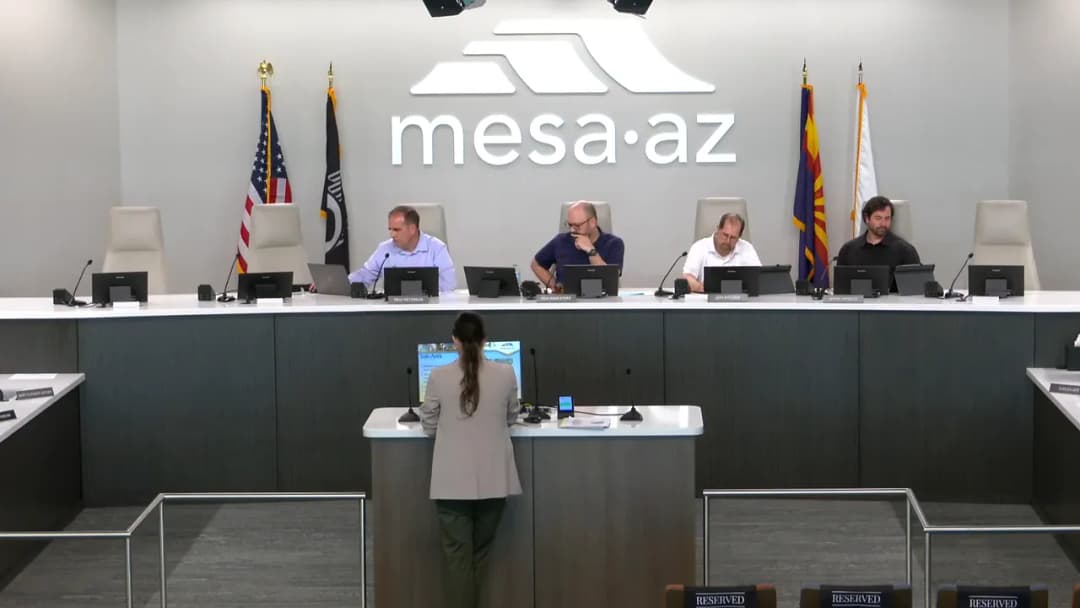
(Note: The transcript indicates the meeting occurred on April 22, 2026; the date below follows the instruction to use the provided timestamp.) The Mesa Planning and Zoning Board held a public hearing on April 27, 2026, chaired by Chair Ayers. The board unanimously approved a consent agenda and deliberated on a single discussion item: a rezone request for a 47-lot single-family residential subdivision. Public testimony focused on traffic access and safety concerns. Consent Calendar - Item 2A: Planning and Zoning Board minutes from April 8, 2026 – approved unanimously. - Item 3B (ZON 25-00578): New Life Fellowship Hall Building – site plan review for a 6,421-square-foot place of worship on 0.6 acres at West Broadway Road and South Dobson Road – approved on consent. - Item 3C (ZON 25-00626): NTT Mesa Phase 10 – data center development on 173 acres at East Pecos Road and South Crisman Road – continued to the May 13, 2026 meeting as recommended by staff. Public Comments & Testimony - Mike Stokes (1301 N. Loma Vista): Requested the development's exit-only be moved from 32nd Street to Miramar (east side) to reduce traffic impact on existing homes. - Joyce Stokes: Opposed the 32nd Street exit because it would be directly behind her home; supported relocation to Miramar, noting a church parking lot buffers homes there. - Ryan Smith (3105 E. Huber): Asked for a designated right-turn deceleration lane on westbound Brown Road (from Val Vista to the canal) for safety at 45 mph; supported the Miramar exit; requested no-parking restrictions on 32nd Street. - Anita Smith (3105 E. Huber): Echoed concerns about the 32nd Street exit and requested a traffic study for 32nd Street; emphasized the need for a right-turn lane on Brown Road and no-parking designation on 32nd Street due to narrowness. Discussion Items - Item 3A – ZON 25-00635 (Ascension): A request to rezone 40 acres at the northeast corner of East Brown Road and North 32nd Street from AG (Agricultural) to RS-15 PAD (Planned Area Development) to allow a 47-lot single-family subdivision with a density of 1.27 dwelling units per acre. - Staff Position: Recommended approval with conditions, including Condition 1 requiring density of 1.24 du/ac (RS-35 equivalent per Citrus Sub-Area Plan), which would necessitate one fewer lot. - Applicant (unidentified representative): Requested removal of Condition 1, arguing the density difference (0.03 du/ac) is minimal and the Citrus Sub-Area Plan has effectively sunset. Applicant noted the site's location at the tail end of the sub-area. He defended the 32nd Street exit-only as recommended by transportation and engineering after studying site slopes and road network connectivity; stated a right-turn lane on Brown Road is not warranted per traffic generation analysis. - Board Discussion: Board members expressed support for deleting Condition 1, citing the negligible density increase and the uniqueness of this parcel. Vice Chair Peterson noted traffic impacts are minimal (under 100 peak-hour trips). Board members agreed to add a condition limiting lots 40–47 to single-story primary and secondary structures. Regarding the exit location, the board deferred to the applicant's and city traffic staff's analysis that 32nd Street serves as a better egress point due to its connection to the larger local road network versus Miramar's dead-end cul-de-sac. No-parking signage on 32nd Street was noted as a separate city process. Key Outcomes - Motion: Approve Item 3A with modifications: (1) delete Condition 1 (density requirement), and (2) modify the PAD chart to restrict lots 40 through 47 to single-story only for both primary and secondary structures. - Vote: Unanimous (6–0) – Chair Ayers, Vice Chair Peterson, Board Members Pitcher, Montes, Blakeman, and Carpenter all voted yes. - Next Steps: The item will move to the Mesa City Council for final consideration. The board also noted that the city's Transportation Department can be consulted regarding no-parking signs on 32nd Street as a separate process.
Public Meetings - Mesa, Arizona
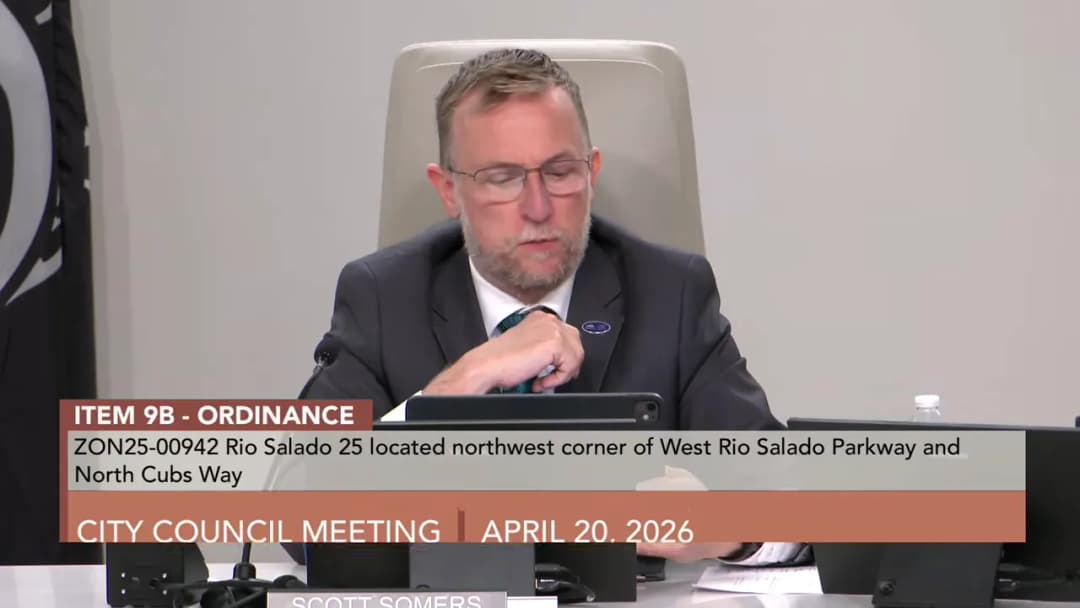
Public Meetings - Mesa, Arizona[Note: The meeting transcript states the date as April 20, 2026, but the provided timestamp is April 22, 2026. This summary uses the instructed date.] The Mesa City Council convened for a regular meeting with all council members present. The meeting opened with an invocation and Pledge of Allegiance, followed by the consent agenda and public comments. Key actions included approvals of various contracts, liquor licenses, development plans, and grant pass-through resolutions, with significant debate on a Planned Parenthood grant application. Consent Calendar - The consent agenda was read by Mr. Christopher. Several items were removed for separate consideration (3B, 4A, 4C, 5B, 5E, 5H, 5O, 5U, 5V, 6A, 6B, 7A, 7B, 9A, 9B). The remaining consent items were approved unanimously. (See Key Outcomes for details on items removed.) Public Comments & Testimony - Noah James Markham (Tempe resident) spoke in favor of multiple items including 3B (liquor license for Babu Jomak), 4A (water reclamation improvements), 5E (Planned Parenthood grant), 5I–5K (autism research), 6A/6B and 7A/7B (development and annexation), 9A/9B (baseball player housing). He also spoke during Citizen Present about conditions at the Mesa ICE facility, calling them inhumane and referencing a congressional visit. - Nathan Allen spoke on 4C (private security contract extension), expressing concern about using security guards instead of police officers and recounting past issues with security guards harassing homeless individuals. - Mary Mabino (Mesa resident near Brown and Recker) spoke against item 5E (Planned Parenthood grant), arguing that the organization is a profitable abortion provider and that Mesa should not associate with it. She asked if the city receives financial benefit from pass-through grants (staff confirmed no financial benefit). - Lindsay Andres (Mesa homeowner and business owner) spoke on item 5U (MOU with Mesa Police Association), criticizing lack of police transparency and citing incidents involving a truck driving through protesters and the Barraza case. She expressed distrust in the system. - Kerry Davis spoke in opposition to items 9A and 9B (Rio Salado minor plan), arguing that high-density multifamily units contribute to higher crime and that Mesa should focus on single-family homes. He compared Mesa's ranking to Chandler and Gilbert. - Dorothy O'Brien (Encore/Eastmark resident) addressed council during Citizen Present about funding priorities. She was appalled by Mayor's suggestion to shift funds from social programs to code enforcement and redevelopment, urging that CDBG funds remain for low/moderate income individuals and that quality-of-life funds and overtime reductions be used instead. - Jeremy Spielsbury spoke about the Mesa ICE facility, describing inhumane conditions and drawing parallels to historical segregation in Mesa. He expressed solidarity with immigrant neighbors and urged council to act. Discussion Items - Item 5E – Planned Parenthood Pass-Through Grant: Staff explained that historically the city passes through grant applications to tribal nations without political judgment, based on whether the nonprofit serves Mesa. Councilmember Taylor strongly opposed, arguing that sponsorship is an endorsement and that the city should not facilitate an organization that provides abortions. Councilmember Goforth supported the item. After debate, a separate motion was made. - Items 9A and 9B – Rio Salado Minor Plan and General Plan Amendment: Council discussed the unique nature of the site adjacent to Sloan Park, which is being developed for a hotel and residential building for professional baseball players (full-time use by minor league players). City Manager Mr. Butler and Councilmembers Taylor and Goforth clarified that the site is not suitable for single-family homes, that access constraints limited commercial development, and that the project strengthens the relationship with the Chicago Cubs. Councilmember Adams noted his usual preference for owner-occupied housing but supported this as a specialty use. - Citizen Present – ICE Facility: Multiple speakers raised concerns about overcrowding and conditions at the Mesa Gateway Airport ICE facility, citing a recent congressional delegation visit. Key Outcomes - Consent Agenda (remaining items): Approved unanimously. - Item 3B (Liquor License – Babu Jomak): Approved unanimously. - Item 4A (Northwest Water Reclamation Improvements): Approved unanimously. - Item 4C (Private Security Contract Extension for Police): Approved unanimously. - Items 5B, 5H, 5O, 5V (Various Grant Pass-Throughs and Others): Approved unanimously as a bundle. - Item 5E (Planned Parenthood Pass-Through Grant): Passed with Councilmember Taylor voting no and Councilmember Goforth voting yes. (Motion passed; only two council votes are recorded but the result was approval.) - Items 6A, 6B, 7A, 7B (Development and Annexation): Approved unanimously as a bundle. - Items 9A and 9B (Rio Salado Minor Plan and General Plan Amendment): Approved unanimously. - Meeting Adjourned: Motion to adjourn passed unanimously.
The Mesa City Council held a study session on April 22, 2026, to review the consent agenda, receive budget presentations from the Energy Resources Department, and discuss proposed Memorandums of Understanding (MOUs) with the Mesa Police Association and United Mesa Firefighters Association. The meeting also included discussion of a 911 center project and recognition of staff achievements. Consent Calendar - Councilmember Taylor requested to pull Item 5E (Edwards) for a separate vote. - Councilmember Go Forth indicated she would pull Item 6A (Long Next Use Developments) from consent for discussion at the next meeting. She had received emails on the item and was satisfied with the responses. - Councilmember Go Forth also asked questions on Item 4B, leading to a detailed discussion of the CMAR (Construction Manager at Risk) process for the 911 center project. Discussion Items - 911 Center Project (Item 4B): Councilmember Go Forth asked about the CMAR process used to select Wilming for pre-construction services. Staff explained that the process followed Title 34, soliciting in October 2025, evaluating experience, workload, Mesa-based firm points, and project understanding, shortlisting, and interviewing. The pre-construction services contract is for negotiating a Guaranteed Maximum Price (GMP); no set timeframe was given but construction is targeted for about a year out. The design is at 30%. The bond for the project was $54 million. Staff noted the contractor selected for the adjacent fire station (Station 223) is the same, creating synergies and cost efficiencies. - Energy Resources Department Budget Presentation (Item 2A): Scott Boucher (Energy and Sustainability Director) highlighted: the public purpose of sustainable, reliable, affordable energy; a 57% renewable electric portfolio; $600,000 in savings from the Parker Davis Voluntary Reduction Program; and participation in a pre-pay program for natural gas starting May 2026 saving an estimated $164,000. Awards included APGA SOAR, APPA RP3 (Platinum), and top 25% for reliability. Key performance indicators: System Average Interruption Duration Index (SAIDI) was strong; gas emergency response times met a 30-minute goal 95% of the time. Staff discussed retention challenges with larger utilities but emphasized Mesa's benefits and career development. Fiscal analyst John Petroff reported that electric and gas operations & maintenance were under budget in 24-25 and 25-26, with proposed 26-27 budgets increasing about $300,000 each for electric and gas. Savings of $263,000 were proposed (eliminating college intern program, reducing locating temps, etc.). Councilmember Taylor had no questions; Councilmember Go Forth praised the department and highlighted retention of linemen and gas personnel. In response to a question, staff noted the electric utility has been operating since around 1917 and serves nearly 19,000 electric and 80,000 gas customers. - Public Safety MOUs (Item 2B): Assistant City Manager Ken Cost presented proposed MOUs with the Mesa Police Association and United Mesa Firefighters Association for July 2026 – June 2029. Key points: - Fire: 3% market adjustment for firefighters, engineers, and captains; 5% annual merit increases; incentives for top-tier medical evaluations; uniform allowance for recruits; and continued cancer screening. - Police: 3.3% adjustment for officers and 4% for sergeants; 5% annual merits; patrol incentive pay; uniform allowance; and advanced training incentives for aviation/drones. Both MOUs include benchmarking in spring 2027 and an adjustment up to 3% in 2028. Office of Management and Budget Director Brian Richel showed the projected impact: the general fund forecast over the next five years shows a $40 million reduction in ending fund balance (from $160.9M to $121M) due to the MOUs, on top of about $160 million in public safety benchmarking over two cycles. City Manager responded that the MOU costs are necessary to remain competitive and that the city has saved $56 million in efficiencies over three years. Councilmembers expressed support, emphasizing public safety as a priority. Councilmember Adams requested a comparison of current projections to last year's forecast to show progress; staff agreed to provide it at the April 30 budget wrap-up. Key Outcomes - The consent agenda items were approved unanimously (vote: all ayes). - The Energy Resources Department budget presentation was received; no formal vote was taken but direction was provided. - The proposed MOUs were discussed; council expressed general support. Formal adoption will occur at a subsequent meeting. - Councilmember Go Forth's questions on the 911 center CMAR process were answered; staff confirmed that pre-construction services will lead to a GMP brought back for council approval. - Councilmember Adams requested a comparative financial forecast, which staff will provide on April 30. Other - The council acknowledged receipt of various board minutes (Item 3) and approved them unanimously. - The Mayor suspended discussion of current events and conferences attended. - Upcoming meetings: State of the City on April 24, 2026; next study session on April 30, 2026 at 7:30 a.m. - Recognition: Jay O'Donnell was named Arizona Economic Development Professional of the Year; Boeing Company received an award for contributions to economic development in Mesa.
This study session of the Mesa City Council, held on April 20, 2026, focused on reviewing the upcoming council agenda, receiving detailed presentations on the Police Department's budget, the five-year Capital Improvement Program (CIP), and the Water Resources budget. Councilmembers discussed crime statistics, traffic safety, budget reductions, infrastructure projects, and resource management. No formal votes were taken; staff provided updates and council gave direction for future considerations. Discussion Items Agenda Review Council briefly discussed items on the April 20 council meeting agenda, including the purchase of One West Main (item 5S), the Christman Road project (item 5T), and a hotel at Longbow (item 6A). Staff clarified that item 5T is an agreement with ADOT to facilitate construction of a portion of Christman Road concurrent with State Route 24 construction. Mesa Police Department Budget Chief Dan Butler and his command staff presented the proposed FY 2026-27 budget. Key points included: - Mesa reported the lowest NIBERS Group A crime rate among comparable cities at 44 crimes per 1,000 residents (2024 data from Arizona DPS; FBI data shows 43). Total Group A crimes were 22,475 in 2024, a 0.7% increase from 2023 (essentially flat with population growth). Property crimes decreased 10.6%, while persons crimes increased 18.6% due to proactive enforcement operations. - Violent crime decreased nearly 14% in 2025, attributed to targeted enforcement (prohibitive possessor offenses up 31%, weapon violations up 19%). - Traffic collisions increased 5% year-over-year; fatalities increased slightly but were down double-digits from 2022-23. Enforcement activity (warnings and citations) increased 22%. Impaired driving arrests increased 8% in the past year and 27% over two years. - The total proposed police budget is approximately $290 million for FY 2026-27. The department proposes a $1.7 million reduction in expenditures from a general fund target of $4.4 million. Reductions include eliminating recruit signing bonuses ($315,000), reducing professional staff by 6.5 positions (vacant), civilianizing three sworn positions (saving $152,000), and eliminating three sworn crime gun intelligence detective positions (with reassignment, not layoffs). The department maintains a hiring pipeline of 125 overhire positions to manage attrition; authorized sworn strength would decrease from 845 to 839 under the proposal. - Overtime hours have declined steadily: from 217,000 sworn hours in FY 2023-24 to a projected 147,000 in FY 2025-26. The department budgeted $17.3 million for overtime but expects to exceed that by $3-4 million. - Council discussed traffic safety, pedestrian fatalities, data analysis, and the need for street design improvements. Council requested quarterly reports on traffic fatalities. Capital Improvement Program (FY 2027-2031) Brian Richel (OMB Director) presented the five-year CIP plan. Key points: - The first year (FY 2026-27) is adopted as part of the annual budget; the remaining four years are a plan. - Utility projects include the Signal Butte water treatment plant expansion, new groundwater wells, the SRP-CAP interconnect facility (SCIF), the Transwestern gas line expansion, and the East-West Mesa service centers. - Non-utility projects include Fire Station 223 construction, the Mesa Arts Center (MAC) lighting replacement (Phase 1), Warner Road widening, and multiple park and playground renovations. - The city is conducting a deferred maintenance assessment via the Gordian Group to prioritize asset repairs. - Council discussed the indoor recreation center in District 2; the $4.5 million in the budget is for design capacity but no decision has been made on location or moving forward. Water Resources Budget Director Joe Judice and Deputy Director Chase Carlyle presented the FY 2026-27 water and wastewater budget. - The water budget is proposed at $6.4 million over the current year, driven by the Signal Butte expansion (5 new positions and operating costs), increased commodity costs, and an additional $1 million for raw water purchases. - The wastewater budget is $50 million, a $700,000 increase due to commodity costs and merit increases. - Enhancements include $144,000 for the Bartlett Dam feasibility study (expected completion mid-2026), $97,000 for the SCIF technical review, and $251,000 for unfunded federal mandates on lead/copper and PFAS testing. - Key performance metrics: water/wastewater affordability for a median-income family is 1% of income (national benchmark 4.5%); sanitary sewer overflows are below the city's standard of 2 per quarter (national average 8); system water loss is below 10% (state standard) compared to national average of 16%. - Council discussed conservation efforts, well drilling in the southeast area, and the current Stage 1 drought stage. Key Outcomes - Council acknowledged the presentations and provided direction for staff to proceed with budget proposals. - Staff will provide quarterly traffic fatality reports to council. - The five-year CIP plan will be adopted but only the first year (FY 2026-27) is binding; the $4.5 million for the indoor recreation center remains as capacity pending further discussion. - The council will consider approval of the police and water budgets as part of the overall FY 2026-27 budget adoption in June. Current Events and Conferences Attended Councilmembers shared recent activities, including attending the Celebrate Mesa event at Pioneer Park, the Cubs Hohokam 75th anniversary dinner, Bike to Work Day, the Alice Cooper Solid Rock Teen Center fundraiser (Coop Stock), and various community meetings. The Mayor reported on a trip to Washington D.C. meeting with the Department of Interior regarding the Bartlett Dam project and attended the Sky Bridge Hotel groundbreaking at Mesa Gateway Airport.
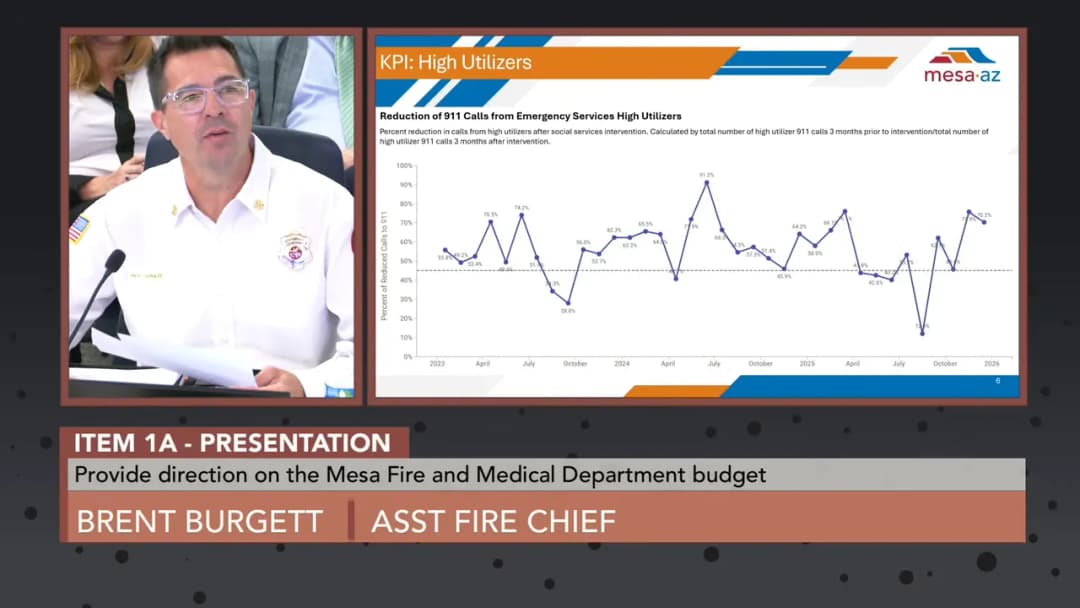
The Mesa City Council held a study session on April 14, 2026, focusing on the Mesa Fire and Medical Department (MFMD) budget, operational performance, and strategic initiatives. Vice Mayor Summers presided, with Mayor Freeman and Councilmember Adams participating remotely. The session began at 7:30 AM and concluded around 9:00 AM. Fire department leadership presented on response times, high-utilizer 911 callers, social services interventions, cancer prevention programs, new station construction, equipment grants, and emerging energy challenges. The council unanimously approved appointments to boards and committees and expressed strong support for the department’s budget and initiatives. Discussion Items - Response Times and Call Volume: Chief Lachlan reported that response times improved since adding stations 21 and 22 (with station 24 under construction) and implementing GPS-based intersection preemption (expected to cut 15–30 seconds per call). Annual call volume has stabilized around 70,000–72,000 since 2021, with medical calls predominating. - High-Utilizer Reduction and Social Services: Chief Burguette presented data showing a 74% average reduction in 911 calls after social services intervention for high-utilizers (≥3 calls in 90 days). A case example (6-year-old female with frequent fall calls) showed a 73% reduction from 11 to 3 calls post-intervention. The department has two social workers and an intern, receiving about 100 referrals monthly. Council questions explored the reactive nature of identification and the need for proactive community risk reduction. Vice Mayor Summers noted the program’s efficiency in freeing up emergency resources. - Budget Overview: Deputy Director Tara Cunha presented the FY26/27 proposed budget of $89.3 M (general government funds), reflecting a 1.35 M reduction over three years through position eliminations and reallocations. Key capital costs included $4 M for self-contained breathing apparatus replacement, $1 M for CPAP ventilators, and $1.4 M for dispatch consoles. The public safety sales tax fund budget includes $800 K cut from overtime by moving four positions from the general fund. The ETS (ambulance) fund shows revenues exceeding expenses, with $7 M in bad debt recognized. - Staffing and Overtime: The department maintains a leave pool (rovers) of about 15 extra personnel to cover daily staffing requirements (142 per day). Rover usage at 70% is the breakpoint for cost-effectiveness compared to overtime. Council discussed balancing staffing levels to avoid excessive overtime and fatigue. - Cancer Prevention: Chief Darling presented on MFMD’s cancer prevention program, funded initially with $210 K from public safety sales tax and over $2 M in grants. Screenings (full-body MRIs, blood tests) identified cancers in 13 members, all of whom survived. Equipment includes exhaust removal systems, clean cab concepts, and turnout cleaning. Councilmember Summers and Mayor Freeman emphasized the program’s importance for firefighter health and recruitment. - New Stations and Equipment: Deputy Director Cunha provided updates: Station 224 (80th Street and Elliott) is over 50% complete, opening November 2026; Station 205 (demo/groundwork) opens in about one year. A $725 K AFG grant with a $75 K city match will purchase 35 Lucas CPR devices for all frontline ambulances, enhancing safety and CPR quality. - Firewise Program: Chief Burguette described Firewise as a community risk-reduction program shifting wildfire mitigation from individual to neighborhood strategies. Three Mesa communities are now Firewise (Los Sandes, Madrid, Mountain Bridge). The department uses drones with GIS to assess vegetation risk. Councilmember Goforth praised the program for building neighbor connections and potential insurance benefits. - Energy Challenges and New Hazards: Chief Lachlan explained risks from solar panels, electric vehicles, CNG vehicles, and lithium-ion batteries (e-bikes/scooters). Training videos on CNG fires and battery fires are shared department-wide. The region is awaiting final research on fire blankets for EV fires; MFMD has them ready for deployment. - Ambulance Diversion and Non-Emergency Calls: Councilmember Taylor asked about mitigating non-emergency 911 calls at the dispatch level. Chief Lachlan noted challenges in quickly triaging without delaying emergent calls. City Manager Butler mentioned efforts to implement a 311-style system and AI-assisted triage. A future presentation on public safety communications was promised. Appointments to Boards and Committees - Motion and Vote: Councilmember Duff moved, Councilmember Goforth seconded. The motion passed unanimously (with Mayor Freeman absent). - Acknowledgment of Receipts: Another motion (Duff/Taylor) passed unanimously to acknowledge receipts of boards and committees. Key Outcomes - The council unanimously supported the MFMD budget as presented, with appreciation for the department’s efficiency and programs. - Unanimous approval of appointments to various boards and committees. - Direction to provide further data on high-utilizer trends, cost per call, and social services referral categories. - A future presentation on public safety communications (311/911 triage) will be scheduled. - The meeting adjourned at approximately 9:00 AM, with next study session on April 16, 2026. Note: The meeting date is April 14, 2026, per the prompt instruction, though the transcript references April 9, 2026.
The City of Mesa Planning and Zoning Board held a public hearing on April 14, 2026, with Chair Ayers presiding. The board unanimously approved the consent agenda and adjourned without additional discussion. Consent Calendar - Approval of Minutes: The minutes from the March 25, 2026, board meeting were approved. - ZON 26-00081 – Breaks Plus Mesa: A major site plan modification and amendment of conditions of approval one and six of Ordinance 5855 for an approximately 4,897 square foot minor auto repair development on 0.9 acres located approximately 510 feet north of the northwest corner of South Ellsworth Road and East Elliott Road. Staff recommended approval with conditions, and the board approved the item as part of the consent agenda. Key Outcomes - The consent agenda, including the minutes and the zoning case, was approved unanimously by all voting members (Chair Ayers, Vice Chair Peterson, Board Members Pitcher, Montes, Blakeman, and Carpenter). - The meeting adjourned after no further business was raised.
The Mesa City Council met on April 7, 2026 (note: transcript indicates meeting began on April 6, 2026, but the official timestamp is April 7). The meeting opened with a moment of silence and Pledge of Allegiance. Councilmember Goforth was excused; Councilmember Heredi participated via Zoom. The council recognized two environmental awards received by the city, then approved several consent agenda items that had been pulled for public comment, and heard public testimony regarding the 287G agreement with ICE. No other business was conducted. Consent Calendar - The consent agenda was read, with items 4C, 4D, 5A, 6A, and 7B removed for separate consideration. - Item 4C (street cleaning services) – Approved after public comment from Noah James Markham in support. - Item 4D (Air Pine Park and Whitman Park Playground Renovation) – Approved after public comment from Noah James Markham in support. - Item 5A (setting a public hearing date for annual assessment through Mesa Town Center) – Approved after public comment from Noah James Markham in support. - Item 6A (rezone Real Salado 25, 3.1 acres) – Approved after public comment from Noah James Markham in support. - Item 7B (RMCD dance studio) – Approved after public comment from Noah James Markham in support. - All other consent items were approved by a single motion. Public Comments & Testimony - Noah James Markham spoke in favor of items 4C, 4D, 5A, 6A, and 7B, expressing general support for city improvements and urging that Mesa not look "ghetto." - Reggie Braun spoke against the 287G agreement with ICE. He argued that the program operates as "fiduciary fraud," citing a 14% drop in crime while 287G transfers doubled to 253, with 81% of transfers having no prior criminal history with MPD. He claimed the program shifts from criminal removal to labor liquidation, negatively impacting the Latino workforce (31% of sheet rock workers) and the construction industry. He also noted a 104-day delay in responding to his public records requests. - Peter Dutra spoke in favor of maintaining the 287G agreement. He argued that cooperation with federal law enforcement is vital for safety, citing examples of dangerous sanctuary cities. He stated that the orderly transfer of custody is safer and more humane, and that ending the agreement would put Mesa at risk. He urged the council to resist attempts to rescind the agreement. - Noah James Markham (second appearance) also spoke in favor of keeping the 287G agreement, identifying as a strong Democrat and praising Congressman Greg Stanton. He also requested extension of the light rail, commented on pedophilia and public indecency, and expressed excitement for the Palo District and a soccer stadium. He suggested adding more citizen presence. Discussion Items - No formal discussion items were listed on the agenda. The council heard the awards presentation and public comments but did not deliberate on the 287G agreement. Key Outcomes - All five consent items removed from the consent agenda (4C, 4D, 5A, 6A, 7B) were individually approved by unanimous votes. - The council took no action on the 287G agreement; it was discussed only during public comment. No vote or directive was made. - The meeting adjourned without further business. Note: The transcript indicates the meeting began on April 6, 2026, but the provided timestamp states the meeting took place on April 7, 2026, 01:25:22 UTC, suggesting the meeting continued into the early hours of April 7.
Note: The transcript of the meeting refers to April 6, 2026, but the official timestamp provided for this summary is April 7, 2026. The summary below follows the instructed date. This study session focused primarily on the transportation department's budget and operations for fiscal year 2026–2027, including presentations on safety initiatives, maintenance programs, and a proposed new active transportation funding pilot. Council also acknowledged board and committee minutes and shared updates on recent community events and conferences. Consent Calendar - Council acknowledged receipts of various boards and committee minutes. Motion passed unanimously. Discussion Items - Transportation Budget Presentation (Item 2A): Transportation Director Eric Kadarian and Deputy Director Andrew Calhoun presented an overview of the department's public purpose statement, outcome areas (focus on reducing safety risk, promoting longevity, enhancing efficiency), and key accomplishments: - Pavement Condition Index (PCI) remains above target due to sustained investment. - LED street light conversion: 400 fixtures remain; completion expected in June 2026. - In-house concrete crew reduced buckled sidewalk repair time from over 30 days to 10 days. - Turf conversion along medians achieved an 80% reduction in water usage; only two locations remaining in city right-of-way. - Photo safety reinvestment fund ($800,000–$1 million annually) funds safety projects near schools, parks, and pedestrian areas; all funds are restricted to safety enhancements. - Downtown repaving project: Four-year plan starting in northwest quadrant, including new striping to accommodate parking, bike lanes, and vehicular lanes per recent study. Initial concrete improvements begin in weeks; phase one expected summer/fall 2026. - Budget Details: - Proposed FY 2026–27 operating budget: $58.9 million (no new employees or programs). - Staffing: 184 full-time equivalents (currently 170). - 94% of funding comes from restricted sources (local street sales tax, Highway User Revenue Fund). - Required 2% reduction ($25,000) applied to the Environmental Compliance Fee (ECF) share for storm channel maintenance; savings from HURF will reallocate to keep operations whole. - Additional $35 million annual lifecycle budget for capital projects (street overlay, storm drains, medians, etc.). - New Active Transportation Pilot Program: - Proposed $3 million per year for three years to fund smaller active transportation projects (e.g., crosswalks, shared-use paths, trailheads) that are community-driven and not suited for larger bond programs. - Funding source: reimbursement dollars from the Maricopa Association of Governments (MAG). - Examples: Westwood Race crosswalk ($600,000); pedestrian crossing costs range from $750,000 to $1 million. - Councilmember Adams noted that trailheads for the Lehigh Shared Path, previously designed but unfunded in the last bond, could be potential candidates. - Conferences and Events (Item 4): Councilmembers shared reports on recent community events, including the Reed Park Easter egg hunt (featuring an Easter bunny arriving by helicopter), a Downtown Mesa Easter celebration, a tour of Southeast Mesa transportation needs in District Six, and the kickoff of Arizona Tech Week at The Post. Key Outcomes - The transportation budget presentation was informational; council provided general support and asked clarifying questions about the active transportation program, trailheads, and traffic calming definitions. No formal vote was taken. - Motion to acknowledge boards and committee minutes passed unanimously. - Meeting schedule adjustments: Fire department budget presentation moved to Thursday, April 9 (morning); police department budget presentation postponed to April 16 (Thursday morning). Council encouraged to clear calendars for a potentially longer meeting on April 16. - Meeting adjourned.
The Mesa City Council held a study session on April 2, 2026, to review the April 6 council meeting agenda and receive detailed presentations on the fiscal year 2026-27 proposed budget, the 2026 financing plan, and the parks and recreation department budget. Discussions included bond refinancing, property auctions, utility capacity fees, and departmental reductions. Discussion Items - World Autism Awareness Day: The mayor noted Mesa is the first autism-certified city, with council members wearing blue in recognition. - Agenda Review – Item 5E (Banner Gateway Improvements): Councilmember Duff questioned whether the city was funding private development infrastructure. City Engineer Mark Halls explained it was a small gas line improvement paired with the Central Mesa Reuse Pipeline, serving a public purpose. The utility will repay the bond proceeds from future revenue. Council clarified the flow of funds: the city pays upfront, then reimburses itself with bond proceeds, expecting to profit over time. - Agenda Review – Item 5F (Reverse Auction for Power): Councilmember Taylor asked for clarity on the $1.3 million reverse auction for additional power. Staff explained it addresses nighttime demand in the electric service area (5.5 square miles) due to rising nighttime temperatures. The $90/megawatt hour limit is the cheapest current contract for summertime off-peak power, with confidence that market prices will be lower. The auction process has worked well previously. - Agenda Review – Item 5B (Auction of 8130 East Redberry): Real Estate Manager Lisa Davis presented results: 10 acres sold for $2,090,001 (minimum bid $1,550,000), with 56 bids over 31 minutes. The property was purchased in 2003 for $630,000 with voter-approved bonds. Three bidders participated; the winning bidder was Blandford Homes. Proceeds will be reinvested in parks in northeast Mesa, consistent with the original bond category. The sale was approved for city manager to sign purchase and development agreements. - Agenda Review – Item 5D (2026 Financing Plan): City Treasurer Mark Hughes presented the plan: (1) refinancing $225 million in utility bonds from 2013-2016, saving $13.6 million (net present value savings 4.2%) without extending maturities; (2) issuing $61 million in general obligation bonds for parks, public safety, and transportation (using authorizations from 2020, 2022, 2024 elections); (3) issuing $341 million in utility system revenue obligations for capacity fee projects (47.5% paid by capacity fees) and non-capacity fee projects (including smart metering, signal view water treatment plant expansion, and gas system improvements). Council discussed the philosophy of bonding smaller amounts more frequently vs. large packages, and the importance of matching project costs to users over time. - Agenda Review – Item 5A (Mesa Town Center Improvement District): Staff explained that the downtown property owners self-assessed to form DMA (a 501(c)(6) nonprofit) in 1985. The city assesses and collects fees as a pass-through. DMA uses funds for clean and safe programs, marketing, and events. The city is the largest landowner in downtown but voluntarily pays a lower per-square-foot assessment to be a team player. - Agenda Review – Item 6A (Riverview Development): Staff discussed a 3.1-acre parcel (former county animal shelter) near the Cubs stadium. A developer plans multifamily housing for Cubs minor league players (year-round) and a hotel for the public and team overflow. Councilmember Taylor expressed concern about lack of retail/dining; staff noted challenges with parking and access, but said this is the best use received for the site. The city will issue a new RFP for the larger Riverview area for mixed-use development. - Fiscal Year 2026-27 Proposed Budget (Item 2A): Budget Director Brian presented an overview. The proposed budget is balanced, with a goal of structural balance by FY 2029-30 – now two years ahead of schedule. Ongoing reductions over three fiscal years total $55.7 million. General fund net sources and uses for FY 2025-26 projected to be negative $29 million (improved from earlier forecast due to higher permit revenue and Prop 400 transit funds). The city maintains reserves above 18%. Key pressures include state legislation losses, compensation, fleet, software, building maintenance, and ending ARPA initiatives. Departments submitted 2% reduction plans; 4.8 of 6.6 million in enhancement requests were approved, including the redevelopment toolkit pilot, new positions (assistant city prosecutor, senior internal auditor, HVAC tech, process server for code, IT tech for Wi-Fi), and $6 million for facility maintenance and $3 million for parks maintenance. - Utility Fund Budget: The utility fund forecast improved significantly with adoption of capacity fees (estimated $24 million annually). A third shift for fleet services at East Mesa Service Center was added to maintain solid waste trucks. A $250,000 allocation for the Bartlett Dam feasibility study was included (Mesa’s portion). Council expressed concern about potential water rate increases from CAP and the need to maintain reserves to avoid spikes. - Parks, Recreation and Community Facilities Budget (Item 2B): Interim Director Andrea Alakot presented the department’s public purpose statement and cost recovery model (five service levels). The department’s total budget is $55.1 million in expenditures with $17.9 million in revenues. Proposed reductions of $942,000 (2%) include: eliminating three vacant full-time positions (recreation specialist, programmer, trades worker); reducing part-time non-benefited hours (7.24 FTE equivalent, less than 5% of total); closing Fremont Aquatic Complex (no summer programming after May 23, 2026, with redirecting users to nearby pools); eliminating spring Celebrate Mesa event (saving $36,000 plus indirect staffing). The department kept all current full-time staff and maintained baseline park maintenance. Key Outcomes - Council acknowledged receipt of minutes for prior meetings (motion passed). - Council provided direction to staff on the proposed budget and financing plan, with further detailed presentations scheduled for April (departments) and a tentative budget update on April 30. - Staff will bring forward the five-year renewal of the DMA organization in October 2026. - No formal votes were taken on the budget or agenda items; these will proceed to the April 6 council meeting for action.
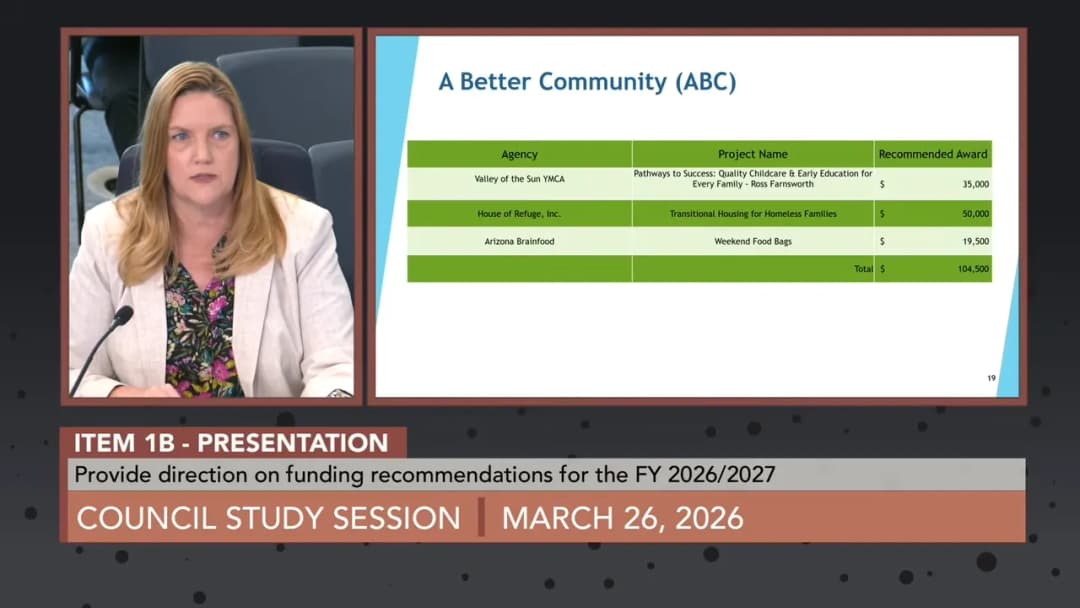
The Mesa City Council held a study session on March 26, 2026, to discuss two major agenda items: a presentation on the proposed redevelopment toolkit and funding recommendations for federal and local community development programs. The meeting focused on staff proposals for eight redevelopment tools designed to address blight, vacancy, and economic development, as well as the annual allocation of Community Development Block Grant (CDBG), HOME Investment Partnerships Program, Emergency Solutions Grant (ESG), Human Services, and Off the Streets funds. Discussion Items: Redevelopment Toolkit Staff presented an 80% design phase of a redevelopment toolkit, refined from earlier presentations. The toolkit includes eight programs: demolition and remediation (max $75,000 grant, 1:1 match), code compliance revitalization (max $25,000 grant, 1:1 match), vacancy registration (required ordinance with escalating fees, free initial registration), reuse ready (reimbursable grants for tenant improvements), strategic acquisition and analysis (city analysis and potential acquisition), placemaking (city-led urban landscape improvements), public infrastructure (tiered support up to $50,000 and above), and EDA revolving loan fund (exploration phase due to complex federal requirements). The total proposed budget is $3 million annually from the general fund for a three-year pilot program. Key discussion points included: - Council members questioned the basis for the $75,000 demolition grant cap, noting demolition costs vary widely. Staff explained the cap was intended to limit city exposure to gift clause issues and to focus on small businesses. Councilmember Duff provided an anecdotal estimate of $50,000 to gut a 1,300 sq ft building. - Councilmember Adams expressed concerns about the vacancy registration program, calling it "big brother" and worrying about fair enforcement between large REITs and local property owners. Staff emphasized the program is not punitive but aims to connect owners with resources. Vacancy data shows 7.7% of Mesa's commercial buildings are vacant. - Councilmember Goforth asked about the proportion of vacant properties owned by local versus out-of-state owners; staff did not have data but committed to follow up. - Councilmember Taylor questioned whether the city could use tax incentives instead of grants; city attorney Jim explained that state law prevents changing sales tax rates for specific businesses. - Councilmember Taylor also asked about the number of focus groups (17-18 individuals) used to test the toolkit, noting statistical limitations. - Vice Mayor Summers supported the toolkit, highlighting its potential to help small businesses overcome hidden costs (e.g., code upgrades). - Councilmember Adams requested performance metrics for the $3 million pilot; staff committed to tracking private capital leverage, tax base growth, and blight reduction, but noted that setting specific goals may be premature in the first year. Discussion Items: Funding Recommendations for CDBG, HOME, ESG, Human Services, and Off the Streets Staff presented funding recommendations for fiscal year 2026-27. Key points: - CDBG: Estimated $3.6 million allocation. Proposed uses include $2.3 million for city emergency repair program (served 165 homeowners, 76% elderly, 48% disabled), and public service awards to Family Promise, Child Crisis Arizona, CAS, and A New Leaf, totaling $573,240. - HOME: Estimated $1.29 million allocation. Recommended $400,000 for city rental/utility deposit program and $2.3 million for A New Leaf's Lamacita Phase IV (54 senior/veteran units), contingent on receiving Low Income Housing Tax Credits (LIHTC) after two previous denials. - ESG: $340,000 estimated. Recommended awards to Tempe Community Action, A New Leaf shelter operations, and Save the Family rapid rehousing, totaling $314,515. - Human Services and ABC (A Better Community) funds: Total $651,663 ($104,500 ABC from donations, $547,163 general fund). Staff initially proposed allocating the $547,163 to Off the Streets program (Windermere), but council direction was to seek alternative funding for Off the Streets. City Manager Butler recommended instead funding community-based nonprofits through the competitive process. The recommended alternative allocates the full $547,163 to agencies including A New Leaf, Child Crisis, House of Refuge (funded under ABC), and others, as listed in the presentation. Council discussion included: - Mayor Freeman advocated for shifting more CDBG funds to "place-based" improvements (e.g., code enforcement, redevelopment personnel) rather than primarily social services, calling for a future policy discussion. - Councilmember Adams supported exploring non-taxpayer-funded solutions and expressed reservations about empowering code enforcement without fairness safeguards. - Vice Mayor Summers emphasized the importance of continuing human service funding, noting that 52% of Mesa residents have housing costs exceeding 50% of income. - Councilmember Taylor clarified that ABC funds are not for utility assistance; separate programs exist for that. - Councilmember Taylor asked about flexibility to change HUD allocations mid-year; staff confirmed changes are possible but require notification. Key Outcomes - Redevelopment Toolkit: Council provided general direction to continue developing the toolkit as an 80% design. Staff will return with additional detail, including performance metrics, as part of future budget discussions. No formal vote was taken. - CDBG, HOME, ESG Funds: Council directed staff to proceed with the proposed recommendations and initiate the required 30-day public comment period. The final resolution is scheduled for council consideration on May 4, 2026. - Human Services and ABC Funds: Council approved the staff's alternative recommendation to allocate the $547,163 in human services funds to the community-based nonprofit agencies listed, rather than using them for Off the Streets. The Off the Streets program funding gap will be addressed separately. - Future Process: City Manager Butler committed to returning before the next funding cycle with options for better aligning CDBG and other federal funds with council priorities, including risk analyses for higher-risk activities like economic development.