Browse by city
Date range
Search help

Search titles, summaries, topics and stored transcripts together. Keywords may match separately; put the whole query in double quotes for a phrase. Matching follows word analysis, so punctuation is not exact. Both dates are included. Documents are not searched.

SHOWING 111–117 ENTRIES
111
SEP 25, 2025 · OLYMPIA, WASHINGTON · CITY COUNCIL & COMMISSIONS
Community Livability and Public Safety Committee Meeting – September 24, 2025 (Note: System prompt indicated Sept. 25, but source materials show Sept. 24)​

The Community Livability and Public Safety Committee of the Olympia City Council met on Wednesday, September 24, 2025, at 5:31 PM in the Council Chambers and via Zoom. Chair Yến Huỳnh presided with members Clark Gilman and Dontae Payne present. The meeting covered two major discussion items: an update on the analysis and recruitment process for council-appointed advisory bodies, and a comprehensive public safety update from the Olympia Police Department (OPD). The meeting adjourned at 7:27 PM. Consent Calendar - Approved the agenda unanimously. - Approved the meeting minutes of July 23, 2025 (item 25-0660) and August 27, 2025 (item 25-0754) by voice vote without objection. Public Comments & Testimony - No public comments were received. Discussion Items - 6A: City Council Appointed Advisory Bodies Analysis and 2026 Advisory Body Recruitment Process Update – Assistant City Manager Stacey Ray and Consultant Genevieve Canceko Chan presented. Chan, a former member of the Social Justice and Equity Commission and current member of the Cultural Access and Advisory Board, described her work analyzing the 13 standing advisory bodies that engage over 100 community members. She is conducting interviews with staff liaisons and chairs, reviewing prior analyses, and benchmarking other municipalities (e.g., Lacey, Bellingham, Tacoma). The typical recruitment cycle was outlined: October launch, December close, January screening by advisory bodies, February/March interviews by the committee, March appointments by full council, April start. Current known vacancies: 5 existing plus 2 members not seeking reappointment, 16 returning, 10 undecided, totaling at least 7 vacancies. Staff reported 17–20 interviews expected. The committee discussed streamlining the process, scheduling interview dates, and engaging outgoing members to recruit through personal networks. Committee members expressed appreciation for the city's high number of applicants and interest in diversifying advisory bodies. Chair Huỳnh suggested locking in interview dates at the January committee meeting. No formal action was taken. - 6B: Public Safety Update – Interim Police Chief Shelby Parker and Lieutenant Paul Frailey presented. Topics included mid-year crime data, Nisqually jail utilization, public demonstrations response, OPD staffing challenges, recruitment incentives, and Flock camera technology. - Crime Data (Jan–Jun 2025): Crimes against persons mostly lower or steady; 24 sexual assaults reported (36 in all of 2024); property crime projected to decline significantly (auto theft on track for 42% reduction, commercial burglary 30%, residential burglary 43%). Chief Parker noted that the majority of violent crimes involve known offenders, not strangers. - Nisqually Jail: Daily custody rate of $130/person; 2025 budget $1.9M; city averaging 50 individuals/day (budget assumed 49), leading to projected budget overrun. OPD will request a 2026 budget enhancement reflecting actual costs. Top charges for Olympia inmates: possession of controlled substance, criminal trespass, theft, assault, DUI. Many individuals are unhoused. Programs include medical-assisted treatment, detox, and reentry services, but duration of stay limits engagement. City Manager Bernie confirmed the overrun will be addressed in the 2026 budget. - Public Demonstrations: Lt. Frailey described planning, risk assessment, training, and de-escalation protocols. OPD uses standardized verbal instructions and after-action reviews. Embedded fire department medics (tactical emergency medical teams) were highlighted. Staffing is a challenge for large events. Recent demonstrations have been peaceful and collaborative. Committee discussed open carry of firearms near demonstrations (state law prohibits within 250 feet) and property damage during protests; OPD emphasized post-event arrests and body-worn camera evidence. - Staffing: OPD has 88 commissioned positions (1 chief, 2 deputy chiefs, 6 lieutenants, 13 sergeants, 66 officers). Current vacancies: 14 officers + 1 chief (deputy chief filled on Sept. 22). Additionally, 10 officers are in training/academy/field training (unavailable for about a year), and 9 are on various leaves. This leaves only 23 deployable patrol officers; minimum contractual staffing requires 32 (16 per team). To bridge the gap, OPD temporarily reassigned community policing and walking patrol officers to patrol (as of Sept. 23, no walking patrol officers remain; only two walking crew members continue). Chief Parker described the decision as temporary, hoping to restore walking patrol by late November/early December when trainees graduate. Two new recruitment incentives were announced: a lateral hiring incentive (up to $25,000 over three years with a three-year commitment) and an OPD member referral incentive (up to $5,000). The department will not lower hiring standards. - Flock Camera Technology: 15 cameras at city entry/exit points, operational since July 2024 under a two-year grant (total cost $100,000). Cameras capture license plates and vehicle attributes, not people. OPD policy (428) and a contract amendment prohibit use for immigration enforcement, surveillance based on protected classes, monitoring First Amendment activities, or tracking travel to healthcare facilities. Data is retained 30 days and not shared with out-of-state/federal agencies without written OPD consent. Results: 29 stolen vehicle recoveries, 39 assault/domestic violence arrests, and multiple burglary, robbery, homicide, human trafficking, and kidnapping arrests since August 2024. Examples included a fentanyl seizure and a road rage incident suspect captured. The committee expressed appreciation for transparency measures and strengthened policies. Key Outcomes - No formal votes were taken on either discussion item. - The committee will determine 2026 advisory body candidate interview dates at its January meeting. - OPD committed to presenting more frequent, shorter public safety updates in 2026. - The 2026 budget will include a request to increase the Nisqually jail housing allocation based on actual average daily population (50 instead of 49). - OPD will continue recruitment efforts with new incentives and plans to restore walking patrol by late 2025. - The committee received the public safety update and will monitor staffing and jail budget developments. Note: The meeting minutes and transcript consistently show the date as September 24, 2025, although the system instruction specified September 25, 2025. This summary uses the date from the source materials.
PUBLIC SAFETY 39% · PUBLIC ENGAGEMENT 19% · STAFFING 12% · SURVEILLANCE TECHNOLOGY 8%
112
SEP 24, 2025 · OLYMPIA, WASHINGTON · CITY COUNCIL & COMMISSIONS
Olympia Planning Commission Finance Subcommittee Meeting - September 24, 2025

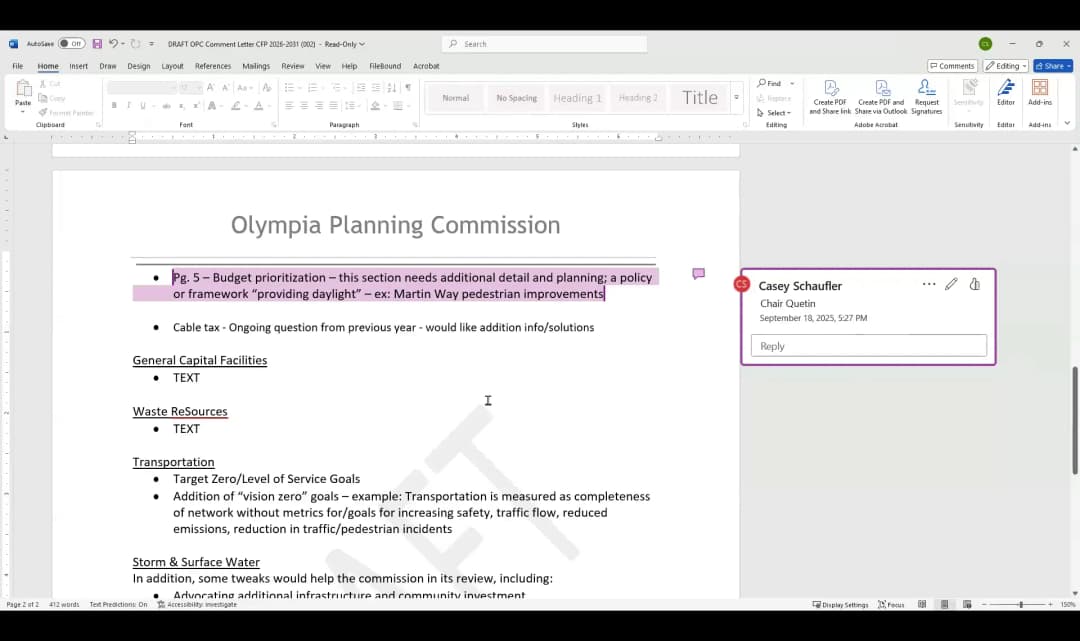
The Olympia Planning Commission Finance Subcommittee met on September 24, 2025, to discuss and draft a comment letter on the Preliminary Capital Facilities Plan (CFP) for 2026–2031. Commissioners approved the agenda and minutes from the prior meeting, then engaged in detailed discussion on strengths and areas for improvement across multiple CFP chapters, including parks, transportation, stormwater, and fire. Key deadlines were set: commissioner edits due by September 29, followed by full Planning Commission review on October 6, and City Council public hearing on October 21. Consent Calendar - Approved the agenda for the September 18, 2025 meeting (motion by Commissioner Mishon, seconded by Commissioner Jason; unanimous voice vote). - Approved the minutes of the September 11, 2025 subcommittee meeting (motion by Commissioner Jason, seconded by Commissioner Shauna; unanimous voice vote). Public Comments & Testimony - No public comments were taken. The chair noted that the CFP public hearing had been completed and deliberations were not yet final; therefore, no public comment on the CFP was accepted during this meeting. Discussion Items General Comments & Celebrated Successes - Commissioners highlighted several strengths: Yelm Highway Park, delivery of sidewalk condition reports, the new Grass Lake trail, clear parks goal tracking, fire department’s CARES program, water department’s aggressive loss policy, and general dedication of city staff. - Concerns included inconsistent level-of-service definitions across chapters, siloed project planning, and the need for cross-departmental prioritization and master plan integration. - The declining cable tax revenue was flagged; commissioners suggested council proactively identify alternative funding or fix the tax structure, echoing a question from prior years. Parks - Commissioner Shauna proposed adding a public tracker (e.g., website updates, photos, livestream) for the Yelm Highway Park to maintain community engagement. - Chair Garcia urged better investigation of park level-of-service metrics beyond current standards (half-mile and acre per 1,000 population). - Commissioner Talius advocated prioritizing acquisition of land with high development challenges (e.g., waterfront, steep slopes) rather than flat, buildable parcels, to avoid undermining housing goals. Commissioner Garcia noted zoning’s Euclidean legacy and suggested linking park plans to the city’s housing crisis proclamation. Transportation - Commissioners supported Target Zero vision but sought concrete, measurable level-of-service outcomes (e.g., percentage of population near low-stress bike network, emissions reductions). - The current street repair PCI (pavement condition index) is 66, below the goal of 75; staff modeling shows it dropping to 60 by 2029 under current funding. Commissioners urged more resources and a policy framework to prioritize maintenance and decommissioning. - Discussion on Seattle’s “glide path to failure” analogy; need for evidence-based prioritization across roads, transit, sidewalks, and bike lanes. Commissioner Talius requested breakdown by road type (transit routes, local access) to assess critical failures. Storm & Surface Water - Commissioner Talius called for infrastructure investments that enable new housing, especially on small parcels, by providing off-site stormwater connections (e.g., deep dry wells beneath bike lanes). - Praise for multi-departmental coordination on Phones Road as a model. Chair Garcia suggested a clearer framework to proactively identify such overlapping opportunities to support housing goals. Fire - Commissioner Jason encouraged council to partner with similar jurisdictions to pursue legislative changes allowing smaller emergency vehicles, thereby reducing required road widths and facilitating more housing. Chairman Garcia noted potential misalignment between transportation and fire standards on road width. - Commissioners supported funding requests for technological improvements (e.g., drones for initial response) and noted the current response time of 10 minutes 23 seconds vs. the national standard of 7 minutes 6 seconds, recommending that measurable outcomes drive modernization proposals. Asbestos Concrete Pipe & Maintenance - Staff provided additional responses on asbestos concrete pipe replacement, but Commissioner Talius noted the need for a full needs assessment. Commissioners requested that the CFP encourage prioritizing service life and maintenance costs over lowest-bid procurement, and suggested stronger tracking of deferred maintenance. Key Outcomes - Commissioners drafted and assigned sections of the CFP comment letter. Chair Garcia will take the first pass; individual commissioners were assigned specific topics (e.g., Commissioner Talius on overlapping benefits, Chair Queen on prioritization and parks). - Edits due to staff (Casey) by Monday, September 29, 2025 (close of business). Staff will compile and submit to the full Planning Commission agenda for October 6, 2025. - The final letter is expected to be adopted by the Planning Commission and forwarded to the City Council prior to its public hearing on October 21, 2025. - No formal votes were taken on the letter contents; all decisions were procedural (agenda and minutes approval).

CAPITAL FACILITIES PLANNING 28% · TRANSPORTATION SAFETY 17% · PARKS AND RECREATION 11% · PROCEDURAL 10%
113
SEP 24, 2025 · OLYMPIA, WASHINGTON · CITY COUNCIL & COMMISSIONS
Lodging Tax Advisory Committee Meeting - September 22, 2025

The Lodging Tax Advisory Committee (LTAC) of Olympia met on Monday, September 22, 2025, at 2:00 PM in Room 112 and online. Chair Jim Cooper called the meeting to order with members Greg Taylor and Theresa Thorning present; Commissioner Kelly Campbell and member Janine Phillips were excused. The committee approved the agenda and the minutes from November 8, 2024. The main business was a presentation by staff member Amelia Layton on the review process for upcoming lodging tax funding applications, which will guide the committee's funding decisions at the next meeting. Consent Calendar - Agenda approved unanimously. - Minutes from November 8, 2024, approved unanimously. Public Comments & Testimony - Shelley Nicholson, a member of the Yelm LTAC and applicant with the City of Lacey, attended to observe Olympia's rubric-based review process. She did not provide formal public comment but expressed interest in learning. - No other public comments were received in person or online. Discussion Items - Presentation on Lodging Tax Funding Application Review Process Amelia Layton presented an overview of the 2026 funding cycle. Key data: 39 applications were received (up from an average of 20–25), with a total ask of $1,773,828. Projected available funds for 2026 are $1,190,700 (after estimated revenue of $625,000, reserves of $1,170,000, encumbered contracts of $234,300, and a recommended reserve of $370,000). This leaves a deficit of approximately $583,128. The committee discussed the need to be hypercritical due to the shortfall. - Scoring Rubric The new scoring system assigns up to 110 points per application, with criteria including: clarity of plan and potential for overnight stays (20 pts), demonstrated room nights (20 pts), partnerships (15 pts), complementarity and diversity (10 pts), additional revenue benefits (10 pts), occurrence in shoulder season (5 pts), and an innovation bonus (5 pts). The process is more structured than previous years, reducing subjectivity. Scoring is anonymous, but scores become public without names. - Discussion on Funding Priorities Members raised concerns about the reliability of room night estimates from applicants. Greg Taylor suggested cross-checking historical projections against actual reports. Terry Thorning emphasized that regional events (e.g., the Olympic Air Show) bring visitors who compress the hotel market, even if they don't directly fill specific hotels. Chair Cooper noted the importance of the 50-mile tourism requirement. The committee also discussed the reserve policy (20% of anticipated contracts) and whether to tap into it; the consensus leaned toward conservative budgeting. - FIFA Fan Zone and 250th Anniversary A question was raised about whether any lodging tax funds were applied to the FIFA Fan Zone request. Amelia confirmed no application was submitted; the City of Olympia's contribution to the fan zone was largely in-kind and funded from other sources. No applications were received for the 250th anniversary of America either. Key Outcomes - The committee received the presentation and information on the review process. - Applications will be distributed via Submittable after the meeting; reviews are due by Friday, October 10, 2025. Members were encouraged to score applications and use the comment boxes to note concerns or excitement. - The next LTAC meeting is scheduled for October 15, 2025, at 2:00 PM in person (second floor) and online, where the committee will discuss funding recommendations based on the scored applications and public comment from applicants. - Amelia will provide historical room night data from previously funded organizations to assist with evaluating projections.

BUDGET EQUITY ANALYSIS 50% · PROCEDURAL 22% · PUBLIC ENGAGEMENT 21% · PUBLIC COMMENT 7%
114
SEP 23, 2025 · OLYMPIA, WASHINGTON · CITY COUNCIL & COMMISSIONS
Committee of the Chairs Meeting – September 23, 2025

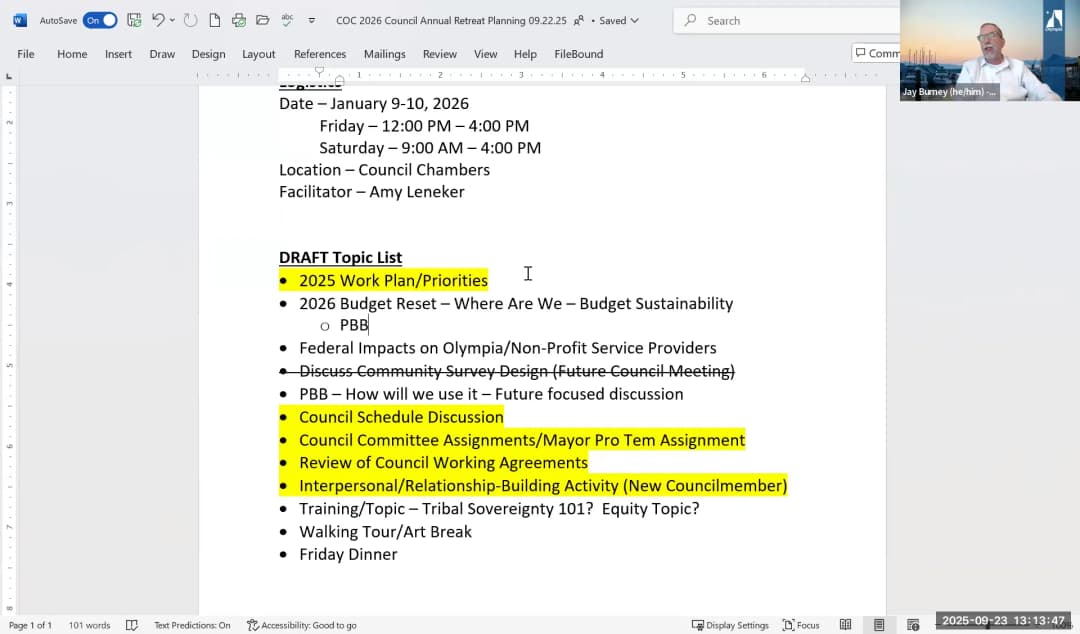
The Committee of the Chairs (Councilmembers Clark Gilman, Yến Huỳnh, and Dani Madrone) met on Tuesday, September 23, 2025, from 12:30 p.m. to 1:30 p.m. to plan the 2026 City Council Retreat. The group discussed logistics, agenda topics, and potential focus areas, including the need to address federal funding impacts on local services. Discussion Items - Retreat Dates: The committee initially considered January 23–24 but shifted to January 9–10, 2026, to allow earlier committee work plan alignment and avoid conflicts with the legislative session. Backup dates of January 16–17 were noted. Councilmember Gilman requested checking for conflicts with all council members. - Location: Council chambers were selected for the retreat. The Friday dinner location will be identified (replacing the now-closed Dockside). - Facilitator: Amy Lenaker (Lenaker Group) will be retained; she will conduct one-on-one interviews with council members to refine the agenda. - Retreat Format: A half-day Friday (noon–4 p.m.) plus dinner, and a full-day Saturday (9 a.m.–4 p.m.). No working lunches will be scheduled; a walking break or alternative activity will be included. - Agenda Topics: The committee reviewed a draft list. Key items include: work plan, committee assignments, working agreements, budget reset, priority-based budgeting (PBB), tribal sovereignty training (with Squaxin Island Tribe Chairman Chris), and community survey input. Councilmember Gilman emphasized the need to leave room to discuss federal cuts affecting housing, homeless services, and healthcare, possibly with scenario planning. Councilmember Madrone stressed a clear goal for such a conversation. The community survey design discussion was moved off the retreat agenda to a later study session, with CLIPS committee potentially front-loading work. - Pre-Retreat Materials: The 2024 community survey will be circulated for optional reading. Homework from Amy Lenaker is expected. - Next Meeting: The committee will reconvene after Amy Lenaker completes interviews to finalize the agenda. Key Outcomes - Dates: January 9–10, 2026 (Friday half-day, Saturday full day). - Location: Council chambers; dinner location TBD. - Facilitator: Amy Lenaker confirmed. - Topics: The list will be refined by Amy Lenaker based on interviews. Federal impacts and community survey were acknowledged as placeholders needing further definition. - No formal votes were taken; decisions were made by consensus of the three committee members.

PROCEDURAL 34% · PROGRAM MANAGEMENT 30% · PUBLIC ENGAGEMENT 9% · PUBLIC SAFETY 9%
115
SEP 18, 2025 · OLYMPIA, WASHINGTON · CITY COUNCIL & COMMISSIONS
Olympia Planning Commission Meeting - September 18, 2025

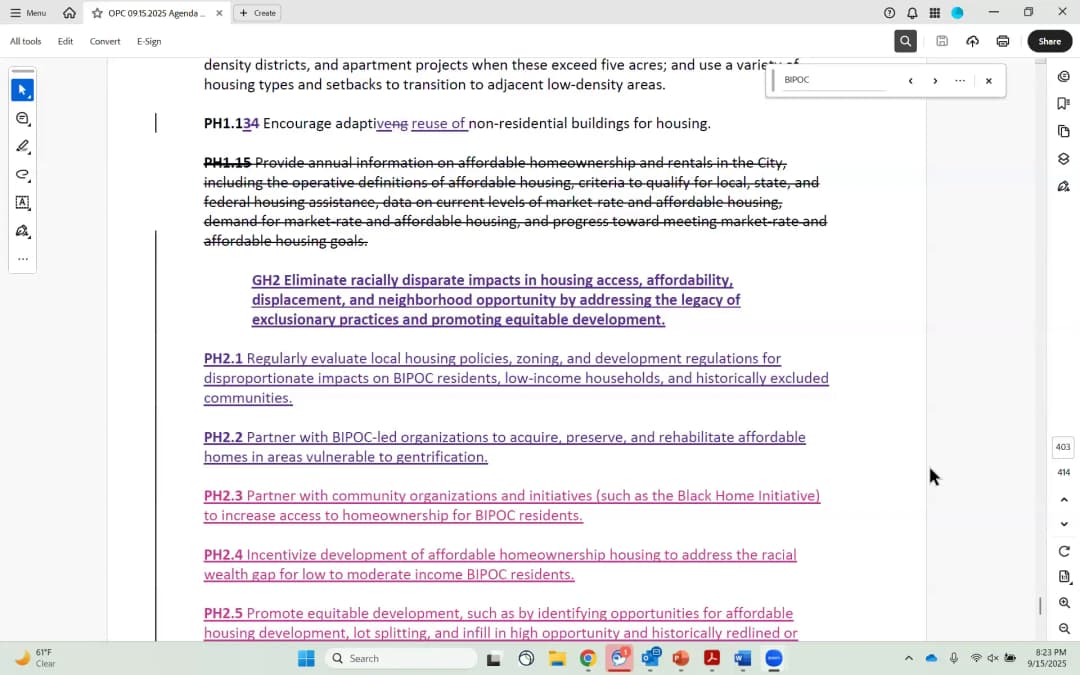
The Olympia Planning Commission met on September 18, 2025, to deliberate on several major items including the preliminary 2026-2031 Capital Facilities Plan, code amendments for the Olympia 2045 Comprehensive Plan, middle housing code amendments, and the housing chapter of the comprehensive plan update. The commission received staff presentations, held a public hearing with no speakers, and voted on recommendations to City Council. Key themes included removing barriers to housing, addressing design review requirements, and emphasizing urgency to meet housing production targets. Consent Calendar - Approval of the agenda was moved by Commissioner Nejati, seconded by Commissioner Raphael Garcia, and passed unanimously. - Approval of the August 18, 2025, meeting minutes was moved by Commissioner Taellious, seconded by Commissioner Grubb. The transcript indicates three abstentions (Commissioners Raphael Garcia, Nejati, and Sauerhoff), but the minutes state the minutes were approved without noting abstentions. This discrepancy is noted. Public Comments & Testimony - No public comments were offered during the public comment period or during the public hearing for the Capital Facilities Plan. Discussion Items - Preliminary 2026-2031 Capital Facilities Plan (CFP): Staff presented the preliminary CFP, noting $77.9 million in projects for 2026 and over $344 million for the six-year plan. No public testimony was received. The Finance Subcommittee will draft a comment letter for commission consideration at the October 6 meeting. Vice Chair Garcia noted inconsistency in level-of-service detail across chapters and advocated for more specific measurable outcomes. - Code Amendments for Olympia 2045 Comprehensive Plan: Long Range Planning Manager Joyce Phillips briefed the commission on development regulation updates required to align with state law and the draft comprehensive plan. The amendments are split into two parts: state-mandated changes (e.g., notice requirements, essential public facilities definition) and consistency updates (neighborhood retail zone size, urban residential designation table). A public hearing is scheduled for October 6, with adoption expected by end of 2025. - Middle Housing Code Amendments: The commission removed the item from the table and continued deliberations. Staff requested adding a reference to a new state unit lot subdivision bill (2025). The commission discussed three proposed revisions: 1. Strike expansion of design review to include neighborhood character and scale outside design review districts. Commissioners debated whether design review is a barrier to housing. Commissioner Nejati expressed concern about removing oversight, but after discussion the majority supported the strike. The final letter included a recommendation to evaluate removing middle housing design review entirely in the future. 2. Increase maximum building height from 35 to 40 feet in lower-density zones. Commissioner Nejati opposed the combination of 40 feet with a 5-foot rear setback. Commissioner Sauerhoff proposed a compromise: 5-foot setback for ADUs, 10-foot for other structures. The commission agreed to include that as a revision. 3. Reduce minimum site size for manufactured/mobile home parks from 5 acres to 1.5 acres or eliminate the requirement. Supported by Commissioners Grubb and Garcia as a way to add affordable housing quickly. The revision was included. Commissioner Taellious also proposed updating the Engineering Design and Development Standards to extend exemptions for middle housing (e.g., frontage improvements for projects with 6 or fewer units). The commission recommended approval with these revisions by a vote of 7-1 (Commissioner Nejati dissenting). - Olympia 2045 Housing Chapter: The commission removed the item from the table. Discussion focused on a revision to policy PH 2.2, which originally read "Partner with BIPOC-led organizations to acquire, preserve, and rehabilitate affordable homes..." Commissioner Nejati argued the language could exclude non-BIPOC organizations and suggested broadening to "Partner with organizations, with an emphasis on BIPOC-led organizations." Staff provided context that partnering with community-based groups is more effective in reducing racial disparities. The commission approved the revised language as an amendment to the motion. Additionally, staff shared building permit data from 2017-2025 showing the city typically issues under 400 permits annually, while the housing needs assessment projects 14,295 new units by 2045 (about 715 per year). Commissioners expressed urgency to reduce barriers, citing the risk of displacing younger generations. The housing chapter was recommended to City Council with revisions unanimously. Key Outcomes - The Preliminary 2026-2031 Capital Facilities Plan public hearing was closed; the Finance Subcommittee will draft a comment letter for the October 6 meeting. - The Middle Housing Code Amendments were recommended for approval with revisions (7-1). Revisions include: removing design review for single-family and middle housing outside design review districts; increasing height to 40 feet in some zones with a 10-foot rear setback (5-foot for ADUs); reducing the minimum site size for manufactured/mobile home parks to 1.5 acres or eliminating it; and updating the Engineering Design and Development Standards to extend exemptions for middle housing. - The Housing Chapter of the Olympia 2045 Comprehensive Plan was recommended for approval with revisions (unanimous). Revisions include modifying policy PH 2.2 to broaden the partner organizations language, and adding a paragraph emphasizing the urgent need to reduce barriers to meet housing targets, informed by building permit data showing production well below the 715-unit annual goal. - Staff announced that Commissioner Adams was excused; the city is recruiting for advisory committees including the Planning Commission; and Leanne Wells was welcomed as the new urban forester.

AFFORDABLE HOUSING 19% · MIDDLE HOUSING 15% · DESIGN REVIEW 14% · ZONING REGULATIONS 11%
116
SEP 17, 2025 · OLYMPIA, WASHINGTON · CITY COUNCIL & COMMISSIONS
Olympia City Council Study Session: Tenant Screening and Comprehensive Plan Updates – September 17, 2025

Note on date: The provided date for this meeting is September 17, 2025, but the agenda, minutes, and transcript all indicate the meeting took place on Tuesday, September 16, 2025. The summary below reflects the actual meeting content from September 16, 2025. The Olympia City Council held a study session covering four major agenda items: a briefing on tenant screening policy options, and three presentations on chapters of the Olympia 2045 Comprehensive Plan update (Land Use and Urban Design, Community Values and Vision, and Introduction). The meeting began at 6:00 PM and adjourned at 9:28 PM. Councilmembers discussed proposed policies, heard survey results, and provided direction to staff. Mayor Dontae Payne presided, with Mayor Pro Tem Yến Huỳnh excused. Tenant Screening Outreach and Policy Options Briefing - Senior Housing Program Specialist Christa Lenssen presented findings from an Engage Olympia survey (283 total respondents: 160 landlords/property managers and 123 renters/service providers) and proposed policy elements for five areas: income-to-rent ratios, social security numbers, criminal history, credit history, and rental history. - Income-to-rent ratios: Proposed limiting income requirements to 2.5 times monthly rent (based on policies in Tacoma, Portland, Colorado). 76% of renters supported; 59% of landlords opposed. Councilmember Dani Madrone noted this was identified by the Land Use and Environment Committee as the most urgent policy. Council discussion included whether to allow combined household income and how to define "successful rental history." Councilmember Clark Gilman raised concerns about landlords requiring each applicant to meet the ratio individually. - Social Security numbers: Proposed prohibiting rejection for not providing a SSN and requiring alternative documentation. 72% of renters supported; 51% of landlords opposed. Councilmember Madrone noted conflict with Olympia’s sanctuary city values and state anti-discrimination law. Councilmember Kelly Green asked about alternatives for screening without a SSN. Councilmember Jim Cooper raised data security concerns. Councilmember Robert Vanderpool expressed worry about records of undocumented tenants being seized. - Criminal history: Proposed limiting consideration to convictions within 5 years (with exceptions for violent crimes, property damage, drug manufacturing, life sex offender registration). 71% renters supported; 48% landlords opposed. Council discussion favored an education-first approach over regulation, due to enforcement challenges and existing fair housing laws. Councilmember Madrone noted landlords can still see criminal records, making discrimination hard to prove. - Credit history: Proposed prohibiting rejection for no/insufficient credit history, medical/education debt, or if applicant has a housing voucher or co-signer. 85% renters supported; 62% landlords opposed. Council discussion leaned toward education rather than regulation, with some members questioning the value of credit checks altogether. Councilmember Vanderpool highlighted systemic inequities. Councilmember Madrone suggested possibly prohibiting credit checks entirely, but no consensus. - Rental history: Proposed prohibiting rejection for evictions where tenant prevailed, cases withdrawn/settled/dismissed, no-fault evictions, satisfied judgments. 80% renters supported; 63% landlords opposed. Council again favored education, noting that eviction records often lack context. - Key outcome: Council directed staff to draft ordinances for the income-to-rent ratio and social security number policies and return them to a business meeting for action. For criminal history, credit history, and rental history, Council supported a robust education and outreach approach as a first step. Council also discussed regional collaboration via the Thurston County Regional Housing Council and potential enforcement mechanisms. Olympia 2045 – Land Use and Urban Design Chapter - Senior Planner David Ginther presented proposed changes, including consolidating low-density residential designations into a new "Urban Residential" category, adding small-scale commercial uses in neighborhoods, and updating the Future Land Use Map. A new focus area for Plum Street was added. - Key discussion: Councilmember Gilman objected to replacing language in policy PL 19.2 that previously prohibited conversion of houses to commercial uses not incidental to residential use, arguing that the new language on home occupations conflates two separate issues. He urged reinstating stronger protections. Councilmember Madrone noted that the new small-scale commercial policy (PL 19.6) aims to allow uses like coffee shops or grocery stores via conditional use permits, and that home occupation policies would be revisited in 2026 alongside small commercial implementation. City Manager Jay Burney and Planning Director Susan McLaughlin explained that the current home occupation code is outdated and difficult to enforce, and that a broader code update is needed. Council agreed to have Councilmember Gilman, Madrone, and staff work on revised language for PL 19.2 to be included before the November 10 acceptance date. - Other issues: Council discussed Planning Commission’s recommendation to increase zoning capacity 5-10 times beyond projected growth (policy PL 1.20). Staff opposed this as inconsistent with the Growth Management Act and unnecessary given current capacity. Council agreed to strike that policy. Council also discussed a new policy (PL 13.9) to evaluate expanding the urban core designation, which was supported as a study item. - Councilmember Green requested adding "safe" to references about pedestrian access in policies PL 1.9, PL 11.7, and PL 12.8. Staff noted the request. Olympia 2045 – Community Values and Vision Chapter - Planning Manager Joyce Phillips presented the draft chapter, which includes a welcome statement from the Squaxin Island Tribe, expanded equity language, and updated values and vision statements for each plan element. The chapter acknowledges past harms to BIPOC, LGBTQIA2S+ communities, and the environment, and affirms commitments to equity, climate action, and reconciliation. - Councilmember Madrone suggested adding language about diverse family structures (e.g., "whatever family looks like to them") to align with the sanctuary city resolution. Councilmembers concurred. Phillips noted the chapter will undergo final proofing for consistency. Olympia 2045 – Introduction Chapter - Ms. Phillips presented the draft introduction, which outlines the plan’s purpose, structure, statutory requirements, updated planning horizon to 2045, and key challenges (equity, climate change, housing affordability). The chapter emphasizes reading the plan through an equity lens and balancing competing goals. - Councilmember Madrone requested adding a section header for the equity lens paragraph to improve clarity. Staff agreed to add it. - Councilmember Gilman praised the integration of equity throughout. Key Outcomes - Tenant screening: Staff to draft ordinances limiting income-to-rent ratios to 2.5 times and prohibiting rejection for lack of a Social Security number, with alternative documentation allowed. Education/outreach plan for criminal history, credit history, and rental history policies. - Comprehensive Plan chapters: Council provided direction on several policies, including striking the zoning capacity expansion policy (PL 1.20) and revising PL 19.2 to better address home occupation vs. conversion concerns. Staff will incorporate changes and bring all three chapters back for acceptance on November 10, 2025. - Next steps: Councilmember Gilman and Madrone to collaborate on revised language for PL 19.2. Staff to add pedestrian safety language and equity section header. All chapters to return for formal council acceptance.

LAND USE PLANNING 23% · TENANT SCREENING 22% · HOUSING AND HOMELESSNESS 12% · AFFORDABLE HOUSING 10%
117
SEP 16, 2025 · OLYMPIA, WASHINGTON · CITY COUNCIL & COMMISSIONS
Olympia Finance Committee Discusses 2026 Budget Deficit and Revenue Options – September 16, 2025

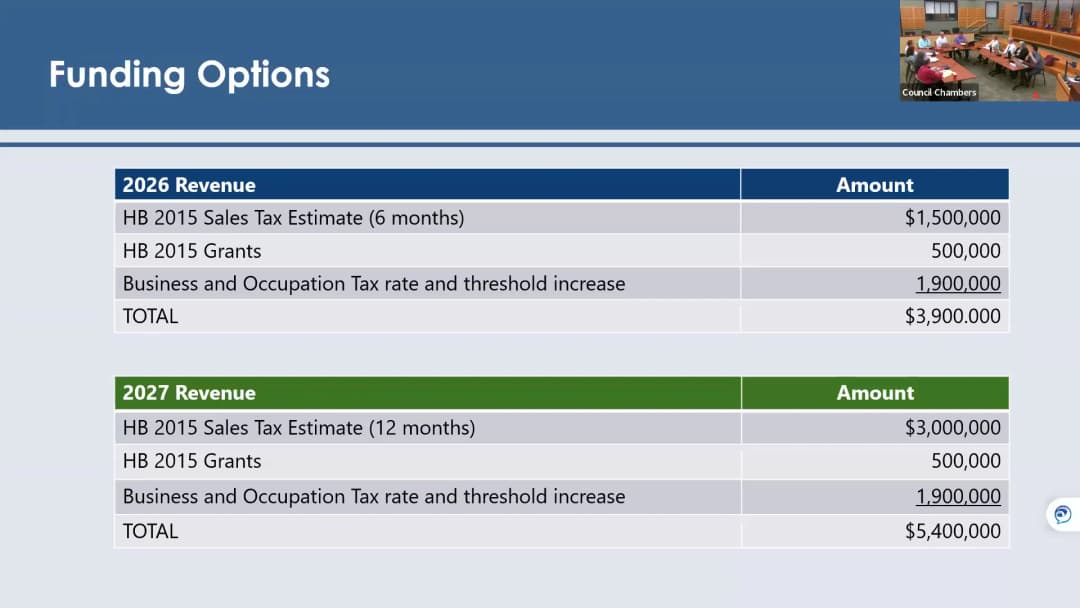
The Finance Committee of the Olympia City Council met to discuss the 2026 Operating Budget, focusing on a projected $7 million general fund deficit. City Manager Jay Burney and staff presented two primary revenue options—adjustments to the Business & Occupation (B&O) tax and a new public safety sales tax authorized by House Bill 2015—alongside potential expenditure reductions and use of reserves. Committee members expressed differing views on the revenue proposals and the need for long-term budget sustainability. No formal recommendation was made; instead, the committee directed staff to bring multiple budget scenarios to the full City Council on September 30, 2025. Consent Calendar - Approved the meeting agenda. - Approved the minutes of the August 18, 2025 Finance Committee meeting. Public Comments & Testimony - No members of the public spoke. Discussion Items - 2026 Operating Budget Update: City Manager Jay Burney provided an overview of the city's budget position, noting that $5 million in fund balance was used to balance the 2025 budget, and 17 general fund positions were eliminated (saving $3.2 million). The 2026 general fund deficit stands at approximately $7 million. - B&O Tax Options: Brandie Andrews, Tax and License Audit Lead, presented options for increasing B&O tax revenue. The city's B&O rates have not changed in 75 years. Options included raising the retail rate from 0.001 to 0.002 (estimated $1.9 million with a $500,000 threshold), raising the threshold to exempt businesses under $500,000 (estimated $1.7 million), or raising rates across all classifications (estimated $2.9 million for a uniform 0.002 rate with $500,000 threshold). Chair Clark Gilman noted some council colleagues had hesitation about B&O changes. - Public Safety Sales Tax: Burney explained a new one-tenth of one percent sales tax authorized by House Bill 2015, which would raise about $1.5 million in 2026 (due to mid-year start) and about $3 million annually thereafter. The tax is tied to a three-year, $100 million statewide grant program for hiring police and alternative programs; Olympia could receive about $500,000 in grants for filling nine vacancies. Committee members discussed the cumulative public safety tax burden (currently 4/10th of 1% to the city and 2/10th to the county) and questioned long-term sustainability. - Use of Reserves and Expenditure Reductions: Burney indicated that with the two revenue options, the remaining gap of about $2 million could be closed without significant cuts. Without new revenues, $7 million in reductions would be necessary, impacting areas like public safety and transportation. Committee member Kelly Green expressed skepticism about revenue longevity and wanted to see the full reduction alternatives before supporting new taxes. Committee member Jim Cooper supported both revenue options and advocated for a balanced package including some cuts and minimal use of reserves. - Priority-Based Budgeting: Senior Budget Manager Debbie reported that the city is analyzing programs by mandate and priority, but the process is not yet ready to produce significant savings for the current budget. The committee discussed how priority-based budgeting could inform future budget cycles. Key Outcomes - The committee did not make a formal recommendation on revenue options. - Staff will present multiple budget scenarios to the full City Council on September 30, 2025, including: Option A (both revenue options plus $2 million in cuts), Option B ($7 million in cuts only), and Option C (combinations of revenue, cuts, and reserves). - City Manager Burney and Executive Director Stacey will conduct one-on-one meetings with council members before the September 30 meeting to gather input on priorities. - The committee noted that the city received the GFOA Distinguished Budget Award for the 2025 Operating Budget, with special recognition for the long-term financial section. Reports and Updates - Finance Director Mike Githens reported that the state auditor's office has begun the accountability audit, including a review of the Olympia Municipal Park District. - Senior Budget Manager Joan Lutz announced the GFOA Distinguished Budget Award. - City Manager Burney praised the work of the new Tax Review Team for their presentations and monthly revenue reports.

BUDGET EQUITY ANALYSIS 40% · PUBLIC SAFETY 32% · BUSINESS LICENSING 12% · PUBLIC ENGAGEMENT 6%
← PREVIOUS
01…1112
OPENPUBLICA · PUBLIC MEETING INDEXUPDATED DAILY · openpublica.com