The Ramsey County Board of Commissioners met on September 16, 2025, at 9:00 a.m. in Council Chambers (Room 300) of the Courthouse. All seven commissioners (Jebens-Singh, McGuire, McMurtrey, Miller, Moran, Xiong, and Chair Ortega) were present, along with County Manager Ling Becker and other staff. The meeting began with a land acknowledgement by Commissioner McMurtrey, approval of the agenda (with an amendment to table item 14), and approval of the September 2, 2025, minutes. A proclamation declaring September 2025 as Workforce Development Month was presented, followed by administrative items, discussion of a warming center grant, board reports, and adjournment at 10:19 a.m. A closed meeting for labor negotiations was held from 10:39 a.m. to 11:57 a.m. Consent Calendar - Agenda Approval (2025-346): Motion by McMurtrey, seconded by Xiong, to amend the agenda by tabling Item 14 (Guaranteed Energy Savings Project). Motion passed 7-0. - Minutes Approval (2025-347): Motion by Miller, seconded by McMurtrey, to approve the September 2, 2025, minutes. Passed 7-0. - Proclamation: Workforce Development Month (2025-310): Commended Ramsey County Workforce Solutions and its partners, citing over 54,624 public sector employees in the county. - Items 4-6, 8-13 (Administrative Items): Approved in a single 7-0 vote (motion by McMurtrey, seconded by Miller): - Item 4: Purdue Pharma L.P. settlement participation and release form. - Item 5: Minnesota Department of Public Safety grant of $200,000 for Ramsey County Youth Support Services (through August 30, 2026). - Item 6: Minnesota Department of Public Safety grant of $347,314 for sexual assault services (through September 30, 2026). - Item 8: HUD Continuum of Care Planning Grant of $438,075 (November 1, 2026 – October 31, 2027). - Item 9: HUD Heading Home Ramsey Continuum of Care Planning Grant of $171,420 (through August 31, 2026). - Item 10: Agreement with Jorgenson Construction, Inc. for Judicial Chambers Room 12D Remodel, not-to-exceed $247,100 (September 16, 2025 – September 15, 2026). - Item 11: First Amendment to MOU with Minnesota Second Judicial District for facility services. - Item 12: Lease with New Brighton Area Historical Society at Long Lake Regional Park for $1 per annum (October 1, 2025 – September 30, 2035, with three 10-year renewal options). - Item 13: Resolution to hold a closed meeting for labor negotiation strategy. - Item 7 (see Discussion Items) was pulled from the consent calendar and voted separately. Item 14 was tabled. Public Comments & Testimony - No public comment period was held. The public did not address the board during the meeting. Discussion Items - Item 7: Grant Award from Minnesota Department of Human Services for Emergency Services Program Grant (2025-345): Sponsor: Housing Stability. Naly Yang (Interim Director, Housing Stability) presented. The grant totals $3,585,290, with $1,400,000 from the Family Homeless Prevention and Assistance Program (September 16, 2025 – June 30, 2027). Discussion focused on challenges in securing vendors for warming centers. Commissioner McMurtrey asked about insufficient responses in prior solicitations. Yang explained that short seasons and operational difficulties have limited interest. This year, a shortened two-week solicitation (mimicking a letter of interest) was posted to attract providers. If no responses are received, the county may amend an existing contract with a current provider for single adult men. Commissioner Moran inquired about long-term contracts and incentives; Yang noted a five-year contract was used last year but one contract was not renewed due to inadequate performance. County Manager Becker added that leadership is working with other cities, the sheriff's office, and faith communities to secure spaces and services. Commissioners expressed support and urged strategic collaboration. After discussion, a motion by McMurtrey, seconded by Miller, passed 7-0 to ratify the application, accept the grant, and authorize necessary agreements. - Item 14: Guaranteed Energy Savings Project with inBYLT, LLC (2025-377): This policy item was for information and discussion only. On a motion by McMurtrey, seconded by Xiong, the board voted 7-0 to table the item. No further details were discussed. Key Outcomes - Agenda and Minutes: Approved as amended (7-0). - Consent Items (excluding Item 7): Approved 7-0. - Item 7 (Emergency Services Program Grant): Approved 7-0 (Resolution B2025-174). - Item 14 (Guaranteed Energy Savings Project): Tabled 7-0. - Closed Meeting: The board held a closed session from 10:39 a.m. to 11:57 a.m. under Minnesota Statutes Section 13D.03 to discuss labor negotiation strategy related to the proposed 2026-27 budget and potential position eliminations. Present were all commissioners, County Manager, Deputy County Manager, Civil Division Director, Chief Human Resources Officer, Benefits Manager, Labor Relations Specialist, Chief Finance Officer, Senior Assistant County Attorney, Manager of Policy and Planning, Chief Compliance and Ethics Officer, and Chief Clerk. - Board Reports: Commissioners provided updates on district events, AMC policy conference (highlighting state funding shifts and solid waste issues), Rice Creek Commons JDA (RFI for developers planned), and the Landmark Center gala (November 7, 2025). Chair Ortega condemned recent divisive remarks from a temporary county employee and called for unity and tolerance.
Public Meetings - Ramsey County, Minnesota
Public Meetings - Ramsey County, MinnesotaThe Ramsey County Budget Committee of the Whole met on September 15, 2025, at 1 p.m. in Council Chambers. The meeting focused on the proposed 2026-27 biennial budget, which includes a levy increase of 9.75% in 2026 and 7.5% in 2027. Presentations were made by the Strategic Service Team, Finance, Human Resources, County Manager's Office, and others, covering organizational alignment, department budgets, fee schedules, debt management, and capital improvements. No votes were taken; the board will set the maximum tax levy on September 23, 2025, and final approval is scheduled for December 16, 2025. Strategic Service Team Presentation - Chief Financial Officer Alex Kutza provided an overview of the budget process and highlighted investments in foundational excellence, including the new ERP system (Workday). The proposed budget operationalizes prior foundational investments. - Deputy County Manager Joanna Berg presented organizational alignment changes, effective January 2026, creating two new service teams: County Operations (led by a new COO) and Community Services and Support. Five administrative director positions are added across service teams. - Commissioners questioned the structural changes, reporting lines (e.g., CFO will report to COO rather than county manager), and the need for additional management layers. A visual org chart was requested. Finance Department Budget - CFO Kutza presented the finance department budget (page 57), which includes four new positions (IT contract lead, budget analyst, accountant, and supplies contract lead) and operationalizes 8 FTEs from prior foundational investments (purchasing, grants, treasury). - Revenue: The department recognizes an additional $1 million from a new fee on investment income, aligning with best practices. A $100,000 investment for an indirect cost plan review and $100,000 for the CERT small business program were also noted. - Discussion included delays in paying community vendors, FTE discrepancies from prior budgets, and the role of the new grants office. Commissioner Zhang noted prior budget items (e.g., comp/class) still lacking progress. Human Resources Budget - Chief HR Officer Patience Ferguson and interim CHRO Kristen Schultz presented the HR budget (page 70). Major changes include 8 new positions (4 in 2026, 4 in 2027) to support benefits transformation, Minnesota Paid Family Medical Leave (PFML) administration, compensation and classification maintenance, and a learning and development strategy. - HR is reorganizing leadership; all vacancies expected to be filled soon. The PFML program starts January 1, 2026; a recommendation on state vs. private administration will come in October 2025. - Commissioners questioned the rationale for new FTEs given prior investments, the impact of PFML on 24/7 services, and the need for consistent performance evaluations and employee feedback mechanisms. A follow-up chart on FTE history was promised. County Manager's Office Budget - Chief of Staff Maria Sarabia presented the county manager's office budget (page 44), reflecting organizational alignment. Key changes include the transfer of compliance/ethics, policy/administrative strategy, government/community relations, and communications functions. - Investments include an additional FTE for compliance (data practices), two FTEs for countywide evaluation efforts, an American Indian Coordinator, and racial/health equity administrators to work across service teams. - Discussion focused on the new community relations position, the role of compliance in risk mitigation, and the placement of the American Indian Coordinator within the policy team. County Board Budget - Budget Analyst Bianca Poussini presented the county board budget (pages 29-36). No new FTEs; increases due to settled contracts, classification/compensation changes, and a new allocation for commissioner responsibilities and constituent innovation. Addenda and Fee Schedule - Bianca Poussini presented the September addenda, which corrects technical errors in FTE counts and alignments without changing the levy. The proposed 2026-27 fee schedule (70 pages) was distributed; changes are highlighted in yellow. No line-by-line review was conducted. - Commissioner Jefferson requested revenue impact data for fee changes. Debt Budget and Bond Financing - Treasurer Jeanette Boyd-Kania presented the debt budget (pages 107-114). The county plans to issue $31.5 million in bonds for 2026, including $12 million for the ERP system. The debt levy increases 5% annually. Ramsey County maintains a AAA credit rating. - Outstanding debt as of December 31, 2024 was $231.2 million. Discussion included the impact of federal tax-exempt bond preservation, capacity to leverage debt, and the 5% levy increase strategy. Capital Improvement Program (CIP) - Bianca Poussini presented the 2026-27 CIP budget (pages 559-583), totaling approximately $260 million in 2026 funding sources. The CIP process involved the Capital Improvement Program Advisory Committee (CPAC), which reviewed projects. The county manager's recommendations modified CPAC's suggestions, including converting an energy savings program to an internal loan and adding the Beaver Lake project. - Discussion highlighted the difference between capital and operating funds, the need for legislative funding opportunities, and the ERP project as a major investment. Key Outcomes - No votes were taken during the meeting. The board will continue budget hearings through September 22, 2025. - The first public hearing on the budget is scheduled for September 22, 2025, at 5 p.m. - The board will set the maximum property tax levy on September 23, 2025. - A second public hearing will be held December 11, 2025, at 6 p.m., with final levy approval on December 16, 2025. - Written comments can be submitted via the Ramsey County website.
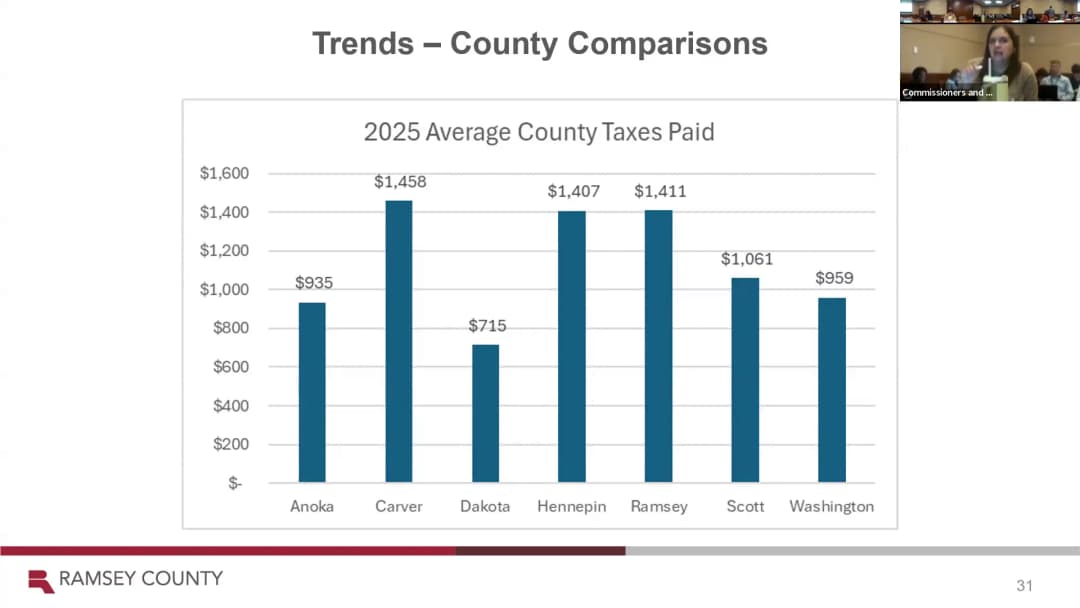
This workshop, held on September 2, 2025, provided an overview of the 2026 property tax process, including market value, tax capacity, levies, and tax rates. County Auditor Tracy West led the presentation, covering key trends, equity implications, and comparisons with other metro counties. Commissioners asked questions and discussed the implications for homeowners, renters, and businesses. No votes were taken. Discussion Items - Property Tax Process Overview: Tracy West explained the components: market value, net tax capacity, levy, exclusions, classification rates, and tax rates. In 2025, Ramsey County collected over $1.1 billion in taxes for about 45 taxing authorities, with 35% going to the county, 33% to cities, 23% to school districts, and 9% to other districts. - Market Value and Tax Capacity Trends: Market values have increased over 50% since 2016 but are leveling off, with an overall 2.3% increase year-over-year. Residential values are rising, while agricultural, commercial, and apartment values are decreasing, shifting the tax burden to residential properties. Tax capacity is increasing by 2.8% overall, but slowing growth creates fiscal pressure if service costs continue to rise. Exempt properties (14% of market value) do not generate tax. - Levy and Budget: County Manager Ling Becker presented the proposed 2026-27 budget. The 2026 levy increase is 9.7%, and 2027 is 7.5%. Over the past five and ten years, Ramsey County's average levy increase of 3.7% is the second lowest among metro counties. - Impact on Homeowners: For a typical single-family home, the average tax increase is $22 per month (4.4%). The median value home sees a 4.3% increase. North Oaks School District (621) has the highest projected increase at 8.9% ($75/month), while North St. Paul (622) has the lowest at 1.4% ($5/month). Within St. Paul, the Thomas Dale area sees the largest increase (7.3%, $19/month), while downtown St. Paul sees a decrease of 0.8% ($2/month). - Equity Concerns: Property taxes are regressive, as they are tied to property values rather than income. Lower-income households bear a heavier burden. For example, Little Canada (median income $71,370) and White Bear Township (median income $124,000) have similar monthly tax increases ($18 vs $19), but the impact is disproportionate. The homestead market value exclusion and state refund programs help mitigate regressivity. - Downtown St. Paul Trends: Downtown accounts for 3% of the county's tax capacity, down from 4.4% in 2019. Commercial tax capacity declined 11% year-over-year, while residential and industrial grew modestly. If large delinquent properties forfeit to the state, downtown's share could fall to 2.5% by 2028, shifting more tax burden to residential properties. The city could diversify the tax base through residential development and mixed-use redevelopment. - County Comparisons: Ramsey County has the lowest average residential market value among metro counties but among the highest average county taxes paid and highest tax rates. This is due to lower property values, higher service demands (urban core services), and slower tax base growth. Commissioners discussed the disproportionate service burden on Ramsey County, with many clients from other counties, and the possibility of seeking reimbursement from those counties. County Manager Becker noted that many programs already bill other counties, but front-door costs are not fully recovered. - Requests for Public Education: Commissioners requested that the county produce a video tutorial explaining the property tax system, similar to those from other counties, and improve the county website to help residents understand the process. Auditor West agreed to work with communications. Key Outcomes - The county board will certify the 2026 maximum levy on September 23, 2025. - All taxing jurisdictions must certify levies to the county auditor by September 30, 2025. - Notices of estimated taxes will be mailed to residents between November 10 and 24, 2025. - Property tax relief programs (homestead exclusion, state refunds) are available at www.revenue.state.mn.us. - No formal votes were taken, as this was a workshop.
The Ramsey County Board of Commissioners met in regular session on September 2, 2025, at 9:31 a.m. in Council Chambers, Courthouse Room 300. All seven commissioners were present, with Commissioner McMurtrey attending remotely. The meeting included approval of the agenda and minutes, two administrative items, a major policy presentation on the proposed 2026-2027 biennial budget, and reports from outside boards and committees. The meeting adjourned at 10:52 a.m., followed by a workshop on the projected impact of 2026 taxes payable. Consent Calendar - Agenda Approval (2025-337): Approved unanimously (7-0) on a motion by Moran, seconded by Xiong. - Minutes Approval (2025-338): Approved unanimously (7-0) on a motion by Moran, seconded by Miller. - Administrative Item 3: Ramsey County 2025 Cooperative Deer Management Plan (2025-321): Approved unanimously (7-0) on a motion by McGuire, seconded by Jebens-Singh. Resolution B2025-163. - Administrative Item 4: Revoke County Road 94/South Shore Boulevard and revert to White Bear Township (2025-349): Approved unanimously (7-0) on a motion by McGuire, seconded by Jebens-Singh. Resolution B2025-164. Public Comments & Testimony No public comments were made during the meeting. Discussion Items - Presentation of the Proposed 2026-2027 Biennial Budget (2025-354): County Manager Ling Becker presented the recommended budget, emphasizing it as "the most difficult budget in recent history." Key points included: - Proposed total budget of approximately $930 million for 2026 (6.57% increase over 2025) and $970 million for 2027 (4.22% increase). - Proposed property tax levy increases of 9.75% for 2026 and 7.5% for 2027, with about 5% and 4% respectively tied to employee investments. - Elimination of 43 filled positions and addition of 110 FTEs in 2026 and 30.5 FTEs in 2027, with staff reductions in non-core county responsible services and investments in core services, including the Appropriate Response Initiative, public benefits access, and technology modernization. - Drivers: employee compensation modernization, rising state cost shifts and unfunded mandates, and need to direct resources to core services. - Organizational restructuring: sunsetting the Strategic Team and Information/Public Record service teams, creating a new County Operations Service Team and a Community Services and Support Service Team, effective January 1, 2026. - Continued advocacy for reforming County Program Aid formula, as Ramsey County receives less than fair share despite being the second most populous county. - County Manager and Commissioner Comments: - Commissioner Moran (Budget Chair) thanked the county manager, outlined the budget process timeline, and emphasized the need for public participation. - Chair Ortega noted the budget prepares for four years of anticipated federal cuts, not just two. - Commissioner McGuire expressed concern about federal cost shifts and the reliance on property taxes, urging continued advocacy. - Commissioner Xiong asked for clarification on FTE changes; County Manager Becker explained that staff reductions are in non-core areas while additions are in core county responsible services and to sustain ARPA-funded programs. - Commissioner Jebens-Singh appreciated investments in staff and data systems for accountability. - Commissioner Xiong also requested more detailed conversations with the Joint Property Tax Advisory Committee and highlighted the Boys Totem Town redevelopment opportunity. - Commissioner McMurtrey (remote) praised the focus on revenue generation (e.g., grants office, random moment time study) to reduce property tax reliance. - County Connections Update: County Manager Becker announced the conclusion of the "All Hands on Deck" effort to reduce public assistance backlogs, with a new initiative called "Accuracy and Access" aimed at reducing the SNAP error rate, targeting a 50% reduction in the first six months and 95% on-time case processing. - Outside Board and Committee Reports: - Commissioner Xiong reported on the Gold Line Joint Powers Board meeting (approved 2026 administrative budget, clean audit, rising ridership) and the Recycling and Energy Board (strategic planning, accelerated EV contracts due to federal shifts). - Commissioner McGuire reported on the Ramsey Washington Recycling and Energy Board (vendor selection for food scraps pickup program) and a County Road C open house. - Commissioner Jebens-Singh attended commitment hearings and alternative courts, completed a District 1 parks tour, and announced the new executive director of Suburban Ramsey Family Collaborative. - Commissioner Miller attended the Metropolitan Conservation Districts Joint Powers Board (routine approvals, Metro Children's Water Festival planning). - Commissioner McMurtrey had no committee updates due to family leave. - Commissioner Moran reported on the Roots Navigator/Free Trial Justice Committee, St. Paul Promise Neighborhood strategic cabinet, and the Minnesota African American Family Preservation Act statewide team. Key Outcomes - Votes: All agenda items approved unanimously (7-0). - Budget Process Next Steps: - Department budget presentations: September 15-22, 2025. - Joint Property Tax Advisory Committee meeting with St. Paul: September 15. - First public hearing: September 22 at 5 p.m. - Board sets maximum 2026 levy: September 23. - Property tax statements mailed to residents: mid-November. - Truth in Taxation hearing: December 11. - Final budget adoption: December 16. - Commissioner-Led Budget Forums: Commissioner Moran announced plans to host district budget meetings; Commissioner Xiong invited District 6 residents to a session on September 4 at Sunray Library. - Adjournment: The meeting adjourned at 10:52 a.m., followed by a workshop on the projected impact of 2026 taxes payable.
The Ramsey County Regional Railroad Authority met on August 26, 2025, at 10 a.m. (with roll call at 9:36 a.m.) in Council Chambers, Courthouse Room 300. Commissioners Jebens-Singh, McGuire, Miller, Moran, and Vice-Chair Xiong were present; Commissioners McMurtrey and Chair Ortega were excused. The meeting covered routine approvals and a significant administrative item to transfer fund balance for Union Depot insurance premiums, followed by corridor updates on the Borealis service and the Union Depot restaurant. Consent Calendar - Agenda Approval (Item 1): The agenda of August 26, 2025 was presented and approved unanimously (motion by Miller, second by Moran; all present voted aye). - Minutes Approval (Item 2): The minutes from August 19, 2025 were presented and approved unanimously (motion by Miller, second by Moran; all present voted aye). Discussion Items 3. Use of Fund Balance – Union Depot Insurance Premiums - Deputy Director of Public Works Mike Rogers presented the item. He explained that the increased insurance costs arise from the Authority taking on more liability control at Union Depot as part of negotiating the Borealis service. Previously, Amtrak backed stop insurance beyond $50 million; now the Authority must maintain $175 million in coverage, costing about $2 million annually. A one-time $1 million state appropriation has been spent. - The current request was to transfer $800,000 (per agenda and minutes) from the Ramsey County Regional Railroad Authority tax levy fund balance to the 2025 Multimodal Planning operating budget to cover the remaining insurance premium gap. (Note: In the transcript, Mr. Rogers stated the request was for about $850,000; the written record consistently shows $800,000. This discrepancy is noted.) - Commissioners discussed the ongoing nature of the cost, the need for future state support, and the possibility of creating an insurance pool with other public entities. Commissioner McGuire, Vice-Chair Xiong, and others expressed support for advocating for broader state funding, noting Union Depot is a statewide asset. - The motion (by Miller, second by McGuire) passed unanimously (Resolution R2025-013). Corridor Updates Although the agenda listed “Corridor Updates” and the minutes state “None,” the transcript includes significant updates provided by County Manager Ling Becker after the vote: - Borealis Service: Exceeded 250,000 riders on July 4, 2025, surpassing ridership forecasts. A challenge noted: Amtrak’s fleet corrosion issues forced replacement cars with 30% less capacity, limiting potential ridership until more cars are available. - Union Depot Restaurant (1881 Eating House): Renamed this year; a patio opened in summer 2025. The restaurant offers parking validation for the Union Depot ramp. Commissioners shared positive personal experiences and encouraged patronage. - Commissioners also noted the addition of the patio as a sign of improved conditions at the depot and encouraged taking the Gold Line downtown. Key Outcomes - Agenda and minutes approved unanimously. - Transfer of $800,000 (or $850,000 per discussion) from fund balance to operating budget for insurance premiums approved unanimously (Resolution R2025-013). - Future actions: Staff will continue to seek state support and explore an insurance pool. The cost will be incorporated into future biennial budgets to avoid similar fund balance requests. - Meeting adjourned at 9:50 a.m.
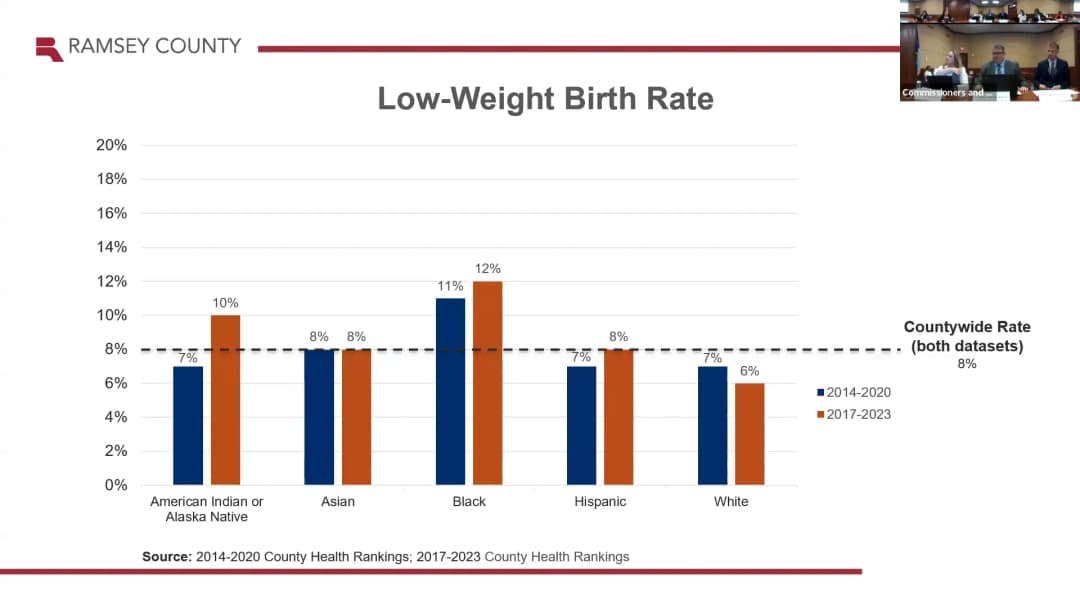
This workshop, held on August 26, 2025, at 1:30 PM in Courthouse Room 220, Saint Paul, focused on the county's community indicators program. The program measures community-wide outcomes across five categories—affordability, wealth creation, early childhood, health, and public safety—to inform strategic planning and budgeting. Presenters from Policy & Planning (Larry Timmerman, Lindsay Minard, Dave Zafron) walked through 8 of the 14 current indicators. No votes were taken during this workshop. Discussion Items - Background and Context: The community indicators originated from an upward mobility project with the Urban Institute (2020–2022). The current 14 indicators were developed through community engagement. Presenters noted that data sources are being improved, particularly for disaggregation by race and ethnicity, and that indicators are updated on the open data portal. - Affordability Indicators: - Median Household Income (US Census ACS 5-year estimates, inflation-adjusted to 2023 dollars). Data for American Indian/Alaska Native populations had high margins of error (26% in 2018, 44% in 2023). - Severe Rent Burden (households spending 50% of income on rent). Data from the National Equity Atlas (replacing Urban Institute source). Commissioner Moran noted the absence of Asian community data; staff explained this is the last indicator not disaggregated for Asian populations. - Wealth Creation Indicators: - Home Ownership Rate: Countywide 59% (2018) to 61% (2023). - Denial Rate for Home Purchase Loan Applications (2023): 14% countywide. Data from CFPB HMDA. Commissioner Miller asked whether county programs were included; staff confirmed loan applications through county programs would be captured. - Early Childhood Indicator: - Child Care Spaces per 100 Children Under Age 5: Ramsey County ranks 78th out of 87 Minnesota counties. New data source: childcareaccess.org (U of M). Discussion about the 20-minute driving distance metric and the need for geographic disaggregation. - Health Indicators: - Low Birth Weight Rate: Countywide 8% (state 7%). Data from County Health Rankings (UW–Madison). Funding for this source has been pulled by Robert Wood Johnson Foundation; future data will need alternative sources. Commissioners requested further disaggregation by prenatal care, insurance status, and contributing factors. - Preventable Hospital Stays per 100,000 Medicare Enrollees: 2022 countywide rate 2,270 (state 2,255). A sharp drop in the American Indian/Alaska Native rate (from 2,758 to 675) is suspected to be a data entry error; staff have contacted County Health Rankings for verification. - Public Safety Indicator: - Juvenile Arrests (Ages 10–17): 2023 data from local police departments, showing arrest shares by race compared to youth population shares. Commissioner Moran requested further disaggregation by age (e.g., 10-year-olds vs. 17-year-olds). Key Outcomes and Next Steps - Data Verification and Follow-up: Staff will investigate the suspected data error in preventable hospital stays for American Indian/Alaska Native populations and report back. They will also explore additional disaggregation for low birth weight (by insurance, prenatal care) and juvenile arrests (by age). - Future Data Sources: Given the loss of County Health Rankings funding, staff will seek alternative sources for health indicators. Commissioners emphasized leveraging local data from Wilder Foundation, U of M, Met Council, Minnesota Compass, and other partners. Commissioner Mai Chong Chong suggested coordination with the Association of Minnesota Counties (AMC) on data advocacy. - Community Engagement: Staff plan to re-engage with community and stakeholders in 2026 to review and potentially update the set of 14 indicators. Commissioners encouraged using the workshop as a platform to build a narrative about the county's role in the broader ecosystem. - Partnerships and Data Sharing: Commissioners highlighted the need to align indicator data with partner organizations (e.g., children's collaborative, CAFRW, U of M) and to reduce duplication. County Manager Becker noted that upcoming nonprofit convenings (November 2025) could be used to coordinate data efforts. - Reporting: Staff will provide answers to unanswered questions from the workshop and continue to update the open data portal with performance measures and community indicators.