Browse by city
Date range
Search help

Search titles, summaries, topics and stored transcripts together. Keywords may match separately; put the whole query in double quotes for a phrase. Matching follows word analysis, so punctuation is not exact. Both dates are included. Documents are not searched.

SHOWING 111–120 ENTRIES
111
OCT 14, 2025 · RAMSEY COUNTY, MINNESOTA · BOARD OF COMMISSIONERS & AUTHORITIES
Ramsey County Board of Commissioners Meeting - October 14, 2025

The Ramsey County Board of Commissioners met in regular session at 9:02 a.m. on October 14, 2025, in Council Chambers, Courthouse Room 300, 15 West Kellogg Blvd., Saint Paul, MN. Present: Commissioners Jebens-Singh, McGuire, McMurtrey, Miller, Moran, and Chair Ortega. Commissioner Xiong was excused. Also present were County Manager Ling Becker and Jada Lewis, Civil Division Director, Ramsey County Attorney's Office. The meeting was adjourned at 10:13 a.m. All votes were unanimous (6-0, with Commissioner Xiong excused). Proclamation: National Domestic Violence Awareness Month Commissioner Jebens-Singh presented the proclamation declaring October 2025 as National Domestic Violence Awareness Month in Ramsey County. Statistics cited: nearly one in three women and one in four men experience intimate partner violence in their lifetime, and more than 9,500 domestic-related 911 calls were made in Ramsey County in the past year. Commissioner Jebens-Singh highlighted the county's "Call for All" initiative, which strengthens how 911 callers experiencing domestic violence are connected with advocates and resources. Multiple community partners and staff spoke in support of the proclamation and the Call for All initiative, including: - Natalie Simonette (Emergency Communications admin planning assistant) announced that beginning next month, all 911 call takers will be required to offer the resource and send an outbound text message with a link to the website, giving victims and survivors autonomy over which advocacy organization they connect with. - Rosie Walker (Women's Advocates) noted her organization is the first domestic violence shelter in the nation. - Ray Black (Tubman shelter community manager, self-identified survivor) expressed gratitude for being part of the project from conception to launch. - Tara Lewis (Winnebago Tribe of Nebraska, Minnesota Indian Women's Sexual Assault Coalition Board chair) spoke about advocating for Native American women and children. - Maria Meyer and Shelley Klein (St. Paul Intervention Project/SPIP), Abby Lane (Northeast Youth and Family Services), Jen Paulzin (CEO, Tubman), Shua (Transforming Generations), Gloria Reyes (Deputy County Manager), Nancy Pass (Emergency Communications director), and others expressed support, emphasizing the collaborative, co-created nature of the initiative. Consent Calendar All consent items were approved unanimously via a single motion by Commissioner McMurtrey, seconded by Commissioner Miller: - Agenda of October 14, 2025 approved (Motion by Miller, seconded by McGuire). - Minutes from October 7, 2025 approved (Motion by McGuire, seconded by Jebens-Singh). - Item 4 - Donation from Minnesota State Fair (Resolution B2025-187): Retroactive acceptance of a $28,000 donation from the Minnesota State Fair to the Social Services Department in the form of 1,400 State Fair tickets. - Item 5 - Property Assessed Clean Energy Charges (Resolution B2025-188): Certified a special assessment for 80 West LLC at 80 4th Street W, Saint Paul, PIN 06.28.22.24.0012, for energy efficiency improvements in the amount of $1,530,000.00, at a 7.49% interest rate, with interest starting to accrue June 1, 2027, over a 24-year finance period with first installment payable with 2027 property taxes. The Chief Clerk was directed to send a certified copy to the County Auditor. - Item 6 - Minnesota Family Investment Program Biennial Service Agreement (Resolution B2025-189): Ratified the submittal of the 2026-2027 County Biennial Service Agreement to the Minnesota Department of Children, Youth and Family; accepted a TANF Block Grant of $18,534,057 annually for January 1, 2026 through December 31, 2027; authorized the Chair, Chief Clerk, and County Manager to execute agreements; and authorized temporary transfers from the General Fund as needed. - Item 7 - Restore 2024 Information Technology Projects Appropriation (Resolution B2025-190): Authorized the County Manager to transfer up to $3,114,817 from General Fund balance to restore the Information Technology Projects Appropriation closed out to fund balance during the 2024 budget closing process. - Item 8 - Minnesota Paid Leave Implementation (Resolution B2025-191): Authorized the County Manager to finalize negotiations and execute an agreement with Metropolitan Life Insurance Company (200 Park Avenue, New York, NY) for administration of Paid Family Medical Leave insurance coupled with Short- and Long-Term Disability insurances, commencing January 1, 2026, for a term of at least two years. - Item 9 - Settlement Agreement in John and Amy Waters v. Ramsey County, et al. (Resolution B2025-192): Approved a settlement agreement totaling $875,000 (Court File No. 62-CV-23-4037) and authorized the Chair and Chief Clerk to execute it. Ordinance Procedures - Item 10 - 2026 Capital Improvement Program Bond Ordinance (Resolution B2025-193): The board waived the first reading of the proposed 2026 Capital Improvement Program Bond Ordinance and set the public hearing for November 4, 2025, at 9 a.m. in the Council Chambers, third floor of Ramsey County Courthouse. Motion by Chair Ortega, seconded by Commissioner McGuire. Passed unanimously. County Connections - County Manager Update County Manager Ling Becker provided updates on: - Windows 10 end-of-support: Microsoft officially ended support of Windows 10 on this date. The Information Services department successfully upgraded 97% of all county computers to Windows 11, avoiding significant costs of extended security support. - Manufacturing Month (October): Manufacturing contributes over $57 billion to the Minnesota economy, representing 12% of the state's gross domestic product. Average manufacturing wages in Minnesota are $79,000 annually, while Ramsey County manufacturing wages average $95,000—10% higher than the state average. Ramsey County has over 650 manufacturing firms employing more than 29,000 people. Public tours are available, including International Paper, Summit Brewing, Harris Companies, and National Checking Company. - Federal shutdown: The county was in week three (day 14) of the federal shutdown. Programs monitored include SNAP, Head Start, Early Childhood, TANF/Minnesota Family Investment Program, SAMSA, FEMA, Medicare, and Medicaid. WIC funding in Minnesota is available through the end of October via drawdowns, and the health department and FRAT team are planning for scenario where WIC funds are exhausted before the shutdown ends. Approximately 17,000 federal employees work in Minnesota; an estimated 20-30% of the civilian federal workforce (about 4,000 residents) resides in Ramsey County and may be furloughed or face pay delays. Outside Board and Committee Reports - Commissioner Moran: Reported on the Active Living Ramsey Communities hybrid meeting (presentations on bike and walk audits with AARP; introduction of public works senior transportation planners Cody Leesman and Amy Barnesdorf; planning for the Ramsey County 20th anniversary celebration on November 17; Metropolitan Council regional bicycle transportation network proposed changes). Also attended the Roseville Fire Department senior resource fair, State of the Friends event, Roseville Area Schools local government meeting, Ramsey County League of Local Governments meetings (chloride pollution; cybersecurity takeaways from the St. Paul attack), do good Roseville 10th anniversary, and the Large Urban County Caucus in Milwaukee (highlighting Milwaukee's public market, South Shore Park, and a regional sales tax model spanning five counties for their professional baseball stadium). - Commissioner Jebens-Singh: Thanked labor and trade partners for "Project Heat is On" energy efficiency work, noted the CAPRW partnership for referring homes, reminded residents about energy assistance applications. Recognized John Anderson Day (October 2) in Ramsey County for the retiring White Bear Lake Area Schools community education leader. Attended a landmark place event on redlining history, the Solid Ground gala (low-income and bridge housing), Vadnais Heights Lions Club waffle breakfast (compostable event), Clean Water Action Brunch for Better, NAMI Walk (noting NAMI director Sue Abderholden's retirement), Northeast Youth and Family Services "Pause for Purpose" (noting they have therapist openings), and do good Roseville. Participated in the Byrne Institute trip to Montgomery and Selma with the youth justice transformation group, describing it as personally moving and catalyzing collaboration. - Commissioner McMurtrey: Welcomed new Ramsey County employees, attended the City of St. Paul's 50th anniversary of district councils, and the AMC (Association of Minnesota Counties) board meeting where the 2026 budget was approved, a new membership database was approved, and legislative priorities were reviewed (with a strategic plan approval goal in January; annual AMC conference December 8-10 in Bloomington). Spoke to the National Association of Retired and Veteran Railroad Employees in Roseville (previewed the budget). Honored the 2026 Family Farm of the Year (Pilgrim Baptist Church community garden). Announced the "Reopen Rice" celebration of phase one completion of Rice Street reconstruction on Saturday, from 11 a.m. to 3 p.m. at the Rice and Arlington Baseball Field Parking Lot, with phases two and three to follow. - Commissioner Miller: Attended the Roseville Local Government meeting (updates on the capital project levy for school safety and technology), the Metropolitan Emergency Services Board (MESB) meeting (selected a lobby firm after a second round of interviews; firm name not yet shared publicly), and NACo's EELU committee meeting (Operation Greenlight; data centers and power demand). Participated in the Indigenous People's Day proclamation at American Indian Magnet School, thanking county departments that tabled, and highlighting community engagement (down payment assistance program at the CED table). Upcoming: Vadnais Heights EDC Partners for Good meeting, AMC tribal leaders meeting in Duluth, and the CLUES gala on Friday. - Chair Ortega: Reflected on the Byrne Institute trip to Montgomery and Selma with colleagues and county staff as a reminder that past laws and policies continue to impact lives today. Attended Fresh Energy's breakfast fundraiser (carbon neutral economy advocacy), met with Joe Munich of Generation Next and Eagle Lab (homelessness issues in downtown), attended the launch party for Keeping Families Connected Minnesota (founder Joanne Whitman; support for families in the child protection system), a Bridging gala (furniture for families transitioning from homelessness; noted Ramsey County's strong relationship with Bridging), and the Hallie Q Brown Community Center fundraiser under new executive director Benny Roberts. Announced that the Rondo Community Library—the busiest library in the City of St. Paul with 250,000 visitors in 2024 and 30,000 visitors in September 2025 alone—will temporarily close by late 2025 for interior renovation. Library services will continue at Hallie Q Brown Community Center during the closure; the exact date will be announced later this month. Also attended the Neighborhood House (Wellstone Center) gala (raised $500,000 that night; $500,000 away from $25 million raised in the past year), the violence reduction leadership group (commending coordinated efforts by St. Paul Police, Metro Transit Police, and Sheriff's Department), the Laborers Union infrastructure summit, and spoke at Ramsey County Correctional Facility for Hispanic Cultural Week. Key Outcomes - All ten agenda items were approved unanimously (6-0; Commissioner Xiong excused). - Resolutions adopted: B2025-187 through B2025-193. - Public hearing for the 2026 Capital Improvement Program Bond Ordinance set for November 4, 2025, at 9 a.m. in Council Chambers. - The Call for All initiative will launch next month, with 911 call takers required to offer the advocacy resource and send an outbound text message link to all domestic violence-related calls. - After the board meeting, a scheduled Board Workshop on County Program Aid and Payment in Lieu of Taxes was held at 10:30 a.m., followed by a Lunch and Learn on Sheriff's Office OT Discussion at 12:00 p.m. - A closed meeting was held at 1:38 p.m. pursuant to Minnesota Statutes § 13D.05, subd. 3(c)(3) regarding the sale of vacant property at 3329 Rice Street in the City of Shoreview. The board unanimously authorized the County Manager to approve and execute purchase agreements, settlements, closing documents, and related real estate documentation (Resolution B2025-194). The closed meeting adjourned at 1:55 p.m. - Advance notice was given that no county board meeting will occur on October 28, 2025 (Mpact Transit + Community Conference) or November 11, 2025 (Veterans Day).
PUBLIC ENGAGEMENT 29% · DOMESTIC VIOLENCE SUPPORT 25% · COMMUNITY ENGAGEMENT 20% · PROCEDURAL 9%
112
OCT 7, 2025 · RAMSEY COUNTY, MINNESOTA · BOARD OF COMMISSIONERS & AUTHORITIES
Ramsey County Board of Commissioners Meeting – October 7, 2025

The Ramsey County Board of Commissioners met in regular session at 9:00 a.m. on October 7, 2025, in Council Chambers. Commissioners McGuire, McMurtrey, Miller, and Chair Ortega were present; Commissioners Jebens-Singh, Moran, and Xiong were excused. County Manager Ling Becker and Civil Division Director Jada Lewis also attended. The meeting included a proclamation, employee achievement awards, approval of administrative items, discussion of bonding priorities, and a presentation on Minnesota Paid Family Medical Leave implementation. Recognition - Proclamation: National Disability Employment Awareness Month – Commissioner McMurtrey presented the proclamation recognizing October 2025 as National Disability Employment Awareness Month, celebrating the contributions of people with disabilities in the workplace. Several employees spoke in support. - Employee Achievement Awards – Three employees received awards for excellent job performance: Tobias Lynum (Financial Worker Specialist), David Triplett (Deputy Director, Property Tax, Records and Election Services), and Tracy Jones (Social Worker). Each award was presented by a commissioner and supported by remarks from supervisors and colleagues. Consent Calendar The following items were approved unanimously (4 ayes, 3 excused) without discussion: - Approval of the October 7, 2025, agenda (Item 1). - Approval of the September 23, 2025, minutes (Item 2). - Agreement with inBYLT, LLC for a guaranteed energy savings project across multiple county facilities, authorizing an initial loan of up to $8,450,000 from the general fund (Resolution B2025-182). - Project budget and financing plan for the East Kellogg Building furniture and fixture disposition project, up to $240,000 from proceeds of the Ramsey County Care Center sale (Resolution B2025-183). - Sole source agreement with CorVel Healthcare Corporation for workers’ compensation managed care services from October 21, 2025, through May 31, 2027 (Resolution B2025-184). - Settlement agreement in Daeshon Tucker v. Dwight Fontae Smith, et al., totaling $100,000 (Resolution B2025-185). Discussion Items - Bonding Project Prioritization (Item 10) – The board approved a resolution supporting two 2026 state bonding requests: Park at RiversEdge ($20 million) and Aldrich Arena & Community Event Center ($6.6 million). Director Josh Olson explained that Rice Creek Commons remains a top county priority but is being funded through transportation sales tax dollars, so it was not included on the state bonding list. Commissioner McMurtrey asked about the selection process; County Manager Becker noted these projects had existing momentum and legislative support. The resolution passed 4-0 (Resolution B2025-186). - Minnesota Paid Family Medical Leave Implementation (Item 12) – Jessica Mumford, Leaves and Accommodations Manager, presented an overview of the new state law effective January 1, 2026. She outlined two compliance options: the state plan (0.88% of wages in 2026) or a private plan through MetLife (0.79% with a two-year rate guarantee). The private plan is projected to save over $1.3 million in 2026–2027 compared to projected state rates. County Manager Becker noted that most metro counties are choosing private plans. The board will consider a resolution (RBA) at the next meeting to authorize opting out of the state plan and contracting with MetLife. The state opt-out deadline is November 10, 2025. Key Outcomes - Resolutions B2025-182 through B2025-186 were approved unanimously by the four commissioners present. - The board directed staff to bring an RBA to the October 14 meeting to authorize a private plan with MetLife for paid family medical leave. - County Manager Becker provided updates: the new county website (ramseycounty.gov) is live; a measles outbreak in the metro has 13 confirmed cases (one in Ramsey County) with no unusual response required; the federal government shutdown is being monitored with no immediate disruptions to county services. - Commissioner updates highlighted community events, including a tribal flag installation at the Juvenile and Family Justice Center, a groundbreaking for 11 deeply affordable housing units, and the upcoming Indigenous Peoples’ Day events. The meeting was adjourned at 10:28 a.m.

HUMAN SERVICES 40% · PROCEDURAL 10% · FISCAL SUSTAINABILITY 8% · DISABILITY RIGHTS 7%
113
SEP 23, 2025 · RAMSEY COUNTY, MINNESOTA · BOARD OF COMMISSIONERS & AUTHORITIES
Ramsey County HRA Meeting Approves Maximum Tax Levy for 2026 Budget - September 23, 2025

The Ramsey County Housing and Redevelopment Authority (HRA) met on September 23, 2025, at 10:15 a.m. (meeting called to order at 10:22 a.m. per minutes) to approve routine items and certify the maximum tax levy for the 2026 budget. The meeting adjourned at 10:39 a.m. All seven members were present: Jebens-Singh, McGuire, McMurtrey, Miller, Moran, Ortega, and Chair Xiong. Also present were County Manager Ling Becker and Assistant County Attorney Scott Schwahn. Consent Calendar - Agenda Approval (2025-384): Approved unanimously on a motion by Miller, seconded by McGuire. - Minutes Approval (2025-385): Approved unanimously on a motion by Ortega, seconded by Miller. The minutes were from July 1, 2025. Discussion Items - Certification of the Maximum Tax Levy for the Ramsey County HRA (2025-316): The HRA approved a motion to certify the maximum tax levy of $14,266,482 to finance the 2026 budget. Josh Olson, Director of Community and Economic Development, presented the item. He noted that the HRA levy, first levied in 2022, is a primary funding source for housing and redevelopment programs. In 2024, the levy accounted for nearly 59% ($10.9 million) of all affordable housing investments. Funds also support the First Home down payment assistance program (46 closings in 2024, 34 with first-generation buyers), the Emerging and Diverse Developers program (160 applicants for 50 spots in 2025), and redevelopment projects. The levy is countywide except North St. Paul, which opted out. Commissioner McGuire clarified that the levy is the statutory maximum and that recent legislative changes only expanded allowable uses, not the amount. Commissioner McMurtry asked about the potential allocation for economic development (EDA) programming; Olson responded that 10-15% ($2 million) is being considered, pending consultation with cities. Commissioner Moran asked about a 5.2% increase in the levy; Olson deferred to the finance team for a precise answer. Chair Xiong and other commissioners emphasized the importance of the levy for growing the tax base and leveraging other funds. Key Outcomes - Motion to Certify Maximum Tax Levy: Approved unanimously (7-0) on a motion by Ortega, seconded by Miller. Resolution H2025-013 was adopted. - Next steps: Staff will continue to engage with cities on economic development programming and provide a written response on the levy increase details.

AFFORDABLE HOUSING 69% · ECONOMIC DEVELOPMENT 19% · PROCEDURAL 12%
114
SEP 23, 2025 · RAMSEY COUNTY, MINNESOTA · BOARD OF COMMISSIONERS & AUTHORITIES
Regional Railroad Authority Approves Maximum Tax Levy, Discusses Corridor Projects - September 23, 2025

The Ramsey County Regional Railroad Authority met on September 23, 2025 at 10:04 a.m. in Council Chambers, Courthouse Room 300. All seven members (Jebens-Singh, McGuire, McMurtrey, Miller, Moran, Ortega, and Xiong) were present. The board unanimously approved the agenda and minutes of the previous meeting, then considered a policy item to certify the maximum tax levy for the 2026 budget. A presentation by Brian Isaacson, Director of Public Works, sparked discussion on eligible uses of funds and ongoing corridor projects. The meeting adjourned at 10:21 a.m. Consent Calendar - Agenda Approval: Motion by Miller, seconded by Xiong. Unanimously approved (7-0). - Minutes Approval (August 26, 2025): Motion by Jebens-Singh, seconded by McGuire. Unanimously approved (7-0). Policy Item: Certification of Maximum Tax Levy - Presentation: Brian Isaacson, Director of Public Works, presented the proposed maximum tax levy of $37,285,643 to finance the 2026 Ramsey County Regional Railroad Authority Budget. He detailed statutory limitations: funds can only be used for railroad-related items (freight/passenger rail, rail crossings, bridges over railroads, and bus rapid transit), with a 10% capital cap for light rail/commuter rail projects, and cannot fund operations or maintenance of light rail/commuter rail. - Commissioner McGuire clarified that the levy can be used for bus rapid transit and infrastructure improvements, and is not limited to trains; trails with a rail nexus may also be eligible. She expressed full support for the levy. - Commissioner Xiong (referred to as Commissioner Jan) asked for clarification on what qualifies as rail or BRT. Isaacson explained rail includes light, passenger, and freight rail; BRT includes exclusive-lane projects like Gold Line and Purple Line. - Commissioner McMurtrey asked about the difference between Regional Railroad Authority funds and the Transportation Improvement Plan (TIP). Isaacson explained that TIP is an all-encompassing document that includes RR authority funds; the authority has specific statutory enabling criteria. - Commissioner Miller thanked staff for the detailed explanation. - Motion: Moran moved, Miller seconded. Unanimously approved (7-0). Resolution R2025-014. Corridor Updates - Northeast Corridor Trail: Chair Ortega noted the corridor has been a placeholder for 25 years, awaiting railroad to relinquish land. Commissioner McGuire highlighted the need for connecting trails and mobility options for walking, biking, and wheelchairs. Isaacson said the board’s recent funding flexibility allows for sharper attention to key corridors. - Purple Line: Commissioner Xiong informed the board of an upcoming community event organized by Move Minnesota and district councils to build support for dedicated transit on the Eastside and into Maplewood. - A-Line Extension: Chair Ortega mentioned the desire to extend the A-Line to Rice Creek Commons, hoping for progress soon. Key Outcomes - Unanimously approved the agenda and minutes. - Approved Resolution R2025-014 certifying the maximum tax levy of $37,285,643 for the 2026 Regional Railroad Authority Budget (with intent to potentially lower the final levy). - Staff will continue engagement with railroad partners on corridor projects, including the Northeast Corridor trail and Purple Line planning. - Meeting adjourned at 10:21 a.m.

TRANSPORTATION SAFETY 66% · PUBLIC ENGAGEMENT 24% · PROCEDURAL 10%
115
SEP 23, 2025 · RAMSEY COUNTY, MINNESOTA · BOARD OF COMMISSIONERS & AUTHORITIES
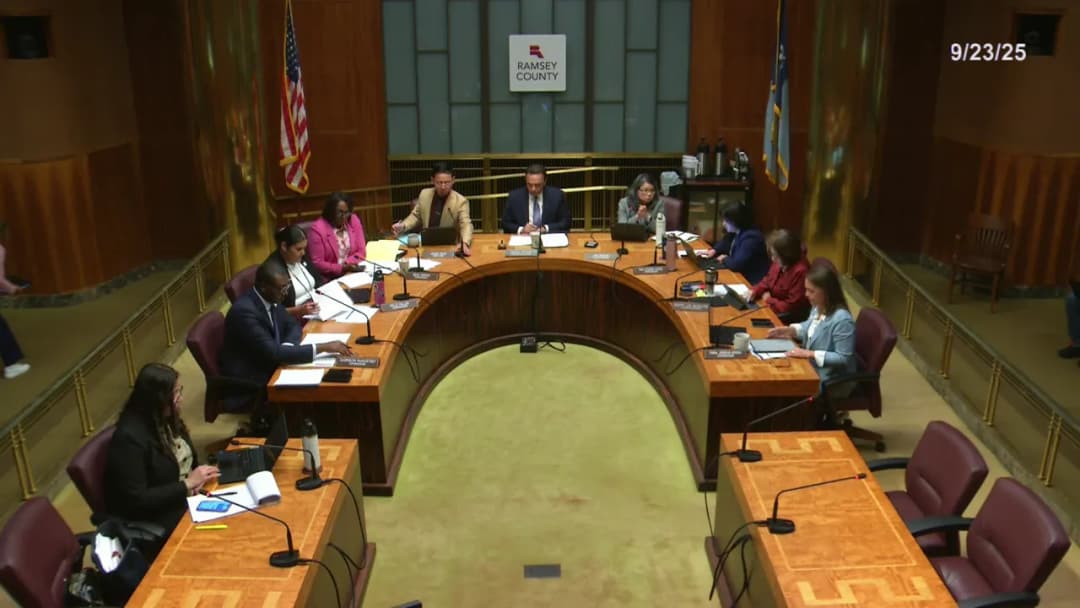
Ramsey County Board of Commissioners Meeting – September 23, 2025

This regular board meeting was called to order at 9:01 a.m. and adjourned at 10:02 a.m. All seven commissioners were present. The meeting included approval of the consent agenda, a presentation on the Guaranteed Energy Savings Project, and certification of the maximum 2026 property tax levy. A closed meeting on public safety followed at 10:50 a.m. Consent Calendar - Agenda and Minutes: Approved the agenda for September 23, 2025, and the minutes from September 16, 2025. (Motion by McGuire/Miller and Moran/Jebens-Singh, respectively; unanimous 7-0) - Capital Improvement Contingent Fund – Metro Square Renovation: Authorized transfer of up to $2.5 million from the CIP Contingent Account to the Metro Square Renovation Project. (Resolution B2025-175; unanimous) - Community Living Infrastructure Grant: Ratified grant application ($1,006,810), accepted award ($400,000) through June 30, 2027, and authorized execution. (Resolution B2025-176; unanimous) - Pierce Butler Route Tree Canopy Improvement Grant: Accepted $171,050 from the Metropolitan Council for tree planting (May 2025 – June 2027) and authorized budget and agreements. (Resolution B2025-177; unanimous) - New Brighton Road State Aid Variance: Approved requesting a variance from MnDOT for a combined lane/shoulder width of 9 feet 11 inches (vs. 12 feet) and vertical clearance of 14 feet 3 inches (vs. 16 feet 4 inches) at the railroad bridge, with indemnification. (Resolution B2025-178; unanimous) - Property Tax Abatements (≥$10,000): Approved abatements for 11 properties listed in the agenda. (Resolution B2025-179; unanimous) - Local Option Disaster Tax Abatements (≥$10,000): Approved abatements for two disaster-affected properties. (Resolution B2025-180; unanimous) Presentation: Guaranteed Energy Savings Project with inBYLT, LLC - Jean Krueger (Property Management Director) and John Felipe (Energy & Technology Manager) presented, joined by Alex Kotze (CFO) for financing details. - Project Scope: Phase 1 of a multi-phase energy savings program covering 21 county buildings (approx. 2.3 million sq. ft.). Measures include LED lighting upgrades, building envelope improvements, solar photovoltaic (1 MW at RCCF), roofing replacements, HVAC modifications, building automation, and water conservation. - Energy Performance: Ramsey County overall energy consumption is down 25% from 2019, with property management buildings down 43.8% since 2008. Phase 1 projects are expected to deliver an 11% reduction in energy use (≈16 million kBtu) and a 15% reduction in carbon emissions vs. prior year. - Financing: Proposed internal loan of $8.45 million from the general fund fund balance (estimated unrestricted fund balance $54 million) at zero interest, repaid over 15–20 years from energy savings. Staff stressed urgency due to federal IRA incentives that must be safe-harbored by end of 2025 and projects completed by mid-2027. - Commissioner Questions: Commissioner McGuire asked about missing federal grants due to the “big beautiful bill” (Inflation Reduction Act phase-out). Staff confirmed urgency drove this proposal; future countywide energy master plan to come in spring 2026. Commissioner Xiong asked about geothermal; staff noted payback was too long (20 years). Commissioner Miller commended the approach for leveraging the county’s financial position. - Next Steps: Staff to finalize contract terms and return to the board in early October for approval of the contract and loan resolution. Policy Item: Certification of the Maximum Tax Levy for Proposed 2026 Property Tax Notices - Proposed Levy: $434,565,563 total ($417,062,635 General County; $17,502,928 Library). The county’s proposed total budget is $929 million. - Discussion: All seven commissioners spoke in favor of approving the maximum levy to preserve options, but expressed deep concern about the impact on residents and the county’s fiscal challenges. Key points: - Commissioner Xiong acknowledged the hard budget, federal/state cost shifts, and the need to balance services with taxpayer burden. He stated the levy is “too high” and urged additional cuts and focus, including review of general operating expenses and professional development. - Commissioner McMurtrey emphasized the levy means “real lives are being impacted” – rent increases, grocery trade-offs – and committed to lowering the final levy by December while investing in competitive employee salaries. - Commissioner Moran highlighted that only tool for revenue is property tax, and that departments presented “have-to” budgets, not wish lists. She noted public safety constitutes 40% of the tax levy increase and called for community input on trade-offs. - Commissioner Miller supported the max levy to keep options open, pledging to work on reductions. - Chair Ortega echoed the commitment to find a solution that maintains services while easing the tax burden. - All commissioners thanked staff and residents who testified at the prior evening’s public hearing. - Vote: Motion by Miller, seconded by McGuire, passed unanimously (7-0). Resolution B2025-181. County Connections, Outside Reports, and Board Chair Update - County Manager Ling Becker provided an update (archived on video). - Commissioners reported on external meetings and community events (e.g., absentee voting update for Nov. 4 general election; over 10,000 ballots mailed; Tulu courts opening; Playwright’s Center grand opening; various district festivals; Met Council activities; Wilder’s East grand opening; etc.). - Chair Ortega noted the full day ahead: Regional Railroad Authority, Housing and Redevelopment Authority, closed meeting on public safety, and afternoon legislative workshop. - No formal board chair update. Closed Meeting (After Adjournment) - The board convened a closed meeting at 10:50 a.m., pursuant to Minn. Stat. § 13D.05 subd. 3(d), to discuss public safety security deficiencies. The closed session adjourned at 12:12 p.m. Key Outcomes - Approved all consent agenda items unanimously (resolutions B2025-175 through B2025-180). - Received informational presentation on the Guaranteed Energy Savings Project; staff to return with a contract and loan resolution in early October. - Approved the maximum 2026 property tax levy of $434,565,563 (resolution B2025-181), with commitment to work toward a lower final levy by December 2025. - No other action items were taken.

BUDGET EQUITY ANALYSIS 20% · TECHNOLOGY AND INNOVATION 17% · PUBLIC ENGAGEMENT 15% · FISCAL SUSTAINABILITY 10%
116
SEP 23, 2025 · RAMSEY COUNTY, MINNESOTA · BOARD OF COMMISSIONERS & AUTHORITIES
Ramsey County Board Workshop on 2026 Legislative Platforms – September 23, 2025

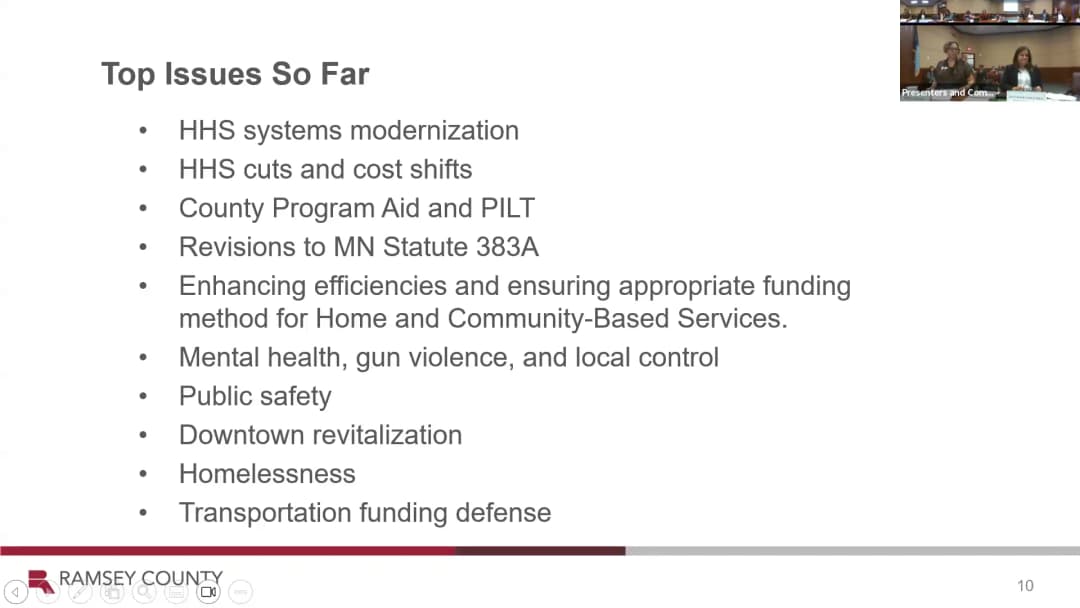
The Ramsey County Board of Commissioners held a workshop on September 23, 2025, at 1:30 p.m. in Courthouse Room 220 to discuss the development of the 2026 state and federal legislative platforms. The workshop was the first of two; no votes were taken. The second workshop is scheduled for October 21, 2025, with final approval expected at the November 18, 2025 board meeting. The meeting was recorded and live-streamed via Zoom. Discussion Items - Process Overview: Director of Government Relations Jennifer Rourke explained that the platform development process started from scratch, using new Legislative Platform Advisory Teams (LPATs) composed of internal staff. Nine LPATs met two to three times each, covering topics such as financial services, community development, health and human services, and public safety. - Commissioner Priorities: Staff summarized themes from one-on-one meetings with commissioners, including the need to address unfunded mandates, protect counties from further cuts, ensure counties are at the table for policy/service delivery changes, and find a financial fix for Ramsey County’s disproportionate burden from the County Program Aid (CPA) formula—possibly using a Payment in Lieu of Taxes (PILT) approach. - Community and Partner Engagement: Chief of Staff Maria Sarabia highlighted ongoing engagement with the City of St. Paul, other Ramsey County cities, the Association of Minnesota Counties (AMC), and various advisory councils. A meeting with city administrators is planned for November 2025. - Legislative Delegation Meeting: On September 11, 2025, about 14 of 25 legislators attended a Zoom meeting where Ramsey County presented its proposed budget. Legislators requested more detailed sessions on specific topics (e.g., property tax, CPA/PILT, transportation, housing). - Key Issues Raised by Commissioners: - Unfunded Mandates: Commissioner Jevins noted the capital security burden on the Sheriff’s Department. - Modernization of State Systems: Commissioners discussed the need for state funding and policy changes to update aging technology (e.g., SNAP, Medicaid systems). A demonstration of system inefficiencies is planned for October 29, 2025, in partnership with AMC. - Property Tax Relief: Automatic property tax relief was mentioned as a policy goal. - Bonding Requests: Commissioner Zhang raised the need to sift through community and departmental bonding requests. - Federal Earmarks: Director Rourke indicated work is underway with federal lobbying consultants to identify potential Community Project Funding (CPF) earmarks for 2027, focusing on areas like opioid/fentanyl response. - Strategy for 2026 Session: Commissioners emphasized the need for a focused, slim platform given the short session (a policy and bonding year) and the 2026 midterm election environment. They discussed using “lead” vs. “support” designations and assigning commissioners as subject-matter leads for key issues. - Mental Health and Gun Violence: Commissioner Jevins requested that mental health be separated from gun violence in the platform, noting that people with mental illness are more often victims than perpetrators. - Top Issues So Far: The draft list includes CPA/PILT, downtown revitalization, public safety, mental health, gun violence, local control, and bonding requests. Key Outcomes - Next Workshop: The second workshop on the legislative platform will be held on October 21, 2025, at which a more refined draft will be presented. - Final Approval: The board will vote on the final platform at its November 18, 2025 meeting. - Legislative Engagement: A series of “hot topic” seminars with legislators is planned, likely on Thursdays, covering four to five topics. Commissioners are encouraged to attend and to share their ideas with the Government Relations team. - AMC Priority Setting: Commissioners will vote on AMC’s priorities at the District 10 meeting on November 3, 2025. The board will discuss strategy at its October 21 workshop. - Internal Refinement: Staff will continue to work with deputy county managers and department directors to finalize the list of top issues and ensure alignment with the budget process.

GOVERNANCE STRUCTURE 32% · COMMUNITY ENGAGEMENT 31% · PUBLIC ENGAGEMENT 14% · TECHNOLOGY AND INNOVATION 8%
117
SEP 22, 2025 · RAMSEY COUNTY, MINNESOTA · BOARD OF COMMISSIONERS & AUTHORITIES
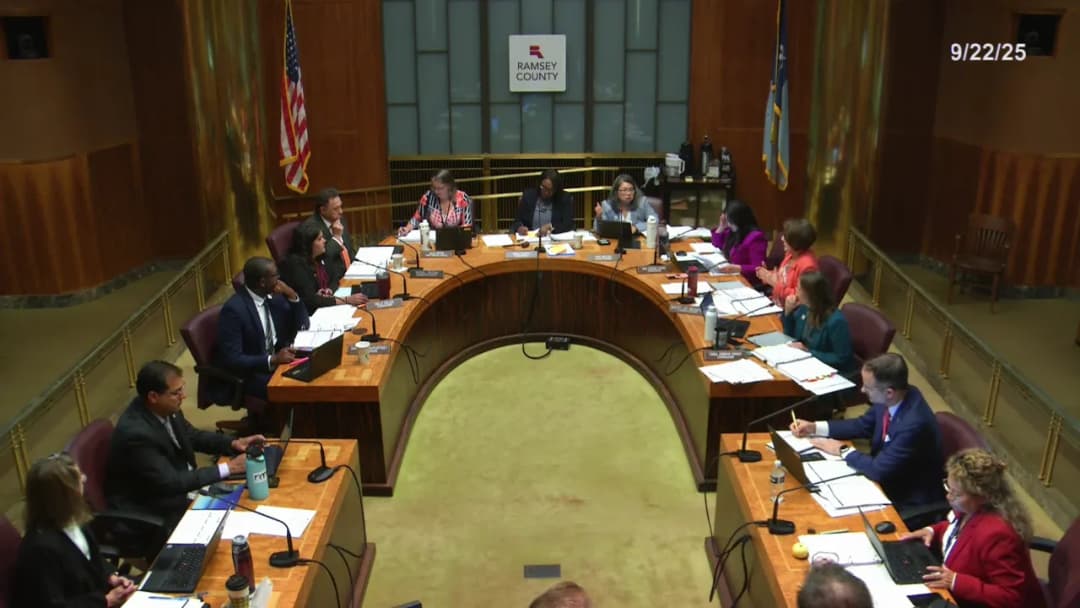
Ramsey County Budget Committee of the Whole – Safety and Justice Service Team Budget Presentation – September 22, 2025

The Ramsey County Budget Committee of the Whole met on September 22, 2025, at 9 a.m. to review the proposed 2026-2027 biennial budget for the Safety and Justice Service Team. The meeting featured presentations from the Office of Safety and Justice, Second Judicial District Court, County Attorney’s Office, Sheriff’s Office, Emergency Communications Center, Medical Examiner’s Office, and Emergency Management. Discussions centered on levy increases, personnel costs, program sustainability, and collaboration with partners. Consent Calendar - No consent calendar items were noted. Public Comments & Testimony - No public comments were taken during the committee meeting; a separate public hearing was scheduled for 5 p.m. on the same day. Discussion Items - Office of Safety and Justice (Deputy County Manager Gloria Reyes): Presented a budget reflecting a proposed levy increase of 9.75% in 2026 and 7.5% in 2027. Major changes included $3 million to stabilize the Appropriate Response Initiative (ARI) with 21 positions (14 FTEs in Social Services, 1.5 FTEs in Public Health, 2.5 FTEs in OSJ, plus intermittent staff and ECC positions), $1.6 million for Justice System Transformation (transfer of three FTEs), and $339,524 for interdepartmental service charges. Discussion covered partnership with the City of St. Paul on ARI, evaluation metrics, and sustainable funding models. Commissioner questions focused on pilot program integration, cost savings, and leveraging alternative revenue sources. - Second Judicial District Court (Presented by Deputy County Manager Reyes): The court’s budget is largely driven by mandated state services, including courtroom rent and court-appointed attorneys. Major changes include transferring a managing attorney position (cost: $227,772) and increased costs from settled contracts. The court noted a decline in CHIPS cases due to social service diversion but an increase in complexity. Commissioners questioned state funding and revenue maximization from Title IV-E. - County Attorney’s Office (John Choi): Presented a revised budget after collaborative adjustments, with no change to the total levy. Key investments included $269,000 for a Collaborative Review Team position (reimagined justice for youth), continued funding for BCA expedited testing ($115,000), and resources for the Minnesota African American Family Preservation Act (MAFPA) implementation. Discussion highlighted salary competitiveness, turnover reduction, and the need for state support for mandated services. Commissioner questions addressed grant alignment, technology modernization, and the impact of levy increases on taxpayers. - Sheriff’s Office (Bob Fletcher): Proposed a status quo budget with two new positions for the non-fatal shooting unit and bail reform. Major changes include no vacancy factor, increased personnel costs from labor contracts, body camera costs ($1 million annually), and $300,000 for community engagement in partnership with the county’s racial health equity administrator. Discussion covered contract cities’ cost structures, Project Bridge (transferring inmates to RCCF), overtime, body camera requirements, and the need for transparent cost allocation. Commissioners requested a breakdown of community engagement spending and a summary of contract city negotiations. - Emergency Communications Center (Dan Palmer): The ECC budget grows from $20.9 million (2025) to $22.7 million (2026) and $23.9 million (2027). Personnel services increase by $1.6 million in 2026, and the budget includes investments in Motorola Assist software ($100,000 in 2027) and AI-enabled non-emergency call handling ($150,000 in 2027). The 60-40 county-city funding model faces challenges due to mid-cycle labor contract adjustments. Future pressures include a $13.1 million upgrade for the ARMOR radio system. Commissioners discussed updating the Joint Powers Agreement and exploring state or federal funding. - Medical Examiner’s Office (Dr. Kelly Mills): The budget adds 1.5 FTEs (one forensic technician and a part-time death investigator) to support a fifth forensic pathologist, with a net cost of $80,393 offset by revenue from contracting with 19 other counties. The office is at risk of exceeding accreditation autopsy limits without additional capacity. Commissioners questioned the contract model for physicians, facility needs, and potential regional partnerships. - Emergency Management and Homeland Security (Judd Freed): The budget emphasizes stabilization, with a 5% increase to $631,978 (2026) and $664,072 (2027). One FTE is shifted from federal grants to the levy to reduce grant dependency, reflecting uncertainty in federal funding (EMPG and Urban Areas Security Initiative). The department is nationally accredited and coordinates continuity planning across all county departments and municipalities. Commissioners highlighted the value of exercises and preparedness, and requested a workshop on emergency management. Key Outcomes - No formal votes or decisions were taken during the committee meeting; the hearing served as a forum for board discussion and questions. - County Manager Becker committed to providing a detailed breakdown of ARI funding streams and contract city cost summaries. - The board set a schedule for further budget actions: a boundary-setting vote on September 23, 2025; a second public hearing on December 11; and final budget approval on December 16, 2025. - The committee acknowledged the need to address long-term fiscal pressures, including the ECC JPA, ARMOR radio system, and reliance on one-time federal grants.

PUBLIC SAFETY 38% · FISCAL SUSTAINABILITY 10% · PROCEDURAL 8% · BUDGET EQUITY ANALYSIS 8%
118
SEP 19, 2025 · RAMSEY COUNTY, MINNESOTA · BOARD OF COMMISSIONERS & AUTHORITIES
Ramsey County Budget Committee of the Whole: Health and Wellness Service Team Budget – September 19, 2025

The Ramsey County Budget Committee of the Whole convened on September 19, 2025, from 9:00 a.m. to approximately 12:00 p.m. (with lunch break) and then from 1:00 p.m. to later afternoon, to review the proposed 2026-2027 budget for the Health and Wellness Service Team. The meeting featured presentations from multiple department directors and the Chief Financial Officer (CFO), followed by extensive discussion and questions from commissioners. Key dates for the budget process were noted: the first public hearing on Monday, September 22, 2025, at 5:00 p.m.; the board will set the maximum 2026 property tax levy on Tuesday, September 23, 2025; a second public hearing on Thursday, December 11, 2025, at 6:00 p.m.; and final approval of the budget and levy on Tuesday, December 16, 2025. Public Comments & Testimony - No oral public comments were made during this meeting. The committee chair reminded the public of two scheduled public hearings (September 22 and December 11) and the opportunity to submit written comments at any time. Discussion Items Office of Health and Wellness (Controller Janelle White) - The Office of Health and Wellness budget (page 442) includes a net increase of 3 FTEs: two positions focused on random moment revenue (federal reimbursement for eligible staff time) and one position for Medicaid support and enrollment. A reduction of 1 FTE (planning specialist) through attrition. The creation of the Division of Fiscal Services centralized all health and wellness fiscal staff (57.8 FTEs) to improve collaboration and consistency. CFO Alice Kutza emphasized that the two random moment trainers are needed to maximize federal revenue; Hennepin County has over 10 trainers while Ramsey County currently has one. The positions are expected to generate more revenue than their cost. Commissioner Jeffris asked about tracking and accountability; County Manager Becker noted a cross-service team will be formed to oversee random moment improvements. Division of Innovation and Strategy (presented by CFO Alice Kutza) - The division provides evaluation, human services technology, and holds administrative costs for Social Services and Financial Assistance Services. Major changes include: moving evaluation team to the County Manager’s office; moving early childhood work and family coach program to Public Health; ending mail processing for Ramsey County Courts and City of St. Paul (saving postage costs); decreasing rent by $2 million due to moving out of the East building to Metro Square; investing in electronic case file management systems (Northwoods Traverse: $550,000 annually starting 2026; Caseworks: $700,000 annually starting 2027). The budget also funds replacement of older FAS systems. Commissioners asked about expected efficiency gains; CFO Kutza noted it is too early to quantify but the move from paper will save staff time. Social Services (Director Sophia Thompson) - Social Services presented a budget focused on county responsible services, investing in staff, reducing wait times. Key investments: 80 FTEs approved in March 2025 for Aging and Disability Services/Minnesota Choices – 47 hired (59%) with 9.9M cost in 2026 generating an estimated $12M in revenue; 32 new FTEs in Children and Family Services to meet safety mandates ($2.5M in 2026, $4.5M in 2027); 5 new FTEs in Mental Health for vulnerable adult protection and crisis response. Major changes: closing the county-operated detox and withdrawal management program on December 31, 2025 (annual savings of over $2M, eliminating 39.5 FTEs); shifting 13 FTEs from child protection grant back to levy. Pressures include rising placement costs (13.72% increase over four years for youth) and a 242% increase in Rule 20 cases since 2020. The budget also reflects partnership with Safety and Justice for the Appropriate Response Initiative (17 FTEs funded through Safety and Justice levy). Veterans Services (Director Ross) - Veterans Services budget (pages 526-539) proposes a transfer of a senior social worker from Social Services to Veterans Services (cost shift of $131,000) and addition of an administrative position for front-end service delivery, funded through a mix of grants and interdepartmental transfers. The department serves approximately 3,500-4,000 veterans out of an estimated 20,000-23,000 in Ramsey County. No federal funds are received for county veteran service officers. The Veterans Treatment Court mentor program and daily outreach at the ADC were highlighted. Performance measures are being revised to better track new veterans accessing benefits. Financial Assistance Services (Director Ali Ali) - FAS budget (pages 463-475) includes a merger of 33 enterprise service navigators into FAS to create a single point of contact for residents. Staffing growth from 379 FTEs (2024) to 465 FTEs (2026/27). Key investments: 22 previously authorized but unfunded positions now funded; 28 staff for basic sliding fee child care (self-funded); barrier assistance funding increased from $550,000 to $950,000 annually. The ‘All Hands on Deck’ initiative reduced backlogs; timeliness has improved. Director Ali noted that SNAP and Medicaid are under federal policy uncertainty (expanded work requirements, shortened certification periods) which could increase workloads. The department serves over 150,000 residents on medical assistance and 90,000 on SNAP. Community Corrections (Director Monica Long) - Community Corrections budget (pages 540-557) focuses on client programming and collaboration. Major initiatives: maintaining client compensation at Ramsey County Correctional Facility (RCCF) at $80,000; free phone calls/video visits increased by $150,000; ending lease at 800 Minnehaha and moving to community-based service model; Project Bridge collaboration with Sheriff’s Office – $2M increase in 2026 and $2.1M in 2027 to house up to 70 pre-sentence clients from the Adult Detention Center (ADC). The department reduced FTEs over time due to lower probation population (from 13,000 to 9,000) though client risk level is higher. The youth detention center (JDC) population is low (10-12 on high days). The department is preparing for the Minnesota Department of Corrections Rehabilitation and Reinvestment Act (expected March 2026) which could add 600 additional clients. Public Health (Director Amy Kairn) - Public Health budget (pages 504-525) is nationally accredited. Major changes: personnel services increase of 27.8 FTEs (many previously approved); reduction in WIC levy ($326,000) and Trusted Messenger program levy ($400,000); reduction in Healing Streets program levy ($300,000) reflecting refined scope. Correctional health services face a levy increase of over $1M due to rising costs. A $100,000 one-time assessment for correctional health is included. Opioid settlement dollars are being strategically planned with a community advisory group. The clinical services building at 555 Cedar is deteriorating; property management is seeking temporary space while a long-term plan is developed. Commissioner Jeffris questioned whether public health could better leverage grants to reduce levy pressure; a deep dive review of public health is planned for 2026. Key Outcomes - Upcoming public hearings: September 22 (5:00 p.m.) and December 11 (6:00 p.m.). - Levy setting: The board will set the maximum 2026 property tax levy on September 23, 2025. - Final budget approval: December 16, 2025. - Budget decisions reflected in the meeting: The Health and Wellness Service Team budget includes difficult trade-offs such as closing the detox center, reducing some programs, and making targeted investments in revenue capture and staffing. - Next meeting: Safety and Justice Service Team presentation on Monday, September 22, 2025, at 9:00 a.m.

HUMAN SERVICES 17% · PUBLIC HEALTH 15% · BUDGET EQUITY ANALYSIS 9% · VETERANS SERVICES 8%
119
SEP 18, 2025 · RAMSEY COUNTY, MINNESOTA · BOARD OF COMMISSIONERS & AUTHORITIES
Ramsey County Budget Committee of the Whole: EGCI Service Team Budget Hearing (Sept. 18, 2025)

On Thursday, September 18, 2025, the Ramsey County Budget Committee of the Whole convened at 9:00 a.m. in the Council Chambers to review the proposed 2026-27 budget for the Economic Growth and Community Investment (EGCI) Service Team. The meeting began with opening remarks from Chair Moran, who noted that the proposed 2026-27 budget calls for a levy increase of 9.75% in 2026 and 7.5% in 2027. The full day featured presentations from department directors, followed by questions and discussion by county commissioners. No public comments were heard. Public Works – Director Brian Isaacson - Isaacson presented the Public Works budget (pages 353-373), highlighting the department’s responsibilities for 293 miles of county roads, 67 bridges, 30,000 signs, and 360 traffic signals. He noted that the capital program has more than doubled in the last two years, but staff increased only about 10%. Major revenue sources include the Transportation Advancement Account (TAA) – a regional sales tax from a 2023 legislative bill – which provided $18 million in 2024 but was initially misallocated as operating and later corrected. Federal funds are described as “at best uncertain and at worst will be rescinded,” with discretionary grant awards delayed (e.g., a Safe Streets for All grant to St. Paul of $15-20 million awarded over a year ago but not yet funded). A $1.7 million increase in Union Depot insurance premiums in 2026 remains flat in 2027. An additional 14.5 FTEs are funded entirely by TAA (not levy). The budget includes $5 million more in professional services for outsourced work to support the growing capital program. Fleet funding remains a challenge; county manager Becker noted exploration of internal cost allocations. Parks and Recreation – Director McCabe - McCabe presented the Parks and Recreation budget (pages 336-352), managing over 7,000 acres, 6 regional parks, 9 county parks, 100 miles of trails, 4 golf courses, 11 ice arenas, and other facilities. The department is 70% fee-based and uses just 1% of the overall county levy. Major changes include converting a part-time cultural liaison position from grant to levy funding ($345,000 grant from the state for a soil and water FTE remains levy-neutral). Fee increases are proposed for golf and arena fees, set at the top third of the market to generate profit for other programs. The Battle Creek Winter Recreation Area received an equity grant through the Met Council that will run out in 2026; children 12 and under remain free. The department is investing $6.6 million in energy reduction across arena systems, projected to reduce energy consumption by 30%. Long-term pressure: state only funds about 10% of regional park maintenance costs, far below the statutory 40% obligation, creating a $2 million gap. Parks reserve funds in the soil and water division are being drawn down and are expected to be fully utilized by the next budget cycle. Property Management – Director Ted Kruger - Kruger presented the Property Management budget (pages 379-390), an internal service department managing 28 owned buildings (4 historic) and 15 leases. The department is 94% funded by internal rental rates, which increase 4% per year (to $13.35/sq ft in 2026, $13.90 in 2027). The proposed budget increases average 4% annually, driven by class and compensation adjustments, insurance increases, and utility costs. Deferred maintenance needs are $18 million per year; the department currently applies $2/sq ft from internal rents for smaller repairs, but major capital projects are funded through the CIP process. The East Building, a lower-cost facility, was sold, which will cause an uptick in rental rates in 2028-29. The department is exploring alternate financing for energy efficiency improvements, to be discussed as a policy item next week. Commissioner Jebasingh raised the need for a strategic facilities plan that aligns programmatic needs with physical maintenance, and county manager Becker emphasized breaking down silos across departments. Workforce Solutions – Director Catrice O’Neill - O’Neill presented the Workforce Solutions budget (pages 392-402), 96% grant-funded with 69.5 FTEs in 2026 and 68 in 2027 (down from 79 in 2024). Grant reductions total about $4.4 million in state and federal allocations for 2026 and an estimated $706,000 decline in 2027, primarily due to the end of ARPA funds and reduced formula grants (WIOA, TANF, MFIP, SNAP). The department is reorganizing to align staffing with grants, saving $1 million in 2026 and $260,000 in 2027. Programs such as Power Within Us (serving justice-involved youth) will be sustained through cross-departmental collaboration, but the Drivers License Academy and some Learn & Earn programs will sunset. The Public Pathways program receives $318,000 in levy funds for internships. County manager Becker clarified that Workforce Solutions’ grants are formula-based allocations, not discretionary grants. Long-term pressure: revenue is decreasing while operating costs increase, straining mandated employment services. Community and Economic Development (CED) – Director Josh Olsen - Olsen presented the CED budget (pages 405-416), funded by general levy, HRA levy, environmental response fund (ERF), CDBG, HOME, state affordable housing aid, and local affordable housing aid (LAHA). The budget adds one FTE to support LAHA administration. CED has deployed $70 million in one-time funding over five years. In 2025, the board approved 27 projects totaling $18 million using LAHA (housing sales tax). Revenue reductions are anticipated in HOME and ERF due to lower transactions. The department plans an update to the Economic Competitiveness and Inclusion Plan (ECI Plan 2.0) starting with a fiscal health analysis. CED is transitioning to a new data tracking system (Neighborly) to improve compliance and evaluation. Commissioner Zhang asked about the rationale for maintaining federal fund levels despite cuts; Olsen noted that 2026 CDBG allocation is confirmed, but 2027 is uncertain. Housing Stability – Director Nali Yang - Yang presented the Housing Stability budget (pages 419-430), a new department focused on the housing continuum. Staffing remains flat. Revenue reductions are anticipated from random moment sampling and grant administration. The department is the lead agency for Ramsey County’s Continuum of Care (Heading Home Ramsey) with over 30 community partners. The termination of the state’s Housing Stability Services program by DHS will reduce wraparound services. Random moment trainers are being added countywide to maximize federal revenue. The department receives FHPAP funds from Minnesota Housing, LAHA dollars, and local homelessness prevention aid. The partnership with the City of St. Paul includes a JPA for Emergency Solutions Grant funds. Commissioner Zhong inquired about countywide encampment response; county manager Becker noted ongoing conversations with cities and the need for clarity on roles. Prevention efforts include using LAHA for housing court diversion. Libraries – Director Payong (presented) - The Libraries budget (pages 324-335) includes a cost reduction of $590,000, reducing hours by 5 FTE. The Shoreview Library will close on Fridays (56 hours to 47 per week), while other branches remain open. The decision was based on the social vulnerability index; Shoreview was deemed least vulnerable. Other libraries are open 45 or 35 hours per week. Partnerships with public health, safety teams, and digital equity programs continue. The rental book collection fee increases from 25¢ to 50¢ per day. The Moundsview Library renovation is being discussed as part of a strategic facilities direction plan. Commissioner McGuire asked about charging for community rooms; Director Payong noted they remain free to ensure equitable access. EGCI Administration – Controller Tom Ock - Ock presented the EGCI Administration budget (pages 315-318), which includes executive management and 25 finance professionals serving the service team. No new FTEs are requested. The chargeback model for accounting services increased revenue to cover salary investments. Long-term pressures include rising costs to attract talent and the need to manage 27 different funding sources. The department will remain under EGCI pending future organizational alignment discussions. Key Outcomes - The board will hold public hearings on Monday, September 22, 2025, at 5 p.m. and Thursday, December 11, 2025, at 6 p.m. to receive public comments on the proposed budget. Written comments are also accepted. - On Tuesday, September 23, 2025, the board will set the maximum 2026 property tax levy. - On Tuesday, December 16, 2025, the board will give final approval of the 2026-27 budget and set the final 2026 levy. - Several clarifications and corrections will be provided by department directors in response to commissioner questions. - Board workshops are planned for 2026 on topics including parks revenue generation, fleet funding, strategic facilities planning, and homelessness encampment response. - The committee will continue budget hearings on September 19, 2025, with the Health and Wellness service team at 9:00 a.m.

PARKS AND RECREATION 14% · WORKFORCE DEVELOPMENT 13% · AFFORDABLE HOUSING 9% · PROCEDURAL 8%
120
SEP 16, 2025 · RAMSEY COUNTY, MINNESOTA · BOARD OF COMMISSIONERS & AUTHORITIES
Budget Committee of the Whole: Information and Public Records Service Team Budget Hearing - September 16, 2025

The Budget Committee of the Whole convened at 1:02 PM on September 16, 2025, to review the proposed 2026–27 biennial budget for the Information and Public Records (IPR) Service Team. Presentations covered the Office of IPR, Enterprise and Administrative Services, Information Services, County Assessor, Property Tax Records and Election Services (Petris), and Communications and Public Relations. No public comments were received. The board heard presentations and asked questions; no votes were taken. The next public hearing is scheduled for September 22, 2025, at 5:00 PM, with the board setting the maximum 2026 property tax levy on September 23, 2025. Discussion Items Office of Information and Public Records - Deputy County Manager Kieran Francois presented the final biennial budget for IPR, which will sunset at year-end. The office’s operating budget decreases by 66%, from over $4.2 million in 2025 to $1.45 million in 2026 and $1.5 million in 2027, reflecting decentralization of internal service costs. - FTEs increase from 7 (2025) to 13 (2026) due to transfers: 6 positions from the capability team (moving from Petris) and 1 administrative position from Enterprise and Administrative Services. Commissioners questioned the accounting methods for decentralization and the alignment of org charts with the proposed reorganization. Enterprise and Administrative Services (EAS) - EAS will sunset at end of 2025. Key changes: $4.6 million in levy moved to Financial Assistance Services for 34 FTEs already transitioned; elimination of 14 FTEs from the Enterprise Project Management Office (EPMO) and administrative services, generating over $1 million in levy savings. One administrative position transfers to the Office of IPR. - Commissioners noted the cost savings and asked about oversight of decentralized project management responsibilities. Francois confirmed that departments will manage their own projects and vendor relationships. Information Services - Chief Information Officer Chaitanya Ganatra presented the IS budget, emphasizing strategic investments in cybersecurity, network reliability, and data management. Major changes: $500,000 from IS fund balance to offset rate increases in 2026; $550,000 reduction in outside consulting services in 2027; $1.3 million pass-through for countywide software maintenance offset by departmental revenue. - New data management team launched. IS is collaborating with Financial Assistance Services to stabilize the case file management system, improving uptime. Partnership with MNIT to share cybersecurity threat intelligence with all Ramsey County municipalities. The Raven AI chatbot (initially English and Spanish) is being evaluated for expansion; languages like Hmong and Karen are not yet supported due to translation limitations. - Commissioners raised questions about working with municipalities on cybersecurity (e.g., regional security operations center) and the impact of consulting cuts. Ganatra stated that the cuts will slow some projects but will be managed through automation and internships. He noted that laptop replacement costs are hitting the county due to the four-year cycle from pandemic purchases. County Assessor’s Office - Director Pat Chapman presented the budget for the County Assessor, responsible for valuing over 167,000 parcels. Major changes are limited to classification/compensation adjustments and internal fee allocations. A new online homestead application will launch soon. - Chapman promoted the state’s Property Tax Refund (PTR) program, noting that $25–30 million goes unclaimed annually. The board discussed efforts to make the refund automatic through legislative change. The county is updating its website and property tax statement mailers to include PTR information. - The office partnered with Mapping Prejudice and the Justice Coalition to discharge racial covenants; in Falcon Heights, outreach to over 1,000 properties led to successful covenant removals. Property Tax Records and Election Services (Petris) - Director Tracy West presented Petris’s budget, highlighting three themes: preparing for increased elections in 2026, adjusting fees to reflect true costs, and strengthening partnerships. Recording revenue has declined (from over $1 million in 2019–20 to about half that) due to high mortgage interest rates. The budget manages this by defunding vacant positions and using fund balance to smooth levy impacts. - Fee increases totaling $181,026 are proposed for services such as research reports and officiate ordination credentials; fees remain lower than comparable counties. No increases for marriage licenses, birth/death certificates (statutory). - Elections budget: $929,000 increase in 2026 offset by $550,000 from general fund balance. Six FTEs transfer to Office of IPR. The department contracts with cities and school districts for election services; costs for special elections are billed to cities unless they are county or state special elections. The SAVE Act is not expected to have financial impact as current practices already align. - The “Productive Properties” team helps about 93% of delinquent homeowners avoid tax forfeiture each year. Communications and Public Relations - Director Rose Lindsay presented highlights: 23 FTEs in 2026 (returning to 24 in 2027). Major change: $146,000 investment to convert a limited-duration position to permanent to expand the community media program “Nojong Ramsey County” (Hmong-language show) and add two more programs (another language and a Gen Z podcast). The program has seen a 166% increase in Hmong navigator requests and a 202% increase in Hmong service center visits at Maplewood. - Internal sponsorship from Environmental Health ($100,000) will support the expansion. The department also refreshed the Guide to Services, conducted a photo shoot with real community members, and is working on digital accessibility compliance for the new ADA law (effective April 2026). - Commissioners encouraged use of hyper-local print publications and coordination with municipal communications partners. Lindsay noted the department recently hosted a local Roseville publication for the environmental center opening. Key Outcomes - The board received the IPR service team budget presentations as information. No votes or formal decisions were made. - The 2026–27 budget process timeline was confirmed: - First public hearing: Monday, September 22, 2025, at 5:00 PM. - Board sets maximum 2026 property tax levy: Tuesday, September 23, 2025. - Second public hearing: Thursday, December 11, 2025, at 6:00 PM. - Final budget approval and levy set: Tuesday, December 16, 2025. - The next budget hearings will be Thursday, September 18 (Economic Growth and Community Investment) and Friday, September 19 (Health and Human Services). - Written public comments are accepted at any time via the county website and are shared with commissioners.

TECHNOLOGY AND INNOVATION 22% · COMMUNITY ENGAGEMENT 12% · PUBLIC ENGAGEMENT 10% · PROPERTY TAX ADMINISTRATION 10%
OPENPUBLICA · PUBLIC MEETING INDEXUPDATED DAILY · openpublica.com