The Sacramento Budget and Audit Committee met on Tuesday, August 11, 2026, at 11:05 a.m. in City Hall. The meeting included a consent calendar, a detailed audit of the Department of Utilities' power purchase agreements, and an update on councilmember proposals. All items were approved unanimously. Consent Calendar - Item 1: Approved the Budget and Audit Committee meeting minutes from June 16, 2026. - Item 2: Accepted the City Auditor's Activity Report for the 4th Quarter of FY2025/26 and forwarded it to the City Council. - Item 3: Accepted the Whistleblower Hotline Activity Report for January–June 2026 and forwarded it to the City Council. - Vote: Motion by Member Maple, seconded by Vice Mayor Talamantes; passed unanimously (Members Maple, Talamantes, Dickinson; Member Guerra absent). Public Comments & Testimony - Lambert Davis spoke on the consent calendar, thanking the City Auditor for outstanding work. He noted that the whistleblower hotline and audit found a no-written-agreement issue related to Davis/Sabonis events and urged continued funding for the hotline. He also mentioned millennials tracking spending in North Sacramento. He left a document for the record. - Later in the meeting, Mr. Davis commented on Item 5, criticizing Councilmember Pluckybom’s attendance record and urging attention to his remarks. He also praised the Inside Magazine article featuring the new city manager and Pete Coletto, and referenced a previous article about his family’s cheesecake business. - No other public comments were made on discussion items. Discussion Items Item 4: Audit of the Department of Utilities Energy Use: Power Purchase Agreements - Presenter: Charles Meadows, Performance Audit Manager, Office of the City Auditor. - The audit reviewed power purchase agreements (PPAs) at the Sacramento River Water Treatment Plant and the E.A. Fairbairn Water Treatment Plant. Key findings: - Combined net PPA savings over the past five years: $63,000. - The PPAs cover only 3–10% of each site’s total energy demand. - The Sacramento River plant had a three-year period of non-production due to poor maintenance clauses; the city lacked remedies for non-performance. - Benchmarking against five other municipalities showed they had stronger maintenance and audit provisions. - Buyout or new panel costs estimated at $1.6–$1.9 million (Sacramento River) and $4.6–$5.3 million (Fairbairn) for standard panels; upgraded panels could increase capacity by 22% but cost more. - The city participates in SMUD’s Solar Shares program, which avoided 32,213 metric tons of CO2 equivalent (equivalent to 3.6 million gallons of gasoline or 82 million miles driven), but resulted in additional energy costs of $622,000–$623,000 over the past seven years. - Discussion: Chair Dickinson asked about renegotiating PPAs before 2032/33 expiration. Director of Utilities Dalif Huddle confirmed the department will use the audit to improve contracts, develop an energy management plan, and start early conversations with SMUD. Vice Mayor Talamantes asked about benchmarking LA’s contracts and next steps. Member Guerra supported approving the audit and suggested exploring battery storage technology (e.g., Peak Energy) to overlay with existing solar. The committee discussed the need for a cost-benefit analysis and a phased approach. - Vote: Motion by Member Guerra, seconded by Vice Mayor Talamantes; passed unanimously (4–0). The audit will be forwarded to the City Council. Item 5: Update on Councilmember Proposals Heard by the Budget and Audit Committee - Presenter: Amy Williams, Chief of Staff to the City Manager. - Three proposals were reviewed: - Tourism Infrastructure BID (District 1): A proposal to create a business improvement district funded by hotel assessments to boost tourism and infrastructure. Staff (Finance Director Pete Coletto) reported that outreach to hoteliers is ongoing; if 50% interest is gained, a resolution of intention will be brought to council. - Illegal Dumping Program (Citywide): A proposal to launch a data-driven, citywide program to combat illegal dumping. A draft report is expected in early August; staff plan to return to council in fall. - District 2 Enhanced Infrastructure Financing District (EIFD): Consultant EPS has finalized study boundaries and begun the fiscal impact analysis. The update is on track for a three-month timeline. - Committee comments: Members expressed appreciation for the quarterly updates, noting they help keep proposals from being lost. Vice Mayor Talamantes and Member Maple praised the process. Chair Dickinson asked for more frequent check-ins on the EIFD item. - Public comment: Lambert Davis again criticized Councilmember Pluckybom’s attendance and urged the committee to pay attention to his remarks. - Action: The report was received and filed as informational. Key Outcomes - Consent Calendar: Approved unanimously. - Audit of Utilities PPAs: Approved unanimously; forwarded to City Council. Staff directed to develop an energy management plan, explore contract renegotiation, and consider battery storage integration. - Council Proposal Updates: Received and filed; staff will continue progress on all three proposals and report back. - Committee Comments: Chair Dickinson noted a future discussion on state property tax payments, as many state entities in Sacramento do not pay taxes but receive municipal services. The committee agreed to discuss with the city manager. - Adjournment: The meeting adjourned at 11:50 a.m.
Public Meetings - Sacramento, California
Public Meetings - Sacramento, CaliforniaThe regularly scheduled joint meeting of the Sacramento City Council, the Sacramento City Financing Authority, the Sacramento Housing Authority, the Sacramento Public Financing Authority, and the Sacramento Redevelopment Agency Successor Agency was cancelled due to lack of business. No agenda items were considered, and no public testimony or votes occurred.
The Sacramento City Council met in regular session on Tuesday, August 11, 2026, at 2:07 PM in the City Hall Council Chamber. Vice Mayor Karina Talamantes called the meeting to order and led the land acknowledgment and pledge of allegiance. All councilmembers were present except Phil Pluckebaum (absent) and Eric Guerra (arrived at 2:14 PM). The meeting adjourned at 2:22 PM after completing consent calendar items, two public hearings, and public comments. The council also adjourned in memory of two community members. Consent Calendar - The council approved all seven Consent Calendar items by a single motion (7-0, with two absent). Items included: 1. Sacramento-Yolo Mosquito & Vector Control District Annual Report – received and filed. 2. June 2026 Monthly Investment Transactions Report – received and filed. 3. Supplemental Contract for Hazardous Waste Management Services (NRC Environmental Services Inc., +$500,000) – Motion No. 2026-0213. 4. Franklin Boulevard Complete Street Change Order No. 10 (George Reed, Inc., $475,081, total $17,252,810) – Motion No. 2026-0214. 5. Granite Park Soccer Fencing and Concrete Improvements contract (Parker Landscape Development, Inc., $451,828) with authorization to remove nine trees – Motion No. 2026-0215. 6. On-Call Underwater Diving and ROV Services contracts (Tidal Marine Construction, Inc. and Underwater Resources, Inc., $900,000 each) – Motion No. 2026-0216. 7. Contract Amendment for Water and Wastewater Rate Study (Raftelis Financial Consultants, +$60,625, total $273,785) – Motion No. 2026-0217. Public Hearings Two public hearings were conducted and closed after staff presentations and a brief comment attempt. - Item 8: Housing and Dangerous Buildings Case Fees – Staff reported an amended total of 165 properties with $164,719.09 in unpaid fees. Three properties (lines 72, 87, 88) were removed from the list. The council adopted Resolution No. 2026-0223 as amended (7-0, two absent). - Item 9: Code Compliance Case Fees and Penalties – Staff reported an amended total of 374 properties with $880,057.80 in unpaid fees and penalties. Thirteen properties (lines 19, 20, 88, 90, 153, 154, 163–166, 176, 251, 364, 365, 474, 536, 572, 573, 612, 690) were removed. The council adopted Resolution No. 2026-0224 as amended (7-0, two absent). Public Comments & Testimony - James Tan approached to speak on Item 8 but was redirected as his issue (a property leak and code enforcement notice at 81 La Fresa Court) was not on the agenda. The city staff offered to assist him after the meeting. - Lambert Davis commented during the public comment period on matters not on the agenda. He remarked on meeting procedures, praised the city manager and council for budget work, and noted Councilmember Maple’s attendance while pregnant. Key Outcomes - All Consent Calendar items were approved unanimously (7-0). - Both public hearing resolutions were adopted as amended, authorizing the city to collect unpaid code enforcement expenses via special assessment levies or personal obligations. - No council member comments or AB1234 reports were presented. - The City Manager gave no report. - The meeting was adjourned in memory of Greg Rusoven (longtime Colonial Heights resident, neighborhood leader) and Joaquin Razo (Oak Park resident, political campaign worker), at the request of Councilmembers Guerra and Kaplan respectively.
The meeting of the Community Police Review Commission scheduled for Monday, August 10, 2026 at 5:30 PM was cancelled due to lack of business. No agenda items were discussed, no public comments were received, and no votes were taken. The cancellation notice was posted in advance.
The Arts, Culture, and Creative Economy Commission met on Monday, August 10, 2026, at 1:00 PM (called to order at 1:03 PM, adjourned at 2:37 PM) in the Sacramento City Hall Council Chamber. Commissioners present: Lavulo (Chair), Ohaegbu (Vice Chair), Eisenberg, Orozco, Smith (arrived 1:07 PM), Wallace (until 2:23 PM), Winlock. Absent: Carter, Hershey. The meeting included a consent calendar, four discussion items, a director’s report, commissioner comments, and public comments. Consent Calendar - Item 1 – Approval of Minutes (June 8, 2026): Passed unanimously (File ID 2026-00112). - Item 2 – Follow-Up Log Adoption: Passed unanimously (File ID 2026-00206). Both items were approved via a single motion (Winlock/Eisenberg) with 6 yes votes (Carter, Hershey, Smith absent). Discussion Items 3. City of Sacramento ARPA Creative Venues Grant (File ID 2026-01468) - Presentation: Melissa Sarroun, Grants and Programs Manager, reported on the federal ARPA-funded grant program for for-profit creative venues (music/performance venues, bookstores, art galleries). Total allocated: $560,000. 22 organizations received funding: 10 venues at $25,000 each, 8 at $10,000, and 4 at $20,000 (with an additional $7,500 supplement to 20 of the 22 grantees). Funds supported rent, insurance, marketing, ticketing, and artist payments. Priority areas were downtown/Midtown, Del Paso Boulevard, and Stockton Boulevard corridors. Testimonials: Cafe Colonial hosted 46 live events selling 2,309 tickets; another venue hosted 14 events with 3,000+ attendees and employed over 30 local artists. - Commissioner Comments: Winlock praised the program as aligned with Creative Edge Plan Goal 4. Orozco admired the detail but questioned why only 20 of 22 grantees received second-round supplements (Sarroun clarified two dropped out: one moved out of Sacramento, one chose not to apply). Wallace commended the shift away from the nonprofit model. Ohaegbu expressed concern that some eligible venues outside priority areas may have been missed despite outreach. Sarroun acknowledged outreach limitations and committed to learning for future rounds. - Action: Receive and comment (no vote required). 4. Accession into Permanent APP Collection – De Colores Southside Park Mural (File ID 2026-01424) - Presentation: Donald Gensler explained that the 1977 mural by the Royal Chicano Air Force (RCAF) at Southside Park, though city-commissioned, was never formally accessioned into the Art in Public Places (APP) permanent collection. The proposal includes restoration, a mentoring program for 10 student volunteers (ages 18+), three online and in-person workshops, and a rededication event in March 2027 (aligned with the mural’s 50th anniversary). Stan Padilla (RCAF original member) spoke about the mural’s history as a Chicano cultural landmark and the importance of teaching muralism professionalism. - Commissioner Questions: Lavulo asked about the importance of accession (Gensler: it ensures maintenance, plaque, and inclusion in the city collection). Orozco asked about volunteer requirements (Gensler: 18+, portfolio of up to 10 images, statement of interest, competitive selection; Padilla emphasized rigorous mentorship). Eisenberg clarified that “student” refers to a learning volunteer, not necessarily an enrolled student. Winlock asked about restoration fidelity (Padilla: glazing process to restore original appearance, no reinterpretation). - Public Comment: None. - Action: Motion passed unanimously (Orozco/Eisenberg; 7 yes votes, Carter and Hershey absent). 5. 2026 Race Equity Ad Hoc Committee – Session 1 of 6 (File ID 2026-01473) - Facilitator: Dr. Steven Winlock outlined the committee’s purpose: to reassess the Commission’s Race and Cultural Equity Statement, review progress against the Creative Edge Plan’s six goals, and present data – not as a complaint session but to celebrate achievements and identify gaps. Suggested meeting times: Tuesdays or Thursdays, 3:00-4:00 PM via Zoom, starting September 2026. - Commissioner Discussion: Wallace urged adding economic justice and anti-displacement to future equity conversations, envisioning a revised statement. Smith expressed excitement to learn from other cities and track implementation. Orozco questioned whether advisory-only recommendations create real change – Winlock emphasized the committee’s educational role and noted examples like the $1 million joint grant with school districts and the “Any Given Child” program. Wallace hoped the work would lead to a transformed statement for the next decade. - Public Comment: None. - Action: Receive and comment. Director’s Report - Jason Jong, Cultural and Creative Economy Manager, announced: - A new public comment portal at publiccomment.cityofsacramento.gov. - The sublease of 9,000 sq ft at 808 I Street (former Capital Athletic Club) for creative community activation – two rentable spaces: large hall (up to 100 people) and community room (1,300 sq ft, suitable for dance/theater). Letters of interest due August 31, 2026. - A call for professional development service providers for Sacramento-based arts nonprofits, proposals due end of August via SAC CityArts.submittable.com. - Current exhibition “Liquid Memories” at the Robert T. Matsui Gallery (districts 6 & 7), featuring emerging curator fellow Lorena Rodriguez, through September. - Two open seats on the Commission (Districts 6 & 7). Commissioner Comments – Ideas and Questions - Winlock announced she is now a certified Crocker Art Museum docent leading school tours, and praised newly appointed County Superintendent Dr. White for her arts advocacy. - Smith reported on a trip to Kigali, Rwanda, where he connected with local artists and poets, noting ancient art (50,000-year-old artifacts, 85,000-year-old spoken word) and plans to share learnings with the ad hoc committee. Public Comments – Matters Not on the Agenda - Wes Sams, lead organizer of the City of Trees Parade, expressed concerns about increasing city fees for events: permit fee rose from $1,000 to $1,776; SAC Fire doubled fees to $600; SAC PD increased services from $9,000 to $14,000 plus added travel time. He argued these arbitrary increases force events to move to other municipalities like Rancho Cordova and Elk Grove. He urged the Commission to advocate for fee rollbacks and increased funding for festivals. Key Outcomes - Consent Calendar – Approved (File IDs 2026-00112, 2026-00206). - ARPA Creative Venues Grant – Received and commented; staff noted $560,000 distributed to 22 for-profit venues. - De Colores Mural Accession – Motion passed unanimously to recommend CCS approval; restoration and mentorship program to begin in winter 2026-2027 with rededication in March 2027. - Race Equity Ad Hoc Committee – First session held; committee to meet 5-6 times starting September 2026 via Zoom (Tuesdays or Thursdays, 3-4 PM); next session to focus on data and examples of progress. - Director’s Report – Noted; public comment for events fees will be conveyed to relevant departments.
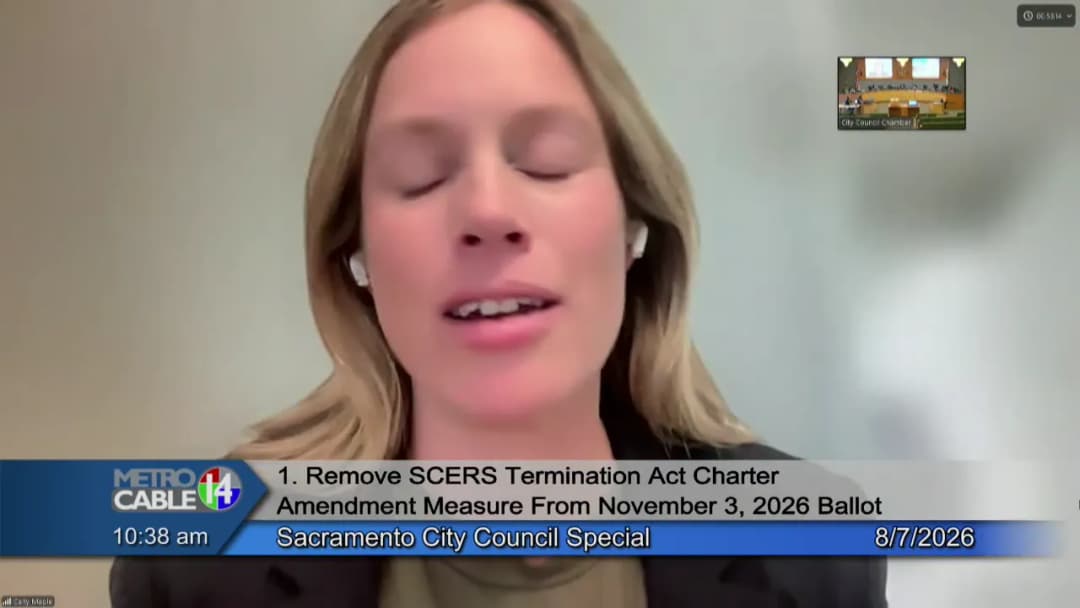
The Sacramento City Council held a special meeting on August 7, 2026, at 10:32 AM to consider a single agenda item: removing the Sacramento City Employees’ Retirement System (SCERS) Termination Act charter amendment measure from the November 3, 2026 ballot. The meeting was a joint session with the Sacramento City Financing Authority, Housing Authority, Public Financing Authority, and Redevelopment Agency Successor Agency. Councilmember Phil Pluckebaum was absent; Councilmember Caity Maple participated remotely due to illness. Discussion Items - Removal of SCERS Termination Act from Ballet (File ID: 2026-01518): The council discussed and voted on a resolution to rescind previous resolutions (2026-0201, 2026-0202, 2026-0214, and 2026-0215) that had placed the measure on the ballot. Mayor Kevin McCarty stated that while the concept of a revolving loan fund for affordable housing—proposed by the City Treasurer—remains a good idea, the measure is not yet ripe due to unresolved legal and policy issues, as well as the fact that one SCERS employee remains active. Mayor Pro Tem Eric Guerra emphasized the need for inclusive stakeholder input and noted existing successes of a city-funded revolving loan program, such as mixed-income housing on Stockton Boulevard. Councilmember Caity Maple expressed support for the removal, thanking labor partners for collaboration and affirming the goal of doing the work right rather than rushing. Key Outcomes - Motion and Vote: A motion to adopt the resolution removing the SCERS Termination Act charter amendment from the November 3, 2026 ballot was made by Mayor Pro Tem Eric Guerra, seconded by Councilmember Caity Maple. The vote passed unanimously (7-0) with Councilmember Phil Pluckebaum absent. Councilmembers Kaplan, Dickinson, Vice Mayor Talamantes, Maple, Guerra, Jennings, Vang, and Mayor McCarty all voted aye. The measure will not appear on the November 2026 ballot, but council members indicated the issue will be revisited in the future.
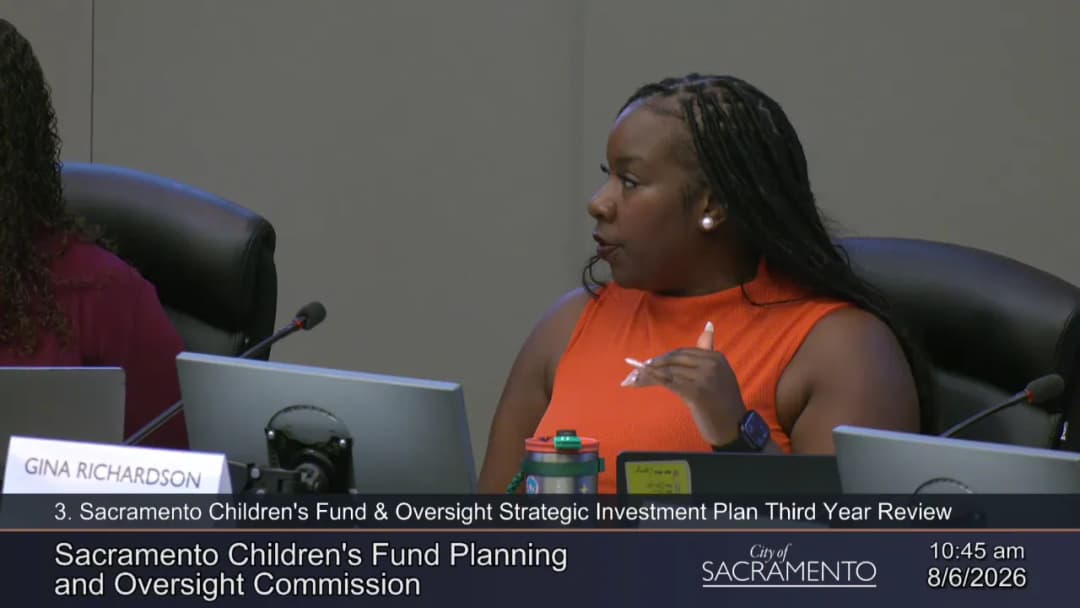
The Sacramento Children’s Fund Planning and Oversight Commission met on Thursday, August 6, 2026, at 10:08 AM in the Sacramento City Hall Council Chamber. Chair Eugenia Richardson presided. The meeting included approval of the consent calendar, a review of the Strategic Investment Plan's third year, and discussion of target populations for the next Request for Proposals (RFP). Commissioners heard public testimony and provided direction on refining RFP criteria. The meeting adjourned at 12:00 PM. Consent Calendar - Approval of Meeting Minutes (File ID 2026-00026): Passed unanimously to approve the June 4, 2026 regular meeting minutes. - Approval of Follow-Up Log (File ID 2026-00276): Passed unanimously to approve the Sacramento Children's Fund Planning and Oversight Commission Follow-Up Log. - Motion: Moved by Vice Chair Ghafari, seconded by Commissioner Kravitz-Wirtz. All present commissioners voted aye, with Commissioners Ruelas Mares and Thomas absent. Public Comments & Testimony - Mercedes Parker (California Youth Connection) spoke on the first discussion item (Strategic Investment Plan Review). She cautioned that evaluating community-based organizations on short-term outcomes (30–90 days) is insufficient and emphasized that prevention is a long-term goal. - Later, during Public Comments on matters not on the agenda, Ms. Parker returned to highlight transportation access for youth as a critical barrier to long-term success (e.g., employment, housing) and suggested the city consider this in future RFPs. Discussion Items - Sacramento Children’s Fund Strategic Investment Plan Third Year Review (File ID 2026-01434): Commissioners discussed outcomes and alignment with the five fund goals. Key points included: - Commissioner Kravitz-Wirtz shared results from a youth survey showing mental/emotional health as the top priority, followed by violence, homelessness, supporting children and youth, and substance abuse. - Commissioners debated prevention levels (primary, secondary, tertiary) and how to better target the most vulnerable youth. Vice Chair Ghafari advocated for giving preference to secondary/tertiary programs, while Commissioner Kravitz-Wirtz cautioned against over-favoring any level due to the existing Strategic Investment Plan (SIP). - Commissioner Williams noted that 98% of applicants in the first round received preference points (the minutes state “over 90%”), raising questions about the effectiveness of the current preference system. (Discrepancy: transcript says 98%; minutes say over 90%.) - Chair Richardson emphasized the need to address all five fund goals, not just mental health, and called for greater focus on violence, homelessness, and substance abuse. - Staff confirmed that current grantees are eligible to reapply for the second funding round, per the SIP. - Sacramento Children’s Fund Target Populations (File ID 2026-01438): Commissioner Kravitz-Wirtz presented four recommendations from the ad hoc committee: 1. Separate priority populations into its own scoring category (20 points) distinct from program design (30 points). 2. Group priority populations into three categories: historically underserved (e.g., race, LGBTQ+, immigration status), youth impacted by poverty/trauma/violence, and youth with co-occurring needs. 3. Require applicants to serve populations from at least two of the three categories. 4. Draft new scoring language explicitly asking applicants to describe how they serve priority populations with multiple adversities. - Commissioners generally supported the recommendations. Chair Richardson and Vice Chair Ghafari suggested adding a preference point for organizations demonstrating secondary/tertiary prevention or impact metrics. Staff noted that any new preference points must align with the SIP and may require careful design to avoid disadvantaging smaller CBOs. - Commissioner Williams proposed simplifying the RFP overall, echoing applicant feedback from the first round about excessive length and complexity. - The commission agreed to move forward with the four recommendations and continue refining preference point ideas at the next meeting. Key Outcomes - Direction on RFP Revisions: The commission endorsed the four recommendations on priority populations and directed staff to incorporate them into the upcoming RFP. - Preference Points: No final decision was made. Staff will research permissible options for preference points (e.g., based on prevention level, impact metrics) and provide an analysis by the next meeting. - Next Steps: Staff will provide additional details on the Seed COI tool and its relationship to priority populations. An evaluation partner is expected to present to the commission later in the fall (likely October or November). - Future Presentations: The city’s child care coordinator, the guaranteed basic income program (contract began July 1, 2026), and the evaluation partner are scheduled to present at upcoming meetings. - Next Regular Meeting: October 1, 2026. Commissioners were encouraged to submit further RFP-related feedback to staff by email. - Commissioner Comments: Commissioner Williams highlighted the Summer at City Hall program and youth concerns about transparency regarding Measure L-funded programs. Commissioner Kravitz-Wirtz suggested lengthening the application window beyond the previous one-month holiday period. Commissioner Green expressed support for site visits and success rate data in scoring.
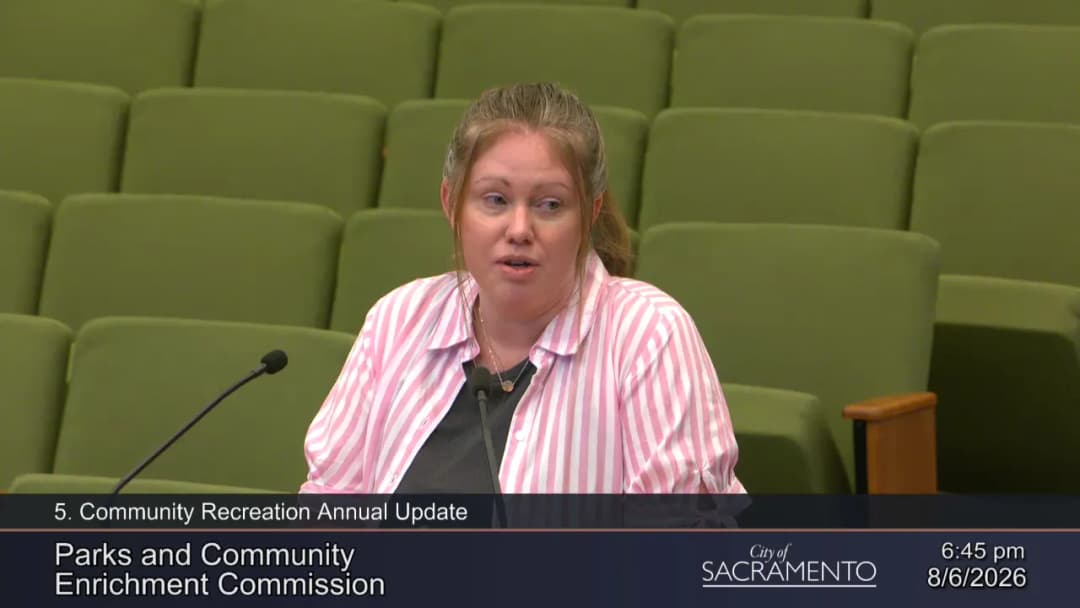
The Parks and Community Enrichment Commission held a regular meeting on Thursday, August 6, 2026, at 5:30 PM at City Hall, 915 I Street, Sacramento. Vice Chair Robbie Robbins presided in the absence of Chair Jeanine Gaines. The meeting opened with a land acknowledgement, Pledge of Allegiance, and a welcome to new Commissioner Kelsey Brewer. The meeting adjourned at 7:09 PM. Consent Calendar - Approved the Parks and Community Enrichment Commission meeting minutes of June 4, 2026 (File ID 2026-00129). - Approved the Parks and Community Enrichment Follow Up Log (File ID 2026-00267). The motion passed 8-0 (Commissioners Brewer, Flores, King, Lang, Langer, Robbins, Uribe, Vasquez voting yes; Commissioners Flournoy, Gaines, and Laver absent). Public Comments & Testimony - Lurie Stetson (Upper Land Park Neighbors Association) spoke on the proposed zoo expansion. She expressed concerns about the visual impact of fencing on the zoo entrance, the proximity of the fence to the Swanston statue gazebo, and the need for a thorough study of zoo attendance impacts on park usage, including parking and traffic. She appreciated the removal of the statue from the expansion area but requested the fence line be pushed back. She also supported the expansion onto Land Park Drive and urged a comprehensive CEQA process. Discussion Items - Update Regarding Proposed Sacramento Zoo Expansion (Item 3): Staff provided a detailed update on the proposed expansion of the Sacramento Zoo within William Land Park. The zoo, approaching its 100th anniversary in 2027, currently serves nearly 500,000 visitors annually with approximately 10,000 member households. The proposed expansion would add 5.6 acres (from 14.3 to 19.9 acres, a 40% increase), the largest since the 1960s. The revised plan excludes the Swanston statue and garden and instead incorporates 0.42 acres east of the main entrance. The expansion is needed to maintain AZA accreditation, improve animal habitats, and enhance visitor amenities. Community engagement included three working group meetings, two input sessions, a webinar, and informational tables, generating over 1,000 responses. Common concerns include tree removal, traffic, parking, pedestrian flow, and historical features. The zoo does not expect a sustained increase in attendance but hopes to generate additional revenue through enhanced experiences. Commissioners questioned staff about attendance projections, tree removal, fencing, historical preservation, and the accelerated MOU timeline. Zoo representatives (CEO Dan Simon and board president Elizabeth Stallard) clarified that the education center across the street would relocate existing programs, not add new attendance, and that the fence line near the Swanston statue is a rough concept to be refined through CEQA. The next step is a proposed amendment to the operating agreement to be brought to City Council in September. The item was received and filed. (No vote required) - Community Recreation Annual Update (Item 5): Staff provided an overview of community recreation programs, including youth and adult sports, the Sacramento Softball Complex, and the 28th & B Skate Park. The skate park is undergoing a renovation process; a survey is open through August 31, 2026, to gather input on design and amenities. The city plans to replace aging wood ramps (built for a one-time event 20 years ago) with concrete ramps, with a first phase funded by approximately $750,000 from Measure L. Commissioner Vasquez expressed concerns about the survey's transparency and community engagement, noting that the process has been opaque. She requested that the survey be paused or improved to include clearer explanations of the demolition of wood ramps, the timeline, and how results will be used. Staff indicated they would look into the suggestions and noted that a community workshop will follow the survey. The item was received and filed. (No vote required) - 916 Day Updates (Item 6): Staff reported on upcoming volunteer events: District 2 (completed), District 4 (August 8 at Grant Park), District 5 (September 12 at Chorley Park Disc Golf), District 8 (TBD at Bally High). A tree planting in Tahoe Park on March 7, 2026, involved 141 volunteers contributing 352.5 volunteer hours. Commissioners suggested additional volunteer opportunities, including a native plant garden and replanting at Bill Bean Memorial Park. The item was received and discussed. (No vote required) Key Outcomes - Consent Calendar approved unanimously (8-0). - Zoo Expansion Update received and filed; staff will bring a proposed amendment to the operating agreement to City Council in September. - Community Recreation Update received and filed; staff will review survey concerns and consider adding more transparency and community engagement. - 916 Day Updates received and discussed; staff will follow up on commissioner suggestions for future volunteer events. - Item 4 (Park Maintenance Annual Update) was withdrawn from the agenda. - Commissioner Comments included a request for improved signage in parks, a reminder to use 311 for reporting issues, a suggestion to reassess the meeting schedule due to budget constraints (limited to six meetings per fiscal year), and a proposal for a watering brigade for newly planted trees. Staff will provide an update on the meeting schedule.
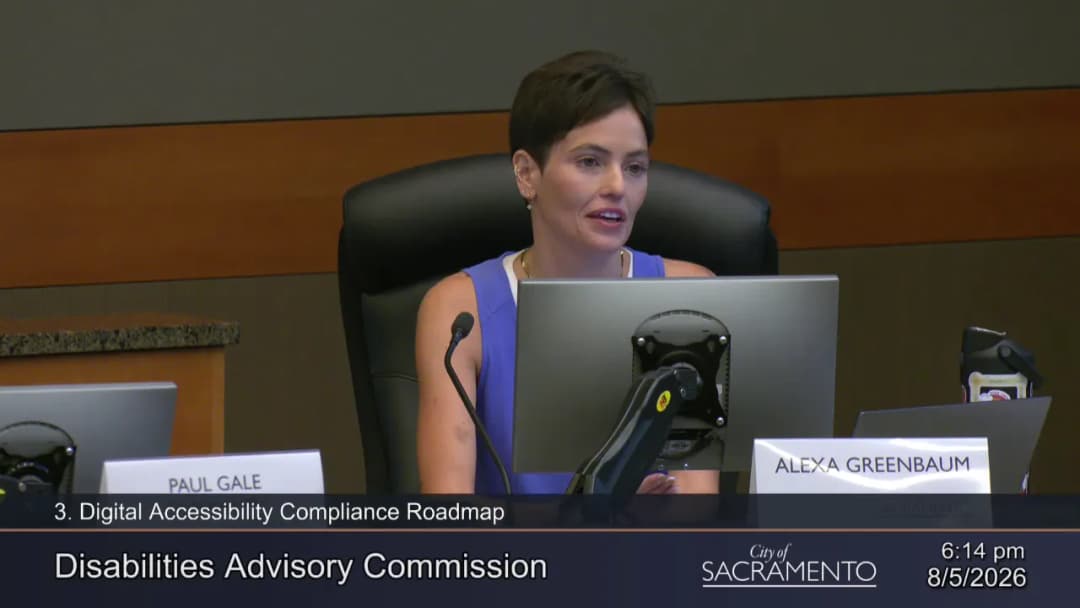
The Sacramento Disabilities Advisory Commission (DAC) held its regular meeting on Wednesday, August 5, 2026, at Sacramento City Hall (915 I Street), called to order by Chair Sylvia Kramer at 5:35 p.m. and adjourned at 8:08 p.m. Six of twelve commissioners were present (Michael Barnbaum, Alexa Greenbaum, Leslie Napper, Ashlee Patel, Karenna Pullen, and Chair Kramer); six were absent (Jacqueline Dyson, Keith Ellis, Elsie Guerrero, Maryclaire Igwegbe, Satty Kaur, and Joseph Wilson). The meeting included three discussion items: the Digital Accessibility Compliance Roadmap, the T Street Bikeway Gap Closure Project, and the Language Access Program, plus a consent calendar and an oral staff report. The commission voted unanimously to extend the meeting past the two-hour mark to complete its agenda. Consent Calendar - Approved the June 3, 2026 meeting minutes (File ID: 2026-00081) by unanimous motion (Pullen/Barnbaum), 6-0. - Approved the Disabilities Advisory Commission Follow-Up Log (File ID: 2026-00216) by the same unanimous consent motion, 6-0. Discussion Items 3. Digital Accessibility Compliance Roadmap (File ID: 2026-01429) - Presenter: Natasha Greer, IT Program Specialist, explained that the Department of Justice extended the Title II ADA compliance deadline from April 26, 2026, to April 26, 2027, giving the city an extra year. She described ongoing website audits, vendor compliance letters sent in 2025, and a suite of accessibility training courses available to staff; the flagship course, "Accessibility Fundamentals," is required for staff with web-related duties. She noted the city is procuring software to check documents for accessibility before PDF conversion, with human review remaining central. - Commissioner Ashlee Patel asked about the software's purpose and whether AI would remove human learning; Greer confirmed the software is primarily for pre-conversion PDF checks and does not eliminate human involvement. - Commissioner Karenna Pullen raised concerns that the city's ADA self-evaluation plan on the website is a rasterized 1991 PDF and inaccessible, and questioned vendor compliance (citing Granicus as an example where IT said it could ask but not require). Greer acknowledged she lacked details on vendor enforcement procedures and suggested questions go to IT Director Darren Arcolino. - Commissioner Leslie Napper asked about training accessibility for staff with disabilities and whether course content uses plain language; Greer said she would take the question back and noted the training interface is minimalist (white screen, black text) but could not confirm accommodations. - Commissioner Alexa Greenbaum (an ADA attorney) asked whether an ADA attorney was on the procurement committee; Greer said the group consulted with the City Attorney's office. - Commissioner Michael Barnbaum suggested adding disability awareness training and referenced the River Cats Independence Field; Greer noted the accessibility fundamentals course covers many disability types. - Multiple commissioners requested a future presentation with compliance percentages, completion denominators, and milestones; Greer agreed to return. Chair Kramer clarified this was a review-and-comment item, so no formal motion was needed. 4. T Street Bikeway Gap Closure Project (File ID: 2026-01430) - Presenter: Kelli Lacy, Assistant Civil Engineer (outgoing project manager; Anthony Grace will take over). The project spans T Street between 34th Street and Stockton Boulevard (Districts 4, 5, and 6). Background: T Street carries 10,000 vehicles daily; the T/Stockton intersection moves 16,000 cars per day and is on the high-injury network. Proposed improvements include: - At 34th and T: restriped high-visibility crosswalks, green bike conflict markings, traffic signal upgrades (video detection, audible pedestrian signals, intersection lighting, CCTV). - At 34th Street and T: all four corners reconstructed (one curb ramp, three bulb-outs), removal of west-leg crosswalk, two rectangular rapid flashing beacons with accessible pedestrian signals on the east leg, reduction of eastbound traffic to one lane plus a dedicated left-turn lane, and green conflict markings. - At T/Stockton/Gerber five-way intersection: elimination of the Gerber signal phase (removing the keep clear area), reconstruction of three corners (shortening the south-leg crossing distance), retaining the no-right-turn-on-red from eastbound T to southbound Stockton (right turn green only), a raised median on the west leg, and right-in/right-out access for Gerber Avenue. - Additional: Class II bike lanes with buffers where space allows, pavement rehab, and relocation of an RT bus stop westbound on T Street from just west of the Subway to under the freeway. Construction budget estimated at up to $4.6 million; final design targeted for winter 2027, construction award spring 2028, construction start summer 2028. - Chair Kramer asked about emergency vehicle access near the hospital and RT bus stop accessibility for mobility devices; Lacy confirmed coordination with RT and that bus stop relocation meets boarding standards. - Commissioner Barnbaum asked about train crossing safety on Stockton Boulevard; Lacy said that area is outside project scope but is covered by a separate Stockton Boulevard corridor study. - Commissioner Greenbaum asked about additional public outreach (including Spanish-language materials) during design; Lacy said that would be handled by the incoming project manager and she would note the request. - Commissioner Napper expressed concern about traffic impacts on the county psychiatric facility near Stockton; Lacy said the team is coordinating with UC Davis personnel and residents, and would consider stakeholder input. - Commissioner Patel asked about the pedestrian refuge island at the T/Stockton intersection; Lacy confirmed the existing curb would be removed and replaced with a new, flat, accessible concrete refuge. Patel also suggested installing reflective poles at the refuge (citing a successful example at Club Center/Fruitridge) to improve safety; Lacy said she would take that feedback to the design team. 5. Language Access Program (File ID: 2026-01431) - Presenter: Alicia Scholer, City Language Access Coordinator, joined by Lynette Hall, Community Engagement Manager. The position was created in February 2025 following a 2022 third-party audit that made 16 recommendations; Scholer reported 100% implementation within 13 months. The city policy adopts the state's 5% population threshold for qualified bilingual staff and translation of informational materials; only Spanish currently meets that threshold citywide. - Key statistics shared: Sacramento residents speak more than 50 languages; 2 in 5 residents speak a language other than English at home; 309,000 residents speak only English; the top non-English language is Spanish (90,000 speakers), followed by Chinese (Mandarin and Cantonese, nearly 20,000 speakers). There are nearly 85,000 residents with limited English proficiency (LEP); 37% of LEP residents speak Spanish, followed by Mandarin/Cantonese, Punjabi, Hmong, Russian, Tagalog, Vietnamese, Hindi, Persian, Ilocano, and Ukrainian. - Program activity in FY26: 100 documents translated into 12 languages (70% into Spanish); 11,365 phone interpretation calls totaling 98,582 minutes; 28 pre-scheduled spoken language interpretation requests; 12 ASL requests fulfilled (up from 1 in FY25). More than 200 bilingual certified staff speak 25 languages; 18 community ambassadors speak 15 languages. 91% of document translations were done in-house at no cost to departments. Fourteen new offices/departments opted into phone interpretation (36 new accounts created). Russian was consistently the 2 most requested phone-interpretation language, leading to a new Russian/Ukrainian community ambassador. - Notable engagements: Spanish interpretation for Councilmember Vang's District 8 homeless services presentation; Spanish, Cantonese, and Vietnamese virtual office hours for the Stockton Boulevard Notice of Funding Opportunity; and ASL interpretation at the special council meeting formalizing the sister-city partnership with Morelia, Mexico. The program also created "I Speak" wallet cards, point-to-your-language handouts, tabletop displays at 19 public counters, and eight dubbed language versions of a how-to video. - Challenges identified: no dedicated budget (each department pays for its own language services), no process for handling large influxes of non-English forms, and lead times (3-4 weeks for in-house translation; 3-4 business days for vendor translations under 1,000 words; 72 hours notice for interpretation requests). - Commissioner Pullen praised the program's progress and raised concerns about the coordination gap between the clerk's office (which handles ADA accommodations including ASL) and the language access program, noting the public-facing process is confusing and that the two offices have no standing meeting. She suggested expanding the program's scope to include ASL and Braille, and creating iSpeak-style cards for ASL. Scholer acknowledged the feedback and noted that the vendor's lead time language had been updated to not differentiate between spoken and sign language requests. - Commissioner Barnbaum asked about Hebrew, Farsi, and Arabic; Scholer confirmed Farsi and Arabic are in the LEP data (beyond the top 11 list) but Hebrew has not been requested in substantial numbers. She noted the program is data-driven and would respond to demand. - Commissioner Greenbaum criticized the lack of a dedicated budget for language access services (beyond Scholer's salary) and suggested outreach to the courts. Scholer noted the program is open to inter-jurisdictional collaboration and has consulted with cities nationwide. - Commissioner Patel suggested bringing interpreters to large district events (e.g., backpack giveaways) and noted several council members have already requested standby interpreters; she also recommended a braille writer as a low-cost solution for braille production. - Commissioner Napper asked about CART (Communication Access Real-Time Translation) and whether videos could include ASL interpretation; Scholer confirmed the video captions are in multiple languages but ASL was not included. Commission Staff Report (Oral Report) - Stephanie Saiz, Assistant Civil Engineer, reported: the Franklin Boulevard Complete Streets Project had a ribbon cutting on July 20, 2026, and won an APWA Project of the Year award in the transportation category (ceremony that Friday); the Phase 3 team attended a District 5 Town Hall on July 22 and a National Night Out event; the project will be presented to the DAC next month by Kelli Lacy. She also noted the commission has three meetings left this year and proposed adding Tim Haley Award nominations as a September agenda item (commissioners agreed in principle). Public Comments & Testimony - No members of the public spoke on the consent calendar, any of the three discussion items, or during the "Matters Not on the Agenda" period. Key Outcomes - Consent Calendar (minutes + follow-up log): passed unanimously, 6-0 (motion by Pullen, second by Barnbaum). - Motion to extend the meeting past two hours: passed unanimously (motion by Barnbaum, second by Pullen). - Digital Accessibility Compliance Roadmap: reviewed and commented; no formal action. IT will provide follow-up data (training completion denominators, website compliance percentages, and vendor enforcement procedures) at a future meeting. - T Street Bikeway Gap Closure Project: reviewed and commented; no formal action. Feedback to be incorporated into design, including Commissioner Patel's suggestion for refuge island safety poles and Commissioner Greenbaum's request for Spanish-language outreach. - Language Access Program: reviewed and commented; no formal action. Commissioner Pullen's feedback on ASL coordination and lead time was acknowledged; the program has already updated its interpretation request form to align with vendor contract language. - Staff Report: Tim Haley Award nominations to be added as a September 2026 agenda item; Franklin Boulevard Complete Streets Phase 3 will be presented at the next meeting. - Next steps: Three DAC meetings remain in 2026 (September, October, November); the commission will discuss the ADA coordinator position in October, and commissioners were urged to speak with their council members on the matter.
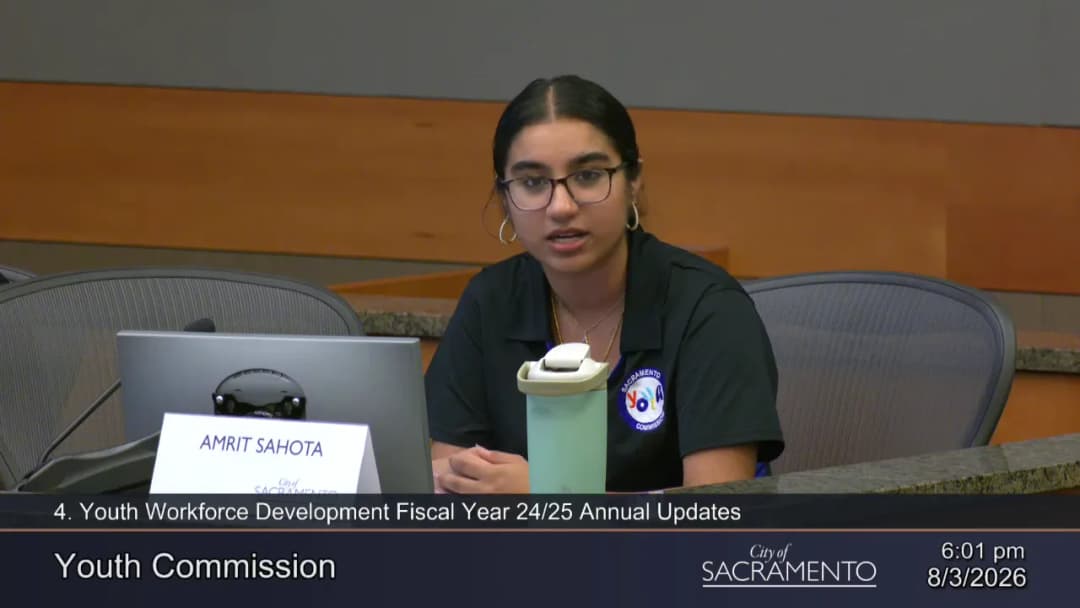
The Sacramento Youth Commission met on Monday, August 3, 2026, to consider the consent calendar, receive an update on youth workforce development programs, and hear staff and member updates. The meeting was streamed on YouTube in English and Spanish, with AI-generated captioning and translations. A quorum was present, and the meeting included a land acknowledgment and the Pledge of Allegiance. Consent Calendar - The consent calendar was approved by voice vote. Commissioner Kachitari requested a correction to the previous follow-up log, noting that the acronym for the organization 'Shivas' should be 'SEVA' rather than 'SAVA'. The motion was made by Commissioner Kachitari and seconded by Commissioner Soda. All commissioners voted in favor, with no opposition. No public speakers commented on the consent calendar. Public Comments & Testimony - No public comments were delivered. One speaker, Vanessa Marshall, signed up for non-agenda public comment but was not present in the audience. No speakers commented on the consent calendar or the workforce development item. Discussion Items - Youth Workforce Development Fiscal Year 2024-25: Staff presented an overview of the Youth Workforce Development Division. The presenter reported that stipend-based programming was offered in all eight council districts, with over 750 young people completing programs including Young Leaders of Tomorrow, Prime Time Teen, Junior Rec Aide, and North Natomas workforce development. The presenter also reported 35 program cohorts totaling 8,900 hours in safe spaces, and 43,284 combined work hours for youth employment, with $714,160 in youth wages. Survey results from the 'Tell It Like It Is' tool showed that 86% of youth agreed or strongly agreed that they were confident securing employment. Commissioners expressed support and asked questions about outreach methods, District 4 participation, year-round programming, and application processes. Staff responded that outreach includes social media, school tabling, and word of mouth, and that lower District 4 enrollment may be due to competing opportunities and transportation barriers. The item was received as informational. Staff Updates - Staff reported that the Semester at City Hall Summer Edition concluded the previous week, with a formal presentation to follow. A joint community connections day with the Youth Mental Health focus area was successful, and a presentation is planned. Open commission seats were announced for Districts 2, 4, 6, and 7. Staff will create shareable social media content, after coordinating with the Clerk's office. The Clerk clarified that applicants must live in Sacramento or attend school within city limits, and must apply for each open seat individually. The vice chair vacancy process remains pending with the Clerk's office. Member Comments - Commissioners shared personal updates, including summer internships, hobbies, and travel. Commissioner Solar reported a new job with DTSC and a photography hobby; Commissioner Chicheri highlighted the mental health focus area project; Commissioner Rupari discussed attending a medical conference in Boston and an internship with the District 3 office; and Commissioner Avila described an internship with an immigrant rights lobbyist group and participation in Future Leaders of America. Key Outcomes - The aquatics annual update (discussion item three) was withdrawn from the agenda. - The consent calendar was approved unanimously, including a correction to the SEVA acronym. - The youth workforce development presentation was received as informational; no vote was required. - Staff will provide follow-up on open seat applications and the vice chair process. - The meeting adjourned.