Browse by city
Date range
Search help

Search titles, summaries, topics and stored transcripts together. Keywords may match separately; put the whole query in double quotes for a phrase. Matching follows word analysis, so punctuation is not exact. Both dates are included. Documents are not searched.

SHOWING 1021–1030 ENTRIES
1021
APR 14, 2022 · SACRAMENTO, CALIFORNIA · PLANNING & DESIGN COMMISSION
Sacramento Planning & Design Commission Approves Chipotle Drive-Through on April 14, 2022

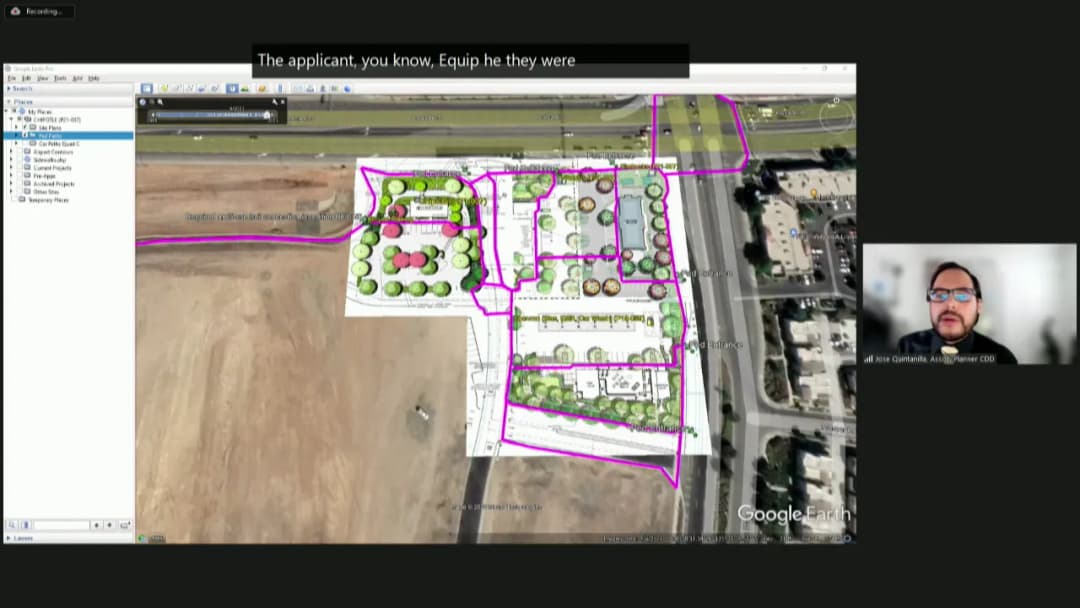
The Planning and Design Commission met on Thursday, April 14, 2022, at 5:30 p.m. via teleconference due to the COVID-19 local emergency. The agenda included a consent calendar, a director’s report, and one public hearing item: a proposal for a Chipotle restaurant with a drive-through pickup window at 2650 Arena Boulevard in the Natomas Crossing area. The commission voted unanimously to approve the project. Consent Calendar - Approval of Minutes (March 24, 2022): The commission voted unanimously to approve the minutes of the previous meeting. Director’s Report - New Senior Planner: Stacia Cosgrove announced the appointment of Garrett Norman as senior planner for the north area of the city. Norman previously worked on ADU ordinances, SB9, and Title 17 code bundles. Public Hearing: Chipotle Natomas Crossing (P21-037) - Location: 2650 Arena Boulevard, Assessor’s Parcel Number 225-2300-019-0000, District 3. - Proposal: Construction of a 2,340‑square‑foot drive‑through restaurant (Chipotle) with a pickup‑window‑only lane (no speaker box). The restaurant would operate from 8 a.m. to 11 p.m. daily. The project includes 30 parking spaces (11 above the 19‑space minimum), including 3 “burrito loading zones,” 2 disabled spaces, and 2 clean‑air/EV spaces. The site plan includes an outdoor seating area and 70% parking lot shading (20% above the 50% minimum). - Required Approvals: (A) Use of previously certified Environmental Impact Report (Resolution 2009‑531; SCH 2007112088); (B) Conditional Use Permit for a drive‑through restaurant in the Shopping Center (SC‑PUD) zone; (C) Site Plan and Design Review with a deviation to exceed the maximum allowed front setback. - Staff Presentation: Associate Planner Jose Quintanilla presented the project, highlighting the pickup‑only drive‑through, vehicle circulation, and pedestrian connections. He noted that a pedestrian connection to the multi‑use trail along Interstate 5 has been conditioned, and staff is open to a Level 2 EV charger instead of a fast charger. Staff received a letter of support from the North Natomas Community Coalition after the staff report was published (included as supplemental material). - Commissioner Disclosures: Vice Chair Hernandez, Commissioners Lenzi, Covill, and Chair Macias Reed reported receiving emails from the applicant’s representative. Commissioner Stuart reported a telephone conversation with the applicant. No recusals were made. - Applicant Presentation: Chris Stewart (on behalf of the applicant) introduced the developer Mike Singolin and Chipotle’s Scott Murdoch. Stewart confirmed agreement with the conditions and answered questions from commissioners. - Commissioner Questions & Discussion: - Commissioner Lindsay inquired about signage for the pickup‑only lane and whether a bypass lane exists. The applicant stated there is no bypass lane, but illuminated and stenciled “Digital Pickup” signs and “Exit Only” markings will be used. The queue confusion is expected to resolve through customer experience. - Commissioner Ogilvie questioned the value of the pickup window and the number of parking spaces. The applicant explained the app‑based ordering system and that the 30 spaces meet code (19 minimum) and accommodate sit‑down dining. - Commissioner Boyd asked about lane width (11 feet – no room for an emergency exit) and recommended additional signage (e.g., a slow‑flashing illuminated sign). The applicant confirmed illuminated entry and exit signs and that staff would work on further enhancements. Jose Quintanilla noted that an electronic sign would not be allowed under the sign code. - Commissioner Chase raised pedestrian‑bicycle safety at the crossing of the drive‑through lane. The applicant and staff agreed to collaborate during plan check to find the optimal location for the trail connection, considering grade differences and ADA access. - Commissioner Lindsay emphasized the importance of pedestrian and bicycle connectivity to the nearby neighborhoods and employment centers, noting the general plan and community plan goals for walkable commercial areas. - Public Comments: No members of the public testified or submitted e‑comments. Key Outcomes - Motions and Vote: Commissioner Lindsay moved to approve the staff recommendation. Vice Chair Hernandez seconded. The motion passed unanimously (all ayes, with Commissioner Wong Connolly and Commissioner Young absent). - Conditions: The approval includes a condition requiring a pedestrian connection to the multi‑use trail, with final location to be determined during plan check. Staff will work with the applicant to ensure safe pedestrian crossings at the drive‑through lane. The EV charging condition will be amended to allow a Level 2 charger instead of a fast charger, with final language in the record of decision. - Next Steps: The record of decision will reflect the final conditions. The project will proceed to plan check and construction.
LAND USE PLANNING 26% · BICYCLE SAFETY 19% · PROCEDURAL 18% · PARKING REGULATIONS 11%
1022
APR 11, 2022 · SACRAMENTO, CALIFORNIA · COMMUNITY POLICE REVIEW COMMISSION
Sacramento Community Police Review Commission Regular Meeting - April 11, 2022

The Sacramento Community Police Review Commission met via Zoom teleconference on Monday, April 11, 2022, from approximately 6:02 p.m. to 7:39 p.m. Chair Graciella Castillo-Krings presided. Commissioners present: Keyan Bliss, Renee Carter, Basim Elkarra, Richard Falcon, Mario Guerrero, Xochimilco Espinoza Salazar, and Stephen Williamson. Commissioners Greg Jefferson and Michael Marion were absent. Consent Calendar - The consent calendar was moved by Commissioner Guerrero, seconded by Commissioner Williamson, and approved unanimously (8 yes, 0 no; Jefferson and Marion absent). - Item 1: Approved the Sacramento Community Police Review Commission meeting minutes of March 14, 2022. - Item 2: Received and filed the 2021 Quarter 4 Police Complaint Activity Report. Public Comments & Testimony - Christina Gillardi and Ryan McClinton of Public Health Advocates commented during the Sacramento Police Department update. They expressed concern that qualitative/freeform CAD data is not being released, which they said limits community oversight and planning for alternative response to behavioral health crises. They suggested contracting an external researcher, creating checkboxes in CAD fields, and asked what clearance an external analyst would need. - Barry Boyd, in public comment on matters not on the agenda, requested that the commission also receive a presentation on Rosenberg's Rules of Parliamentary Procedure, in addition to the proposed Brown Act training. Chair's Update - Chair Castillo-Krings reported that the Sacramento City Council considered seven commission recommendations at its March 22, 2022 meeting. The council referred Recommendation 1 (additional staff support) to the budget/audit committee; folded Recommendations 2, 4, and 5 into a broader commission process being developed by Mayor Steinberg's personnel and public employees committee; treated Recommendations 3 and 6 (annual meeting with police chief and SPD liaison attendance) as already underway; and adopted Recommendation 7 with amended language replacing "authority" with "opportunity" for the commission to review and provide feedback on SPD general orders related to body-worn cameras, foot pursuits, and use of force and discipline. - Commissioner Guerrero and Vice Chair Bliss emphasized that even practices currently being done should be codified in writing so future SPD leadership and staff are clear about their obligations. Commissioner Guerrero, who attended with the Chair, asked that these commitments be kept explicit. - The Chair also described plans to meet individually with city council members and noted the tight timeline for setting the next agenda. She asked commissioners to email OPSA with any proposed agenda items or rules changes. Rules of Procedure Proposal - Vice Chair Bliss presented proposed amendments to the commission's Rules of Procedure, including: adding individual attachments identifying requesting commissioners to agenda packets; publishing supplemental written materials and presentations on the city website as separate attachments; increasing public comment time to five minutes for matters not on the agenda and three minutes for consent/discussion calendar items; eliminating the eight-minute-per-meeting speaker cap; allowing speakers 30 seconds to finish after the time limit; permitting speakers to yield their place in queue; and keeping public comment open until the chair closes it. - Commissioner Falcon suggested uniform time limits across agenda items to avoid public confusion. Commissioner Guerrero asked for clarification on how ad hoc committee chairs are selected. - The commission agreed that all commissioner feedback must be gathered first, the city attorney's office must review the document, and then the final rules proposal would be agendized for a future vote. Sacramento Police Department Update - Lt. Galliano provided the SPD update. The department had finalized the commission's communications center data request, producing four Excel spreadsheets via Dropbox containing redacted data from approximately 1.4 million calls for service across four years. Redactions included addresses for sexual assault and domestic violence reports. - Lt. Galliano explained that structured CAD data fields can be pulled, but freeform text entered by dispatchers and officers is not extractable by the data system. He stated that answering all 54 requested questions for all calls would take roughly 144 employees working full-time for a year, so SPD released only pullable data. He also said ride-alongs have resumed for prospective applicants. - Vice Chair Bliss and Commissioner Williamson pressed for access to more data, including the freeform notes, or a narrower filter request, and asked for a written explanation for each withheld data field. Commissioner Williamson asked whether narrowing by type/location/ZIP code could allow de-identified freeform text to be reviewed. Lt. Galliano responded that redaction would still be required and that raw CAD calls are generally not releasable except for SB 16/SB 1421 qualifying events (about 200 in SPD history). The city attorney's office said it would need to consult SPD's attorney on the legal interpretation. - Commissioner Guerrero thanked SPD for its work on the transgender/gender non-conforming policy and media policy, and requested written follow-up on outstanding recommendations. Discussion Item: Follow-Up Log - The follow-up log was received and filed. During discussion, commissioners added the following requests: - Vice Chair Bliss requested a May 9, 2022 presentation from SPD on the military equipment use policy, General Order 4106, with Deputy Chief Norman Leong as presenter, and a presentation from ACLU representative Marshall Arnwine on AB 481 and SPD's proposed policy. He also requested a written response explaining unavailable data fields from the CAD release. He noted an apparent discrepancy in policy versions: the copy shared with the commission was dated November 10, 2022 (likely a transcription error for 2021), while the version shared with the council's Law and Legislation Committee was updated February 10, 2022. - Chair Castillo-Krings requested a city clerk presentation on the Brown Act for commissioner training. - Commissioner Guerrero requested that OPSA check with the city council on sending commissioners to the NACOL conference (September 11-15), and requested a standing agenda item for ad hoc committee reports. - Commissioner Falcon asked how redistricting affects commissioner district assignments; the deputy city clerk said staff would follow up. Other Commissioner Comments - Commissioner Falcon announced a community town hall with Police Chief Lester on May 7, 2022, 2-4 p.m., at the Maple Neighborhood Center, 3301 37th Avenue, hosted by United Latinos, the Hispanic Chamber, and the Office of Community Engagement. - Vice Chair Bliss commented on the recent K Street shooting near 10th Street, expressed heartbreak for victims, cautioned against what he called false narratives using the tragedy, and urged the community and media to wait for all facts and focus on healing. Key Outcomes - Consent calendar approved unanimously: March 14, 2022 minutes approved; 2021 Q4 Police Complaint Activity Report received and filed. - Follow-up log received and filed; new items were added for staff follow-up. - SPD data request discussions will continue: Vice Chair Bliss will provide written follow-up on missing data fields; city attorney's office will consult with SPD's attorney regarding SB 16/SB 1421 access. - May 9, 2022 agenda requests: SPD General Order 4106 presentation and ACLU AB 481 presentation. - Rules of Procedure changes will be circulated for commissioner feedback, reviewed by the city attorney's office, and brought back to a future meeting for a vote. - OPSA will follow up on Brown Act training, Rosenberg's Rules presentation, NACOL conference training opportunities, and the commissioner redistricting question. - Meeting adjourned at 7:39 p.m.

PUBLIC SAFETY 30% · PROCEDURAL 19% · PUBLIC COMMENTS 15% · PUBLIC RECORDS ACT 9%
1023
APR 11, 2022 · SACRAMENTO, CALIFORNIA · ARTS, CULTURE, AND CREATIVE ECONOMY COMMISSION
Sacramento Arts, Culture, and Creative Economy Commission Regular Meeting - April 11, 2022

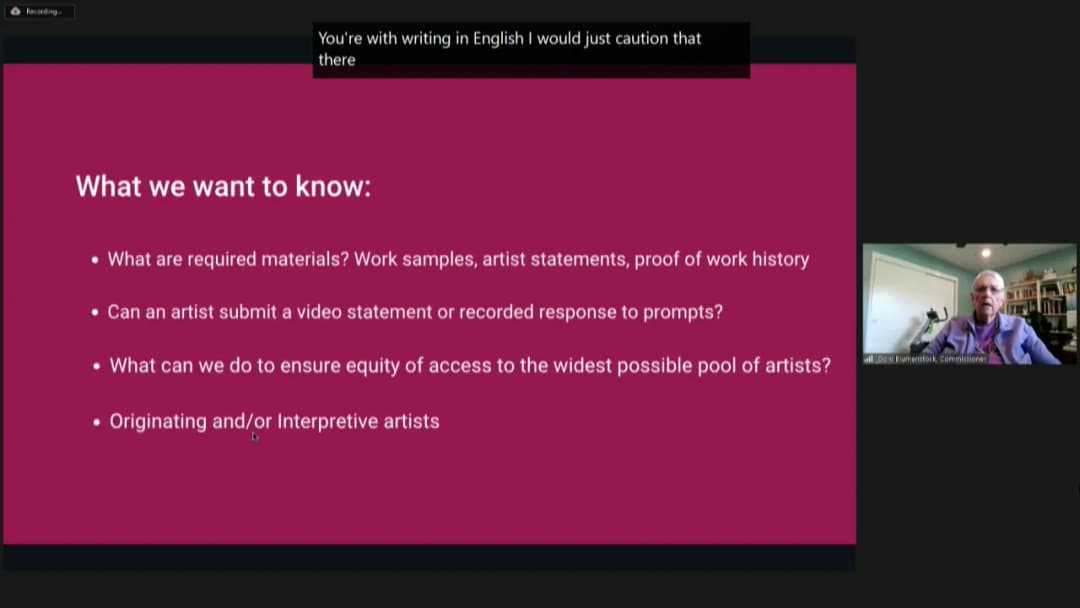
The Commission met virtually on April 11, 2022, to discuss the Seeding Creativity grant program, hear the Chairperson's report, receive public comments, and address commissioner ideas. The Consent Calendar was approved, and discussion items were received and filed. Consent Calendar - Approval of Meeting Minutes (March 14, 2022): Motion by Commissioner Blumenstock, seconded by Commissioner Hastings. Passed 7-0-1 (Vice Chair Enriquez abstained; Commissioners Gott and Wilson-Ramey absent). Public Comments & Testimony - Item 02 - Seeding Creativity Grant Program: Vijay Singh expressed support for the program but urged caution on equity, noting that requiring a three-year work history or sales history might exclude new artists or those from underrepresented communities. He emphasized the importance of mentorship and guidance through the application process. - Matters Not on the Agenda: Shauna McDaniels highlighted the Sacramento Banana Festival (21 years) and Sojo Fine Arts Festival (10 years) as existing community events that should be supported. VJ Singh echoed the call to focus on equity and support existing activities. Discussion Items - Seeding Creativity: A 2022-23 Grant Program for Individual Artists (Item 02): Melissa Cirone, Program Coordinator, presented the NEA-funded program offering $450,000 in $10,000 stipends to 45 artists across all disciplines. Commissioners provided input on application materials, including support for video submissions to reduce barriers for artists who struggle with writing, the need for simplicity and minimal paperwork, broad inclusion of disciplines (e.g., fashion, design, photography), and evaluation criteria for written vs. video applications. Commissioners also discussed the importance of workshops, mentorship, social media presence, and tying the program to the creative economy. The item was received and filed (no vote required). - Chairperson's Report (Item 03): Chair Winlock reported on Art Public Month events on April 7, highlighting community partnerships, the mayor's support, and the visibility of commissioners. Commissioners praised the event and shared ideas for future festivals, pop-up performances, and neighborhood engagement. Vice Chair Enriquez advocated for supporting existing community events and using ARP funds for equity. The item was received and filed (no vote required). - Commission Comments-Ideas and Questions: Commissioners discussed organizing a large arts festival, free summer pop-ups, and touring shows per district. Commissioner Naranjo raised concerns about preserving existing murals (e.g., at Washington Neighborhood Center and Southside Park). Commissioner Enriquez emphasized focusing on neighborhood arts and marketing. Commissioner Mehta announced publishing a children's book benefiting anti-child-abuse nonprofit. The discussions were informational with no formal action. - Public Comments – Matters Not on the Agenda: In addition to comments above, Commissioner Naranjo acknowledged Ms. McDaniels’ museum efforts. Key Outcomes - Consent Calendar approved (minutes of March 14, 2022). - Item 02 (Seeding Creativity) received and filed; staff to incorporate commissioner input into final guidelines, to be presented for approval in May 2022. - Item 03 (Chair's Report) received and filed. - No formal votes on other agenda items; direction for staff to explore workshop and mentorship support for grant applicants. - Discussion of potential future festival and pop-up events to be further considered by commissioners.

ARTS AND CULTURE 65% · PUBLIC ENGAGEMENT 10% · PUBLIC COMMENTS 10% · PROCEDURAL 9%
1025
APR 5, 2022 · SACRAMENTO, CALIFORNIA · LAW AND LEGISLATION COMMITTEE
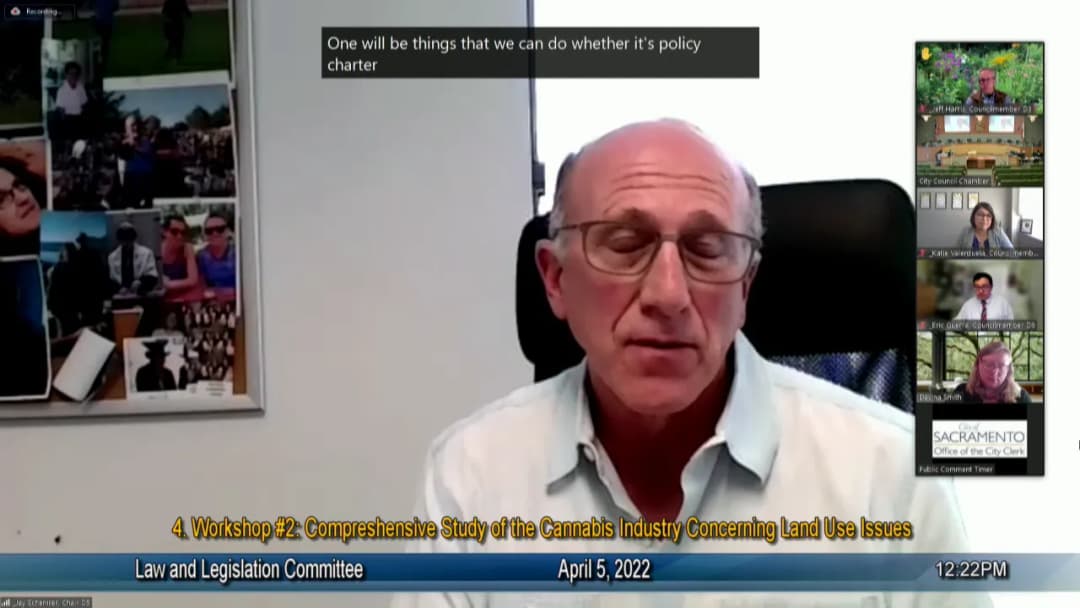
Law and Legislation Committee Special Meeting: Cannabis Land Use Study Workshop – April 5, 2022

The Law and Legislation Committee held a special meeting on April 5, 2022, from 10:35 a.m. to 12:36 p.m. to conduct the second workshop on the Comprehensive Cannabis Study, focusing on land use issues. The committee reviewed a consent calendar and heard presentations from consultants Economic & Planning Systems (EPS) and Office of Cannabis Management staff, followed by public testimony and committee deliberation. Direction was provided to staff on several zoning, buffer, cap, and event policy recommendations. Consent Calendar - Item 1 (Law and Legislation Log): Approved unanimously. - Item 2 (Meeting Minutes – March 15, 2022): Approved unanimously. - Item 3 (Ordinance Amending Section 12.72.060 and Adding Chapter 12.100 – Old Sacramento Docks): Reviewed and forwarded to City Council for consideration. Unanimous vote. Public Comments & Testimony - Maisha Bahati (Crystal Nuggs): Expressed support for opening event licenses beyond Cal Expo; noted difficulty and cost of using Cal Expo for cannabis events. - Jarrett Hill (Core Participant): Supported opening C3 and EC zoning for cannabis businesses, and urged the city to make surplus real estate available to core participants. - Kevin Hooks: Urged that any zoning changes be limited to social equity and core applicants; criticized tobacco buffer distances and high rents; requested smaller event spaces for brand awareness. - John Long (Sky Cloud): Supported matching state buffer reductions; questioned security requirements that are not applied to existing dispensaries; requested C3 zoning. - Rachael Brown (Power In Alliance): Raised concerns about defining mixed-light cultivation and its odor impacts; asked that caps on cultivation in District 6 be maintained until businesses are spread citywide. - Jay J. (Trees of Knowledge Delivery): Supported opening more zones; argued that restricted zones inflate rents and hurt core members; noted that many patients rely on delivery and would benefit from nearby storefronts. - Deanna Garcia: Requested on-site consumption and events throughout the city, not just at Cal Expo, to boost tourism and equity. - Joe Devlin (Northern California Cannabis Alliance): Supported reviewing buffers between cultivation and residential; suggested tobacco buffers should be reconsidered; argued indoor cultivation remains viable in Sacramento. - Michael Snell: Supported on-site consumption and expanded events; urged removal of stigma; asked for more incentives for social equity businesses and no time limit for retail licensees to open. - Kimberly Cargyle (Therapeutic Alternative): Questioned the $130,000 in neighborhood responsibility fees paid; requested an accounting and use of those funds for community projects like the Yellow Brick Road safe pathway to school. Discussion Items - Workshop 2: Comprehensive Study of the Cannabis Industry Concerning Land Use – EPS presented findings: cannabis businesses have not negatively impacted neighboring retail, industrial, or residential property values; crime rates at cannabis businesses are low relative to citywide; short-lived rent spikes in 2018 have normalized; and concentrations are highest in Districts 2 and 6 due to limited zoning. Staff then presented seven recommendations: 1) cultivation use and odor plan review; 2) maintain comparable security standards when opening new zones; 3) allow expiration of the District 6 delivery cap; 4) retain a district-based cultivation/distribution cap until additional zones are opened (possibly excluding distribution); 5) review sensitive uses and buffers (e.g., schools, youth centers, tobacco retailers, light rail); 6) determine additional zones for cannabis (e.g., C3, EC); 7) consider allowing consumption lounges or expanding temporary event locations. Committee members discussed each recommendation. Councilmember Guerra supported retaining the cultivation cap in District 6 until the market matures, stressed the importance of safety and security, and urged using the 1% neighborhood fee for community safety and youth programs. Councilmember Valenzuela advocated for opening C3 zoning, removing unnecessary buffers (tobacco, light rail), but keeping buffers for schools, youth, and medical treatment centers; she supported exploring on-site consumption and events. Councilmember Harris agreed with a buffer between cultivation and residential areas, supported retaining the cultivation cap until other zones open, and stated firm opposition to on-site consumption until a reliable sobriety test for cannabis exists. Councilmember Schenirer emphasized treating the industry more like other businesses, letting market forces work, and using a phased approach to zoning changes. Sergeant Young (SPD) noted that cannabis businesses are currently prime targets for burglaries, but compliance with security conditions and enforcement are improving. Staff noted that delivery caps were originally based on traffic and crime concerns, but studies show no adverse impacts, while cultivation caps protect against rapid displacement of traditional industrial uses. Key Outcomes - The committee directed staff to move forward with the following recommendations and report back to the committee and/or City Council: 1. Cultivation Odor Plan Review: Analyze best practices and enforcement tools (e.g., nasal rangers) and consider differentiating indoor vs. mixed-light cultivation. 2. Security Standards: Ensure any new zoning includes comparable security conditions, developed with SPD. 3. Delivery Cap in District 6: Allow the existing cap to expire, unless a compelling rationale is found to extend it. 4. Cultivation/Distribution Cap in District 6: Retain the cap until additional zones are opened; consider removing distribution from the cap. 5. Sensitive Uses & Buffers: Re-evaluate all buffers; preserve buffers for schools, youth centers, and medical treatment facilities; remove or reduce buffers for tobacco retailers and light rail stations; maintain PDC review for parks. 6. Additional Zones: Open C3 and possibly EC zoning for appropriate cannabis uses to reduce concentration in Districts 2 and 6. 7. Consumption Lounges & Events: Continue exploring on-site consumption and temporary event locations beyond Cal Expo, with careful consideration of impaired driving enforcement. - The committee also requested that the 1% neighborhood responsibility fund be used for public safety, community improvements, and youth education, and that an accounting of the fund be provided. - Staff will continue stakeholder engagement with SPD, industry, and community groups on security and compliance. - The next workshop (Workshop 3) is scheduled for April 19, 2022, at 1:00 p.m. to discuss fiscal issues, business operations tax, and overall policy principles. - The equity study will address co-op spaces and other items deferred from this workshop.

CANNABIS REGULATION 62% · PUBLIC SAFETY 20% · LAND USE PLANNING 8% · PUBLIC COMMENTS 6%
1026
APR 5, 2022 · SACRAMENTO, CALIFORNIA · BUDGET AND AUDIT COMMITTEE
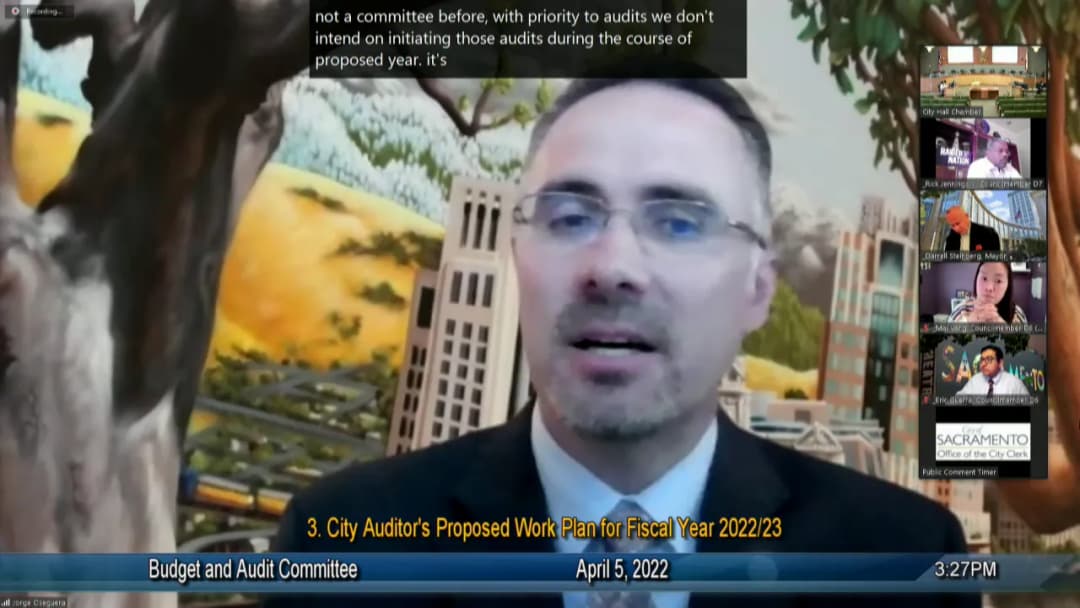
Budget and Audit Committee Meeting - April 5, 2022

The Budget and Audit Committee of the Sacramento City Council met on April 5, 2022, at 3:00 PM. The meeting included approval of consent calendar items and a discussion on the City Auditor's Proposed Work Plan for Fiscal Year 2022/23. The committee approved the work plan with direction to the auditor to explore prioritizing a comprehensive audit on homelessness coordination across departments. Consent Calendar - Approved meeting minutes from January 4, 2022, February 1, 2022, February 8, 2022, and March 1, 2022. - Accepted the City Auditor's Recommendation Follow-Up Report for the six-month period ending December 31, 2021, and forwarded it to the City Council for final approval. Both items passed on a motion with a 4-0 vote (Councilmember Getta, Jennings, Vang, Mayor Steinberg in favor). Public Comments & Testimony - Mr. Davis (phone caller): Expressed appreciation for Mayor Steinberg's leadership during a recent tragedy, noting that the basketball game proceeded and was well-attended. He spoke generally and not to any agenda item. Discussion Items - City Auditor's Proposed Work Plan for FY 2022/23 (Item 3) - Presenter: City Auditor Jorge Oseguera presented the proposed work plan, which includes five sections: performance audits, cannabis, utilities, research and analysis, and hotline activity. Key proposed new audits include the Community Development Department (planning division), Department of Community Response (homeless services), citywide pedestrian safety, public works recycling and solid waste (contract audit), and animal care services. Under cannabis, audits of illegal cultivation and administrative penalty appeals are planned. Utilities audits include supervisory control and data acquisition, succession planning, and security/emergency preparedness. Research and analysis projects include a community survey, employee diversity and inclusion, and an audit of the ethics commission. The office also manages approximately 160 whistleblower investigations annually. - Councilmember Vang: Commended the office's work and highlighted the importance of the language access audit. She requested an addition to the work plan: a holistic audit of how various city departments (e.g., DCR, police, code enforcement, community development) coordinate resources to address homelessness. She noted the city is scaling up efforts and wants to ensure effectiveness and efficiency across departments. - Councilmember Guerra: Thanked the auditor for the language access work and supported the homelessness coordination audit. He expressed concern about workload and suggested reprioritizing existing audits rather than adding new resources. He questioned whether a proposed $150,000 contract audit for code enforcement could be redirected. He also asked for an update on the complaint investigation and resolution practices audit, which is facing challenges with the city manager and city attorney. - Mayor Steinberg: Echoed support for prioritizing the homelessness coordination audit, emphasizing it should be a high priority, not a tier-two request. He directed the auditor to assess what trade-offs would be required if this audit were moved up. - Auditor Response: Oseguera agreed to meet with Councilmember Vang's office to refine the scope and incorporate her concerns into the existing DCR homeless services audit. He clarified that priority-two items require additional funding (e.g., $150,000 for a contract audit) and are not currently planned for initiation. Key Outcomes - The committee passed a motion (4-0) to accept the City Auditor's Proposed Work Plan for FY 2022/23 and forward it to the City Council for final approval, with direction to the auditor to: 1. Meet with Councilmember Vang to incorporate a comprehensive audit of homelessness coordination across all relevant city departments. 2. Return to the full City Council with an analysis of trade-offs (which audits would be delayed or deprioritized) if the homelessness audit is given higher priority. - The meeting adjourned at approximately 3:45 PM, with the full City Council session scheduled for 5:00 PM.

AUDIT MANAGEMENT 47% · HOMELESSNESS 22% · PROCEDURAL 19% · CANNABIS REGULATION 8%
1027
MAR 29, 2022 · SACRAMENTO, CALIFORNIA · LAW AND LEGISLATION COMMITTEE
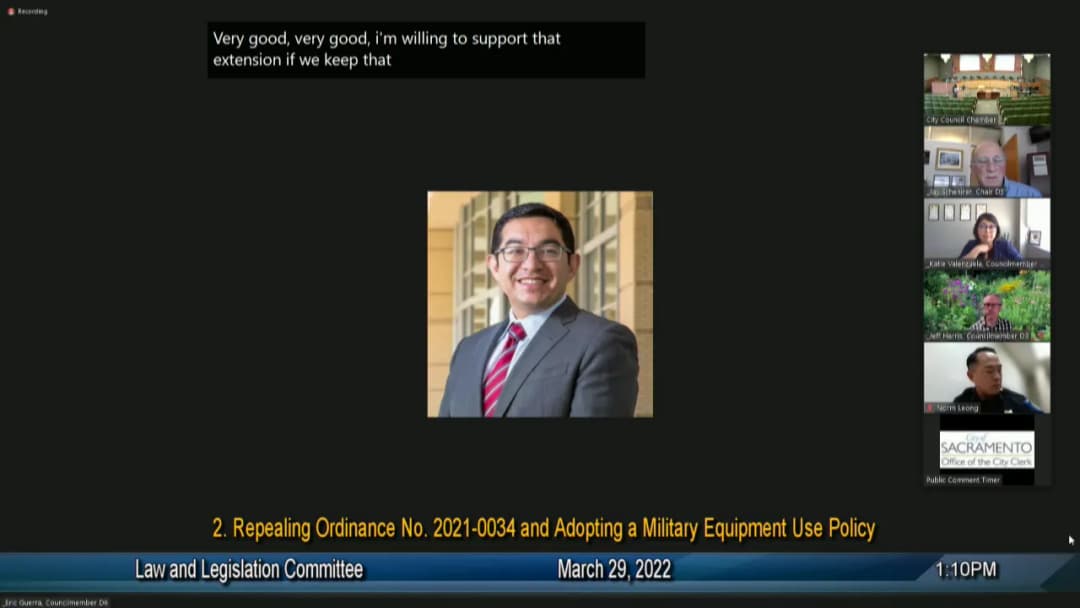
Law and Legislation Committee Special Meeting - March 29, 2022

The Law and Legislation Committee held a special teleconference meeting on Tuesday, March 29, 2022, at 12:30 p.m., adjourning at 1:53 p.m. The committee considered three items: an update to the Military Equipment Use Policy, a proposed ordinance restricting city staff from using their titles to support or oppose ballot measures, and a framework for a Community Benefits Ordinance. Public testimony focused on deficiencies in the military equipment policy, and the committee provided direction on each item. Public Comments & Testimony (Item 2 - Military Equipment Use Policy) - Louise Melher: Expressed disturbance at the process, citing lack of civilian oversight and incomplete information on past equipment use; urged complete reporting on deployments. - Barb Atwell (American Friends Service Committee): Raised three concerns: the policy describes only authorized users, not purposes; it does not conform to AB 48 (limiting tear gas use); and the LRAD policy does not meet AB 481's standard of safeguarding civil rights. - Marshall Arnwine (ACLU of Northern California): Requested council reject the policy because it lacks specific authorized uses for each equipment, particularly chemical agents, and violates AB 48 by using language like "not limited to." Noted the 180-day review period and urged thorough review. - Jennifer II (American Friends Service Committee): Echoed earlier comments, noting that the LRAD has resulted in lawsuits (e.g., New York City paid $750,000). Stressed there is no urgency and council should send the policy back for correction. - Diane Rosenbloom (Sacramento resident): Urged policy to specify when equipment cannot be used, citing risks of LRAD hearing damage, chemical agents in crowds, and emotional impacts of armored vehicle deployment. - John Lindsay Poland (American Friends Service Committee): Emphasized policies should not authorize unlimited use; need for de-escalation requirements and explicit references to AB 48 limitations on chemical agents and impact projectiles in crowd control. Discussion Items 1. Military Equipment Use Policy (Item 2) - Deputy Chief Norman Leong presented a proposal to repeal and replace Ordinance 2021-0034 to add four omitted items: flashbang, armor-piercing ammunition, two types of UAVs (micro and aerial). Stated the department grounded the micro UAVs pending approval. - Councilmember Jeff Harris expressed support for moving the policy to City Council, noting the value of UAS tools for safety. He made a motion to recommend the ordinance to council. - Councilmember Katie Valenzuela opposed immediate forwarding, citing lack of 30-day advance notice (noted the December process was rushed), and argued the policy should include clearer prohibitions and references to AB 48. She recommended the policy come back to committee for amendments, allowing 180-day timeline. - City Attorney Steve Itagaki clarified that the 180-day clock started on submission (March 25) and use of equipment is permitted during that period. He explained that the ordinance must be repealed and replaced annually per state law. - Assistant City Manager Ken Chonlin warned that overloading the ordinance with employment policies would create an administrative burden, as those policies change frequently. - Councilmember Eric Guerra supported a 60-day return to committee to refine language without delay. - Outcome: Committee gave direction to staff to continue working with stakeholders and return to Law and Legislation within 60 days with clarified language, including better delineation of when equipment can and cannot be used and cross-references to related policies. No formal vote was taken; the motion by Harris died for lack of a second. 2. Ordinance on City Staff Use of Titles for Ballot Measures (Item 3) - Chair Jay Schenirer introduced the item, prompted by Measure G where a senior staffer used their city title to oppose a measure that council took no position on. He proposed an ordinance requiring alignment: if council takes a position, staff may only use their title in alignment; if council takes no position, staff may not use their city title at all. - Councilmember Harris disagreed, arguing staff have a right to use their titles as voters, and saw no problem with differing opinions. He favored status quo. - Councilmember Guerra supported the proposal, noting similar practices in the CSU system. - Councilmember Valenzuela supported the direction, stating the public would justifiably conflate a staff title with city position. - Chair Schenirer moved to direct the City Attorney to prepare an ordinance and bring it to City Council for consideration. - Vote: 3-1 (Guerra, Valenzuela, Schenirer in favor; Harris opposed). Motion passed. 3. Community Benefits Ordinance Framework and Outreach (Item 1) - Leslie Fritzsche and Ellen Sullivan (Office of Innovation and Economic Development) presented a framework based on examples from Detroit and Richmond. Key components: trigger (thresholds for requiring a CBA), benefits menu, oversight, and metrics. Proposed triggers: Tier 1 ($75M+ project value with $1M+ city investment); Tier 2 ($3M+ value with $300k+ city investment). Aggie Square settlement requires a draft ordinance by June. - Public Comment: Lambert Davis (To the Bay and Back Cheesecakes) urged metrics to benefit underserved neighborhoods like Del Paso Heights, noting his family business is the only Black-owned cheesecake business in Sacramento. - Committee discussion emphasized flexibility, avoiding overly prescriptive requirements that could deter development, and ensuring local hire, procurement, apprenticeship programs, and anti-displacement measures. Councilmember Valenzuela suggested including post-construction job quality and housing affordability. Councilmember Harris cautioned that triggers should be set high (millions) to avoid deterring small projects. Chair Schenirer supported in-lieu payment options, developer certainty, and oversight via meet-and-confer processes. Committee requested staff work closely with SAC IWD (Sacramento Investment Without Displacement) and engage developers (e.g., Wexford, GSAC, Metro Chamber, labor unions) in outreach. - Outcome: Committee provided direction to staff on the framework and directed staff to bring back a draft community benefits ordinance to Law and Legislation for consideration. Staff committed to meeting the June timeline but emphasized doing it right over meeting an artificial deadline. Key Outcomes - Military Equipment Use Policy: Staff directed to continue working with stakeholders and return to Law and Legislation within 60 days with refined language incorporating clearer use restrictions and cross-references. - Staff Ballot Measure Ordinance: Motion passed (3-1) directing the City Attorney to prepare an ordinance restricting city staff from using their titles to support or oppose ballot measures unless aligned with council action, to be brought to City Council. - Community Benefits Ordinance: Staff directed to proceed with outreach and bring a draft ordinance back to the committee for consideration, with guidance to include flexible triggers, a menu of benefits, enforcement mechanisms, and stakeholder engagement.

MILITARY EQUIPMENT USE 35% · COMMUNITY BENEFITS AGREEMENT 29% · LEGAL 10% · PUBLIC EMPLOYEE CONDUCT 9%
1028
MAR 24, 2022 · SACRAMENTO, CALIFORNIA · PLANNING & DESIGN COMMISSION
Planning & Design Commission Meeting - March 24, 2022: Cannabis, Office Expansion, Senior Care Facility

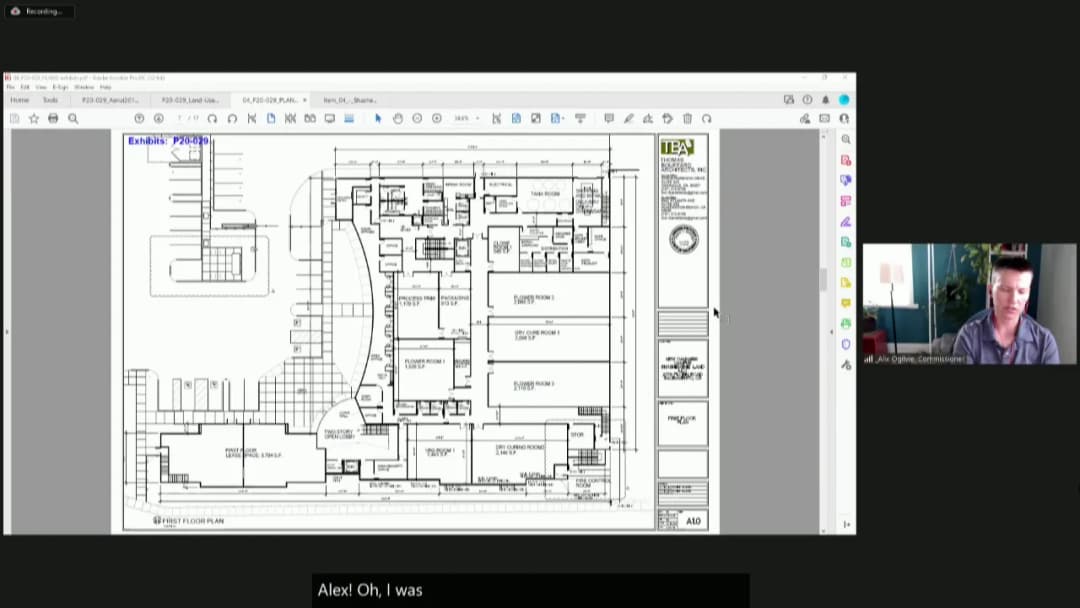
The Sacramento Planning & Design Commission held a virtual teleconference meeting on Thursday, March 24, 2022, starting at 5:31 p.m. and adjourning at 7:51 p.m. The commission considered four items: approval of prior minutes, continuation of teleconferencing due to COVID-19, and three public hearings for development projects. All items were approved, with one commissioner voting against a cannabis facility project. Consent Calendar - Approval of Minutes (File ID: 2022-00564): The commission unanimously approved the minutes from the February 24, 2022 meeting. - Teleconferencing Meetings During COVID-19 State of Emergency (File ID: 2022-00678): The commission unanimously approved a motion to continue meeting by teleconference for another 30 days, citing the ongoing state of emergency and public health risks from in-person gatherings. Public Comments & Testimony Item 4 – Shashemene Land Institute of Agriculture & Holistic Rehabilitative Medicines (P20-029) - Eight members of the public spoke in support of the project, including representatives from the Greater Sacramento Urban League, Sacramento Sister Circle, SAC Black Biz, and the Institute for More. Speakers emphasized the project's potential for community uplift, equity in the cannabis industry, workforce development, and economic opportunity in South Sacramento. One nearby resident expressed concerns about noise from planned events, potential cannabis smoking in the wellness park, and the design of a mural on the building. The applicant clarified that the space would be membership-only, events would be limited and permitted, smoking would not be allowed outdoors, and the mural was a placeholder from online images and would be replaced with local community-selected art. Item 5 – Office Space Expansion at 8561 23rd Avenue (P21-019) - No public comments were received. Item 6 – Tenfold Natomas RCFE (P21-031) - One member of the public asked how to obtain a recording of the meeting (procedural question, not substantive comment on the project). Staff directed the speaker to the city's website. Discussion Items Item 4 – Shashemene Land Institute - Staff presented a proposal for two conditional use permits (delivery-only cannabis dispensary and cannabis production: cultivation, distribution, manufacturing) and site plan/design review for a 66,429-square-foot, two-story building on a 3.03-acre vacant site at 2759 Florin Road. The project includes a wellness park, classroom, and office space, with a focus on Ethiopian heritage and community education. The site is in the General Commercial zone and partially within a Transit Overlay. - Commissioner questions addressed the intended distribution network, membership-only access to the wellness park, street-level articulation and opaque windows, pedestrian safety improvements along Florin Road (future public works projects), and the possibility of a future retail storefront (applicant clarified it is not planned). Commissioner Ogilvie expressed concern that the building design did not meet Florin Road corridor design guidelines, particularly regarding street frontage activation. Urban Design Manager Bruce Monighan defended the design, noting the building's internalized program and cultural significance. The applicant offered to work with Commissioner Ogilvie on any concerns. - A motion to approve the staff recommendation passed 11-1, with Commissioner Ogilvie voting no. Item 5 – Office Space Expansion at 8561 23rd Avenue - Staff presented a request to convert 9,434 square feet of warehouse space to office space within an existing 43,200-square-foot building on a 2.27-acre site in the M-2(S) Heavy Industrial zone, to accommodate a construction contracting company moving from Milpitas. The project included a deviation to open space standards. No commissioner questions or public comments. The commission unanimously approved the project. Item 6 – Tenfold Natomas RCFE - Staff presented a request for a PUD schematic plan amendment and site plan/design review to build a 157,550-square-foot, three-story residential care facility for the elderly (RCFE) at the southwest corner of Arena Blvd. and Truxel Road. The project includes 142 units, 170 residents, 90 full-time/part-time employees, and a deviation to exceed the maximum building setback (28 feet instead of 23 feet). The site is adjacent to a future light rail easement. The applicant (Tenfold Senior Living) highlighted their existing projects and philosophy of resident autonomy, assisted living, and memory care. - Commissioner Boyd asked about the appropriateness of an 80+ age facility near a light rail station and the dimensions of the light rail easement. Staff confirmed the commercial/retail parcels to the south remain, and the easement is 12.5 feet for utilities and 40 feet for tracks. The project is considered compatible with the general plan designation. - The commission unanimously approved the project. Key Outcomes - Item 4 (Shashemene Land Institute): Approved 11-1 (Commissioner Ogilvie dissenting). The commission approved the environmental exemption (CEQA Infill), conditional use permits for the dispensary and production facility, and site plan/design review. Commissioner Ogilvie expressed that the building design was inconsistent with Florin Road corridor design guidelines. - Item 5 (Office Space Expansion): Approved unanimously (12-0). - Item 6 (Tenfold Natomas RCFE): Approved unanimously (12-0). - All approvals are subject to conditions of approval listed in the staff reports.

CANNABIS REGULATION 34% · PROCEDURAL 13% · SENIOR SERVICES 11% · PUBLIC COMMENTS 9%
1029
MAR 23, 2022 · SACRAMENTO, CALIFORNIA · DEFINED CONTRIBUTION PLANS COMMITTEE
Sacramento Defined Contribution Plans Committee Meeting - March 23, 2022

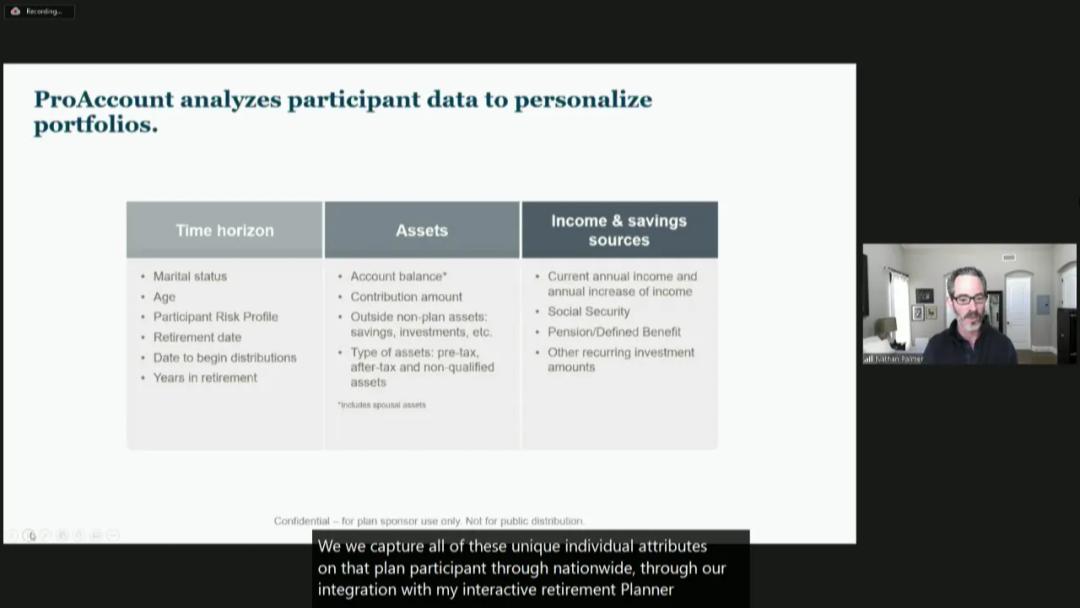
The Defined Contribution Plans Committee of the City of Sacramento met virtually on March 23, 2022, in a teleconference-only meeting under AB361 and the City's COVID-19 local emergency resolution. The agenda open session was scheduled for 9:00 a.m.; the Chair noted at 11:00 a.m. that the meeting needed to wind down by about noon, and later discussion was shortened accordingly. A quorum was present, with Chair Murray Levison presiding; Members Boyd, Foster (late), Hoekstra, Zalaski, and Vice Chair Bader (late) participated, with alternate member Knox also participating. The clerk reported no public speakers on any agenda item. Note: the Chair's oral roll-call near the start of the transcript says 'May 3rd, 2022,' which conflicts with the agenda date of March 23, 2022; this summary uses the agenda date. Consent Calendar - Approved the minutes of the September 22, 2021 (Special) and December 15, 2021 meetings, as amended. Chair Levison requested amendments so the minutes reflect the subcommittee membership named in the September 22 motion and the committee's direction not to move forward with a deemed IRA; he also requested formatting and spelling corrections. Motion by Member Boyd, second by Member Hoekstra, passed unanimously. - Received and filed the Official City of Sacramento Land Acknowledgement. Discussion Calendar Item 3 - Chair and Vice Chair Selection for 2022 - Chair Levison was re-elected Chair for calendar year 2022 by motion of Member Boyd, seconded by Member Hoekstra, with a unanimous roll-call vote. - Member Boyd was elected Vice Chair for 2022 by motion of Member Hoekstra, seconded by alternate member Knox, with a unanimous roll-call vote. Chair Levison noted that the staff report's statement that the election takes effect at the next meeting does not appear in the bylaws, and he planned to discuss that discrepancy offline. Item 4 - Revisions to the Fee and Expense Policy Statement - The item was tabled to the June meeting. Chair Levison said he had prepared substantial edits, including adding participant fee descriptions and a budget reserve/fund balance policy for the administrative allowance account, and the committee needed time to review them. He will send the edits to staff and the investment consultant. Motion by Member Boyd, second by Member Bader, passed unanimously. Item 5 - Informational Update from Nationwide Retirement Solutions - Nationwide reported that its My Interactive Retirement Planning tool had just added a 'detailed income view' / spend-down tab for retirees, giving participants a more complete retirement-readiness picture. Chair Levison said he, as a retiree, had trouble getting the online tool to work; Nationwide offered to work with him offline. - Nationwide's Rick Watson reported fourth-quarter outreach: approximately 351 appointments, retirement workshops including a 'Get the Facts' webinar, mailers to non-enrolled employees, and the first in-person worksite visit in two years. Nationwide indicated representatives were returning to in-person visits. - Chair Levison asked about the administrative allowance account, specifically whether an $8,000 SLA penalty payment from 2018 had been deposited there and how interest and gains were reported. Nationwide said the account is invested in a money market fund and would research the deposits. Item 6 - Adding Retiree Loans and Distributions on In-Service Rollover Contributions to the 457(b) Plan - Staff recommended allowing retirees to take loans from the 457(b) plan and allowing participants to take distributions on money rolled into the plan from previous employers. The committee expanded the loan recommendation to include terminated employees, but the motion did not extend loans to the 401(a) plans. - Nationwide explained current loan terms: the stated interest rate is 4.28%, with 4.25% credited back to the participant, for a net effective rate of about 0.03%; general loans can be up to five years and primary-residence loans up to 15 years. Repayment is by ACH directly between the participant and Nationwide. - Motion by alternate member Knox, second by Member Foster, passed unanimously. Item 7 - Hyas Group Review of 2021 Fourth Quarter - Hyas reported strong long-term results for the combined 457(b)/401(a) plans: approximately $736 million in plan assets as of December 31, 2021, up from about $300 million at the start of the record-keeping contract; $162 million in market gains during 2020-2021 and $250 million since 2019; positive net cash flow; and average participant balances above national and California averages. - Hyas also highlighted a fee improvement: total plan costs dropped by 10.1 basis points, or about $101 per $100,000 in participant assets, to 34.6 basis points (30.4 basis points investment costs plus 4.2 basis points administration). Vanguard target retirement funds reduced their fees to 8 basis points effective February 11, 2022. - Hyas recommended adding Vanguard Target Retirement 2065 and, once available around August 2022, 2070 funds to the lineup. No formal vote was taken on this recommendation. - Chair Levison raised the appearance of a conflict after Hyas Group's acquisition by Morgan Stanley, given that plan funds may hold Morgan Stanley shares. Hyas said its business, FINRA registration, and contracts are unchanged, that Morgan Stanley does not influence its advice, and that future fund-search materials would include conflict disclosure language. - Committee members also discussed service-level agreement reporting and requested clearer underlying data from Nationwide. Item 8 - American Century Mid Cap Value R6 Fund Watch - Hyas identified American Century Mid Cap Value R6 as the underperforming 'problem child' in the lineup: over five years it returned 9.76% versus 11.22% for its benchmark, ranking at the 64th percentile among peers. It fell out of compliance in Q1 2021, and Hyas acknowledged it should have been placed on watch in Q2 2021 but was missed. The fund has improved in early 2022, ranking 13th among peers and trailing its benchmark by only 33 basis points for the year to date. - The committee passed a motion to place the American Century Mid Cap Value R6 fund on watch effective June 30, 2021. Motion by Member Bader, second by Member Zalaski, passed unanimously. Chair Levison asked that the Investment Policy Statement language on watch timing be clarified in a future review. Item 9 - Review of Nationwide's Managed Account Services - Nationwide, with Wilshire Associates, presented its discretionary ProAccount managed account service. Wilshire described an independent, institutional approach using 42 portfolios across aggressive, moderate, and conservative glide paths. Portfolio assignment uses participant data from the My Interactive Retirement Planning tool and runs 1,000 Monte Carlo simulations targeting an 80% probability of not outliving retirement savings. For example, a 50-year-old participant could be assigned an equity allocation between 52% and 90% depending on financial circumstances. - Nationwide presented participant-level data comparing do-it-yourself investors, target-date users, and ProAccount users, and noted that do-it-yourself investors outperformed the help options over the five-year period shown, an outcome it attributed to strong domestic equity markets. Hyas had prepared a separate analysis comparing managed accounts against target-date funds net of fees. Staff emphasized that the presentation was educational and that there is no proposal to eliminate managed accounts. - Chair Levison expressed concern that retirees, including himself, have struggled to use the My Interactive Retirement Planning tool, making it harder to provide the personalized data on which ProAccount relies. Nationwide acknowledged the issue and offered to work with him offline. In response to an HR question, Nationwide said the ProAccount service is a small part of field representatives' overall compensation, not a simple commission, and that representatives are expected to discuss fees and fit. - No action was taken; the committee agreed to continue the discussion at the next meeting. Items 10-11 - Legal/Regulatory Updates and Committee Work Plan - Item 10, Legal and Regulatory Updates, was tabled to the next quarterly meeting because of time constraints. - On the work plan, staff asked the committee to specify the data elements it wants in Nationwide's service-level agreement reporting. Chair Levison gave examples from prior requests: the number of new hires enrolled versus the 50% enrollment goal, and the 185 new participant goal, which appeared to show only 109 new enrollments in the first two quarters of 2021. HR also reported no further action on allowing non-career employees to participate in the 457 plan because those voluntary payroll-deduction products are not treated as employee benefits and recent labor agreements specify career employees for 457 participation. Key Outcomes - Consent calendar approved unanimously, with the two prior meeting minutes amended as requested. - Chair Levison and Vice Chair Boyd elected for 2022. - Fee and Expense Policy Statement revisions tabled to June 2022. - Committee recommended adding retiree and terminated-employee loans and in-service rollover distributions to the 457(b) plan. - American Century Mid Cap Value R6 placed on watch effective June 30, 2021. - Managed account services discussion will continue; Legal and Regulatory Updates tabled. - No public comments were made on any agenda item.

RETIREMENT PLANNING 40% · INVESTMENT POLICY 18% · PROCEDURAL 8% · EMPLOYEE BENEFITS 8%
1030
MAR 23, 2022 · SACRAMENTO, CALIFORNIA · UTILITIES RATE ADVISORY COMMISSION
Utilities Rate Advisory Commission Meeting - March 23, 2022

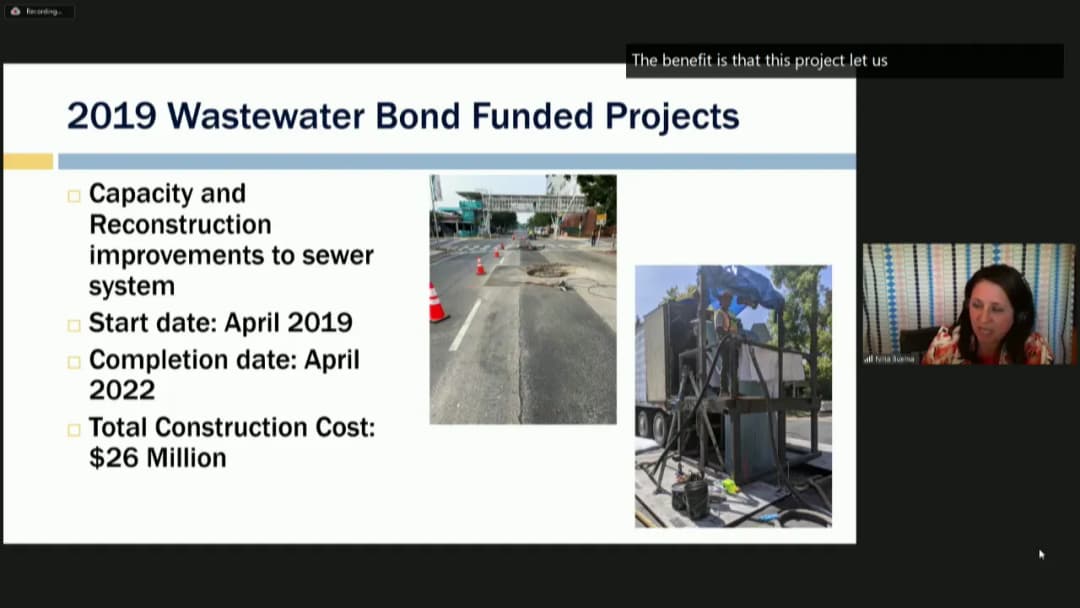
The Utilities Rate Advisory Commission (URAC) held a virtual teleconference meeting on March 23, 2022, at 5:30 p.m. The meeting included the approval of consent calendar items and a detailed presentation on the Department of Utilities' second-quarter accountability plan for Fiscal Year 2022. Commissioners discussed the SURA program, the McKinley Vault project, drought response, water conservation, and development review statistics. Consent Calendar - Approval of Minutes: The commission unanimously approved the minutes from the January 26, 2022 meeting. - Teleconferencing During COVID-19 Emergency: A motion was passed to continue meeting by teleconference for another 30 days, citing the ongoing state of emergency and social distancing measures. Commissioner Megan Fidell inquired about the timeline for returning to in-person meetings. Staff responded that the city council is considering plans and that commissions will likely follow the council's lead; the next month's meeting is expected to remain virtual. Public Comments & Testimony - No members of the public spoke during the meeting. Discussion Items - Department of Utilities Accountability Plan Update – 2nd Quarter of Fiscal Year 2022: Staff presented a comprehensive update covering the SURA program, community engagement, sustainability, water efficiency, and engineering projects. - SURA Program: As of December 31, 2021, there were over 8,600 residential participants and five non-profit organizations. Approximately $931,000 was spent in the second quarter, with $1.8 million of the $3.78 million budget expended. The program is being restructured to a fixed percentage discount to improve budgeting and administration, with direction from the Budget and Audit Committee to maintain the benefit level. Commissioner Melissa Lee asked about the rationale and comparison to other utilities (e.g., SMUD, which uses a straight percentage). - McKinley Vault: The 6-million-gallon offline storage vault performed as designed during the October 24, 2021 storm event (a 100-year, 6-hour storm with 2.52 inches of rain). Commissioner Connie Gutowsky raised concerns about a flyer claiming the vault failed; Director Bill Busath explained that the vault prevented structural flooding, though localized street flooding occurred. The vault was completed in October 2021. - Water Conservation: The city saved an estimated 48.9 million gallons over the lifespan of various measures, costing about $630,000, with half reimbursed via grants. The average annual conservation rebate budget is approximately $2.7 million. Staff committed to providing updates on the conservation master plan. - Drought: A Stage 2 water alert was declared in August 2021, and the state may issue mandatory conservation levels. Staff will update the commission on potential impacts to utility rates. - Engineering Division Update: Nina Buelna, Supervising Engineer, reported on the October 24, 2021 storm (5.62 inches in 24 hours; 500-year event). The city responded to 1,991 calls (787 wastewater, 1,204 stormwater). The combined sewer system improvement plan has invested $156 million since 1995, adding 20 million gallons of storage (equivalent to 34 Olympic swimming pools). - Water Program Highlights: The accelerated water meter program installed 42,000 meters and 61 miles of water main, completed in November 2021 at a cost of $225 million. The Shasta Reservoir and Groundwater Well project improved water pressure in South Sacramento, including methane and magnesium removal. - Development Review: In 2021, the team reviewed 1,048 commercial plans and 2,525 residential plans. New developments must mitigate impacts via on-site measures or pay fees based on a development impact study. Projects under review include the old Kings Arena (potential hospital) and rail yards. Key Outcomes - Received and Filed: The commission received and filed the Department of Utilities Accountability Plan Update for the 2nd Quarter of FY2022. No vote was required on this item. - Teleconferencing Extension: Approved unanimously (5-0, with Chair Thomas absent) for an additional 30 days. - Storm Drainage Ballot Initiative: Staff noted that ballot results are expected by the end of the following week, with a presentation to the City Council on April 12, 2022. - Next Steps: Staff will provide future updates on the SURA program restructuring, conservation master plan, and drought impacts. The commission will continue to meet virtually until the city council resumes in-person meetings.

WATER MANAGEMENT 39% · PUBLIC WORKS 17% · PROCEDURAL 13% · UTILITIES 13%
OPENPUBLICA · PUBLIC MEETING INDEXUPDATED DAILY · openpublica.com