The Active Transportation Commission met virtually on Thursday, February 17, 2022, from 6:00 p.m. to 7:28 p.m. The meeting included approval of the consent calendar, a staff report on completed and ongoing projects, approval of the commission follow-up log with amendments, and an extensive update from Transportation Planning. Commissioners also discussed future agenda items, including semi-annual reports on Vision Zero and bicycle/pedestrian master plan projects. Consent Calendar - Item 1 – Approval of Meeting Minutes: Approved unanimously (8-0) the January 20, 2022 meeting minutes. Commissioners present: Ron Brasel, Manuel Buenrostro (joined at 6:03 p.m.), Ali Doerr Westbrook, Melissa Granville, Tamiko Heim, Jim Houpt, Curtis Paullins, Tim Smith. Rachel Carpenter joined later (6:24 p.m.). Jeanie Ward-Waller was absent. Public Comments & Testimony - Shawn Danino (public comment on Item 2) asked whether the North 12th Street Complete Streets project would extend beyond C Street. Staff responded that the study determined extension infeasible due to on-street parking needs. He later (on Item 3) expressed strong support for lowering speed limits (20–25 mph), citing increased fatality risk at higher speeds and racial equity—noting Black and brown people are 70% more likely to be killed by cars. - Sue Haida (public comment on Item 4) recommended the commission track projects through a formal delivery pipeline (conception, study, feasibility, funding, engineering, construction, maintenance, assessment) and request a tabular status of projects in each phase. Discussion Items - Item 2 – Commission Staff Report (Oral): Jennifer Donlon Wyant, Transportation Planning Manager, reported: (a) North 12th Street cycle track is 99% complete, awaiting one final bike signal; (b) the “Battle of the Bollards” survey of three vertical delineator types on J Street will be conducted in spring; (c) the Innovation Park/Arena Reuse project was approved by City Council on February 15 and incorporated commission comments on western connectivity. The report was received and filed. - Item 3 – Commission Log Approval: Drew Hart presented the updated Active Transportation Commission Follow-Up Log. A commissioner (Heim) moved to split the “speed reduction” log item into two separate items: one on the city’s speed hump program and another on speed limit setting studies. The motion passed (9-0). A subsequent motion to approve the log as amended passed (9-0). Staff explained that future log items will be added via “Commission Comments” at the end of each meeting and will appear on a future consent calendar. - Item 4 – Updates from Transportation Planning: Jennifer Donlon Wyant provided an extensive overview of active projects and programs, including: Active Street Plans (in North Sacramento, Broadway, and South Sacramento with paid community planning teams); Airport Road shared-use path feasibility; bike/scooter parking expansion (7,000 spaces); climate and transportation “seven big ideas” presented to council; Freeport Boulevard corridor study; Northgate Boulevard corridor study; Pocket-Greenhaven Transportation Plan; shared rideable monitoring (3,500 devices); and upcoming grant cycles (HSIP, ATP, SACOG, IIJA). The report was received and filed. Key Outcomes - Consent Calendar approved (Item 1). - Commission Log approved as amended (Items 3) after splitting the speed reduction item into two separate topics. - Staff reports received and filed (Items 2 and 4). - Future agenda items added to the log: Commissioner Smith requested semi-annual updates on (a) Vision Zero top-five corridor projects and action plan implementation, and (b) Bicycle and Pedestrian Master Plan project priorities, with emphasis on equity. Chair Doerr Westbrook suggested organizing group rides or district events for May is Bike Month. - Meeting adjourned at 7:28 p.m.
Public Meetings - Sacramento, California
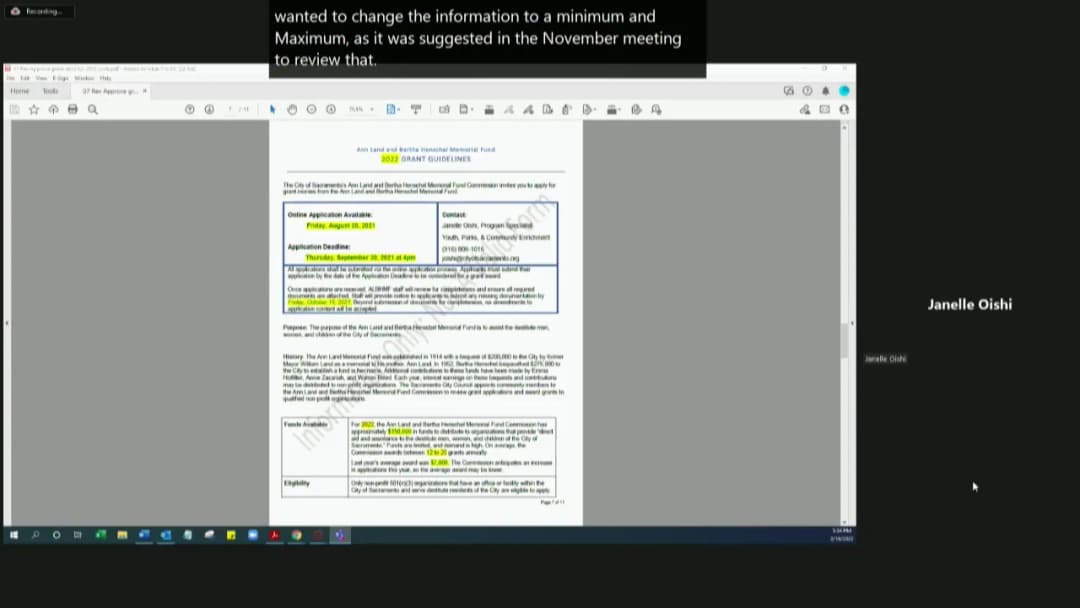
Public Meetings - Sacramento, CaliforniaThe Ann Land Bertha Henschel Memorial Fund Commission held a special meeting virtually via Zoom on Wednesday, February 16, 2022, at 4:00 p.m., under AB361 and the City of Sacramento's COVID-19 local emergency resolution. Commissioners present: Alison Leary, Karen Korbs, Laurie MacIntosh, Talbott Smith, and Wanda Yanez. Absent: Howard Chan and Yousaf Zamanudin. The meeting opened with a land acknowledgement and pledge of allegiance. Consent Calendar - Approved the November 17, 2021 meeting minutes. - Adopted the 2022 Regular Meeting Calendar. - Received and filed the Official City of Sacramento Land Acknowledgement. All consent items passed unanimously with 5 ayes and 2 absences. Discussion Items Housing Strategies Presentation - Danielle Foster, Housing Policy Manager, presented the continuum of housing services: homelessness prevention, problem solving, transitional/interim housing, permanent supportive housing, landlord relationships, and retention. She described affordable housing income categories and rental assistance. - Key statistics: the city has received over $35 million and the county $45 million in COVID-era prevention funds; 40–50% of people counted in recent point-in-time homeless counts were first-time homeless; the median income for a 4-person household in Sacramento County is $91,910; an affordable rent for an extremely low-income single individual is about $400; the county currently has 61 access points for 120 programs. She also noted the City Council funded the first $1 million toward a coordinated access system the previous night. - Commissioners asked about filling funding gaps, Section 8 voucher mechanics, accountability and rules for program participants, mental health and civil liberties, and reuniting unhoused individuals with out-of-state family. Foster advised that flexible local funds are best used on gaps and on programs that can leverage other funding. Semiannual Report (July–December 2021) - Janelle Oishi, Program Specialist, reported that all 2021 grantees submitted required reports except two: Next Move Homeless Services and NeighborWorks Sacramento. No grantee had unexpended funds. - Only Next Move is also a 2022 grant recipient. Next Move received its January 2022 payment, but future payments will be withheld until both reports are received. Michael Sparks, Senior Deputy City Attorney, noted that failure to comply could constitute a breach of contract, with clawback as a last resort. 2022 Site Visits - Commissioners selected site visit assignments for each 2022 grant recipient. Five sites were assigned to Vice President Zamanudin, who was absent. - Staff flagged Harm Reduction Services: it signed a grant agreement but has not registered with the city's supplier portal, so no payments have been processed. - A motion to approve the assignments passed unanimously. 2023 Grant Cycle Documents - The commission discussed and approved the 2023 Annual Commission Funding Priorities. The priorities are: food, and housing with a focus on programs and services designed to prevent homelessness. Commissioner Leary made the motion, seconded by Commissioner Yanez; it passed unanimously. - The 2023 Awards Matrix was approved as presented, with staff asked to incorporate automatic calculations. - The 2023 Grant Guidelines and Application were approved with changes: a maximum grant award of $10,000, a statement that applicants may not request more than $10,000, removal of the sentence "last year's average award was $7,000," updated dates and five-year award averages, and a link to the evaluation matrix. The motion passed unanimously. - Commissioner Talbott Smith observed that Question 9 (number of clients served) was answered inconsistently by applicants and provided little evaluation value; the commission decided to keep the question and consider it in context. Election of 2022 Officers - Alison Leary was re-elected President. - Laurie MacIntosh was elected Vice President. - Talbott Smith was elected Secretary. All officer elections were unanimous. Key Outcomes - Consent calendar approved 5-0. - Housing Strategies Presentation and Semiannual Report received and filed. - 2022 Site Visit assignments approved; reports due Friday, July 29, 2022. - 2023 funding priorities set as food and homelessness prevention services. - 2023 Awards Matrix and Grant Guidelines/Application approved, including the $10,000 maximum award/request cap. - 2022 officers: President Alison Leary, Vice President Laurie MacIntosh, Secretary Talbott Smith. - Meeting adjourned at 6:12 p.m.
The Personnel and Public Employees Committee (P&PE) met on Tuesday, February 15, 2022, at 3:04 p.m. via teleconference due to the COVID-19 pandemic. The committee reviewed applicants for several boards and commissions, discussed changes to the Animal Care Services Citizens Advisory Committee, and approved a new annual reporting process for city advisory bodies. Public Comments & Testimony - Brandy Boyd, Chair of the Sacramento Disabilities Advisory Commission, expressed support for the annual reporting process and echoed Councilmember Valenzuela's request for improved staffing and training for commission support. She noted the lack of a clear mechanism for advisory bodies to communicate with council. - Barry Boyd asked about the removal of SHRA board meeting postings from the city's website (explained by staff as due to separation of SHRA from city council). He also expressed concern that annual reporting might restrict the scope of commissions; Chair Ashby responded that it aims to align priorities with council goals. Discussion Items - Item 1 – Review of Applicants for Capitol Area Development Authority Governing Board: Committee interviewed two candidates for Seat B: Jose Bodipo-Memba and Phil Pluckebaum. Pluckebaum withdrew and endorsed Bodipo-Memba, citing his superior qualifications. The committee unanimously recommended Bodipo-Memba for appointment to the Mayor and Council. - Item 2 – Review of Applicants for the Utilities Rate Advisory Commission: Five seats (B, C, D, E, F) were open. Candidates Connie Perkins, Jill Zito, Rae Vander Werf, and Philip Thomas were interviewed. Incumbent P. Anthony Thomas did not attend. Councilmember Harris initially nominated all five candidates except Thomas, but later withdrew the motion to allow further discussion and to invite Thomas to the next meeting. Action deferred to next P&PE meeting. - Item 3 – Review of Applicants for Ann Land and Bertha Henschel Memorial Funds Commission: Two seats (G and I) were open. The committee interviewed Michelle Arnoult and reviewed applications from Sheila Ellis and Sarah Bannerman. A motion to appoint Michelle Arnoult to Seat G and Sheila Ellis to Seat I passed unanimously. - Item 4 – Review of Applicants for Sacramento Ethics Commission: Three seats (B, C, D) were open. The committee interviewed Deanna Adams, Nicole Velasquez, and Linda Ng. Councilmember Ashby strongly supported Deanna Adams. The committee unanimously approved Deanna Adams for Seat B, Nicole Velasquez for Seat C, and Linda Ng for Seat D. - Item 5 – City of Sacramento Animal Care Services Survey: Farishta Ahrary (Principal Fiscal Policy Analyst) and Phillip Zimmerman (Animal Care Services Manager) presented survey results from July–August 2021 (nearly 700 responses). The survey found animal services ranked third in city priorities; key concerns included stray/injured animals, lost and found services, and affordable veterinary care. The item was received and filed. - Item 6 – Review of Sacramento City Code Chapter 2.86 (Animal Care Services Citizens Advisory Committee): The committee discussed revising the ordinance to change the commission’s structure. Councilmember Valenzuela favored retaining expertise-based seats, while Chair Ashby advocated for council district appointments for better accountability and representation. Compromise: revise language to require “experience” (paid or volunteer) rather than mere interest; keep a seat for a veterinarian or registered veterinary technician (via P&PE appointment); phase in changes over one year, allowing current members to complete their terms. Direction given to staff for ordinance revision. - Item 7 – Annual Reporting of City Advisory Bodies to Ensure Transparency, Consistency, and Inclusive Participation: City Clerk Mindy Cuppy proposed a process requiring each advisory body to submit an annual report to P&PE, which would review and recommend action to council. Councilmember Harris moved to approve; Councilmember Valenzuela suggested additions: ensure city departments review recommendations before submission, clarify that annual reporting is a floor (not a ceiling), and improve staff training and communication. Motion passed unanimously with direction to incorporate these clarifications. Key Outcomes - Appointments recommended to Mayor and Council: - CADA Governing Board Seat B: Jose Bodipo-Memba (unanimous). - Ann Land & Bertha Henschel Funds Commission Seat G: Michelle Arnoult; Seat I: Sheila Ellis (unanimous). - Sacramento Ethics Commission Seat B: Deanna Adams; Seat C: Nicole Velasquez; Seat D: Linda Ng (unanimous). - UrAC appointments deferred to the next P&PE meeting pending further review. - Animal Care Services Ordinance: Direction given to revise Chapter 2.86 to require experience-based qualifications, include a veterinary/professional seat, and phase in council district appointments over one year. - Annual Reporting Process: Approved and forwarded to City Council with added clarifications on departmental review and communication expectations.
The Sacramento Community Police Review Commission held a regular meeting on Monday, February 14, 2022, at 6:01 p.m. via teleconference. The meeting included the approval of the consent calendar, election of a new Chair and Vice Chair, discussion on forming 2022 ad hoc committees, review of the commission's follow-up log, and public comment. The meeting adjourned at 7:46 p.m. Consent Calendar - Approval of Minutes (Item 1): Passed a motion approving the minutes of December 13, 2021. - Official Land Acknowledgement (Item 2): Received and filed. - 2022 Regular Meeting Calendar (Item 3): Pulled for separate discussion; passed a motion to approve after Commissioner Bliss raised questions about scheduling. Staff clarified that the mayor's office directed calendar adoption but special meetings can be requested. The calendar was approved unanimously (7-0, with Commissioners Carter, Falcon, Jefferson, and Zamora absent). - Dissolution of 2021 Ad Hoc Committees (Item 4): Passed a motion dissolving five ad hoc committees: Mental Health/Alternative, Community Engagement and Media, LGBTQ+, Crowd and Riot Control, and Budget. Public Comments & Testimony - Evan Minton (co-chair of Lieutenant Governor's Transgender Advisory Council) spoke on Item 6 (Ad Hoc Committees). He thanked outgoing Chair Guerrero, congratulated new Chair Castillo-Krings and Vice Chair Bliss, and urged continuation of the LGBTQ+ ad hoc to follow up on the adopted SPD policy and to address interactions with sex workers, LGBTQ+ people of color, and individuals living with HIV/AIDS. Discussion Items - Item 5 – Selection of Chair and Vice Chair for 2022: - Commissioner Graciella Castillo-Krings was nominated by Chair Guerrero and seconded by Commissioner Marion, and elected Chair by a 7-0 vote. - Commissioner Keyan Bliss was nominated by Chair Castillo-Krings and seconded by Commissioner Elkarra, and elected Vice Chair by a 7-0 vote. - Item 6 – Ad Hoc Committees for 2022 (Oral Report): - Commissioners proposed and discussed six topic areas for new ad hocs: (1) Alternative Response Model/911 (proposed by Chair Castillo-Krings), (2) Surveillance (proposed by Vice Chair Bliss), (3) Implementation of past recommendations (proposed by outgoing Chair Guerrero), (4) LGBTQ+ (proposed by Guerrero), (5) Budget (proposed by Bliss), and (6) Use Case Framework (proposed by Commissioner Williamson). - Staff and the City Attorney advised that ad hocs must have distinct names and purposes to avoid becoming standing committees. The commission agreed to have the new Chair and Vice Chair finalize the ad hoc structures and appointments. - Item 7 – Follow-Up Log: - Commissioners reviewed outstanding items, including requests for SPD presentations on protest policies, riot control manual updates, 911 dispatch data, hiring processes, and the Truth, Reform, and Reconciliation project. Lieutenant Galliano provided updates: the crowd and riot control manual is in final review; a standalone policy will be created; nameplates will always be worn on outermost garments; SPD adopted a transgender policy but not all commission requests; the 911 data request is being processed (1.4 million calls, redaction underway). Dr. Watson noted that a $600,000+ reconciliation project awaits council approval. Key Outcomes - Elected Graciella Castillo-Krings as Chair and Keyan Bliss as Vice Chair for calendar year 2022 (both 7-0 votes). - Approved the 2022 regular meeting calendar with allowance for special meetings. - Dissolved all 2021 ad hoc committees. - Identified six topics for 2022 ad hoc committees, to be formalized by the new Chair and Vice Chair. - Received and filed the follow-up log; several pending items remain open, including data requests and policy presentations. - Commission comments included welcoming new commissioners, discussion of the pending City Auditor's report on the commission (to be presented after council action on February 22), and plans to revise rules of procedure regarding public comment (verbal instructions, extended speaker time, maintaining Zoom raise-hand feature). - The meeting adjourned at 7:46 p.m.
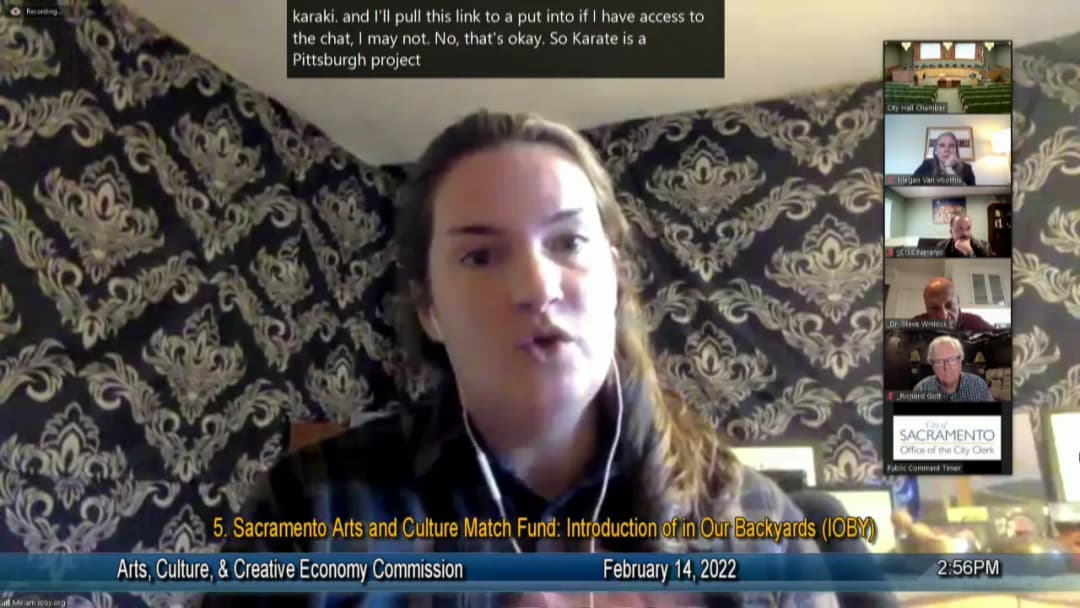
The Sacramento Arts, Culture, and Creative Economy Commission held a virtual teleconference meeting on Monday, February 14, 2022, from 2:02 p.m. to 4:03 p.m. The meeting included the introduction of a new youth commissioner, a discussion on the commission's advocacy role, a presentation on the new Arts and Culture Match Fund via IOBY, and a detailed equity analysis of CARES individual artist investments. All agenda items were received and filed or approved without public comment. Consent Calendar - Approval of Meeting Minutes (December 13, 2021): Approved unanimously by a motion from Commissioner Naranjo, seconded by Commissioner Hastings. Commissioners present: Gott, Hastings, Mehta, Naranjo, Wilson Ramey, Enriquez, and Chair Winlock. Absent: Blumenstock, Lavulo, Lepore, and Perez. - Official City of Sacramento Land Acknowledgement: Received and filed. Public Comments & Testimony - No members of the public spoke on any agenda item. Discussion Items - Introduction of Youth Commissioner Akshaj Mehta: Commissioner Mehta, a 16-year-old junior at Thomas Pacific Pathways Prep and a published writer, was introduced. He expressed excitement about representing youth on the commission. Commissioners welcomed him and noted the importance of youth perspective. - Discussion on the Work of the Commission (Oral Report): Chair Winlock led a discussion on how commissioners view their advocacy role. Commissioners shared their individual efforts: Commissioner Naranjo promoted a solo artist show and raised concerns about a gallery closing; Commissioner Hastings highlighted her magazine's promotion of artists and coverage; Commissioner Perez discussed collaboration in the dance industry; Commissioner Enriquez emphasized evangelizing the arts and exploring funding opportunities; Commissioner Gott focused on building infrastructure for young artists and understanding grant processes. Chair Winlock noted that the next meeting would address what commissioners need to support their advocacy (e.g., business cards, public emails). - Sacramento Arts and Culture Match Fund: Introduction of IOBY: Megan Van Voorhis introduced Miriam Parson from IOBY (In Our Backyards). The program uses a crowdfunding match model to double community donations for creative projects, targeting unincorporated groups and BIPOC communities. The fund will roll $100,000 per quarter, with up to $15,000 match per project. Commissioners asked about examples (e.g., Afghan food festival in Pittsburgh, Sofa Stories in Detroit) and funding structure. Van Voorhis requested commissioner help in identifying community contacts for outreach. - Race & Cultural Equity Check-In: Analysis of CARES Individual Artist Investments Disaggregated by Race: Megan Van Voorhis presented data on nearly $2 million distributed to 231 individual artists. Success rates varied by race: White, Multiracial, Hispanic/Latino, Black/African American had higher success rates; Asian/Asian American, Pacific Islander, and Native American/American Indigenous had lower success rates. Average awards also differed, with Black/African American artists receiving the lowest average. The analysis noted underrepresentation of Hispanic/Latino and Asian populations in the applicant pool and recommended further outreach and capacity building. Commissioner Naranjo raised concerns about grant application complexity, inclusion of Latinos as people of color, and the status of a proposed grant workshop program. Van Voorhis responded that program design affects equity and that ARPA funding decisions were pending. - Director’s Report (Item 7): Van Voorhis reported on executed contracts, arts education efforts, equity data collection, upcoming grant rounds (Cultural Equity Investment Program, NEA individual artist grants), and a review of arts and entertainment permitting processes. Also mentioned assistance with Caltrans Clean California art applications and a Carbon Zero Art Contest for youth ages 14–24 (prizes up to $500, submissions due February 24). Luis Montes from the Mayor’s Office presented the contest details. Commissioners requested flyers and suggested extending the deadline. - Chairperson’s Report (Item 8): Chair Winlock highlighted the equity data work, attended the California Car Museum's lowrider art exhibit, and praised the Friends of Sacramento's jazz celebration. He welcomed the youth commissioner. Key Outcomes - All items on the consent calendar were approved unanimously. - All discussion and information items were received and filed (no votes required, as they were informational). - The commission will prepare a follow-up on commissioner needs for advocacy (business cards, public emails) at the next meeting. - Staff will send a list of talking points and outreach contacts for the IOBY match fund. - The Carbon Zero Art Contest deadline may be extended; commissioners will promote it. - Commissioner Naranjo raised several questions (joining California Arts Advocates, chamber of commerce, mural restoration, Crocker Art Gallery representation) which were noted for follow-up at the next meeting. - The meeting adjourned at 4:03 p.m. due to loss of quorum.
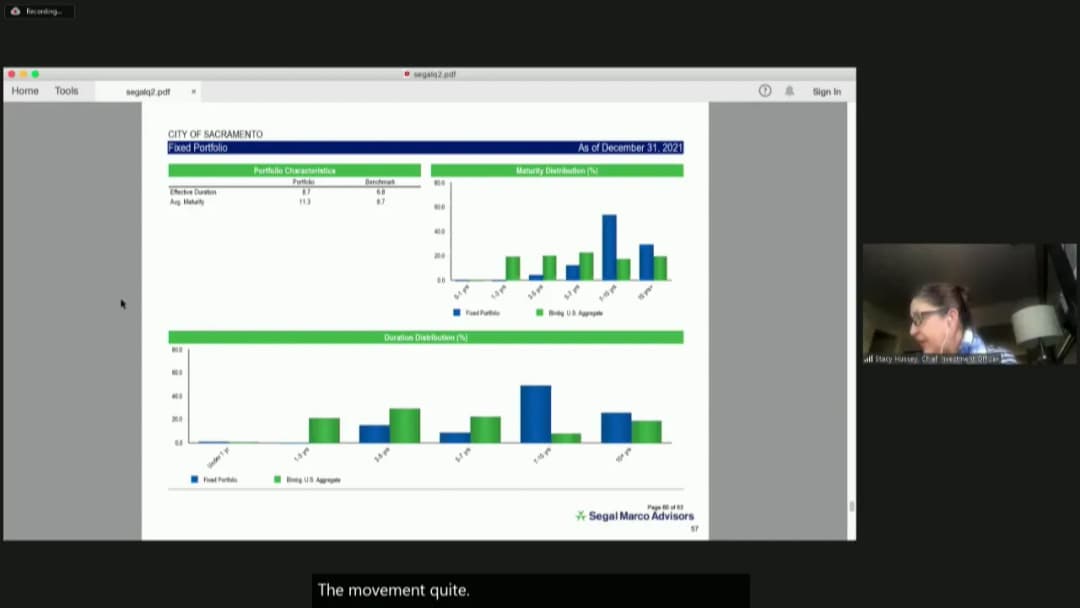
The Administration, Investment & Fiscal Management Board (AIFM) of the City of Sacramento met via teleconference on Thursday, February 10, 2022, from 1:36 p.m. to 2:15 p.m. Chair Manuel Leon presided. The board unanimously approved all consent calendar items, accepted quarterly investment reports, received the SCERS annual financial audit, and elected new leadership for calendar year 2022. Consent Calendar - Approved the minutes from the November 18, 2021 meeting. - Received and filed the Official City of Sacramento Land Acknowledgement. - Accepted SCERS monthly investment reports for October, November, and December 2021. - Approved the continuation of the Bloomberg Agreement for Fiscal Year 2022–2023. - All consent items were passed by a single 5–0 vote (Members Bach, Bader, Colville, Combs, Leon voting yes). Discussion Items - Segal Marco Advisors Quarterly Investment Performance Report (Item 7): Craig Chaikin reported that equity returns were strong in Q4 2021, with the S&P 500 up 11%. The total portfolio earned 6.2% for the quarter and 16.9% for the one-year period. He noted that inflation (CPI at 7.5%) and anticipated Federal Reserve rate hikes are creating volatility in early 2022. The board passed a motion to accept the report (5–0). - SCERS Quarterly Investment Report (Item 8): Chief Investment Officer Stacy Hussey presented the SCERS portfolio, valued at $317.5 million as of December 31, 2021. She reported that the plan is approximately 110% funded, with a net pension asset of $28.8 million. However, January 2022 saw a roughly 2% decline, and fixed income has underperformed due to rising interest rates. The board accepted the report unanimously (5–0). - SCERS Annual Financial Report & Audit Letters (Items 9–11): Osvaldo Lopez, Finance Manager, presented the fiscal year 2021 financial statements, which received a clean (unmodified) audit opinion. Key figures: net position increased $48 million to $311 million; investment income rose from $7.6 million to $77 million; plan membership fell from 924 to 876, with only 3 active members. The board received and filed all three items without a vote. - Selection of Chair and Vice Chair (Item 12): After discussion, Vice Chair Jason Bader was elected Chair for 2022 (motion by Member Colville, second by Chair Leon; vote 5–0). Member John Colville was then elected Vice Chair (motion by Vice Chair Bader, second by Chair Leon; vote 5–0). The new chair will take office at the next meeting. Board Comments & Introductions New members David Bach (46 years of investment experience, former CalPERS) and Emily Combs (new City Finance Director) introduced themselves. Chair Leon noted he has served two terms and will be rotating off the board; recruitment for a replacement is ongoing. Key Outcomes - All consent calendar items approved 5–0. - Segal Marco and SCERS quarterly investment reports accepted 5–0. - FY 2021 SCERS financial report, auditor’s letter, and internal control report received and filed. - Jason Bader elected Chair and John Colville elected Vice Chair for calendar year 2022. - No public comments were received on any agenda item. - Meeting adjourned at 2:15 p.m.
The Budget and Audit Committee met via teleconference on Tuesday, February 8, 2022, from 3:02 p.m. to 4:08 p.m., to consider the Fiscal Year (FY) 2021/22 Midyear Review. Committee members present: Mayor Darrell Steinberg (Chair), Eric Guerra (Vice Chair), Rick Jennings, and Mai Vang. The meeting included a presentation by Finance Director Emily Combs on the city's financial status, a supplementary proposal from Mayor Steinberg to invest $27 million in one-time community priorities, 14 public comments (all supportive), and a unanimous vote to forward the midyear review and the mayor's amendments to the full City Council for approval. Public Comments & Testimony - David Ben Wellos (member of the public): Expressed strong support for the $200,000 allocation to the Latino Center of Arts and Culture at Wynne Park, citing the importance of arts and cultural spaces for community bridging and tourism. - Julie Heroda (CEO, St. John's Program for Real Change): Supported the $1 million for women and children shelter resources, reporting that St. John's supported 475 unhoused women and children last year, with 70–75% exiting to stable housing. - Bassim Alkyra (Executive Director, CARES Sacramento Valley): Supported renewed funding for the FUEL Network, noting its essential role in providing pro bono immigration services to low-income immigrants and refugees, especially amid the Afghan refugee crisis. - Nia Mooreweather (Community Organizer, Youth Forward and Sacramento Kids First Coalition): Supported the midyear review and the mayor's proposal, emphasizing the importance of inclusive economic development and youth investments. - Rachel Rios (representing La Familia): Thanked the mayor for the $2 million La Familia Opportunity Center proposal, and supported youth services, homeless projects, the Latino Center, and the FUEL Network. - Arlen Orchard (representing Sacramento State and SMUD): Advocated for the $1 million to the California Mobility Center, noting that it trained over 500 participants in the past year, resulting in more than 120 job placements and 50 internships. - Richard Falcone (Community Organizer, United Latinos; Executive Director, Teatro Nahua): Supported the mayor's proposals, particularly for the FUEL Network, La Familia, and the Latino Center of Arts and Culture. - Lambert (owner, To the Bay and Back Cheesecakes): Thanked the mayor for his vision but requested similar investment in Del Paso Heights and the California Black Chamber of Commerce. - Brian Lopez (President, Cruz Reynoso Bar Association): Supported continued FUEL Network funding, emphasizing the ongoing need for immigration legal services due to the complexity of immigration law and the persistent threat of deportation. - Adrian O'Correl (Policy Director, Sacramento Housing Alliance): Thanked the mayor for the $10 million housing trust fund replenishment and urged the council to prioritize a $100 million affordable housing bond to leverage state and federal resources. - Jeffrey Tardi Gia (Co-Chair, Point-in-Time Count): Appreciated funding for the point-in-time homeless count, which helps quantify the issue. - Lisa Bates (Sacramento Steps Forward): Expressed support for the $1 million coordinated access system, explaining that Sacramento lacks a streamlined entry point for homeless services, and that over 60% of unsheltered individuals are not in HMIS. - Carolyn Caballas (Latino Economic Council of Sacramento): Endorsed the mayor's proposals, particularly $2 million for La Familia, $200,000 for the Latino Center, and $500,000 for the FUEL Network, citing that Latino residents represent approximately 28% of the city. - Jesus Mata (Board member, Latino Center of Art and Culture): Voiced strong support for the $200,000 allocation for the Wynne Park building renovation, hoping his brothers can see Latino contributions reflected in public spaces. - Dante Williams (Mercy Housing, former resident of Marina Vista): Urged approval of the $2.5 million for Marina Vista and Alder Grove, describing the need for youth programs and community support. Discussion Items Fiscal Year 2021/22 Midyear Review Finance Director Emily Combs presented the midyear review, highlighting key financial changes since budget adoption: - Revenue and Fund Balance: The city ended the prior year with additional resources due to higher sales tax, Measure U transaction taxes, property transfer taxes, and operational savings from position vacancies. Recommended revenue adjustments total $26.2 million, with $12.3 million allocated to debt service and $20.5 million estimated for pending labor contract costs. A surplus of $49.9 million is reserved for future budget deficits. - One-Time ARPA Allocations: Includes funding for a citywide equity study, towing fee reform, Sacramento Native American Health Center for COVID-19 services, 19 positions for homeless outreach and code enforcement (alternative response), building inspection positions, after-hour veterinary care, staff additions in the City Clerk's Office and City Manager's Office, and park development for the Sacramento River East Levee project. - Measure U Funds: Additional costs for Fire 911 dispatch center, solid waste disposal (CPI adjustment), and delinquent account rate payment waiver program. - Five-Year Forecast: Revised to include $7.2 million for housing trust fund replenishment (including $5 million for labor negotiations and $2.2 million from fire diversity positions). - Budget Timeline: Proposed budget release week of April 18, 2022; City Council hearings in May and June; final adoption June 14, 2022. Mayor Steinberg's Proposal to Amend the Midyear Review Mayor Steinberg presented a letter recommending an additional $27 million in one-time investments (beyond the city manager's foundation), echoing prior midyear practices. The proposal includes: - Housing and Homelessness ($14.8 million): $10 million to replenish the Affordable Housing Trust Fund (including $7.2 million already owed), $2.8 million for Department of Community Response (DCR) outreach contracts with community-based organizations to have teams in every council district, $1 million for a coordinated access system (contingent on county and Continuum of Care matching funds), $1 million for women and children's shelter resources. - Economic Development ($3.2 million): $2 million for La Familia Opportunity Center, $1 million for California Mobility Center (workforce training), $200,000 for Latino Center of Arts and Culture at Wynne Park. - Youth and Community Investment ($5.5 million): Broad youth program investments building on ARPA/CARES funds, plus $2.5 million specifically for Marina Vista and Alder Grove neighborhood initiatives. - Racial Equity ($500,000): Virtual resource center, racial equity council, grants for trauma-informed mediators and mental health counselors, and exploration of a national reparations policy. - FUEL Network ($500,000): Continued support for immigrant and refugee legal services. Key Outcomes - Motion and Vote: Councilmember Eric Guerra moved to accept the FY2021/22 Midyear Review as amended by the mayor's letter and forward it to the City Council for approval. Councilmember Rick Jennings seconded. The motion passed unanimously (4–0) with all members voting yes. - Committee Member Requests: - Councilmember Vang requested that future reports include performance metrics and outcomes for midyear investments, and asked that a status update on the Measure U participatory budgeting pilot be agendized at a future Budget and Audit Committee meeting. - Councilmember Jennings requested a future discussion on deferred maintenance of city ball fields, potentially separate from the midyear review. - Councilmember Guerra raised the issue of high ambulance wall times and career pathways for EMTs/paramedics; Mayor Steinberg suggested a full council workshop in April 2022, contingent on the status of labor negotiations with Local 522. - Next Steps: The midyear review and the mayor's amendments will be presented to the full City Council for final approval at an upcoming meeting.
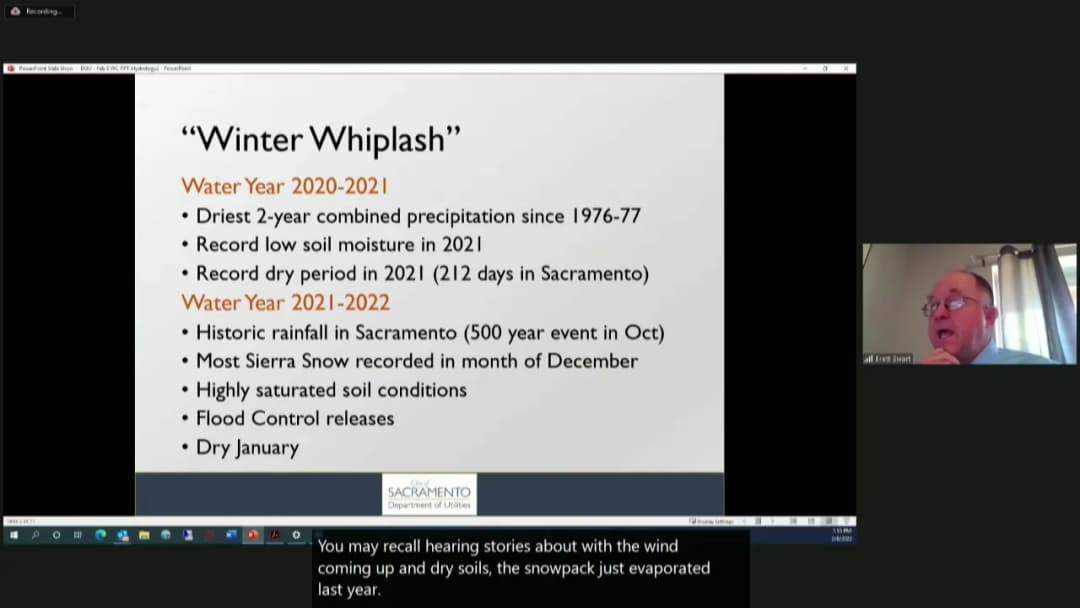
The Sacramento Water Committee met on Tuesday, February 8, 2022, from 1:01 p.m. to 2:10 p.m. via teleconference. Chair Jeff Harris (District 3) presided, with Vice Chair Mai Vang (District 8) and Councilmember Katie Valenzuela (District 4) present. The committee received and filed four oral reports: the Central Valley Flood Protection Plan 2022 Update, the Sacramento Regional Water Bank Update, the Department of Utilities 2021 Year in Review, and a Current Hydrology and Conservation Update. The agenda was reordered to start with item 4 for the convenience of presenters. Public Comments & Testimony - Daphne (public speaker on Item 3 – Sacramento Regional Water Bank Update): Requested that copies of the presentation be made available after the meeting. No other public comments were received on agenda items or on matters not on the agenda. Discussion Items - Item 4: Central Valley Flood Protection Plan (CVFPP) 2022 Update – Mary Jimenez (Department of Water Resources) and Ruth Darling (Central Valley Flood Protection Board) presented the working draft. Key points: The plan is the state’s programmatic vision for flood risk management over 30 years; the total investment need is now estimated at $25–$30 billion (up from $17–$21 billion in 2017); new policy issues on equity/social justice and climate resilience are being introduced; a public draft is expected by late March 2022, followed by a 60-day comment period with in-person and virtual public hearings. Chair Harris noted the Yolo Bypass Cache Slough Partnership is stalled and critical for flood protection, and that SAFCA has secured $1.8 billion for local flood projects. - Item 3: Sacramento Regional Water Bank Update – Jim Peifer (Executive Director, Regional Water Authority) presented. Key points: The water bank aims to adapt to climate change by storing water underground; the region’s groundwater basin has capacity to store more water than Folsom Reservoir; climate change is projected to reduce snowpack by 75% and shift runoff peaks from May to March; the city’s cost to divert and deliver water has tripled since 2003 while inflation rose only 50%; Peifer asked for regional support to secure state and federal investment for the water bank. The committee received and filed the presentation. - Item 1: Department of Utilities 2021 Year in Review – Bill Busath (Director, Department of Utilities) presented. Highlights: 31 billion gallons of water treated in 2021; the five-year meter installation program is essentially complete, on time and under budget; the McKinley Vault project performed well during record storms; the drainage division managed significant flood events and addressed unhoused encampments at critical facilities; over $3.1 million in federal assistance was received to cover water bill arrearages; the Utilities Rate Assistance (SURA) program will be discussed at the Budget and Audit Committee on March 1, 2022, with potential budget adjustments for new rate adjustments. - Item 2: Current Hydrology and Conservation Update – Brett Ewart (Senior Engineer) presented. Key points: Despite heavy storms in October and December 2021, January 2022 was dry, and statewide storage remains low; Folsom Reservoir storage is above normal but may be drawn down to meet statewide deficits; the city’s water conservation efforts have resulted in a 6–22% reduction compared to 2020, and the city remains one of the most efficient water users in the region; the state’s new regulations on wasteful water use are already matched by city code; the drought is not over, and no relaxation of conservation measures is recommended. Committee Comments & New Business - Councilmember Valenzuela raised the issue of access to clean drinking water for unhoused residents, noting that a county contract for water delivery to encampments had lapsed. She proposed exploring the creation of public water access points (e.g., at parks) and asked for discussion at the next Water Committee meeting in May 2022. Director Busath acknowledged the issue and said he would begin discussions with city staff. Key Outcomes - All four oral reports were received and filed by unanimous consent. - The committee will next meet on May 24, 2022, and then on August 9, 2022. - The public draft of the CVFPP 2022 Update is expected by late March 2022, with a 60-day comment period thereafter. - The Department of Utilities will present on the SURA program structure and funding at the Budget and Audit Committee on March 1, 2022.
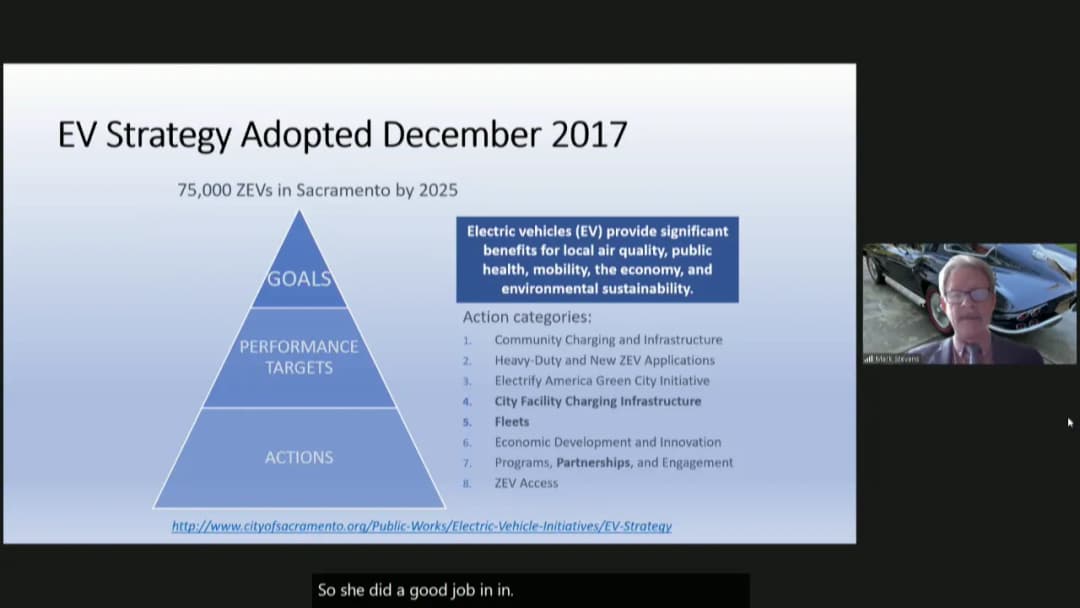
The Budget and Audit Committee of the Sacramento City Council met on Tuesday, February 1, 2022, from 3:03 p.m. to 4:01 p.m. via teleconference. The meeting covered consent calendar items, a discussion of the Fiscal Year 2020/21 Annual Comprehensive Financial Report (ACFR), the Truth, Reform, & Reconciliation Multi-Year Operating Project, and a Fleet Electrification Update. All members were present: Mayor Darrell Steinberg (Chair), Councilmember Eric Guerra (Vice Chair), Councilmember Rick Jennings, and Councilmember Mai Vang. Consent Calendar - Item 1 – Cannabis Business Operating Permit Extension Fee and Appeal Fee: The committee considered and forwarded to City Council the establishment of an extension fee for cannabis BOP applications and an appeal fee for illegal cultivation. - Item 3 – FY 2020/21 Independent Accountants’ Report on Appropriation Limit Calculation: Received and filed. - Item 4 – FY 2020/21 Transportation Development Act Fund Audited Financial Statements and Compliance Report: Received and filed. - The consent calendar was adopted unanimously via a single motion (Guerra/Jennings) with all four members voting yes. Public Comments & Testimony - No public comments were made on any agenda item or on matters not on the agenda. Discussion Items - Item 2 – Fiscal Year 2020/21 Annual Comprehensive Financial Report (ACFR): This item was moved from the consent calendar to the discussion calendar. Osvaldo Lopez, Finance Manager, presented the ACFR, noting a clean audit with an unmodified opinion. Key financial results: General Fund tax revenue exceeded budget by $23.5 million; department operations saved $11.6 million; offset by $4.9 million in citywide expenditures, resulting in $30 million in one-time resources added to the available fund balance. An additional $15.7 million was available in the Major U fund. The city’s other post-employment benefit trust was $74.8 million (25% of estimated liability), and the General Fund Economic Uncertainties Reserve increased from $55.2 million to $58.5 million. The committee accepted the report and forwarded it to the City Council for approval (motion by Guerra, second by Vang; unanimous). - Item 5 – Truth, Reform, & Reconciliation Multi-Year Operating Project: Dr. LaTesha Watson, Director of the Office of Public Safety Accountability, presented a timeline and cost breakdown. The project originally had $320,000 approved, but the selected firm (Sustainable Equity) proposed a total of $600,000 (an additional $280,000). Committee members discussed the need to align this work with the city’s racial equity initiatives (Race Forward and the Racial Equity Leadership Network). Councilmember Vang requested clarity on deliverables and stipends for community participants. Councilmember Jennings stressed urgency to move forward. The committee directed staff to refine the MOU and scope of work to ensure synergy with existing racial equity efforts. The item was received and filed, with direction to present a refined proposal as part of the mid-year budget discussion. - Item 6 – Fleet Electrification Update: Mark Stevens, Fleet Manager, reported that the city’s fleet of about 2,700 vehicles is 49% alternatively fueled, with operating costs for battery electric vehicles at 18 cents per mile vs. 33 cents for gasoline vehicles. Barriers include upfront capital costs and infrastructure needs. The committee requested a detailed budget and infrastructure plan to support the city’s goal of 75,000 electric vehicles by 2025 and to accelerate the transition of the city fleet. Councilmember Guerra suggested exploring economic development opportunities through local manufacturing and design. The item was received and filed, with a request for a follow-up presentation. Key Outcomes - Item 2: Motion passed unanimously to accept the FY2020/21 ACFR and forward to City Council. - Item 5: Received and filed; direction given to refine the MOU in coordination with racial equity efforts and bring back for budget consideration. - Item 6: Received and filed; staff directed to return with a capital and infrastructure plan for fleet electrification, including potential costs and economic development opportunities.
The Measure U Community Advisory Committee convened virtually on January 31, 2022, from 6:04 p.m. to 10:39 p.m. The meeting featured the election of officers, a detailed workshop to finalize the Participatory Budgeting (PB) Pilot Program Playbook, the formation of a budget ad hoc committee, and the approval of the 2022 meeting goals and consent calendar. Consent Calendar - The committee unanimously approved the Consent Calendar (Items 5-9), which included: - Approval of the November 15, 2021, meeting minutes. - Acceptance of the 2022 Regular Meeting Calendar. - Receipt and filing of the Official City Land Acknowledgement. - Receipt and filing of the Ad Hoc Committees Membership Roster. - Receipt and filing of the Final Recommendations to City Council for FY2021/22 Midyear Budget Priorities. - The motion was made by Member Mora and seconded by Member Dickinson, passing unanimously (10-0, with Goris and Perez absent). Public Comments & Testimony - Several members of the public provided comments on the Participatory Budgeting Pilot Program Playbook (Item 2): - PJ expressed support for the process but strongly advocated for active measures to include historically disenfranchised voices to prevent domination by whiter, wealthier residents. They questioned the inclusion of Woodlake in the focus areas. - Barry Boyd (a city commissioner) requested a clear definition of "equity" and warned against government acronyms. He expressed concern that the 30-day outreach timeline was too short to reach underrepresented communities, noting he had not heard of the project until this meeting. He advocated for excluding Johnson Business Park and including Freeport Manor. - Keon Bliss urged the committee to ensure proposals directly benefit the most disenfranchised residents and cautioned against the process being co-opted by more affluent residents. They also advocated for compensating volunteers and proposal delegates. - Stevie (a local civics teacher) praised the youth voting age of 14 but pushed for specific outreach plans targeting high schools and youth representative bodies in the focus neighborhoods. - Rachel Minnick asked why specific high-need neighborhoods were chosen over the entire inclusive economic development map, surmising it was due to the limited $1 million budget. - Ryan McClinton (program manager with Public Health Advocates) commended the process and asked about alignment with existing policies like the public safety resolution and whether a weighted scale would be used to prioritize projects from underrepresented groups. Discussion Items - Selection of Chair and Vice Chair (Item 1): The committee unanimously re-elected Flojaune Cofer as Chair and Kimberly Williams as Vice Chair for calendar year 2022. (Note: The meeting minutes recorded Tracy Thomas as absent for these votes; the transcript indicates she was online but muted for the Chair vote, treated as an abstain, and was briefly offline for the Vice Chair vote.) - Participatory Budgeting (PB) Pilot Program Playbook Workshop (Item 2): The PB Ad Hoc Committee led a workshop to finalize the Playbook, which outlines the rules for spending $1 million in Measure U funds. Key discussion points included: - Geographic Focus: The committee debated the proposed focus neighborhoods. Members Sala, Dickinson, and others successfully argued to remove the "mitten" area (Alkali Flat, Dos Rios, Richards) and to add Gardenland and Strawberry Manor to ensure the pilot targeted the most historically underinvested areas. The inclusion of Woodlake was also questioned. - Timeline: Several members and public commenters expressed strong concern that the proposed 30-day timeline for idea collection was too aggressive to achieve meaningful community engagement. - Equity: Member Thomas questioned how equity was specifically defined and operationalized in the Playbook versus other cities, expressing a need for more clarity. - Governance: Member Thomas raised concerns about the transparency of the Ad Hoc committee's decision-making process and the level of authority delegated to it by the full committee. - City Staff and Council Role: Chair Cofer clarified that the City Council retains final approval authority for projects selected through the PB process, and city staff (including NDAT) will be integrated into the proposal development process. - FY2022/23 Measure U Budget Priorities (Item 3): The committee discussed the timeline for developing budget recommendations. Chair Cofer proposed forming a new Ad Hoc committee to develop detailed priorities for presentation at the March meeting, rather than finalizing them in January. Member Pray made a motion to create the Ad Hoc, which was seconded and passed unanimously. - 2022 Committee Goals and Meeting Agendas (Item 4): The committee discussed and approved the updated agenda log for the year, which schedules future discussions on budget priorities and the city's budget proposal. Key Outcomes - Chair and Vice Chair (Item 1): Re-elected Flojaune Cofer as Chair and Kimberly Williams as Vice Chair for 2022. Unanimous. - Participatory Budgeting Playbook (Item 2): The committee passed a motion (10-0-1, with Thomas abstaining) to approve the Playbook with key amendments: - Geographic areas adjusted: Gardenland and Strawberry Manor were added; the "mitten" area was removed. - Timeline extended: The outreach and idea collection phase was extended by at least 30 days. - Budget Ad Hoc Committee (Item 3): A new Ad Hoc Committee was formed to develop FY2022/23 Measure U Budget priority recommendations. Members Sala, Dickinson, and Thomas volunteered to serve. The committee is to report back at the March meeting. - Consent Calendar (Items 5-9) & Goals (Item 4): The consent calendar and the 2022 committee agenda log were approved unanimously.