The Sacramento Civil Service Board held a teleconference meeting via Zoom on Monday, January 31, 2022, from 1:01 p.m. to 1:50 p.m. Due to COVID-19, the meeting was conducted remotely under AB361. The board addressed a closed session matter, approved a consent calendar of routine items, and elected its chair and vice chair for calendar year 2022. Four members were present (Gwynnae Byrd, Emmanuel Amanfor, Joy Gonzalez-Cabatic, and Kathryn Meola); Shalinee Hunter was absent. No members of the public provided comment. Consent Calendar - Approval of Civil Service Board Minutes (File ID: 2022-00231) – Passed a motion approving the minutes of the December 6, 2021 meeting. - Official City of Sacramento Land Acknowledgement (File ID: 2022-00277) – Received and filed. - Revision of the Fingerprint Clerk Classification Specification (File ID: 2022-00281) – Approved revisions to more accurately reflect job duties. - Revision of the Police Officer Classification Specification (File ID: 2022-00320) – Approved revisions adding language compliant with Assembly Bill No. 846. - Revision of the Police Sergeant Classification Specification (File ID: 2022-00307) – Approved revisions adding language compliant with Assembly Bill No. 846. All consent items were approved by a single motion (4-0, with one absent). Closed Session - The board adjourned to closed session under Government Code Section 54957 to discuss public employee discipline/dismissal/release. Upon reconvening, Chair Byrd reported that the board approved the arbitrator’s decision with additional recommendations. The motion passed unanimously (4-0). Discussion Items - Selection of Chair and Vice Chair for Calendar Year 2022 (File ID: 2022-00276) – Staff presented the process for annual rotation. Chair Byrd expressed willingness to continue but encouraged others to serve. Vice Chair Amanfor declined nomination for Chair. Member Meola nominated Byrd for Chair, seconded by Amanfor. Motion passed 4-0. Chair Byrd then nominated Amanfor for Vice Chair, seconded by Meola. Motion passed 4-0. Both incumbents were re-elected to their positions for 2022. Board Comments & Public Comments - No board comments or questions were offered. - No public comments were made for matters not on the agenda. Key Outcomes - Approved the arbitrator’s decision in closed session (4-0). - Adopted the consent calendar (4-0), including revisions to three Police and Fingerprint Clerk classification specifications. - Re-elected Gwynnae Byrd as Chair and Emmanuel Amanfor as Vice Chair of the Civil Service Board for calendar year 2022 (both votes 4-0).
Public Meetings - Sacramento, California
Public Meetings - Sacramento, CaliforniaThe Sacramento Planning and Design Commission held a regular meeting on Thursday, January 27, 2022, beginning at 5:30 p.m. via teleconference due to the COVID-19 pandemic. The commission addressed three public hearings: an appeal of the planning director’s determination that a cannabis conditional use permit (CUP) had expired, a conditional use permit for a delivery-only cannabis dispensary, and an amendment to the Gateway Center Planned Unit Development (PUD) to allow multi-unit residential uses. The meeting also included a consent calendar, a director’s report, and commissioner comments. The meeting adjourned at approximately 8:30 p.m. Consent Calendar - Approval of January 13, 2022, Minutes (File ID: 2022-00247): The commission unanimously approved the minutes from the previous meeting. - Teleconferencing Meetings During COVID-19 State of Emergency (30-Day Finding) (File ID: 2022-00269): The commission approved a motion to continue meeting by teleconference pursuant to California Government Code section 54953(e), citing the ongoing emergency and risks to health and safety. Director’s Report - Stacia Cosgrove, Principal Planner, reported two updates: (1) the City Council had denied an appeal of the commission’s decision to deny a conditional use permit for off-site alcohol sales at a gas station on West El Camino and Orchard Lane; (2) the Council approved the 2022 Planning and Zoning Work Program on Tuesday, January 25, 2022. Public Comments & Testimony - Item 4 – Appeal of Planning Director’s Determination of Expiration (M21-011): One member of the public, Don Carlson, representing the Power and Alliance, spoke in support of staff’s recommendation to deny the appeal. He acknowledged the applicant’s investments but stated that the cap on cannabis cultivation square footage must be upheld and that the project should be denied. - No public comments were received on Items 5 or 6, or on matters not on the agenda. Discussion Items Item 4 – Appeal of Planning Director’s Determination of Expiration (M21-011) - Location: 5801 & 5811 Alder Avenue (also 8955 & 8951 Osage Avenue), District 6. - Background: The applicant, Remy Handel, had been granted a conditional use permit (CUP) for cannabis production on January 30, 2019, with a condition that building permits must be obtained and construction commenced by February 5, 2020, or the CUP would expire. This one-year condition was imposed due to a Southeast Area undue concentration ordinance (cap) adopted in June 2018. The applicant did not apply for a building permit or seek an extension before the deadline. A building permit was applied for after expiration, and the planning director issued a formal determination of expiration on September 16, 2021. The applicant appealed. - Applicant’s Position: The applicant argued that (1) they were not notified of the expiration, (2) they spent significant money on electrical upgrades ($378,000) and site work, and (3) they relied on oral promises from staff (Christian Svensk) that the city would work with them and that progress would suffice. The applicant’s attorney, Jacob Callaghan, emphasized that the city’s internal failure to catch the expiration during plan check (which took over a year) should not penalize the applicant. - Staff’s Position: Staff argued that the conditions were clear, the applicant was responsible for tracking expiration dates, and that the work done (electrical, roof, trenching) did not constitute “construction” for the cannabis use. Staff also noted that the cap on square footage was intended to ensure fair allocation, and that other applicants were waiting for the square footage to become available. No extension request was ever submitted. - Commissioner Questions and Deliberation: Several commissioners asked about the clarity of conditions, the city’s intake process, and whether the applicant had been misled. Commissioner Chase expressed concern about the city’s failure to catch the expiration early, noting that the applicant had acted in good faith. Commissioner Wallace suggested revisiting outreach processes to avoid similar issues. The city attorney clarified that the commission could not apply equitable estoppel; the question was whether the building permit was obtained before expiration. The vote was 12 in favor of denial (Commissioner Chase dissenting). Item 5 – BLK Cannabis Delivery-Only Dispensary CUP (P21-010) - Location: 700 El Camino Avenue, District 2. - Proposal: A conditional use permit to establish a delivery-only cannabis dispensary in an existing 5,332-square-foot commercial building, with site plan and design review for exterior renovations. The project was found exempt from CEQA under Guidelines Section 15301 (Existing Facilities). - Outcome: The commission approved the item without discussion. The motion passed unanimously. Item 6 – Gateway Center Planned Unit Development Amendment (P21-034) - Location: Venture Oaks Way, approximately 550 feet east of Gateway Oaks Drive, District 3. - Proposal: An amendment to the Gateway Centre PUD guidelines and schematic plan to allow multi-unit dwelling uses on a 14.5-acre site currently zoned Office Business (OB-PUD). The amendment would bring the PUD into conformance with the underlying OB zone, which allows multi-unit dwellings by right. No development plans were submitted; future projects would require full review. The applicant held a community outreach meeting with the River Oaks Community Association, which offered no objection. - Outcome: The commission approved the amendment unanimously. Commissioner Wang Connelly asked about shared parking strategies, and the applicant noted that would be considered at the development stage. Key Outcomes - Item 4 (Appeal of Expiration): The commission denied the appeal by a vote of 12–1 (Commissioner Chase dissenting), upholding the planning director’s determination that the CUP had expired. The decision is appealable to the City Council. - Item 5 (BLK Cannabis Dispensary): Approved unanimously. The conditional use permit, environmental exemption, and site plan/design review were all granted. - Item 6 (Gateway Center PUD Amendment): Approved unanimously. The resolution adopting findings of fact for the amendment passed, allowing multi-unit residential uses in the OB-PUD zone. - Commissioner Comments: Commissioner Wallace suggested that the city revisit outreach and engagement processes for CUP expiration conditions, particularly given the pandemic and changes in review procedures. Staff indicated they would work to include clearer guidance in future staff reports.
The Utilities Rate Advisory Commission (URAC) held a teleconference meeting on Wednesday, January 26, 2022, at 5:30 p.m. (Pacific Time) via Zoom. The primary focus was a public hearing on a proposed new property-related Storm Drainage fee and a recommendation to the Mayor and City Council. The commission also unanimously approved the consent calendar and deferred the selection of chair and vice chair to a future meeting. Consent Calendar - Approved the meeting minutes of November 17, 2021. - Passed a motion to continue teleconferencing meetings during the COVID-19 state of emergency (30-day finding). - Received and filed the 2022 regular meeting calendar. - Received and filed the Official City of Sacramento Land Acknowledgement. - Received and filed the Department of Utilities Accountability Plan Update for the 1st quarter of Fiscal Year 2022. - The consent calendar passed 4-0 with Chair Thomas abstaining. Public Comments & Testimony On Item 6 (Proposed Storm Drainage Fee): - Stephen Maviglio (identified as a progressive) stated there is no dispute the fee is needed but questioned the timing, citing business closures, housing affordability, and recent rate increases. He suggested phasing the increase and noted that federal infrastructure funds ($1 trillion deal) could be used for this purpose. He urged the commission to consider the macro economic impact. - Roxanne Fuentes opposed the fee, arguing that federal funding (including $8.3 billion for wastewater and $1.15 billion for water storage) should be used instead. She expressed concerns about environmental impacts on wildlife, concrete ditches, and financial burdens on homeowners and renters during the COVID-19 crisis. - Clarence Cohorn (representing St. Luke's Lutheran Church) asked whether the fee was a replacement for or an addition to the existing fee. Director Bill Busath confirmed it is an additional fee. Mr. Cohorn expressed concern that the church, with half its property vacant, could see its drainage fee rise to $7,000–$8,000, placing a severe burden on a small church already losing attendance and income due to COVID-19. On Matters Not on the Agenda: - Angela Tangetty (via written comments previously) questioned the effectiveness of street sweeping services and whether goals are being met, particularly for bike lanes and drainage. She asked how written comments are used by the commission. Chair Thomas committed to providing her contact information to Department of Public Works for follow-up. - Clarence Cohorn (again) reiterated his concerns about the added fee and requested a formal appeals process. Director Busath offered to provide email guidance on how to challenge the fee. Discussion Items Item 6: Public Hearing on Proposed Department of Utilities Storm Drainage Property Related Fee - Director Bill Busath presented an overview: The city's storm drainage system (137 basins, 105 pump stations, 68 miles of levees) is largely pumped and underfunded. The current fee has not been increased since 1996. The proposed new fee ($0.02 per square foot of impervious surface per year) would generate revenue for capital improvements (estimated $240 million in needed projects). A Proposition 218 protest mailer was sent to 155,000 property owners; protests received were less than 0.2% (under 300). A survey in September-October 2021 showed about two-thirds of respondents would probably or definitely vote in favor. - The fee would be placed in a separate fund and could generate 1,300 jobs over 10 years. The Department recommends including the fee in the Sacramento Utility Rate Assistance Program (SURA), which currently provides a 36% discount to 8,500 participants. - Commissioners discussed: Commissioner Lee asked about the discount and potential use of federal grants. Commissioner Fidell expressed support, noting the need is clear and the rate design is well-targeted despite the difficulty of rate increases. - The commission voted 4-1 to recommend the new storm drainage fee and a mailed ballot election to the Mayor and City Council. Voting yes: Commissioners Fidell, Gutowski, Lee, and Vice Chair Vanderwerf. Voting no: Chair Thomas. Item 7: Selection of Chair and Vice Chair for 2022 - This item was pulled and will be taken up at the next meeting. Commissioner Comments and Ideas: - Commissioner Fidell requested a future presentation on federal grant opportunities (stormwater, water, wastewater) from the Department's Government Affairs lead (Ann Sanger). Director Busath agreed to arrange this. Key Outcomes - Approved (4-1) a motion recommending a new property-related Storm Drainage fee and a mailed ballot election to the Mayor and City Council. The ballot would be mailed to property owners by February 14, 2022, with ballots due March 16, 2022. - The selection of Chair and Vice Chair for 2022 was deferred to the next meeting. - The Department will coordinate a presentation on federal grants for a future agenda. - The City Clerk will provide contact information for public works follow-up on street sweeping concerns. - Director Busath offered to provide St. Luke's Lutheran Church with information on how to challenge or appeal the new fee.
The Sacramento Racial Equity Committee met by teleconference on Tuesday, January 25, 2022, from 10:03 a.m. to 11:42 a.m., under AB361 pandemic teleconference rules. Mayor Darrell Steinberg chaired; Councilmember Mai Vang co-chaired; Councilmembers Jay Schenirer (arrived at 10:33 a.m.) and Rick Jennings II participated. The agenda included an update on the SCORE initiative and discussion of a draft Cannabis Equity Study RFP, plus staff and public comment periods. Public Comments & Testimony - On the Cannabis Equity Study RFP, Barry Boyd asked whether the Office of Cannabis Management had engaged neighborhood associations and community radio stations in addition to posting the draft RFP on the city website. Malaki Amen (also written Malachi Amen), director of the Institute for More, expressed concern that the racial equity study is a separate companion to the EPS study, that there was no evidence the council would wait for the equity study before making cannabis policy decisions, and that independent researchers had not been brought into the EPS scope; he suggested the study could be done without going to bid to save time and money. - During public comments on matters not on the agenda, Malachi Amen said he had not seen a timer during his earlier comment and reiterated that the EPS contract was not competitively bid, questioning why the racial equity study had to go out to bid and saying it would add about a year. Barry Boyd asked whether concerns from an audit of cannabis tax collection (including lax or non-collection of taxes through a cash-only payment system) had been addressed, and requested publicly available 2021 cannabis tax figures, including a breakdown by minority and non-minority ownership. Discussion Items SCORE Initiative Update - Kelly F. Rivas, Mayor Steinberg's chief of staff, reviewed the multi-year Sacramento Centered On Racial Equity (SCORE) initiative, a long-term engagement project to develop a citywide racial equity definition, resolution, and lens for city decisions. She said the work began in fall 2020 and that Race Forward and community members confirmed support in late October 2021, including a trust-building component. - Race Forward staff (Nora Liu and Jesse Villalobos) described Race Forward's history in Sacramento, including workshops beginning in summer 2019, the pandemic's exposure of racial inequities, and the creation of the Sacramento Racial Equity Leadership Network. - Network members explained the network's structure and goals. Kim Williams (Building Healthy Communities/Black Child Legacy) said the network has about 23 members and is focused on sustainability and accountability. Nia Moore-Wethers (Youth Forward) described membership criteria and said the network is designed to center Black, Brown, Native, youth, and LGBTQIA+ voices. Bobby Roy (District 8 neighborhood resident) said the network had adopted a responsibilities and capacities document for the Racial Equity Council, which will help guide the city's community engagement and racial equity assessment tools. A representative of the Council on American Islamic Relations emphasized that centering community must maintain community agency and follow community-led solutions. - Councilmembers discussed the need to move at the speed of trust, increase transparency, and recruit additional network and council members. Mayor Steinberg acknowledged his own discomfort about his role and asked for examples of past decisions that could be used as learning tools. He also asked how the SCORE work intersects with the city's reparations initiative; Race Forward said it would bring that question to the network's next meeting. - Councilmember Vang asked what support the network and council need. Kim Williams asked the city to be honest and not discard community work. Nia Moore-Wethers requested future budget funding for the network, grassroots organizations, and racial equity training. Nora Liu clarified that the current contract includes funding for Racial Equity Council members, but not necessarily for members of the broader leadership network. Bobby Roy said an apology would help restore trust. Cannabis Equity Study RFP Discussion - Davina Smith, program manager with the Office of Cannabis Management, presented the draft RFP for a Cannabis Equity Study. The study is intended to provide deeper data on barriers and opportunities and to inform policy, procedure, and practice changes to improve equity in Sacramento's cannabis industry. The draft had been posted on the city website for about two weeks, and the RFP was expected to be issued the following week. - Smith explained that the Cannabis Equity Study is phase two of the earlier EPS study. The EPS study is a phase-one overview, expected in a few weeks, over 200 pages, with law and legislation hearings scheduled for February and March and a recommendation package aimed for April/May. - Councilmember Vang asked about alignment between the studies and suggested applying an equity lens to phase-one recommendations. Councilmember Schenirer asked that phase two be completed before phase-one recommendations are finalized; staff responded that some decisions, such as ownership and tax structure changes, may need to occur in 2022. Racial Equity Staff Report - Leyne Milstein, assistant city manager, announced that mid-year funding will be requested for a citywide racial equity study to establish baseline data on racial inequities in economy, education, transportation, air quality, environment, housing, public safety, neighborhoods, and civic life. The RFP would involve the racial equity network and council for input. - Milstein also reported that the executive team would take a DELTA training (Developing Equity Leadership Through Action) on Friday, developed by GARE and Race Forward. She described it as a six-hour training; staff later clarified it is 5.5 hours. Committee members supported extending the training to council members and staff. Staff will schedule it, and the committee will report to the full council with a formal ask. Key Outcomes - The committee discussed the SCORE initiative and workplan; no formal vote was taken. Staff and Race Forward will revisit the timeline for the citywide racial equity resolution and bring the reparations intersection question to the next network meeting. - The committee reviewed the draft Cannabis Equity Study RFP and provided feedback. The Office of Cannabis Management will finalize and release the RFP, with attention to aligning phase one and phase two. - The committee supported DELTA training for council members and staff and agreed to communicate that request to the full council. - The meeting adjourned at 11:42 a.m.
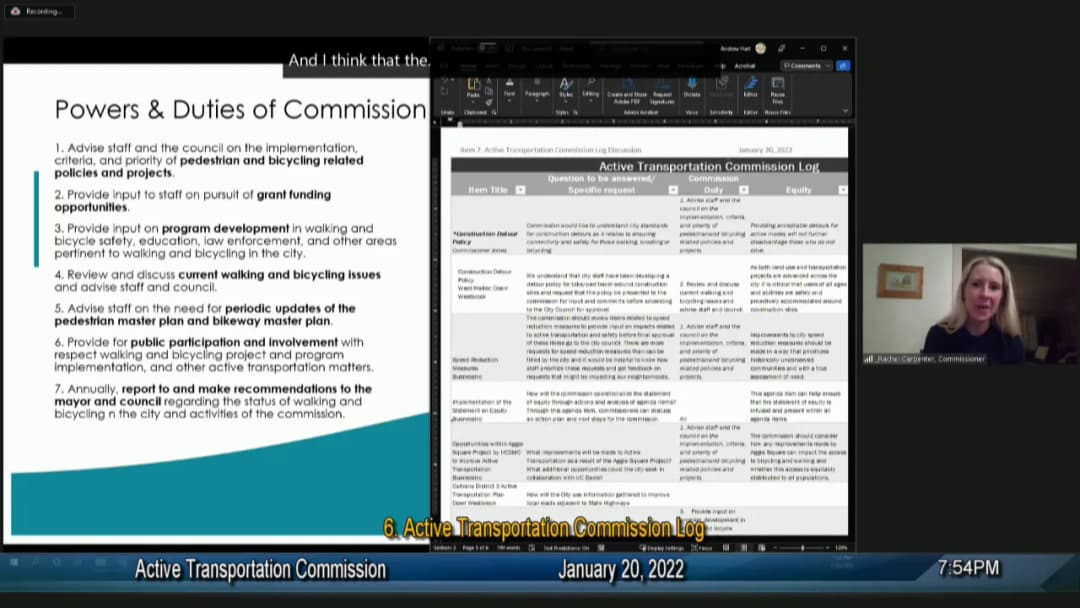
The Active Transportation Commission of Sacramento met virtually on January 20, 2022, at 6:00 PM to approve consent items, elect officers, discuss shared rideable parking issues, and adopt the commission's work log. Key outcomes included the election of Ali Doerr Westbrook as Chair and Curtis Paullins as Vice Chair for 2022, and approval of the Active Transportation Commission Log. Consent Calendar - Approved minutes of October 21, 2021. - Received and filed the 2022 regular meeting calendar. - Received and filed the official city land acknowledgement. Public Comments & Testimony - Bob Walsh (Bird operator): Supported a cautious approach to new shared rideable parking rules, noting recent operator changes and lock-to requirements. Suggested marking racks for private bikes but urged delay to assess impacts. - Melissa Harris: Requested the commission take action on improvements at the Marconi Transit Center in Hagginwood, citing multiple prior studies and lack of implementation for sidewalks, gutters, and lighting. - Tara Kirse (District 2 resident): Expressed frustration over neglected infrastructure in North Sacramento/Hagginwood, including dangerous intersections and lack of sidewalks, and asked the commission to push for action on existing plans. Discussion Items 4. Selection of Chair and Vice Chair for 2022 - Commissioner Carpenter nominated Ali Doerr Westbrook for Chair; Commissioner Smith nominated Curtis Paullins. After discussion, Commissioner Paullins deferred and the commission voted: Motion passed (9-0, 1 absent) electing Ali Doerr Westbrook as Chair. Then a separate motion elected Curtis Paullins as Vice Chair (9-0, 1 absent). The selections take effect at the next meeting. 5. Shared-Rideables Over Parking - Staff presented three potential solutions to overparking of shared bikes/scooters at bike racks: (1) install additional parking, (2) prohibit operator deployment in overparked locations, (3) designate specific racks for private bikes via stickers. Discussion included combining options, piloting, color-coding racks, and the impact of new lock-to requirements. Commissioners expressed support for all solutions, with emphasis on short-term fixes and longer-term study of operator competition. No formal action was required; item was for review and comment. 6. Active Transportation Commission Log - Commissioners proposed items for the commission's work log, including: speed reduction measures, operationalizing equity, Aggie Square opportunities, bike network gap analysis, construction detour policy, Caltrans Active Transportation Plan, neighborhood traffic calming, pedestrian/bike crash data, red light camera report, and bait bike program. After debate on process, the commission passed a motion (7-1-1) adopting the log as developed, with the ability to add or remove items in future meetings. Key Outcomes - Elected Ali Doerr Westbrook as Chair and Curtis Paullins as Vice Chair for calendar year 2022. - Approved the Active Transportation Commission Log via motion (7-1-1), with items to be added/removed in future. - Discussed shared rideable parking issues; staff will consider commissioner input and may bring back a proposal. - No action on public comments; items logged for future discussion. Additional: Staff announced a City Council workshop on climate and transportation on February 8, 2022, at 5:00 PM. Meeting adjourned at 8:25 PM.
On Tuesday, January 18, 2022, at 3:04 p.m., the Sacramento Personnel and Public Employees Committee (PMPE) convened via teleconference to conduct interviews and make appointments to multiple city boards and commissions. Members present: Chair Angelique Ashby, Vice Chair Katie Valenzuela, Councilmember Sean Loloee, and Councilmember Jeff Harris. The meeting adjourned at 4:11 p.m. Discussion Items - Item 1 – Ann Land and Bertha Henschel Memorial Funds Commission: Conducted interviews for Seat G (general public) and Seat I (general public). Only one of three applicants was present. Continued to next meeting for discussion and nomination. - Item 2 – Civil Service Board: Conducted interviews for Seats B and D (citizens with no city government connection). Passed a motion to reappoint incumbents Emmanuel Amanfor (Seat B) and Kathryn Elizabeth Meola (Seat D). Vote: 4-0. - Item 3 – Ethel MacLeod Hart Trust Fund Advisory Committee: Conducted interviews for Seats B, D, E (population at large, age 60+), and Seat G (AARP representative). Appointed Clara Chapala (Seat B), Mynga Futrell (Seat D), Boyd Lemon (Seat E), and David Pacheco (Seat G). Vote: 4-0. - Item 4 – Natomas Basin Conservancy Board of Directors: Conducted interviews for Seats B, C, E (non-employees of specified agencies). Appointed David Christophel (Seat E); continued Seats B and C to next meeting for additional outreach. Vote: 4-0. - Item 5 – Preservation Commission: Conducted interviews for Seats B (architectural historian), F (public at large with preservation/planning background), and G (public at large with history background). Appointed Justin Wisely (Seat B), Daniel Herrick (Seat F), and Max Slavkin (Seat G). Vote: 4-0. - Item 6 – Sacramento Ethics Commission: Conducted interviews for Seats B and C (general public with law/ethics/government background) and Seat D (general public). Seven applicants interviewed. Continued to next meeting for discussion and nomination. - Item 7 – Sacramento Yolo Mosquito and Vector Control District: Conducted interviews for Seat A (City of Sacramento appointment). Reappointed Raymond LaTorre. Vote: 4-0. - Item 8 – Sacramento Disabilities Advisory Committee: Deliberated nominations for Seat E and Seat H (members representative of disability groups). After a substitute motion, appointed Alan McMillan (Seat E) and Tiffany Fink (Seat H). Vote: 4-0. Applicants Zachary Bonnie and Sophia Neal were deferred to next meeting for consideration for Seat G. Key Outcomes - The committee made appointments for six of eight agenda items, with two items continued for further discussion. - All appointments required majority approval; all votes were unanimous (4-0) when taken. - The committee directed staff to close the application period for the Disabilities Advisory Committee Seat G and bring forward the current candidates for consideration at the next meeting. - Committee members expressed appreciation for the high quality of applicants and encouraged those not selected to apply again.
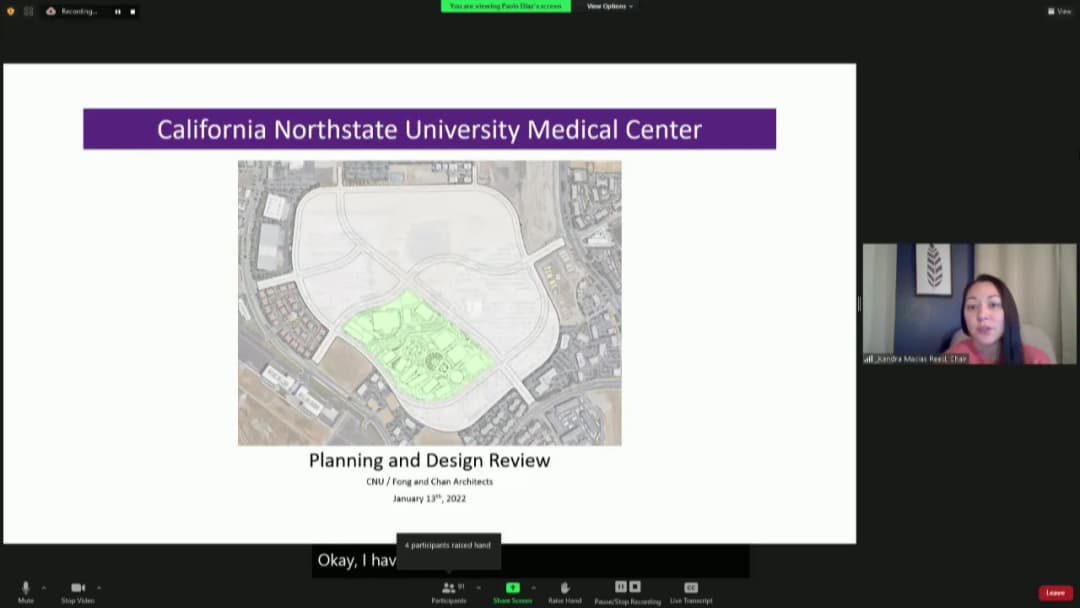
The Sacramento Planning and Design Commission met virtually on Thursday, January 13, 2022, at 5:30 p.m. to consider two major items: a recommendation for a 24-unit senior apartment project (Luther Gardens) and a recommendation for the Innovation Park Planned Unit Development and California Northstate University Medical Campus. The commission also approved the consent calendar and received a director's report. Consent Calendar - Approval of Meeting Minutes (December 9, 2021): Passed unanimously (11-0). - Official City Land Acknowledgement: Received and filed. Director's Report - Stacia Cosgrove reported that the City Council adopted the housing element on December 14, 2021, and that the California Department of Housing and Community Development (HCD) has certified it. Public Comments & Testimony - Item 4 – Luther Gardens Senior Apartments: No public testimony was offered. - Item 5 – Innovation Park PUD and CNU Medical Campus: - Red Baines (resident across from the site) expressed opposition to the location of the central plant, citing noise, light pollution, and emergency access concerns. He suggested moving the central plant southward. - Kevin Ferriera (Executive Director, Sacramento Sierra Building and Construction Trades Council) expressed support for the project. - Scott Powell (Executive Vice President, Greater Sacramento Economic Council) urged approval, citing job creation, economic diversification, and the need for more healthcare workers. - Chris Holm (resident and bicycle advocate) raised concerns about bicycle facility safety at project entrances, recommended protected intersections and dark-sky standards, and requested the school site be moved centrally. - Michael Tavares (Crown Downtown) expressed support, noting the long community effort to redevelop the Sleep Train Arena site. Discussion Items - Item 4 – Luther Gardens Senior Apartments (DR21-206): - Staff recommended approval of a rezone from R-2B to R-3 and construction of a 24-unit, three-story senior apartment building on a 0.79-acre site east of Luther Burbank High School. - Commissioner Boyd asked about community engagement with Luther Burbank High School and neighborhood associations; staff noted 500-foot notification and a posted sign. - Commissioner Pluckebaum raised concern about ADA parking, requesting an additional accessible space (total of two). The applicant initially resisted but later agreed. - The commission voted 11-0 (Commissioner Covill recused) to forward a recommendation of approval to City Council with the added condition of two ADA-compliant parking spaces. - Item 5 – Innovation Park Planned Unit Development and California Northstate University Medical Campus (P18-077): - Staff (Teresa Haenggi) and the applicant team (Jeff Dorso, Sacramento Kings; Paulo Diaz, architect) presented the 183.7-acre project, which includes a hospital, medical campus, mixed-use districts, parks, and a mixed-income housing strategy. - Mixed Income Housing Strategy: Requires 10% affordable units for the first 1,500 units, with options to dedicate two acres to SHRA or provide 10% of units on-site. Commissioner Young raised concerns about the adequacy of two acres to achieve 150 affordable units and the lock-in of existing fee levels; staff noted the housing impact fee is revised by council resolution. - Design: Commissioner Yi asked about light glare from the central plant and parking garage, vegetation screening, and the commitment to LEED Gold certification. The applicant confirmed LEED Gold is a design commitment. - Traffic and Parks: Commissioner Pluckebaum asked about the traffic study; staff confirmed the analysis is in the EIR. Commissioner Lindsay noted community desire for continued engagement on future phases. - Public testimony included concerns about the central plant location and emergency access, and strong support from economic and labor organizations. - Commissioner Lindsay made a motion to recommend approval, seconded by Commissioner Covill. The motion passed unanimously (12-0). Key Outcomes - Luther Gardens Senior Apartments: Recommended approval to City Council with an added condition for two ADA parking spaces (vote: 11-0, with one recusal). - Innovation Park PUD and CNU Medical Campus: Recommended approval to City Council on all 10 items (A-J) as presented (vote: 12-0). The project is scheduled for City Council consideration on February 15, 2022. - Other: Commissioner Chase requested a future discussion on the Healthy Places Index tool; staff indicated it is being developed.
The Budget and Audit Committee of the Sacramento City Council met on January 4, 2022, at 3:03 p.m. via teleconference to receive and discuss recommendations from the Measure U Community Advisory Committee regarding the Fiscal Year 2021/22 midyear budget. The committee received a presentation, heard public comment, and directed staff to schedule the item for full City Council consideration before the midyear budget discussion. Measure U Community Advisory Committee Recommendations Ash Roughani, Special Projects Manager, introduced committee member Lisa Prey, who presented the committee's midyear budget recommendations. The recommendations focused on using any surplus Measure U funds for: - Affordable housing: Direct support such as rental assistance, down payment assistance, and gap funding for new affordable housing projects. - Homelessness: Expanding the homeless housing initiative to include older children, youth aging out of foster care, veterans, and additional respite center and safe ground sites. - Senior services: Expanding service hours, geographic dispersion, and language access for programs like the Heart Senior Center, Triple R, 50+ Wellness, and Caring Neighborhoods. - Youth programs: Expanding K-12 programming to youth under 24, making services culturally relevant for Native American and Hmong communities, and creating a protected fund for children and youth. - Branding: Creating a Measure U logo and branding to identify projects funded by Measure U, improving public awareness. - Participatory budgeting and mapping: Using the city's Neighborhood Development Action Team (NDAT) to produce neighborhood-level reports on program placement and impact, ensuring funds reach underserved areas. Public Comments & Testimony - Lambert (representing “to the Bay and Back Cheesecakes”): Expressed concern that Measure U funds are not reaching underserved communities like Del Paso Heights. He urged that funds be prioritized for such neighborhoods and requested that the city produce surveys and graphs to confirm the distribution. Discussion Items - Councilmember Vang thanked the committee, asked about current Measure U branding efforts, and suggested mapping place-based investments in coordination with the racial equity ad hoc committee to avoid duplication. She recommended that the item be forwarded to the full City Council for discussion before the midyear budget. - Councilmember Jennings praised the committee’s work, particularly the focus on underserved populations, and supported bringing the item to the full council. - Staff (Leyne Milstein, Assistant City Manager) noted that some branding exists (e.g., signage at facilities, patches on uniforms) and that a scan of strictly Measure U-funded programs could be done. Staff also noted that a geographic mapping tool exists but does not currently show dollar spending; they would explore the feasibility with departments. - Vice Chair Guerra suggested flexibility in scheduling the full council discussion, but Councilmember Vang and Jennings preferred to have it before the midyear budget to allow the full council to consider the recommendations. Staff agreed to bring the item to council prior to the midyear budget presentation. Key Outcomes - The committee received and filed the Measure U Community Advisory Committee recommendations (action: receive and file). - The committee directed staff to schedule the item for full City Council consideration before the midyear budget discussion, which is planned for February 2022 (Budget and Audit Committee on February 1 or 8, and Council on February 8). - No formal vote was taken; the decision was made by consensus. - The meeting adjourned at 3:27 p.m.
The Law and Legislation Committee of the Sacramento City Council met via teleconference on Tuesday, January 4, 2022, at 1:03 p.m. The meeting was called to order by Chair Jay Schenirer and adjourned at 1:48 p.m. All four members were present: Eric Guerra, Jeff Harris, Katie Valenzuela, and Jay Schenirer. The committee reviewed and acted on four agenda items, including the city's legislative platform, cannabis code amendments, and vacant lot registration. Consent Calendar - Item 1: Law and Legislation Log (File ID: 2022-00017) – Approved unanimously without discussion. The log documents city lobbying activities and positions on state and federal legislation. Public Comments & Testimony - Joe Devlin (Northern California Cannabis Alliance) – On Item 2, requested the city add support for state legislation eliminating the cannabis cultivation tax (currently $161 per pound), citing the industry's economic strain. On Item 3, expressed support for most proposed cannabis code changes, urging the committee to view regulations through the lens of business sustainability and parity with other industries. - Kimberly Cargyle (CEO of Therapeutic Alternative) – On Item 3, thanked staff for aligning local regulations with state law, saving time and money for all parties. Urged committee members to vote yes. - Brenda Ruiz (Sacramento Food Policy Council) – During public comment on non-agenda matters, supported councilmembers' direction on vacant lot exemptions and community garden access. Noted that the Urban Agriculture Incentive Zone expired in 2019 and requested a renewed program and better access to vacant lot owner information for community advocates. Discussion Items - Item 2: Review and Approval of City’s State and Federal Legislative Platform (File ID: 2021-01465) – Consuelo Hernandez, Director of Governmental Affairs, presented the updated 2022 platform, which includes perennial priorities (housing, homelessness, climate action, public safety, local authority) and new items: support for federal Build Back Better Act provisions, infrastructure funding for infill development, cyber attack protection, and inclusive economic development. Councilmember Valenzuela requested explicit inclusion of “Medicare for All” language; staff confirmed “universal healthcare” was already included, which Valenzuela accepted. Councilmember Schenirer requested cannabis-related language reflecting the city's $22 million annual revenue and support for state equity grants and favorable tax structures, to be drafted by staff. The platform was approved as amended unanimously. - Item 3: Ordinance Amending Chapter 5.150 and Section 8.132.050 – Cannabis Businesses and Illegal Cultivation (File ID: 2021-01323) – Davina Smith, Cannabis Manager, presented a periodic cleanup ordinance aligning local rules with state law. Key changes: streamlining background checks (businesses retain records rather than submitting change forms), increasing delivery vehicle carry limit from $3,000 to $5,000, removing vehicle age limit, aligning motor carrier permits with state DMV requirements, requiring labor peace agreements for businesses with 20+ non-supervisory employees, updating security requirements with police input, adding processes for cessation of operations, removing display size limits on accessories, and establishing an abandoned application provision. For illegal cultivation appeal fees, staff proposed disconnecting the flat $250 fee to allow council to set a higher fee (average appeal costs exceed $1,500 each), while retaining fee waivers for low-income appellants. Councilmember Valenzuela raised concerns about deleting the definition of “collective or cooperative dispensaries.” Staff explained the section is outdated (state no longer allows such models) and that any future cooperative provisions should apply across all permit types via a comprehensive policy review. Valenzuela agreed to delete the section after staff committed to bringing back broader cooperative language as part of upcoming EPS study discussions. The ordinance was approved as amended unanimously for forwarding to City Council. - Item 4: Ordinance Relating to Vacant Lot Registration (File ID: 2021-01366) – Peter Lemos, Code and Housing Enforcement Chief, briefed the committee on the existing vacant lot registration program (adopted 2018) and recommended amendments. The program currently registers approximately 3,500 lots annually (down from 6,000 due to development and exemptions). Staff proposed adding defined exemptions (e.g., lots adjacent to a primary residence and well-maintained), stronger enforcement for nuisance lots (securitization, no-trespassing signs, cleanup timelines), and vegetation height limits to address fire hazards. Councilmembers Guerra and Valenzuela supported exemptions for adjacent, maintained lots. Councilmember Harris requested a provision requiring vegetation height limits to prevent fire hazards (current code only allows enforcement when weeds are dead and a fire hazard, which leads to weeds up to 4 feet high by May). Staff was also directed to explore ways to connect community groups with lot owners for interim uses like community gardens. Councilmember Valenzuela suggested reviving the Urban Agriculture Incentive Zone (expired 2019) and improving public access to owner information. No formal vote was taken; direction was provided to staff to draft amendments and bring back to committee. Key Outcomes - Consent Calendar (Item 1) – Approved unanimously. - Item 2 (Legislative Platform) – Approved as amended (4-0) and forwarded to City Council. Amendments include adding cannabis-related language and clarifying universal healthcare support. - Item 3 (Cannabis Ordinance) – Approved as amended (4-0) and forwarded to City Council. Amendment: removed the definition of collective/cooperative dispensaries with commitment to revisit broader cooperative policy during EPS study discussions. - Item 4 (Vacant Lot Registration) – Committee provided direction to staff: (1) add exemptions for adjacent, maintained lots; (2) strengthen nuisance lot enforcement (securement, trespassing signs, cleanup timelines); (3) include vegetation height limits to prevent fire hazards; (4) explore mechanisms to connect community groups with lot owners for interim uses; (5) investigate renewal of Urban Agriculture Incentive Zone. Staff to bring back ordinance amendments for committee consideration.
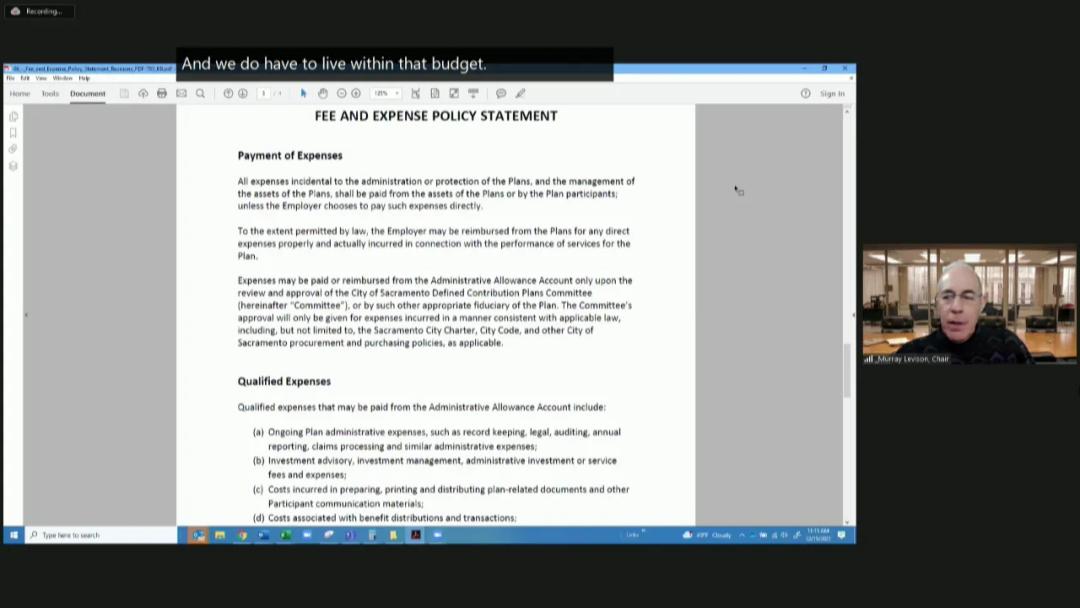
The Sacramento Defined Contribution Plans Committee met virtually on December 15, 2021, beginning at 9:00 a.m., in a teleconference-only meeting conducted under AB361 and the City Council’s COVID-19 local emergency declaration. The committee approved its consent calendar, reviewed third-quarter 2021 investment results, discussed Nationwide’s managed account (ProAccount) service, began a fee and expense policy review, received legal and regulatory updates, and adjusted its 2022 work plan. No members of the public spoke during the meeting. No minutes were available; this summary is based on the agenda and meeting transcript. Consent Calendar - The committee received and filed the item on teleconferencing meetings during the COVID-19 state of emergency. - The committee received and filed the recap of subcommittee work for the fund lineup changes. During discussion, a member asked when Nationwide’s notice was mailed; staff said Nationwide mailed it on November 4, 2021. Staff also recommended that future city-generated notices be mailed to all participants because the city does not have email addresses for every participant. - Motion by Vice Chair Bader, second by Member Foster, passed unanimously by roll call vote. Member Boyd was absent for the roll call and later left the meeting at about 10:00 a.m. Public Comments & Testimony - No public comments were submitted on any agenda item, and no public comments were made during the matters-not-on-the-agenda period. Discussion Items - Proposed 2022 Committee Meeting Dates: Staff proposed March 23, June 29, September 14, and December 8, 2022. Staff confirmed these dates with Hyas Group and confirmed room availability with the City Clerk’s office. No vote was required; staff was directed to finalize the dates. - Review of the 2021 3rd Quarter by Hyas Group: Hyas reported total plan assets of approximately $707 million as of September 30, 2021, an all-time high, with year-to-date gains of about $54 million and positive year-to-date cash flow of $5 million after a negative $2 million first quarter. Hyas noted that fixed income and target-date funds together made up about 40% of total plan assets. Hyas also reported that the average account balance for the NAGDA peer group was around $75,000, while the California average was about $90,000. The fund lineup change effective November 16, 2021, was expected to reduce total fees by about 12 basis points, saving participants approximately $840,000 per year. Hyas discussed underperformance in American Century Mid-Cap Value, attributing it to missed consumer cyclical/consumer staple rotation and underweighting of “meme stocks” relative to peers. Later in the meeting, Hyas corrected its earlier statement, saying this was not the first underperforming quarter and that the fund should be placed on watch. Hyas also discussed tracking error in Fidelity Contrafund K6 and underperformance in Mission Square target-date funds, with a possible future recommendation to align all plan lineups, including RHSA plans, using Vanguard target-date funds. - Review of Nationwide’s Managed Account Services (ProAccount): Hyas presented part one of a two-part review. As of September 30, 2021, approximately $219 million of the $707 million in plan assets was in managed accounts, with about 2,300 of approximately 7,000 participants using the service. Nationwide’s ProAccount fee is 45 basis points on the first $100,000, decreasing in 5-basis-point increments. Hyas compared this with the city’s all-in plan cost of 35 basis points and target-date fund costs of 9 basis points, dropping to 8 basis points in February 2022. A committee member said the report did not adequately explain how participant questionnaire answers are turned into asset allocations. Nationwide said it would include ProAccount assets and participant counts in future quarterly reports. A Nationwide representative clarified that participants may place an individual plan in ProAccount while keeping another plan in target-date funds. The performance comparison of ProAccount versus target-date funds was deferred to the next meeting. - Fee and Expense Policy Statement Review: Staff requested direction on adding a purpose statement, describing the annual administrative allowance budget, and setting a threshold for the administrative allowance account. The current annual budget is approximately $86,000, funded largely by the $18 participant fee, and the account balance was about $9,000. Committee members discussed using the account for anticipated expenses such as future RFPs and consulting costs, as well as unanticipated expenses. Some members discussed fee holidays rather than refunds if the account exceeded a target. One member suggested a $150,000 cap. Staff was directed to bring examples from other agencies and draft policy language back to the March 2022 meeting; no vote was taken. - Legal and Regulatory Updates: Hyas reported that the U.S. Supreme Court is hearing its first excessive-fee lawsuit, involving Northwestern University, with Justice Barrett recused. Hyas also reported that a group of senators criticized the Department of Labor’s new ESG rule, that Social Security benefits will receive a 5.9% COLA, that fiduciary liability insurance costs have risen about 25%, and that the DOL has issued cybersecurity guidance. Hyas noted that cryptocurrency remains unavailable in the 457 plan because the DOL has cautioned against it. IRS contribution limits for 2022 increased by $1,000 for regular limits, while the age-50 catch-up remained unchanged pending possible changes in SECURE Act 2.0. - Committee Work Plan: Staff reviewed completed and outstanding items, including continued review of ProAccount services, ratification of 457 documents related to the CARES Act, and potential online planning tool workshops. Committee members discussed whether an audit or more formal budget/expense review should be added to the work plan. Nationwide agreed to provide an administrative allowance account report at the March 2022 meeting. The work plan discussion also included making the RFP item cover all service providers and clarifying whether non-career employees are eligible to participate in the 457 plan. Key Outcomes - The consent calendar was approved unanimously by roll call vote, with Member Boyd absent. - Staff was directed to schedule the 2022 committee meetings for March 23, June 29, September 14, and December 8. - Hyas stated that American Century Mid-Cap Value should be placed on watch because its underperformance was not limited to the third quarter; no formal vote was taken. - Nationwide committed to include ProAccount assets and participant counts in future quarterly reports. - The ProAccount performance-versus-target-date comparison and deeper questions about how ProAccount constructs portfolios were deferred to the March 2022 meeting. - The Fee and Expense Policy Statement was not approved; staff will return with examples and revised language in March 2022. - No formal votes were taken on discussion items other than the consent calendar.