The Aggie Square Enhanced Infrastructure Financing District (EIFD) Public Financing Authority (PFA) held a special teleconference meeting on April 13, 2021, at 11:00 a.m. to conduct the third and final public hearing on forming the Aggie Square EIFD and adopting the Infrastructure Financing Plan. The meeting included staff presentations, public testimony from labor representatives, and board discussion leading to a unanimous vote to form the district and adopt the plan, with additional direction to staff. Public Comments & Testimony - Scott Little Hale, representative of Carpenters Local Union 46, expressed concern that a hole in state prevailing wage law means only minimum wage standards would apply to affordable housing projects funded by EIFD loans outside the district. He noted that construction workers in Sacramento County are 40% more likely to be low income and three times more likely to lack health insurance, and urged the PFA to address this omission in the plan or implementing policies. - Marco Lattori, senior agent for the Carpenters Union, requested that any money loaned from the EIFD for affordable housing include requirements for prevailing wage, healthcare, apprenticeship standards, and local hire standards. Discussion Items - Eric Frederick (Finance Department) presented the third public hearing item, noting the plan had been revised since the March 9, 2021 hearing. A typographical error on page 39 was corrected: the initial phase development will generate approximately 3,100 on-site employees, not 3,500. - Jamie Gomes (EPS consultant) summarized key revisions: text refinements for EIFD law compliance, clarified revenue definitions, and an updated map showing the intended area for affordable housing investments. - Councilmember Guerra distinguished between on-campus housing (by UC Davis/Wexford, subject to prevailing wage and not using EIFD funds) and future affordable housing projects funded by the EIFD’s 20% housing set-aside. Staff confirmed that policies for wage standards on those projects will be determined by the PFA and likely city council within the next year, as EIFD funds will take at least a year to become available. - Discussion on ongoing community involvement: Leslie Fritzsche (Office of Innovation and Economic Development) outlined plans for working groups on transportation, workforce, housing, and youth engagement; quarterly town halls; and regular reporting. Councilmember Jennings emphasized a transparent process moving from engagement to partnership. - Chair Schenirer requested a fact sheet on potential excess EIFD funds (beyond the 80% capital improvements and 20% affordable housing commitments) and options for directing those funds to the community, possibly augmenting the $150,000 annual commitment from Wexford. Key Outcomes - The PFA voted unanimously (5-0) to close the public hearing and adopt the resolutions forming the Aggie Square Enhanced Infrastructure Financing District and adopting the Infrastructure Financing Plan. The ordinance will be brought back for a second reading and final adoption on April 20, 2021. - Additional direction to staff: work with labor, community stakeholders, the developer (Wexford), and UC Davis to schedule follow-up meetings addressing workforce, local hire, and prevailing wage concerns. - Staff directed to prepare a fact sheet on the timeline and possible uses of excess EIFD revenues for presentation at a future PFA meeting.
Public Meetings - Sacramento, California
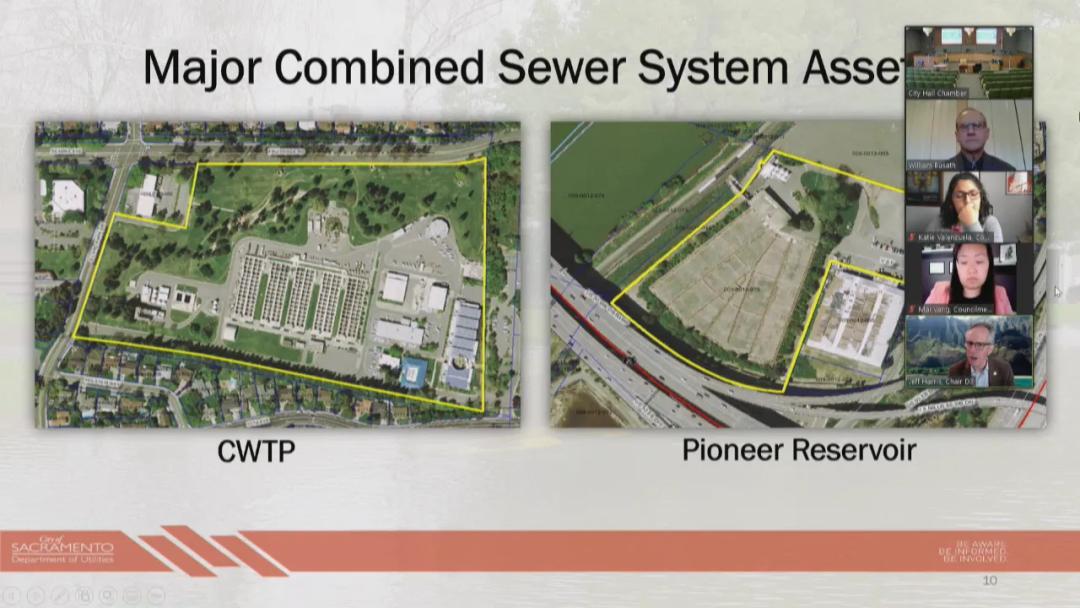
Public Meetings - Sacramento, CaliforniaThe Sacramento Water Committee met on April 13, 2021, to discuss three major items: an amended regional wastewater management agreement, the city's storm drainage system challenges and funding, and an update on sustainability and water efficiency efforts. The meeting was reordered to address the wastewater agreement first, followed by the storm drainage overview, and concluded with the sustainability update, which was cut short due to time constraints. A public comment on a non-agenda matter was also heard. Discussion Items - Amended Sacramento Regional Wastewater Management Program Master Interagency Agreement (MIA): Ryan Pham, Business Services Division Manager, presented the proposed amendments to the MIA, which includes the City of West Sacramento as a new contributing agency, extends the agreement term to 50 years, and shifts responsibility for sewer rate collection and bad debt absorption to Regional San. The county's role is being phased out via a sunset clause ending in 2024. Chair Harris asked about the rationale for the county's departure; Bill Busath clarified that Regional San no longer needs the administrative services provided by the county. A motion to forward the item to the City Council was made and seconded. - City of Sacramento Storm Drainage System Overview: Bill Busath, Director of Utilities, presented an overview of the city's unique pumped storm drainage system, which includes 105 pump stations, 850 miles of pipes, and a combined sewer system serving a portion of the city. He highlighted that the system is aging, undersized, and faces a $240 million backlog of needed projects. The drainage fund is unsustainable, with no rate increase since 1996; current revenues are insufficient for capital improvements, and the fund balance is projected to go negative by fiscal year 2026–2027 under current spending. A Prop 218 ballot initiative is being planned to raise drainage rates. A survey of 1,200 customers is underway to gauge support for a potential $5–$6 per month increase, with a goal of bringing a measure to voters in early 2022. Councilmember Valenzuela asked about best practices from other combined-system cities; Busath noted that Seattle, Portland, and San Francisco have much higher rates. Chair Harris emphasized the impracticality of separating the combined system, which would cost over $2 billion and take decades. The item was received and filed. - 2021 Update on Sustainability and Water Efficiency Efforts: Roshni Das, Sustainability Program Manager, provided an oral report. Key points included: current water supply conditions are trending dry (50% of average rainfall, 83% of average snowpack) but the city is positioned to handle a second dry year through conjunctive groundwater use. State mandates (AB 1668 and SB 606) will require new water efficiency targets by 2024 with enforcement in 2026. The city's water demand has stabilized at 168 gallons per capita per day, well below pre-drought levels. Conservation programs have been successful, including a national award for the Wyland Mayors Challenge, turf conversion rebates, smart meter leak detection, and equity-focused programs like "Redo the Loo" and "Leak Pre-Sacramento." Councilmember Valenzuela requested district-level data on program usage. The presentation was cut short due to time; Chair Harris asked for the sustainability plan to be brought back to the next Water Committee meeting for further discussion. Public Comments & Testimony - The committee heard one public comment on a matter not on the agenda. A caller, identifying themselves as "Sanqua," demanded that the City Council approve all recommendations from the Police Review Commission from the last three years and grant the commission subpoena power and independent legal counsel. Chair Harris noted that the caller had reached the wrong meeting (Water Committee) and suggested they call back for the appropriate council meeting. Key Outcomes - Item 2 (Amended MIA): The committee voted unanimously (3–0) to forward the item to the full City Council for approval. Councilmember Valenzuela made the motion; Councilmember Vang seconded. The vote was recorded: Councilmember Valenzuela – yes, Councilmember Vang – yes, Chair Harris – aye. - Item 3 (Storm Drainage System): The presentation was received and filed. No action was taken, but staff will continue outreach and survey efforts toward a potential ballot measure in early 2022. - Item 1 (Sustainability Update): The update was received and filed, with a commitment to continue the discussion at the next Water Committee meeting.
The Sacramento Community Police Review Commission met via teleconference on Monday, April 12, 2021, at 6:00 p.m., in compliance with COVID-19 emergency orders. Chair Mario Guerrero presided. The meeting included approval of previous meeting minutes, presentations from advocacy organizations, and a follow-up log review. The commission adjourned at 8:11 p.m. Consent Calendar - Item 1: Approval of the March 8, 2021, meeting minutes. Motion by Richard Falcon, seconded by Graciella Castillo-Krings. Vote: 8 yes (Castillo-Krings, Bliss, Elkarra, Jefferson, Falcon, Savage-Sangwan, Carter, Guerrero), 2 abstain (Escobar, Zamora), 2 absent (Marion, Elkarra — note discrepancy: minutes list Elkarra as both voting yes and absent). Motion carried. Public Comments & Testimony - No public comments were recorded during the meeting. A phone line was available but no testimony is transcribed. Discussion Items - Item 2: Presentation from The National Press Photographers Association (Oral Report). Received and filed. - Item 3: Presentation from the ACLU of Northern California and the Lawyers’ Committee for Civil Rights of the San Francisco Bay Area (Oral Report). Received and filed. - Item 4: Sacramento Community Police Review Commission Follow-Up Log. Received and filed. Key Outcomes - Approved the March 8, 2021, meeting minutes. - Received and filed presentations from the National Press Photographers Association and the ACLU/Lawyers’ Committee. - Received and filed the commission’s follow-up log. - Chair’s update, Police Department staff update, and commissioner comments were provided without formal action.
The Sacramento Arts, Culture, and Creative Economy Commission met on Monday, April 12, 2021, at 2:00 PM. The meeting included approval of prior minutes, a discussion and vote on a $100,000 grant to Capital Public Radio for its new community engagement center, a detailed oral report on the state of the creative economy with pre-pandemic data and COVID-19 impact survey results, and reports from the director and chairperson. Commissioners also received a message from Vice Mayor Jay Shaneer about a new youth commissioner position. Consent Calendar - Approval of March 8, 2021 Meeting Minutes – The commission passed a motion unanimously to approve the minutes. Discussion Items - Capital Public Radio Facilities Grant – Melissa Cirone (Arts Coordinator) presented a staff report recommending approval of a $100,000 grant to Capital Public Radio for its new Sutter Health Center for Community Engagement at 1010 8th Street. The grant was originally approved in 2016 but reconfigured due to project changes. Shirley Tully from Capital Public Radio answered commissioner questions about the space's configuration, rental rates for community groups, civil dialogue programming, and digital/broadcast readiness. The commission voted unanimously to approve the grant and receive and file the report. - State of the Creative Economy (Oral Report) – Megan Van Voorhis (Cultural and Creative Economy Manager) presented data from the Creative Vitality Suite and a COVID-19 impact survey conducted in partnership with Americans for the Arts. Pre-pandemic (2019) data showed 23,000 creative industry jobs in Sacramento proper with over $1.2 billion in associated earnings. Key sectors included independent artists/writers/performers (4,000 jobs), broadcasting, and advertising. Self-employed workers accounted for 10,500 jobs. The COVID impact survey (44 respondents, mostly nonprofits) reported approximately 770,000 lost attendance, $25 million in cuts to expenditures, and 56% feeling very or extremely confident of survival. Many organizations used furloughs and salary cuts. The report also highlighted the need for cash, audiences, and marketing to reopen. Commissioners discussed the importance of using this data for advocacy, especially regarding federal stimulus funds (American Rescue Plan). - Director’s Report – Megan Van Voorhis reported on site visits to SAC Dance Lab, Unseen Heroes HQ, and Sojourner Truth Museum. She noted that the city council requested a review of monument policy and the percent for art ordinance, including potential local artist preferences. Commissioners raised concerns about equity, balancing local and national artists, and ensuring funds reach underserved areas. - Chairperson’s Report – Dr. Steven Winlock reported on a meeting with the mayor, the formation of an education consortium, and encouraged commissioners to meet with their city council members. Vice Mayor Jay Shaneer (via recorded message) announced the creation of a youth commissioner position and asked commissioners to help mentor the youth appointee. Public Comments & Testimony - Shira (The Atrium) – Expressed gratitude for the data and work of the commission, highlighted the importance of supporting independent creatives and vendors at events, and noted that the CARES X fund helped build an online marketplace that paid creatives $35,000 in three months, serving 24,000 visitors. Key Outcomes - Consent Calendar – Motion to approve March 8, 2021 minutes passed unanimously. - Capital Public Radio Facilities Grant – Motion to approve the grant and receive and file the staff report passed unanimously. - State of the Creative Economy – Received and filed as an oral report. - Director’s Report – Received and filed; staff will pursue reviews of monument policy and the percent for art ordinance. - Chairperson’s Report – Received and filed; commissioners will continue meeting with council members. - Next Steps – The commission will discuss concepts for using American Rescue Plan funds at the next meeting on May 10, 2021. Commissioners were urged to gather input from their districts. - Public Comment – No formal action; comments received for information.
The Sacramento Planning and Design Commission met on Thursday, April 8, 2021, at 5:30 p.m. via teleconference. The meeting included a consent calendar, public hearings on four items, and a discussion calendar. All commissioners were present except Lynn Lenzi and Kendra Macias-Reed. Commissioner Alix Ogilvie recused herself from Item 5. The meeting adjourned at 7:23 p.m. Consent Calendar - Approval of the meeting minutes of March 25, 2021: Moved, seconded, and carried (9-0-2, with two absent) to approve. - Director’s Report (oral report): Received and filed; the Planning Director noted that the City Council authorized the Housing Element to be sent to the state and approved the Sacramento Valley Station Area Plan. Public Comments & Testimony - Item 4 (16R Mixed-Use): Jameson Parker, representing the Midtown Association (a property and business improvement district), spoke in support of the project, citing the need for housing and the activation of a long‑vacant parcel. He urged approval. - Item 5 (1760 Challenge Way Cannabis Dispensary): Three callers spoke: - Leslie Gray (District 3 resident) expressed strong support, noting her medical needs and desire for a safe, accessible dispensary location. - Phil Tesher, representing retail properties near Arden Fair, opposed the project, citing concerns about vandalism, homelessness, and inadequate police response. - Raquel, a CORE program graduate, expressed mixed feelings, supporting cannabis businesses but concerned about the impact of the moratorium on equity applicants. - Item 6 (Appeal of 2678 5th Avenue Fence Deviation): Multiple callers spoke in support of retaining the fence as built. Speakers included neighbors who praised the fence’s aesthetic quality and compatibility with the Curtis Park neighborhood. No caller spoke in opposition. E‑comments and letters overwhelmingly supported the fence. Discussion Items - Item 3: Ordinance to Update Terminology Related to Somatic Practitioners (File ID 2021-00344) – Staff presented a citywide proposal to replace the term “somatic practitioner” with “massage therapy practitioner” and “somatic practitioner establishment” with “massage therapy establishment” in Title 17. The changes are minor and do not alter substantive requirements. The Commission held a public hearing with no public comments. A motion to forward the ordinance to the City Council with a recommendation of approval passed 9-0-2. - Item 4: 16R Mixed-Use (P20-023) – 1619 R Street – Staff presented a request to rezone a 0.89‑acre parcel from Office Business Low‑Rise Mixed‑Use (OB‑SPD) to General Commercial (C‑2‑SPD) and to approve site plan and design review for a six‑story, 150,779‑square‑foot mixed‑use building with 104 apartment units, 12,000 square feet of open space, 4,200 square feet of ground‑floor commercial space, and 101 parking spaces. A deviation for building height is included. Staff noted a supplemental sheet addressing a public comment and clarifying conditions C39‑C41. Commissioners discussed parking quantity, transit‑oriented development goals, and the city’s work plan for parking maximums. The Commission voted 9-0-2 to forward the project to the City Council with a recommendation of approval. - Item 5: 1760 Challenge Way Cannabis Dispensary & PUD Amendments (P20-026) – Staff requested commission approval of a conditional use permit, PUD schematic plan amendment, and PUD guidelines amendment to allow a storefront cannabis dispensary in an existing 7,821‑square‑foot building. The site is in the Point West PUD. Commissioner Wallace disclosed she had discussed the item with staff. Public testimony included support and opposition. The Commission approved the project 8-0-3 (with Ogilvie recused, Lenzi and Macias-Reed absent). Vice Chair Pluckebaum clarified that the decision is a land‑use determination separate from operating license and equity issues. - Item 6: Appeal of 2678 5th Avenue Fence Deviation (DR20-113) – The property owner appealed the Zoning Administrator’s decision requiring removal of a 16‑inch lattice atop a six‑foot fence along the street side. Staff recommended approving the fence height on the interior side yard (7’4”) but denying the deviation for the street side and requiring the fence to be cut to six feet. The applicant presented photos and letters of support, arguing the lattice enhances privacy and security and complements the craftsman character of the neighborhood. After public testimony, Commissioner Chase moved to approve the project with modified conditions: the fence on the alley side may remain at 7’4”; on the street side, the first section (approximately one bay, about 8 feet) wrapping around from the alley may also remain at 7’4”, then drop to six feet; and the vertical posts may exceed the horizontal fence height by up to six inches, with final details to be coordinated by staff. The motion passed 9-0-2 with the modifications. Key Outcomes - Item 3: Motion to initiate and forward the somatic practitioner terminology update to the City Council with a recommendation of approval – passed 9-0-2. - Item 4: Motion to forward the 16R Mixed‑Use project (rezoning and design review) to the City Council with a recommendation of approval – passed 9-0-2. - Item 5: Motion to approve the cannabis dispensary and PUD amendments (conditional use permit, PUD schematic plan and guidelines amendments) – passed 8-0-3. - Item 6: Motion to approve the fence deviation appeal (denying the appeal) with modified conditions – passed 9-0-2. The conditions allow the fence to remain at 7’4” on the alley side and for one bay on the street side, then dropping to six feet, with posts potentially extending up to six inches above the fence top, as coordinated by staff. - Consent Calendar: Minutes approved (9-0-2). Director’s report received and filed.
The Budget and Audit Committee met on Tuesday, April 6, 2021, from 3:08 p.m. to 3:39 p.m. to consider the City Auditor's Proposed Audit Plan for Fiscal Year 2021/22. The committee heard a detailed presentation from City Auditor Jorge Oseguera, discussed potential additions to the audit plan, and unanimously voted to accept the plan and forward it to the City Council for final approval. The meeting was conducted via teleconference due to COVID-19. Discussion Items City Auditor’s Proposed Audit Plan for Fiscal Year 2021/22 City Auditor Jorge Oseguera presented the proposed audit plan, which was developed through a citywide risk assessment and input from the Mayor, Council, executive team, and whistleblower information. The plan included: - Performance Audits in Progress: Emergency Medical Services (Fire Dept.), Evidence and Property Division (Police Dept.), and COVID-19 response revenue/expense assessment. - Proposed Performance Audits for 2021/22: Department of Utilities risk assessment, Planning Division audit, Homeless Services audit, Recycling/Solid Waste audit (carried over from prior year), Information Technology audit, Language Accessibility and Community Engagement review (citywide), Employee Travel audit, Code Enforcement audit, and availability for Council requests. Priority two audits (pending resources) included Body Worn Cameras, Parks Operations, Animal Care Services, and DOU risk assessment. - Cannabis Compliance Auditor Work: Continuous monitoring of cannabis policy education, tax payments, code enforcement, and business permitting; in-depth reviews of cannabis code enforcement and administrative penalty appeals process. Priority two cannabis audits (pending resources) included business operation tax cash collection, illegal cultivation, conditional use permits, and community impact. - Research and Analysis Division Work: In-progress reviews of Police Commission, diversity of employee applicants/separations, citywide community survey (over 5,000 paper surveys plus online), Wide Open Walls, and David Sobon events. Planned annual reviews: community survey, diversity/equity/inclusion, ethics commission, diversity of boards/committees/commissions. Planned ad hoc audits: city financial condition analysis, revenue source risk assessment, and Transient Occupancy Tax audit. Councilmembers discussed several aspects: - Diversity and Workplace Harassment: Councilmember Guerra requested the City Auditor to explore processes for racial disparity assessments, particularly in departments with high incidences, and to coordinate with the Office of Public Safety Accountability (Dr. Watson) and Human Resources. The Auditor agreed to incorporate these concerns. - Language Accessibility: Councilmember Vang praised the inclusion of language accessibility in the audit plan and urged the city to provide simultaneous interpretation for virtual meetings (citing Fresno’s practice). The Auditor indicated the language audit would likely begin in early 2022 with a report to Council mid-2022. - Timelines and Resources: Councilmember Jennings requested estimated timeframes for priority audits and a discussion on adding resources. The Auditor agreed to provide broad timeline targets and resource information when the plan goes to Council, acknowledging potential flexibility due to shifting priorities. - Cannabis Audits: Vice Chair Guerra requested assessment of illegal cannabis cultivation if resources allow. - City Manager’s Office Updates: Assistant City Manager Leyne Milstein noted that a revised travel policy and new booking system are being implemented, and a study on cannabis industry impact is underway, which may accelerate related audits. Committee Comments – Ideas, Questions, and Meeting Reports - Participatory Budgeting: Councilmember Vang requested a status update. Ms. Milstein reported that the Measure U Committee is staffing participatory budgeting and awarding a contract; funding will be included in the end-of-month budget proposal. - Measure U Committee Recommendations: Councilmember Vang asked that the City Council respond in writing within 60 days to the committee’s comprehensive recommendation list. Vice Chair Guerra directed the City Clerk and City Attorney to work with Councilmember Vang on a response mechanism. Key Outcomes - Motion to Accept Audit Plan and Forward to City Council: Moved by Vice Chair Guerra, seconded by Councilmember Vang. Passed 3-0 (Members Guerra, Jennings, Vang voting yes; Mayor Steinberg absent). The motion included direction to the City Auditor to explore racial disparity assessments and improve whistleblower reporting on workplace conduct, particularly in public safety departments. - Councilmember Vang’s Request: Directs City Clerk and City Attorney to develop a written response to the Measure U Committee within 60 days regarding their recommendations. - Future Steps: The City Auditor will include estimated timelines and resource needs in the final plan presented to City Council.
The Law and Legislation Committee met via teleconference on Tuesday, April 6, 2021 at 1:02 PM to consider a consent calendar item and a discussion item regarding an ordinance related to laid-off employee recall rights during the COVID-19 pandemic. All four members (Eric Guerra, Jeff Harris, Katie Valenzuela, and Chair Jay Schenirer) were present. The meeting adjourned at 2:09 PM. Consent Calendar - Item 1: Law and Legislation Log – Approved unanimously (4-0) as part of the consent calendar. Public Comments & Testimony On Item 2 (Recall Rights Ordinance): - Several workers and union representatives expressed support for the ordinance, arguing it would provide job security for hospitality, event, and janitorial workers who lost jobs through no fault of their own. Speakers included Benjamin Greger (Citizen Hotel employee, 12 years), Antonio Morales (Sheraton Hotel, 21 years), Indriqueta Layuni (Citizen Hotel housekeeper, expressed need for health insurance and job security), Jesus Guerrero (Holiday Inn Downtown Plaza, 16 years), Ty Hudson (Unite Here Local 49, stressed recall rights had expired for union and non-union workers), Fabrizio Sasso (Sacramento Central Labor Council), Maria Garcia (Sacramento City St. Hotel, 10 years), and Andrew Gross-Gaitan (SEIU, representing janitors and security officers). - Opposition was voiced by Sarah Aquilano (Visit Sacramento), who argued hotels are already doing their best and government intervention is unnecessary; Brandon Black (Sacramento Metro Chamber), who called the ordinance an overregulation that alters at-will employment and exposes the city to litigation; and Matt Sutton (Restaurant Association), who said it would hamper flexibility in rehiring and that restaurants already prioritize former employees. - Committee members asked questions clarifying the scope and impact. On Matters Not on the Agenda: - Chris Lawson and Kim Mims (ARCC – American Redress Coalition of California) urged the committee to support a resolution endorsing state and federal reparations efforts, including AB 3121 (California Reparations Task Force) and enhanced versions of HR 40 and S 40. They requested the City of Sacramento adopt a resolution and consider local reparations initiatives. Discussion Items Item 2: Ordinance Relating to Laid-Off Employee Recall Rights Related to COVID-19 - Peter Lemos, Code and Housing Enforcement Chief, presented the history and background of the proposed ordinance, noting it had been deferred multiple times due to pending state legislation and concerns from stakeholders. He explained the original proposal required employers with 50+ employees to offer recall rights by seniority. However, the current version under consideration was a narrowed substitute submitted by Unite Here Local 49 in correspondence, focusing on hotels, event centers, and commercial property workers. - Councilmember Jeff Harris opposed the ordinance, characterizing it as a "solution in search of a problem" and argued that businesses naturally rehire former employees and that the city lacks enforcement capacity. He suggested a resolution supporting best practices instead. - Councilmember Eric Guerra supported forwarding the narrowed ordinance to council as a stopgap measure for the hardest-hit workers, mostly women of color and immigrants. He emphasized the need for stakeholder meetings between labor and business. - Councilmember Katie Valenzuela seconded the motion, stating the ordinance is a preventative measure to ensure equity in the recovery and noting that good actors already comply but the law protects against bad actors. - Chair Jay Schenirer expressed hesitance, requesting more data on which hotels already practice recall rights and which have received government assistance. He proposed that the ordinance's sunset be tied to a specific employment recovery level (e.g., 85-90% of pre-pandemic employment). - Assistant City Attorney Matthew Ruyak clarified that the motion would substitute the new proposed language, which would be scrubbed for legal consistency before going to council. Key Outcomes - Motion (Guerra/Valenzuela): Passed 2-1 (Guerra and Valenzuela yes; Harris no; Schenirer abstain) to forward the narrowed ordinance (as submitted by Unite Here in correspondence) to the full City Council for approval. The motion included: (1) substituting the original ordinance with the narrower version targeting hotels, event centers, and commercial property workers; (2) keeping the five-day turnaround for recall offers; (3) authorizing the City Attorney to edit the language for code consistency; (4) directing staff to facilitate stakeholder meetings between labor and business prior to council; and (5) exploring a sunset tied to employment levels (e.g., when the industry reaches 85-90% of pre-pandemic employment). - The committee also heard public comments on reparations but took no formal action on that matter.
The Sacramento Planning and Design Commission met on March 25, 2021, to consider five agenda items, including the approval of minutes, a Title 17 Omnibus Ordinance, an update on the Scale-Up Strategy and Aggie Square, and the development of the Environmental Justice Element for the 2040 General Plan. The meeting also featured public comments, updates from staff, and member comments. Consent Calendar - Approval of Meeting Minutes (March 11, 2021): The Commission approved the minutes with Commissioner Buckley abstaining due to absence. The motion passed unanimously with one abstention. Public Comments & Testimony - On Item 5 (Environmental Justice Element): Jennifer Holden, a District 5 resident and former teacher, spoke about the need for fresh food access in low-income areas. She emphasized that students at a continuation high school valued fresh produce and argued against stereotypes that such communities do not value healthy food. She urged support for programs that allow residents to grow or access fresh food without relying on stores. - On Matters Not on the Agenda: Jennifer Holden criticized inadequate public notice for the eight-year housing element presentation, stating that notice was given only four and a half hours before the meeting, which limits community preparation and input. Discussion Items - Item 3: 2021 Title 17 Omnibus Ordinance (M19-010): Staff presented amendments to the planning and development code, including substantive changes to market gardens and gas stations in industrial zones, temporary residential shelter requirements (consistent with state law), indemnification requirements, and a revised definition of “correctional facility.” Commissioners raised concerns about the correctional facility definition, with Commissioner Ogilvie noting it could unintentionally classify re-entry programs as correctional facilities. Commissioner Pluckybaum suggested removing the definition change from the bundle to allow further discussion. The Commission recommended approval of the ordinance but requested that the correctional facility definition be revisited later by the City Council. - Item 4: Scale-Up Strategy, Stockton Blvd Plan, and Aggie Square Review: Staff presented an overview of the city’s inclusive economic development efforts, the Stockton Boulevard neighborhood plan, and the Aggie Square innovation district. Key highlights included a $50 million affordable housing fund, a 20% local hire commitment for 10 years (rising to 25%), a community benefits agreement with a $1 million annual community fund, and $1.1 million for intersection improvements at Broadway and Stockton. Commissioners expressed strong support, noting the comprehensive community benefits and the importance of STEM programs for local schools. Two legal challenges to the project’s CEQA document were acknowledged but not seen as stopping progress. The presentation was for review and comment only; no vote was taken. - Item 5: Environmental Justice Element Update: Staff and consultants presented the process for developing the Environmental Justice (EJ) Element, including outreach efforts, a technical background report, and the identification of disadvantaged communities using CalEnviroScreen and locally-specific data. The EJ Collaborative Governance Committee (CGC), a community-led group, is working to move engagement from consultation to collaboration and empowerment. Commissioners praised the work, noting the importance of tree canopy, food equity, and focusing resources on the most impacted areas. Public comment emphasized the need for fresh food access and better notice for community meetings. The item was for review and comment; no vote was taken. Key Outcomes - Consent Calendar: Approved (one abstention). - Item 3 (Omnibus Ordinance): The Commission voted unanimously to recommend approval to the City Council, with the understanding that the correctional facility definition amendment be removed from the bundle and reviewed separately at a later date. - Item 4 & 5: These were informational items; no formal action was taken. Staff will incorporate commissioner feedback into ongoing work. - Member Comments: The Commission congratulated Greg Sandlin on his appointment as Planning Director and recognized Commissioner Alex Ogilvie for her service and contributions as outgoing member.
The regularly scheduled meeting of the Utilities Rate Advisory Commission for March 24, 2021, was cancelled. No agenda items were discussed, and no actions were taken.
The Active Transportation Commission of Sacramento, California, met virtually on Thursday, March 18, 2021, at 6:00 p.m. to discuss and act on several items related to active transportation projects and policies. Key topics included updates on the Slow & Active Streets program, a detailed review of the Stockton Boulevard Corridor Study, and various committee reports. The commission took action to recommend City Council approval of the Stockton Boulevard Corridor Study and approved the consent calendar, which included meeting minutes and the commission log. The meeting also included public comments on the slow streets program and the Stockton Boulevard plan.