The Sacramento Community Police Review Commission (SCPRC) held its regular meeting on October 5, 2026, at City Hall. The agenda featured a comprehensive discussion on the future of police oversight with the OIR Group, the development of the 2027 Work Plan focusing on three core goals, and updates on the Military Equipment Use (MEU) community forum. Public comment raised concerns about police resource allocation in Oak Park. Consent Calendar - The Commission unanimously approved the meeting minutes from the September 14, 2026 regular meeting. Discussion Items Sacramento Police Department Staff Report - Captain Clay Buchanan of the Sacramento Police Department provided the monthly report, noting there was no formal presentation prepared for this meeting. Military Equipment Use (MEU) Community Forum Follow-Up - Vice Chair John Johnson requested a status update on the MEU process. Captain Buchanan reported that the MEU report passed the Law and Legislation (L\&L) Committee with only minor, non-substantive recommendations. The item is scheduled to go before the City Council for final approval in early November 2026. - Councilmember Jennings expressed interest in being involved in the community outreach efforts for the next MEU cycle. - The SCPRC discussed their remaining role in this matter. The City Attorney clarified that while the report is not final until the Council votes, the SCPRC's formal obligations regarding the MEU process have been sufficiently fulfilled. The Commission agreed to remove it from their active monthly agenda and track the final outcome through their annual report process. Discussion on the City's Office of Public Safety and Accountability (OPSA) and Police Oversight - Representatives Michael Gennaco and Stephen Connolly from the OIR Group (Office of Independent Review) presented to the Commission. The City of Sacramento has contracted OIR to evaluate the police oversight structure, specifically to "reimagine and reset" the Office of Public Safety and Accountability (OPSA) following the departure of its director and staff reductions. OIR noted they are in a listening and information-gathering phase. - Commissioner positions and perspectives: - Commissioner Coleman expressed the need for a clearer bridge between the Commission and OPSA so the public can better access oversight functions. He noted the public is often unfamiliar with what OPSA is. - Commissioner Brookins highlighted strong, intentional community-police relationships developed in the North Sacramento area over the past decade, contrasting it with historical tensions elsewhere. - Commissioner Korbs observed a recent decline in OPSA's engagement with the Commission. She reported that OPSA is currently without a director and is operating with an estimated five to six full-time staff members. - Commissioner Griggs stressed the importance of commissioner training on police procedures to improve the quality and relevance of the Commission's oversight. - Commissioner Johnson called for OPSA to provide deeper, neighborhood-level analysis of complaint trends so the Commission can offer more actionable information back to the community. - Chair Jason Sample advocated for a unified oversight "system," suggesting OPSA should be a regular fixture at Commission meetings, providing monthly staff reports to align goals and share information between the Commission, OPSA, and the Police Department. - The OIR Group indicated that this feedback will inform their recommendations for restructuring OPSA, which may include modifications to the existing ordinance. 2027 Work Plan Development - The Commission reached a strong consensus to focus the 2027 Work Plan on three specific goals to ensure achievable outcomes, narrowing it from a broader list of seven potential items. - The three agreed-upon goals are: 1. Military Equipment Use (MEU) Outreach: Facilitating robust community engagement on the statutorily required MEU report. 2. Commission Training: Implementing ongoing informational sessions, integrated into monthly Police Department staff reports, to enhance commissioner expertise. 3. Community Engagement: Increasing the visibility and impact of the Commission through active outreach and strategic partnerships. - The Commission agreed to formally adopt this narrowed work plan at the November meeting. 2026 Annual Report Discussion and Blue Envelope Program Update - Commissioners reviewed the draft 2026 Annual Report, which will be finalized for approval in November. - Commissioner Gianulias announced a successful advocacy outcome: Councilmembers Pluckybaugh and Jennings have each committed $500 from their discretionary funds to support the implementation of the "Blue Envelope Program," which aids individuals with autism or similar conditions during police interactions. The funding and promotion of this program will fall under the "Community Engagement" goal of the 2027 Work Plan. Follow-Up Log - The Commission reviewed the follow-up log, which contained no pending items, and unanimously approved it. Key Outcomes - Votes: The Commission unanimously approved the Consent Calendar (September meeting minutes) and the empty Follow-Up Log. - Consensus on 2027 Work Plan: The Commission agreed to narrow its 2027 focus to three core goals: MEU Outreach, Commissioner Training, and Community Engagement. A formal vote on the finalized work plan will occur in November 2026. - Direction to OIR Group: The OIR Group will continue its assessment of OPSA, incorporating the Commission's expressed desire for better integration, communication, and community-level data analysis. - Action Items: The MEU report will be heard by the City Council in early November. The Annual Report Ad Hoc Committee will bring a revised report for Commission approval in November. - Referral: Commissioner Gianulias will lead coordination with Council offices and the Police Department to facilitate the procurement of Blue Envelope Program kits. Public Comments \& Testimony - L.R. Roberts (Oak Park Resident, District 5): Expressed concern over what he characterized as a misallocation of police resources. He cited three recent shooting incidents in Oak Park, contrasting them with what he described as heavy police responses to minor infractions, such as ticketing a homeless woman, ticketing an individual for public napping, and a large response to an anti-ICE demonstration involving 13 officers. He advocated for resources to be redirected toward addressing violent crime.
Public Meetings - Sacramento, California
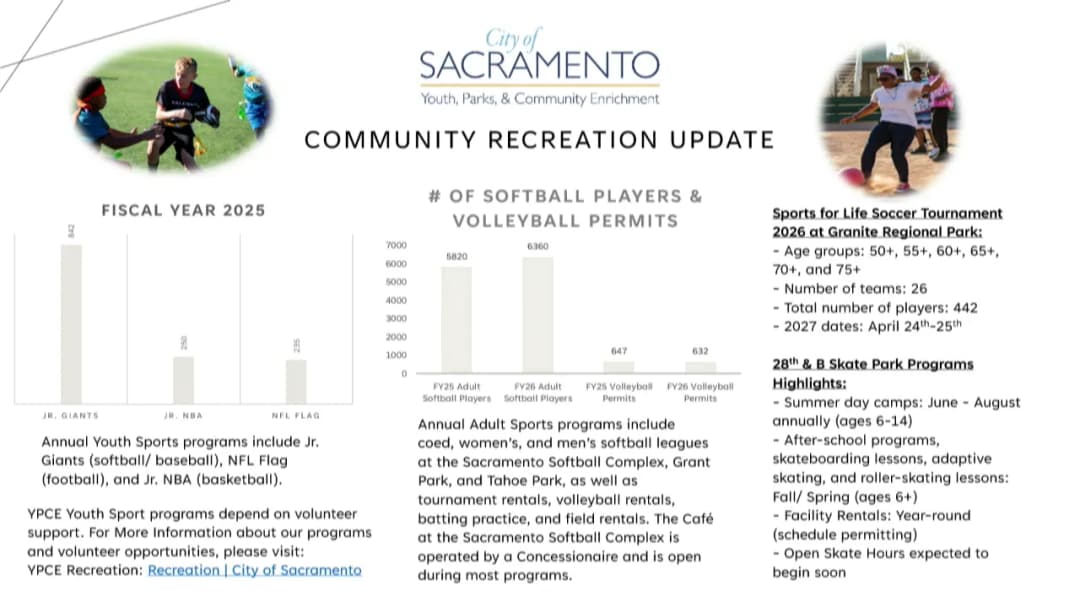
Public Meetings - Sacramento, CaliforniaThe Sacramento Youth Commission held its regular business meeting on October 5, 2026, at City Hall. The commission approved the consent calendar, received updates on community recreation programs, SacTown Youth Nights, and the Organizational Resiliency Fund, and heard commissioner reports. Consent Calendar - Approved the August 3, 2026 meeting minutes and the Youth Commission Follow-Up Log via motion with no opposition. Public Comments & Testimony - No members of the public spoke on agenda items or on matters not on the agenda. Discussion Items - Community Recreation and Access Leisure Program Updates: Heather Kopf presented on skate park operations (RFP selected, open skate expected fall 2026), youth sports (Junior Giants free, NFL Flag and Junior NBA fee-based, scholarship available), and Access Leisure programs (306 activities, 3,496 participants in FY2026). Commissioners asked about outreach methods, skate park redesign community meeting, and expansion of programs. - SacTownYouthNights Presentation: Brian Vargas reported that since 2021, the program has served over 50,000 youth; in the current cycle (Feb 2026 – Jan 2027) 8,400+ youth have attended 167 events via 24 organizations. Priority neighborhoods include Del Paso Heights, Meadow View, Valley High, and Oak Park. The program uses an independent scoring panel; youth commissioners are invited to serve. Some organizations requested reduced publicizing for safety. - Organizational Resiliency Fund Update: Marissa Eng and Laura Littlefield presented on the grant program providing resiliency building and general operating support. Eligibility criteria include serving youth in priority neighborhoods, budget $50K–$4M. Three youth panelists participated in scoring. 15 grantees funded from June 2026 to December 2028. A community of practice meeting on self/collective care received 100% positive feedback. December session will focus on youth voice; youth commissioners invited as special guests. Key Outcomes - Consent Calendar motion passed unanimously. - Items 3, 4, and 5 were received and filed/discussed; no votes required. - Commissioners requested future presentations: Sacramento Children's Fund (November 2026), priority neighborhoods overview, SAC youth center, 350 Sacramento/Outgrow, and involvement in grant processes. - Follow-up requested on youth program scholarship requirements. - Staff emphasized importance of responding to clerk's office emails to maintain quorum (10 of 12 commissioners needed).
The scheduled meeting of the Arts, Culture, and Creative Economy Commission for Monday, October 5, 2026 at 1:00 PM was cancelled due to a lack of business items. No agenda items were discussed, and no minutes or transcript of official proceedings are available.
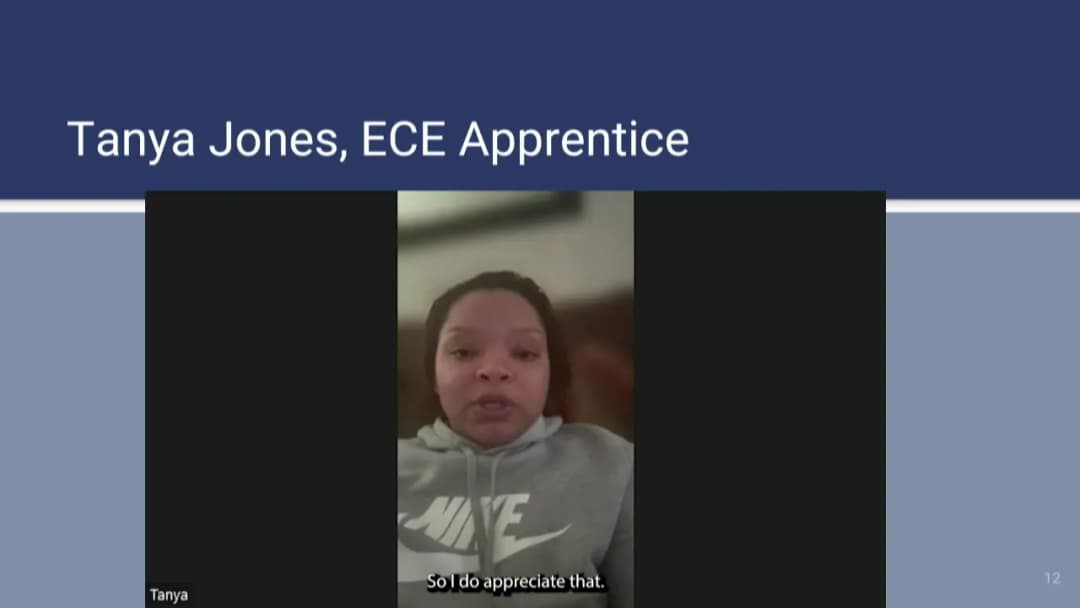
The Sacramento Children's Fund Planning and Oversight Commission met on Thursday, October 1, 2026, at 10:08 a.m. in Sacramento City Hall. Chair Eugenia Richardson presided, with seven commissioners present and one absent. The meeting featured presentations on early childhood investments and the third‑year review of the Strategic Investment Plan (SIP), public comments, and discussion of changes for the next Notice of Funding Opportunity (NOFO). The meeting was extended past two hours and adjourned at 12:00 p.m. Consent Calendar - Approval of Regular Meeting Minutes (August 6, 2026) – File ID 2026-00027: Passed unanimously. - Approval of Commission Follow‑Up Log – File ID 2026-00277: Passed unanimously. Public Comments & Testimony - Gabriel Valdez (Government Affairs Intern, Child Action / Lift Up Sacramento coalition) presented data on child‑care gaps in Sacramento County: only 29% of children aged 12 and under with working parents have access to licensed child care; 96,400 children qualify for subsidies but only 20% are enrolled; over 4,000 children are on waiting lists; child‑care disruptions cost the county $1–$1.2 billion annually in lost economic potential. He expressed strong support for continued investments in early learning and care infrastructure. - Tasha Johnson (new Executive Director, Youth Forward) introduced herself, noting her experience with youth development, workforce development, and housing stability, and pledged to work with the commission to support youth‑driven decisions. Discussion Items Item 3 – Sacramento Children’s Fund 0‑5 Fund Goal Janine Cooper (Child Care Project Manager, City Economic Development) presented on the importance of zero‑to‑five investments. She highlighted: - Scale of need: Nearly 300 children on the city’s subsidized waitlist, over 4,000 in Sacramento County; average monthly cost $1,000–$1,325; only 1 in 4 eligible children under three receive early intervention services. - City investments since 2021: $1.5 M ARPA funds for child‑care services; $394k federal grant for an ECE apprenticeship program; $850k for capacity building; $1 M+ for the ECE workforce. All are one‑time funds. - Apprenticeship program results: Two cohorts graduated (22) with 89% job‑site retention for at least one year; three cohorts now running with over 50 participants; wraparound services increased retention from 50% to 78%. - Family child‑care home expansion: 26 new family child‑care homes created 208 slots; infant/toddler expansion added 128 slots; ongoing business development program. Commissioners asked about targeting the highest‑need families, and Ms. Cooper recommended continuing the apprenticeship program and supporting family child‑care home providers. Commissioners also discussed the importance of investing in educators and non‑traditional care models. Item 4 – Sacramento Children’s Fund Strategic Investment Plan Third Year Review Julie Garen (Program Specialist) provided an update: - Fiscal year 2026 fund allocation: $8,410,200 (down $633,800 from FY2025). Revenue projects the fund will hold steady in future years. - Guaranteed Basic Income (GBI) launch: Applications opened October 1, 2026, for transitional‑age foster youth (16–23). Participants will receive $900/month for two years; nearly 300 pre‑applications already received. United Way will present details in November. - Proposed changes for the next NOFO (February–March 2027, estimated $10–14 M): - Applicants select only a primary fund goal (no secondary) plus a narrative on cross‑cutting strategies. - Identify level of prevention (primary, secondary, tertiary) as self‑identification for all fund goals. - Seed COI preference points: Require verifiable proof (lease/MOU, participant data) to eliminate automatic points; consider updating data and narrowing thresholds. - Small/emerging CBOs: Raise the organizational budget threshold from $200k (to $500k or more) and increase the set‑aside from $375k (potentially to $500k). Award amounts may increase from $75,000 over 3.5 years. - Grant review panel: Stipends ($200–$500), mandatory anti‑bias training, and earlier recruitment to avoid delays; commissioners asked for a recruitment timeline. - Grants management system (GMS): Upgraded; commissioners preferred receiving a video overview rather than a live demo at the November meeting. Commissioners reached consensus on moving to a single primary fund goal and identifying level of prevention. They agreed to further discuss small/emerging CBO funding amounts and thresholds at the November meeting. Key Outcomes - Consent Calendar approved by voice vote (7‑0). - Motion to extend the meeting past two hours (Commissioner Thomas / Vice Chair Ghafari) passed (6‑0, two absent). - Next RFP/NOFO direction: Commissioners generally supported: (1) applicants select only a primary fund goal, (2) self‑identify level of prevention, (3) stricter Seed COI documentation, (4) increased set‑aside for small/emerging CBOs (with specific numbers to be determined in November), and (5) raising the organizational budget threshold for small/emerging status. - Follow‑up items: Julie Garen will provide a timeline for grant‑panel recruitment at the November meeting; the citywide violence reduction strategy will be shared when final; a video overview of the GMS will be sent to commissioners. - Future meetings: A possible January 2027 meeting was requested, as the NOFO is expected in February–March 2027. The commission also plans a joint meeting with the Youth Commission in 2027. - Adjournment: 12:00 p.m.
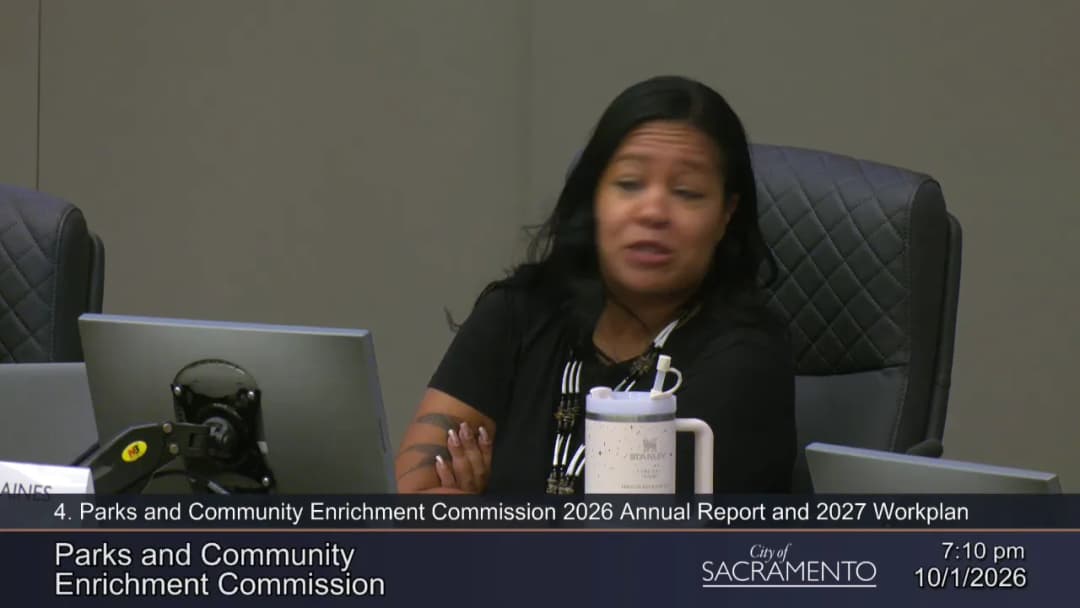
The City of Sacramento Parks and Community Enrichment Commission held its regular meeting on Thursday, October 1, 2026, beginning at 5:38 PM and adjourning at 7:25 PM. The main agenda item was a proposal to rename Cesar Chavez Plaza to Union Plaza, which sparked extensive debate over historical representation, community engagement, and equity. After a 90-minute discussion and a roll-call vote, the commission opted not to support the proposed name and instead sent the matter back to a city council subcommittee for further outreach. The commission also reviewed its draft 2026 annual report and 2027 work plan, deciding to incorporate additional items before a final vote. Consent Calendar - Approval of Minutes: The commission unanimously approved the minutes of the previous meeting (motion by Vice Chair Robbins, second by Commissioner Uribe). Public Comments & Testimony - Fabrizio Sasso, Executive Director of the Sacramento Central Labor Council, AFL-CIO, spoke in support of renaming the plaza to Union Plaza, stating that the name represents solidarity, community, and the labor movement. He urged the commission to advance the name to City Council. - Marnie Leisure (public comment at end of meeting) thanked city staff for rapid assistance in addressing weed and irrigation issues at the Natomas Rose Garden, an all-volunteer garden she has helped maintain for over 20 years. Discussion Items Cesar Chavez Plaza Renaming to Union Plaza Staff presented results of a citywide community engagement process conducted from June 12 to July 24, 2026, which generated 2,600 survey responses and 350 unique name submissions. Union Plaza received 450 votes, nearly double the second-place choice, Dolores Huerta Park (243 votes). Other leading suggestions included Farm Workers' Plaza, People's Plaza, Plaza Park, and Nissanon Park. Staff recommended that the commission support the mayor-appointed subcommittee's recommendation to adopt the name Union Plaza. Commissioners raised multiple concerns: - Commissioner Langer (who identified as a member of the Ione Band of Miwok Indians) criticized the lack of tribal consultation and argued that renaming the plaza would erase the Latino and Mexican American community's legacy, which was central to the original naming. She noted that the survey was cumbersome (1,000 of 2,600 respondents did not submit a name) and questioned whether results represented marginalized communities. - Commissioner Flores echoed concerns about losing Latino representation among Sacramento's 240+ parks, noting that only a handful honor Latinos. He suggested the name
The Sacramento City Council, along with the City Financing Authority, Housing Authority, Public Financing Authority, and Redevelopment Agency Successor Agency, held a special closed session meeting on Tuesday, September 29, 2026. The meeting was called to order at 12:18 PM (originally scheduled for 11:00 AM). A quorum was present. Item 1 (real property negotiations) was not heard. The body then adjourned to closed session to discuss the remaining items. Closed Session Items - Item 2: Conference with Labor Negotiators – Designated representatives: City Manager Maraskeshia Smith, Tina Gallegos, Aaron Donato, and Tim Davis. Employee organization: Sacramento Police Officers Association. - Item 3: Public Employee Performance Evaluation – City Attorney Gustavo Limón Martinez. - Item 4: Public Employee Performance Evaluation – City Auditor Farishta Ahrary. - Item 5: Public Employee Performance Evaluation – City Clerk Mindy Cuppy. - Item 6: Public Employee Performance Evaluation – City Manager Maraskeshia Smith. - Item 7: Public Employee Performance Evaluation – City Treasurer John Colville. Key Outcomes - The council did not consider Agenda Item 1 (conference with real property negotiators regarding 825–831 K Street). - The council proceeded to closed session to conduct the listed labor negotiations and performance evaluations. No votes or public actions were taken during the open portion of the meeting.
The city's Personnel and Public Employee Committee convened on September 29, 2026, to receive and review the annual reports of five charter officers appointed by the city council: City Attorney Gustavo Martinez, City Auditor Parisha, City Clerk Mindy Keppy, City Manager Mara Keisha Smith, and City Treasurer John Colville. The meeting centered on their offices' recent work, caseloads, financial impacts, challenges, and goals for the upcoming fiscal year. The committee voted unanimously to forward all reports to the full city council. Discussion Items Annual Report: City Attorney (Gustavo Martinez) – Martinez presented the office's report for fiscal year 2526, highlighting 10,500 legal assignments, 457 active civil cases (209 new, roughly four per week), and a staff of 54 out of 62 budgeted positions. He noted a significant spike in litigation costs, with outside counsel billing $350–$600 per hour compared to in-house costs of $98–$160. The office is managing 33 amicus briefs and three direct lawsuits against the Trump administration. Councilmembers expressed strong support for a proposed litigation incentive pay program to attract and retain seasoned litigators and reduce reliance on expensive outside counsel. Vice Chair Kaplan and Vice Mayor Telemonte voiced strong support for filling vacancies. Martinez stated his 'why' is the office's respectful, DEI-focused culture and the ability to see the direct impact of their work on the community. Annual Report: City Auditor (Parisha) – Parisha reported completing eight projects, including audits of the city's homeless response, emergency medical services, and Measure L. Since 2010, the office has identified $100 million in potential benefits, with $41.9 million realized. Over 150 recommendations were tracked, with more than 60 implemented. The office is now fully staffed and launched a fellowship program with California State University, Sacramento. Goals for 2027 include leveraging AI for audit efficiencies, expanding the fellowship, and enhancing audit recommendation tracking and implementation. Councilmember Vang praised the office's work on the language access and Measure L audits. Parisha stated her 'why' is the ability to see the community impact of her office's recommendations. Annual Report: City Clerk (Mindy Keppy) – Keppy reported that her office staffed 271 public meetings, processed 1,700 staff reports, and managed 5,000 public records requests (82% closed within 10 days). The June 2026 primary election was successfully managed without a November runoff. The office assisted in the recruitments for city manager and city attorney. Priorities for the coming year include a new agenda management platform for improved accessibility, a citywide commission effectiveness assessment, and updating the city's records retention schedule. Keppy stated her 'why' is demystifying public agencies and ensuring the public and council have the tools they need to participate and make informed decisions. Annual Report: City Manager (Mara Keisha Smith) – Smith detailed her first eight months, closing a $66.2 million general fund budget gap and helping adopt a $1.7 billion budget. She launched the 'One City, One Future' strategic plan. Key statistics included a 28% decrease in shootings, 42% decrease in homicides, 2,800 potholes patched, and 418,000 service requests handled through 311. She emphasized strengthening accountability, improving internal coordination, and a renewed focus on quality-of-life issues. Councilmembers praised her communication, community presence, and leadership. Smith stated her 'why' is creating a legacy for underrepresented communities and ensuring equitable services across the city. Annual Report: City Treasurer (John Colville) – Colville reported the office manages $2.1 billion in assets. Highlights included a $5.65 million savings from bond refunding, $12 million in investment earnings returned to the general fund, and the SAFE (SCRS) pension fund reaching a 115% funding status. The office is working on a social responsible investing policy. Succession planning is a key concern due to the office's average age of 56. Colville stated his 'why' is his team and seeing capital projects tangibly improve the city. Councilmembers recognized the office's critical role in generating revenue and emphasized supporting competitive compensation to fill vacancies. Key Outcomes - The committee voted unanimously to forward the annual reports of the City Attorney, City Auditor, City Clerk, City Manager, and City Treasurer to the full City Council. - Councilmembers directed the City Attorney to develop a formal litigation incentive proposal to improve recruitment and retention. - The committee underscored the need for workforce development, competitive compensation, and strong succession planning across all charter officer departments, particularly given high vacancy rates and aging tenures. - The City Auditor was encouraged to continue improving audit recommendation tracking and implementation workflows to ensure council-directed recommendations are followed through. - The City Manager was tasked with continuing to refine strategic priorities to better align organizational capacity with council direction.
The Aggie Square Enhanced Infrastructure Financing District (EIFD) Public Financing Authority held a special meeting on September 29, 2026, at Sacramento City Hall. Vice Chair Eric Guerra called the meeting to order at 9:34 a.m. and adjourned at 9:43 a.m. Members present: Rick Jennings (District 7), Christopher Romney, and Vice Chair Eric Guerra (District 6). Members absent: Yzabelle Dela Cruz (District 5) and Chair Caity Maple (District 5). The meeting included a consent calendar, one public hearing, and commissioner comments. Consent Calendar - Approval of Minutes: The Authority unanimously approved the special meeting minutes of June 17, 2025, and August 25, 2026. (File ID: 2026-01578) Public Comments & Testimony - No members of the public signed up to speak on any agenda item. Discussion Items - Second Amendment to the Infrastructure Financing Plan and Third Amendment to the Master Funding Agreement (File ID: 2026-01482) - Sini Makasini (Senior Development Project Manager, Finance Department) presented the staff report. The proposed second amendment to the Infrastructure Financing Plan makes two minor changes: (1) amends the list of public facilities to be financed by the EIFD, and (2) amends the list of authorized financing methods to allow the EIFD to pay impact fees as a financing method. The City Council approved these same amendments on September 22, 2026. - The Authority conducted a public hearing, closed it, and then voted unanimously (3-0, with two members absent) to adopt the resolution approving the second amendment and to authorize the PFA Executive Director to enter into the Third Amendment to the Master Funding Agreement with the University of California, related LLCs, and the City. - Vice Chair Guerra emphasized the importance of ongoing public engagement and noted that an annual Aggie Square community meeting is upcoming. Commissioner Jennings echoed the need to keep the community informed and involved throughout the process. Commissioner Comments-Ideas and Questions - Vice Chair Guerra raised concerns about parking accessibility at Aggie Square, noting that parking costs can be a barrier, and encouraged exploring solutions. He also expressed appreciation for seeing students on campus tours. - Commissioner Jennings reiterated the importance of creative public engagement to ensure community voices are heard. - Leslie Fritzsche (Economic Investment Manager) responded that the Authority holds regular meetings with the SACMA Investment Without Displacement Group (next one in October) and quarterly community meetings (the next potentially on October 21). She noted that the last annual report recorded over 300 community meetings held at Aggie Square, reflecting its role as a community hub. She also acknowledged the parking issue and mentioned that parking validation is often provided for community meetings tied to the Community Benefits and Partnership Agreement. Key Outcomes - Approved the Consent Calendar (minutes) unanimously. - Adopted the Second Amendment to the Infrastructure Financing Plan and authorized the Third Amendment to the Master Funding Agreement for the Aggie Square Project (unanimous vote, 3-0). - No further actions or referrals.
The Sacramento City Council held a regular meeting on Tuesday, September 29, 2026, from 5:04 p.m. to 6:29 p.m. at City Hall. The primary action was the unanimous declaration of a city-owned 102-acre parcel at 3100 Meadowview Road as surplus land under the California Surplus Land Act, initiating a 60-day notice of availability and subsequent negotiation process. The meeting also included a special presentation honoring community leader Señora Angelbertha Cobb on her 95th birthday. No consent calendar items were considered. Special Presentation / General Communications - Mayor Pro Tem Guerra presented a proclamation declaring October 10, 2026 as Señora Angelbertha Cobb Day in Sacramento, recognizing her decades of cultural and educational leadership, including founding danza groups and co-founding D-Q University. Her son thanked the council on behalf of the family. Public Comments & Testimony - Carisha Calvin (District 8 resident, Cabrilla Park Neighborhood Association president) asked for guarantees that community priorities (recreation, housing, open space) would be enforceable in future negotiations, stating "listening alone is not protection." - Silverio Rizzo (102 Acres Advisory Committee member, Detroit neighborhood resident) expressed support for declaring surplus land but with two reservations: mixed-use transit-oriented development (due to proximity to Morrison Creek Light Rail) and inclusion of open/recreational spaces (e.g., fishing pond, skate park, sports fields). He referenced West Sacramento's use of state/federal dollars for parks. - Mark Velasquez spoke in opposition to declaring the entire parcel surplus, urging the council to reserve half for a future public cemetery. He argued that a $6 million investment for a cemetery could serve residents for centuries and called for more vision beyond financial gain. - Leanna H criticized alleged ICE collaboration with Sacramento Police, citing an incident where police responded to traffic cones instead of a weapons call. She urged the council to take meaningful action to protect sanctuary city policies. - Kevin Boltz opposed the surplus declaration conditionally but raised concerns about public-private partnerships, citing cost overruns for the Golden 1 Center (e.g., $5.7 million budget shortfall over two years). He questioned the city's commitment to affordable housing, noting only 500 units built last year against a need for thousands. - Leah Morris (Animal Well-Being Commission member, former chair) requested retaining 8–10 acres of the 102-acre site for a new animal shelter. She cited a 2024 needs assessment showing the current 1.8-acre shelter on Front Street is inadequate and that an 8–10 acre facility could house 300 animals and co-locate social services, training, and community space. - Clarence Griffin (speaking for Jubilee Training Center) supported the surplus declaration but requested that Jubilee be considered as a community anchor. He described a campus concept with senior/affordable housing, workforce training, business incubator, health services, and open space, noting the site's need for partners and outside funding. - Chinwa Rhodes urged the council to ensure that community voices from years of dreaming and planning (e.g., eight guiding principles) are not forgotten when development proceeds. Discussion Items - Item 1: Declaration of Surplus Land – 102-Acre Parcel (File ID 2026-01324) Staff Presentation: Ginger Weagraff (Economic Development) explained that the city purchased the land in 2022. A feasibility study showed at least $50 million needed for infrastructure, making a private partner essential. A $500,000 grant application for pre-development work was unsuccessful in 2025. In January 2026, a Request for Expressions of Interest (RFEI) found that none of the three submissions met the conditions for an exemption under the Surplus Land Act (specifically Exemption H, which would have required significant affordable housing tied to non-residential uses). Staff concluded the only viable path is the traditional surplus land process: a 60-day Notice of Availability, then at least 90 days of good-faith negotiation with qualified entities. Tonight's action does not approve a sale or specific project; any future development agreement requires council approval. Community engagement produced eight guiding principles (affordable housing, community center, civic amenities, natural features like open parks, connectivity, equitable neighborhoods, job/education opportunities) that staff will embed in the Notice of Availability. Councilmember Mai Vang (District 8) spoke of her long-standing commitment to a community-led process, referencing the 102 Acres Advisory Committee formed to ensure continuity. She highlighted that eight guiding principles will be incorporated and that a Disposition and Development Agreement (DDA) coming back to council will include legally enforceable public benefits. She moved to adopt the resolution with the guiding principles embedded, directing staff to negotiate a DDA consistent with the Surplus Land Act. Councilmember Eric Guerra raised the possibility of retaining 8–10 acres for a potential new animal shelter, citing the Front Street shelter's limitations and the Animal Well-Being Commission's needs assessment. He asked if the city could later rescind surplus status on a portion for city use. Staff (Richard Sanders, Facilities & Real Property Superintendent) confirmed the city could declare only a portion surplus, issue a Notice of Availability on the remainder, and if later determined that a portion is needed for city purposes, council could rescind the surplus declaration on that portion. Vice Mayor Karina Talamantes asked how the city evaluates proposals with equal affordable housing numbers (e.g., 25% affordability and same unit count). Richard Sanders explained the Surplus Land Act prioritizes first the highest number of affordable units, then the greatest depth of affordability (lowest AMI). The city can negotiate with multiple respondents and place additional priorities (e.g., guiding principles) in the solicitation. Council ultimately reviews and approves any final agreement. Mayor Kevin McCarty emphasized that the city retains leverage through the DDA and zoning process, and that the eight community priorities should serve as the "North Star" for evaluation. He reaffirmed that the 102 Acres Advisory Committee will continue to advise as the project advances. Councilmember Roger Dickinson asked about the parcel map: the southwest corner is already excluded for a planned water reservoir by the Department of Utilities. He supported directing public works to evaluate feasibility of setting aside acreage for an animal shelter before issuing the Notice of Availability. Councilmember Lisa Kaplan commended the community engagement process and supported moving forward. The motion by Councilmember Vang, seconded by Mayor McCarty, carried unanimously 8-0 (Councilmember Caity Maple absent). Key Outcomes - Adopted Resolution No. 2026-0259 declaring the 102-acre parcel at 3100 Meadowview Road as surplus land under the California Surplus Land Act. The resolution directs staff to: - Issue a Notice of Availability for at least 60 days. - Embed the community-developed eight guiding principles (affordable housing, community center, civic amenities, parks, connectivity, etc.) into the solicitation. - Negotiate in good faith with qualified entities for at least 90 days, prioritizing proposals with the highest number and deepest affordability of housing units. - Return to Council for approval of any Disposition and Development Agreement, which will include public benefits and regulatory agreements for affordable housing. - Commitment to continue the 102 Acres Advisory Committee to provide ongoing community oversight and input throughout the negotiation and development stages. - Direction to City Manager and Public Works to evaluate the feasibility of retaining up to 8–10 acres for a potential animal shelter (as requested by the Animal Well-Being Commission and Councilmember Guerra) and report back before issuing the Notice of Availability. - No other items were discussed or voted on. The meeting adjourned at 6:29 p.m.
The Sacramento City Council convened in a regular meeting on Tuesday, September 29, 2026, at 2:13 p.m. at City Hall. Vice Mayor Karina Talamantes presided. Councilmembers Caity Maple and Phil Pluckebaum were absent for the full meeting; Councilmember Eric Guerra was absent for the final discussion item. The meeting was a joint session of the City Council, the City Financing Authority, the Sacramento Housing Authority, the Public Financing Authority, and the Redevelopment Agency Successor Agency. Consent Calendar Items 1 through 18 on the Consent Calendar were approved in a single 7-0 vote. Several council members highlighted specific items: - Item 2 (International Rescue Committee Contract): Councilmember Guerra stated this $317,000 contract fulfills a commitment in the Aggie Square community benefits agreement to provide housing stabilization and prevent displacement. - Item 3 (SETA Operating Budget): Mayor Pro Tem Guerra expressed appreciation for the agency's proactive work in preparing for upcoming federal policy and healthcare changes. - Item 4 (Community HealthWorks Amendment): Councilmember Kaplan praised the Street to Housing Pilot Program, noting a $201,055 amendment for landlord engagement and case management. - Item 10 (CalVIP Cohort 5 Subawards): Councilmember Vang celebrated the $3.3 million authorization to 14 community organizations for the CLIIR Project. Public speaker Paris Dye of Impact SAC shared a powerful first-hand account of using the program that same week to de-escalate a potential violent conflict between youth. - Item 12 (Extreme Heat Grant): Councilmember Dickinson questioned staff about the county's co-application for the Northern Bike Trail. Staff confirmed the city's $400,000 request is for tree planting and irrigation within city limits. - Item 16 (Roseville Road Campus): Councilmember Kaplan highlighted the effective work of First Step Communities and The Gathering Inn at the Roseville Road campus, supporting an additional $2.25 million and $2.6 million in contracts respectively. Discussion Items - Item 19: Greenbriar Community Facilities District Bonds: The council approved the issuance of approximately $18 million in Series 2026 special tax bonds for Improvement Area 2. Councilmember Kaplan separated the third recommendation—which would have interpreted land use classifications for specific parcels—from the bond sale, arguing that such policy decisions should not be bundled into a bond issuance. The bond resolution passed 7-0. The bond has a true interest cost of 6.17% and total debt service to final maturity of $43.7 million. - Item 20: City Positions on November 2026 Ballot Measures: Director of Governmental Affairs Consuelo Hernandez recommended supporting Prop 1 (veteran and housing bond) and opposing Prop 43 (two-thirds vote threshold for citizen tax initiatives). The council expanded the city's official positions. Support was adopted for Prop 1, Prop 3 (school funding extension), and Prop 37 (home buyer down payment assistance). Oppose was adopted for Prop 39 (voter ID requirement) and Prop 43. Vice Mayor Talamantes voiced concern that the process was rushed and did not allow enough time for review. The motion passed 6-1, with Councilmember Vang dissenting due to needing more time on Prop 43. - Item 21: Rio Linda Senior Housing Project (Homekey+ Funding): The council adopted a resolution to accept $31,866,126 in Homekey+ funding for a 100-unit permanent supportive housing project for seniors and veterans at 2809-2821 Rio Linda Boulevard. City Housing Manager Ya-yin Isle noted the project will utilize 240-square-foot "boss homes" as a cost containment strategy. The resolution passed 6-0 (Councilmembers Guerra, Maple, and Pluckebaum absent). Public Comments (Matters Not on the Agenda) - Clyde Mosby proposed a community-based violence prevention pilot program based on his personal experience as a formerly incarcerated gang leader. - Michael Milton criticized contradictory city policies on marijuana and the high cost of parking tickets for residents of affordable housing. - Barb Ram criticized campaign mailers, expressed support for the new housing units, and questioned the city's use of bonds and interest payments. - Herman Barrahona & Fatima Garcia (Sacramento Environmental Justice Coalition) requested the city reconsider charging for parking meters on Sundays, citing a recent cultural event at Southside Park where families and worshippers faced financial penalties. Key Outcomes - Consent Calendar (Items 1-18): Approved 7-0. - Item 19 (Greenbriar Bonds): Bond issuance approved 7-0. Land use interpretation item separated for further debate. - Item 20 (Ballot Measures): Approved 6-1. City takes formal positions on five propositions. - Item 21 (Rio Linda Homekey+): Approved 6-0. $31.8 million accepted for 100 senior/veteran housing units. - City Manager's Report: Announced the opening of the Measure L foster youth guaranteed income program, a red light camera workshop, and a hazardous waste disposal event. - Council Reports: Vice Mayor Talamantes attended the League of California Cities conference. Councilmember Kaplan attended the CalCities Board meeting.