The Sacramento Community Police Review Commission met on Monday, February 12, 2024, at 5:34 PM in the City Hall Council Chamber. Chair Keyan Bliss presided. The meeting included a special presentation to welcome new Commissioner Jody Johnson, approval of the consent calendar, discussion and approval of the 2024 Work Plan, continuance of the Annual Report, and approval of the Follow-Up Log with an addition. No public comments were made on matters not on the agenda or on consent items. Special Presentation - Chair Bliss welcomed newly appointed Commissioner Jody Johnson, who expressed gratitude and eagerness to collaborate. Commissioner Johnson was appointed by the mayor. Consent Calendar - Item 1 – Approval of Meeting Minutes (January 8, 2024): Approved unanimously (8-0, with three members absent). - Item 2 – OPSA 2023 Quarter 4 Police Complaint Activity Report: Received and filed. The report documented 67 complaints closed in Q4, involving 160 allegations, of which 9% were sustained. Commissioner Carter Martinez arrived at 6:18 PM and departed at 6:28 PM due to personal health conditions, but did not participate in the consent vote. - During discussion, commissioners queried OPSA Director Dr. Watson about the backlog of investigations (some from 2020-2021), the availability of Q1 and Q2 2023 quarterly reports, and trends in search and seizure allegations (31 allegations noted). Dr. Watson stated that staffing shortages (only three people) limit comprehensive analysis, but that six additional staff were approved and are being onboarded. He noted that improper search and seizure is consistently among the top allegation categories and that a standalone policy is needed. Commissioner Carter requested data on the percentage of sustained complaints that lead to lawsuits; Captain Buchanan indicated the department tracks litigation but could not provide immediate statistics. Commissioner Z. Wayne Johnson suggested using a composite list of officer complaints and commendations to assess behavior patterns, and requested this be discussed in a subcommittee. Discussion Items - Item 3 – Proposed 2024 Work Plan: Commissioner Castillo-Krings presented a draft work plan. After discussion, the commission refined the work plan to include three priority work areas: (1) Community Policing and Response (including homelessness response and community engagement), (2) SPD Strategic Planning and Budget Transparency, and (3) Civilian Oversight Engagement and Function (including MEU policy reviews and improving commission effectiveness). Commissioners emphasized the need for early and robust community outreach for MEU forums, with at least one month's notice. The work plan also includes goals to conduct a joint workshop with City Council on the city auditor's recommendations, review outstanding commission recommendations from 2020-2023, and up to six community forums. The motion to approve the work plan passed unanimously (8-0). - Item 4 – Annual Report to City Council: The proposed annual report includes the commission's 2023 recommendations (including those on search and seizure policy) and the 2024 work plan. Commissioner Castillo-Krings noted that the search and seizure recommendations had been expanded in the current version compared to the January draft, and without clear track changes, she and other commissioners were uncomfortable voting. After discussion, the commission moved to continue the item to the March 11, 2024 meeting. The motion passed unanimously (8-0). Commissioners expressed desire to see a version with strikethroughs/redline changes before approving. - Item 5 – Follow-Up Log: The follow-up log was approved as amended. Commissioner Bliss added a request for a presentation on the 2024 RIPA (Racial and Identity Profiling Act) report from the California Department of Justice. The motion to approve the log with that addition passed unanimously (8-0). Commissioner and Staff Comments - Chair Bliss provided an update on the planned joint workshop with City Council, which aims to clarify the commission's role and powers. He expressed strong support for a civilian oversight model and cautioned against a purely advisory function, stating he would not participate in a performative process. Other commissioners acknowledged the advisory nature of the commission but awaited the workshop's outcome. Commissioner Jody Johnson raised interest in a community know-your-rights workshop; Chair Bliss suggested this could be incorporated into the work plan's community engagement process. Key Outcomes - Consent Calendar: Approved (meeting minutes and Q4 OPSA report). - 2024 Work Plan: Approved unanimously, defining three priority work areas and a calendar for community forums, with emphasis on early notification and coordination with SPD on MEU policy. - Annual Report: Continued to March 11, 2024, pending clear documentation of changes to search and seizure recommendations. - Follow-Up Log: Approved with addition of a request for a DOJ RIPA report presentation. - New Commissioner: Jody Johnson seated and welcomed.
Public Meetings - Sacramento, California
Public Meetings - Sacramento, CaliforniaThe Sacramento Arts, Culture, and Creative Economy Commission met on February 12, 2024, at 1:00 p.m. to discuss the Creative Edge cultural plan, review the 2023 annual report, and outline the 2024 work plan. The meeting also featured extensive public comment regarding the Wide Open Walls mural festival, with multiple speakers alleging exploitation, cultural appropriation, and underpayment of artists. Consent Calendar - Approved the minutes of the January 8, 2024 meeting by a unanimous vote (8-0, with Commissioners Lavulo and Tocalino absent). Discussion Items - Creative Edge Overview and 2023/2024 Work Plan (File ID: 2024-00497): Commissioners Winlock and Enriquez provided an overview of the Creative Edge plan, a cultural guidebook adopted in June 2018 after extensive community engagement. Staff (Jason Jong and Megan Van Voorhis) reported on progress toward the plan’s six goals: arts education, cultural equity, creative economy, artist support, neighborhood infusion, and investment. They highlighted the use of CARES and ARPA funds, a $4.75 million Capital Region Creative Corps grant, and the transition of the Any Given Child program to the Sacramento County Office of Education. Challenges include stable funding and the need for a dedicated revenue source. The commission discussed the need to reaffirm Creative Edge goals and create a public dashboard. Public Comments & Testimony - On Creative Edge item: Marcos (artist) questioned how to improve the creative economy and noted that many commissioners were unaware of his community project. Commissioner Naranjo echoed concerns about funding bottlenecks. - On Matters Not on the Agenda (Wide Open Walls): Over a dozen speakers, including artists, community leaders, and residents, criticized Wide Open Walls (WOW) for a pattern of harm, including cultural appropriation, exploitation, and underpayment. Specific allegations included: paying artists as low as $250 per mural, charging clients significantly more; a lack of women and artists of color in early festivals; the recent misrepresentation of a Kalinga warrior in Little Saigon without community consultation; and board members profiting while artists suffered. Speakers urged the city to fund equitable organizations, ensure transparency, and hold WOW accountable. Several artists shared personal experiences of being underpaid or disrespected. Speakers also raised concerns about the city’s role in approving such projects and the need for community input. Key Outcomes - The commission received and discussed the Creative Edge overview and work plan; no formal vote was taken on the item. - Chair Enriquez and Vice Chair Lavulo thanked the public for their courage in speaking and acknowledged the harm expressed. - Megan Van Voorhis recommended that the commission place an item on the next meeting’s agenda to clarify the city’s role and relationship with Wide Open Walls and discuss options for accountability. The chair agreed to bring a staff report to the next meeting. - No immediate action was taken on the public comments, as the matter was not agendized. The commission will follow up with a future discussion. Director’s Report - Jason Jong reported on website migration, a new arts program assistant, a community mural discussion at Sutter’s Landing, Del Rio Trail progress, the dedication of the River Crossing public art piece, the Hanami Line cherry tree project, and upcoming film grant opportunities. Commissioner Comments - Commissioners highlighted upcoming events, including Aggie Square Public Art process (Feb 29), the Sojourner Truth Museum festival, and a “Seat at the Table” discussion at Verge Gallery (Feb 21). Commissioner Naranjo promoted the Sacramento Artist Roundtable website for grant opportunities.
The Sacramento Planning and Design Commission met on Thursday, February 8, 2024, at 5:30 p.m. at City Hall (915 I Street). The meeting was called to order at 5:33 p.m. and adjourned at 8:23 p.m. Chair Maya Wallace presided. All 11 commissioners were present (Commissioner Macias Reed absent). The agenda included a consent calendar, one public hearing on a gas station conditional use permit, and two discussion items related to neighborhood revitalization and age-friendly planning. Consent Calendar - Approval of Minutes (File ID: 2024-00008): The commission unanimously approved the minutes from the January 25, 2024 meeting. Motion by Vice Chair Yeung, second by Commissioner Xiong; passed 11-0. Public Hearings - Fuel Stop Gas Station (P22-021): A public hearing was held on a request for a Conditional Use Permit (CUP) and Site Plan and Design Review to reestablish a gas station and convenience store at 3200 Rio Linda Boulevard. Staff recommended denial due to the site’s proximity to residential uses (within 30 feet), inconsistency with General Plan policies protecting disadvantaged communities, and the site's low Healthy Places Index score (10.8, meaning 89.2% of state tracts have better conditions). The applicant, Sarita (owner for 25+ years), explained that a 2020 fire and contractor bankruptcy caused delays, leading to the expiration of the deemed CUP. She emphasized community support and plans for future EV chargers. Three public speakers (Tara, Melissa Harris, Adam Schip) supported the project, citing the need for services and concern about blight if denied. After deliberation, Commissioner Chase moved to deny staff’s recommendation and direct staff to prepare findings supporting approval. The motion cited economic development goals, the pre-existing use, and extenuating circumstances (fire, COVID, contractor failure). Commissioners cited General Plan policies ED 1.1 and ED 1.4. Motion seconded by Commissioner Hernandez; passed 11-0. Staff will prepare findings of fact for approval and return to the commission at a future date. Discussion Items - Forward Together Action Plan: Marysville Del Paso Blvd. Commercial Corridor and Neighborhood Revitalization (File ID: 2024-00165): Staff presented the plan, developed over 24 months with community engagement (including a Community Advisory Committee, walk-arounds, and surveys). The plan is organized into four categories (Live, Work, Shop, Experience) and includes a $500,000 pilot grant program (with collaborative impact grants up to $400,000 and action grants up to $25,000). Public speakers (Melissa Harris, Tara, Adam Schip) urged implementation and accountability. Commissioners praised the effort and offered suggestions: Vice Chair Yeung emphasized affordable housing funding and land banking; Commissioner Buckley noted displacement strategies and AFFH; Commissioner Caden recommended environmentally clearing active transportation projects and leveraging Valley Rail extension; Commissioner Lamas asked about metrics. The item was for review and comment only; no vote taken. - Age-Friendly Community Action Plan (File ID: 2024-00365): Staff presented a draft plan based on AARP’s 8 Domains of Livability, with a three-year implementation horizon. The plan resulted from stakeholder working groups (21 members) and community outreach tied to the 2040 General Plan. Public comment period is open until February 9. Commissioners asked about accessibility for blind seniors, connections to climate resilience, and quantifiable goals. The item was for review and comment; no vote taken. Public Comments & Testimony - Item 2 (Fuel Stop): Three speakers supported the gas station, citing community need, the owner’s involvement, and risk of blight. No opposition speakers were present; one letter of opposition was received from a neighbor but later resolved per the applicant. - Item 3 (Forward Together): Three speakers voiced strong support, emphasizing the need for action and accountability. No opposition speakers. - Item 4 (Age-Friendly): No public speakers. - Public Comments – Matters Not on Agenda: None. Key Outcomes - Fuel Stop Gas Station (Item 2): The commission voted 11-0 to direct staff to prepare findings of fact for approval of the Conditional Use Permit and Site Plan and Design Review, effectively overturning staff’s denial recommendation. Staff will return with findings at a future meeting. The applicant may proceed once findings are adopted. - Forward Together Action Plan (Item 3): The commission reviewed and commented; no formal action required. Staff will continue implementation with the pilot grant program and present to City Council in mid-March. - Age-Friendly Community Action Plan (Item 4): The commission reviewed and commented; public comment period closes February 9. The plan will go to City Council after adoption of the 2040 General Plan. - Commissioner Comments: Commissioner Chase thanked colleagues for guidance on the motion; Vice Chair Yeung wished everyone a happy Lunar New Year.
The Law and Legislation Committee met on Tuesday, February 6, 2024, from 10:00 a.m. to 11:00 a.m. in the City Hall Council Chamber. The meeting included a consent calendar item and a single discussion item focused on a councilmember proposal to regulate intoxicating hemp-derived products. After presentations, public testimony, and committee deliberation, the committee voted unanimously to direct staff to develop a plan and return with options, including an update by summer 2024. Consent Calendar - Item 1: Law and Legislation Log (File ID 2023-01662) – Approved unanimously by a motion from Councilmember Guerra, seconded by Vice Mayor Maple. No items were removed for separate consideration. Public Comments & Testimony Eight members of the public spoke on Item 2 (hemp regulation). Their positions are summarized below: - Tisha Aguilar (CEO of Native Sisters Circle, mother of three) – Expressed urgent concern for youth protection, citing the American Academy of Pediatrics and CDC warnings about THC effects on cognitive development and the risk of dependency. - Eric Henry (owner of Unity Health Center, Susanville) – Opposed a city ordinance, arguing that the state should enforce existing laws. Stated that compliant businesses follow federal and state regulations (0.3% THC limit, lab testing, permits). Requested state compliance checks instead of city action. - Mike Duncan (Executive Director of Native Dads Network) – Supported regulation, emphasizing the generational impact and accessibility of these products to youth. Urged the committee to prioritize youth safety over budget concerns. - John (CBD company owner) – Opposed a city ordinance, claiming most products are compliant. Argued that enforcement would burden police and code enforcement, and that the city should not “weaponize” police against businesses. - Albert Tittman (Director of Native Dads Network, father of five, 15 grandchildren, addiction treatment counselor) – Supported regulation, highlighting the normalization of intoxicating hemp products and the need to protect youth. Cited his work with tribal communities and the Impact Indigenous Mentors program. - Emiliano Rossas (representing Pro-Youth and Families, prevention partner since 1981) – Expressed strong support for any city policy to restrict sale of intoxicating hemp near schools, citing lack of age verification and proximity to schools. - Gera Gonzalez (Getting It Right from the Start, Public Health Institute) – Urged the committee to take action, specifically setting a cap of less than 1 mg THC per package and age limits for all hemp products. Stated Sacramento has leadership capacity. - Connie Chen Robison (Executive Director, PHI Center for Collaborative Planning) – Supported regulation, requesting prohibition of sale of intoxicating hemp, prohibition of artificially derived cannabinoids, age limits, restricted places of sale, and prohibition of youth-targeted packaging. Represented hundreds of families. Discussion Items - Item 2: Councilmember Proposal Request for Committee Consideration – Regulation of Hemp-Derived Products (File ID 2024-00420) - Presentation: Councilmember Valenzuela introduced the proposal, noting a loophole allowing hemp-derived intoxicating products (e.g., Delta-8 THC) to be sold without age restrictions or potency caps, often near schools. Youth Forward staff (Sarah Michael Gaston and Ajuwa Achianu) presented slides showing examples of products purchased without ID at gas stations, packaging mimicking candy, potency up to 30 times the legal cannabis limit (500 mg per gummy vs. 10 mg cap), and data showing over 30,000 national poisonings and half of California 10th graders using cannabis starting with hemp products. They urged the city to adopt a model ordinance from Public Health Institute limiting intoxicating cannabinoids to <1 mg per package outside licensed cannabis retailers and prohibiting artificially derived cannabinoids. - Staff Response: Assistant City Manager Laney Milstein stated that the city lacks enforcement capacity (police and code enforcement stretched thin) and that the state has failed to enforce existing laws. She recommended directing advocates to the California Department of Public Health and county, not the city, as the city cannot commit resources to a new regulatory structure. - Committee Discussion: - Vice Mayor Maple questioned whether a local ordinance would duplicate existing state law (0.3% THC limit) and whether the real problem is enforcement. She supported exploring sensitive use buffers near schools, age limits for consumables, and packaging restrictions, but cautioned against overly broad prohibitions that could burden businesses. - Councilmember Guerra compared the issue to the flavored tobacco ban, noting that Sacramento acted alone initially but needed county cooperation. He supported moving forward but with realistic expectations about staff capacity. He suggested immediate actions: sending cease-and-desist letters to non-compliant businesses, engaging the county, and requesting legal advice on enforcement. - Councilmember Jennings stressed urgency, saying “failure to plan is planning to fail.” He advocated for a comprehensive plan involving state and federal partners, learning from San Diego County’s example, and educating the community. - Chair Valenzuela clarified that the intent is to explore options, not necessarily a full ordinance, and suggested including Youth Forward and Public Health Institute in staff work. The committee agreed to ask for an update by summer 2024. Key Outcomes - Motion: Councilmember Guerra moved, seconded by Councilmember Jennings, to direct staff to: (1) research and develop a plan with options to address intoxicating hemp products, including enforcement, education, zoning, and potential local ordinance; (2) engage with Sacramento County, state agencies, and other cities (e.g., San Diego); (3) provide an update to the committee by summer 2024. The motion passed unanimously (4-0). - The committee did not take a final vote on the proposed ordinance but referred the matter to staff for further study and return with recommendations.
The Ann Land and Bertha Henschel Memorial Funds Commission held a regular meeting on January 31, 2024, at 5:30 PM in the City Hall Complex, 915 I Street, Sacramento. The meeting was called to order by President Talbott Smith at 5:31 PM. Commissioners present: Beckman, Ellis, Hinojosa, Ruhl (arrived at 5:35 PM), Yanez, Zamanudin, and President Smith. Absent: Chan and Korbs. The commission approved the November 15, 2023 minutes, discussed and provided direction on grant award procedures, assigned 2024 site visits to commissioners, received semiannual reports, and elected officers for calendar year 2024. One public comment was received on a matter not on the agenda. Consent Calendar - Approval of Minutes (File ID: 2024-00156): The commission passed a motion (6-0, with Commissioners Chan, Korbs, and Ruhl absent) to approve the meeting minutes from November 15, 2023. Public Comments & Testimony - Christian Rodriguez (CEO, 501c3 nonprofit for disabled individuals): Spoke during Public Comments – Matters Not on the Agenda. He described his organization providing adaptive equipment and Paralympic sport programs for physically challenged individuals in Sacramento County. He noted current lack of gym availability in Sacramento and requested networking and assistance from the commission to find city park and rec facilities for their programs. Discussion Items - Item 2 – Procedures for Awarding Grants (File ID: 2024-00431): Commissioners reviewed and commented on the grant award process used in November 2023. Discussion included whether to require all applicants to give oral presentations (as done previously) or only when commissioners had questions. Several commissioners supported the streamlined approach (only questioning applicants when needed), noting it saved time and was similar to other grant processes. Concerns were raised about potential disparaging comments toward one applicant. Staff clarified that city staff pre-screen only for completeness, not for eligibility criteria (e.g., pet food requests still come to commission). Commissioners also discussed revisions to the semiannual reporting form to clarify that “use of funds” covers only the current six-month reporting period, to avoid confusion with full-year reporting. Direction was given to staff to modify the form (e.g., add clarifying text) and to present updated procedures for approval at a future meeting. No formal action was taken. - Item 3 – Assignment of 2024 Site Visits (File ID: 2024-00425): The commission reviewed a list of 25 grant recipients for 2024. Commissioners self-selected three site visits each, with Commissioner Korbs assigned the remaining four (absent). The motion (passed 7-0) designated commissioners to visit each grantee site and set a due date of June 30, 2024 for submission of site-visit reports (noting June 30 is a Sunday; staff clarified reports due that date are acceptable). Commissioner Yanez suggested May or June visits to allow grantees to have spent some funds. - Item 4 – Semiannual Reports for July–December 2024 (File ID: 2024-00426): Staff reported that eight grantees had not yet submitted their semiannual reports; two additional reports were received during the meeting, leaving six outstanding (Salvation Army, Sierra Service Project, River City Food Bank, My Sister’s House, Freedom Through Education Campus, and Community Against Sexual Harm). Several commissioners expressed concern about non‑compliance and suggested consequences such as withholding second‑year payouts or adjusting future grant eligibility. As the item was for receive and file only, no action was taken, but the commission agreed to agendize a discussion on enforcement at the next meeting. - Item 5 – Selection of President and Vice President for Calendar Year 2024 (File ID: 2024-00446): The commission elected officers. President: Commissioner Talbott Smith was nominated by Commissioner Yanez and seconded by Commissioner Zamanudin; the motion passed unanimously (7-0). Vice President: Commissioner Sheila Ellis was nominated by Vice President Zamanudin and seconded by Commissioner Yanez; the motion also passed unanimously (7-0). Both terms begin at the next regular meeting. - Commissioner Comments – Ideas and Questions: Commissioners discussed the meeting start time. Commissioner Yanez requested moving the start time back to 3:30 PM from 5:30 PM, citing safety and traffic concerns. Other commissioners noted that 5:30 PM accommodates those with full‑time jobs. Direction was given to staff to inquire with the City Clerk’s office about possible earlier start times. President Smith also reminded commissioners to mark all 2024 meeting dates on their calendars to avoid rescheduling due to lack of quorum. Key Outcomes - Approved the November 15, 2023 meeting minutes (consent calendar). - Provided direction to staff to revise the semiannual reporting form to clarify current reporting period and to bring back updated grant procedures for formal approval at a future meeting. - Passed a motion assigning 25 site visits to commissioners and setting a June 30, 2024 deadline for site‑visit reports. - Received and filed the semiannual reports; agreed to place a discussion on enforcement of reporting requirements on the next agenda. - Elected Talbott Smith as President and Sheila Ellis as Vice President for calendar year 2024. - Staff will explore the feasibility of an earlier meeting start time and report back to the commission.
The Sacramento City Council's Racial Equity Committee met on January 30, 2024, from 10:04 a.m. to 12:01 p.m. Members present were Mayor Darrell Steinberg (Chair), Councilmember Mai Vang (Co-Chair), Councilmember Lisa Kaplan, and Councilmember Rick Jennings. The committee discussed progress on the multi-year SCORE initiative, mandatory DEIB/racial equity training, and received public testimony. A key outcome was a motion directing staff to develop an interim racial equity tool and a detailed work plan within 30 days, with a special meeting to be scheduled in February. Consent Calendar - Item 1: Approved the October 24, 2023, meeting minutes. Councilmember Kaplan abstained due to absence. Motion passed (Members Jennings, Vang, Mayor Steinberg yes; Kaplan abstain). Public Comments & Testimony - During Item 4 (training discussion) and at the end of the meeting, members of the public commented. - Davis Lambert: Criticized the slow pace of racial equity work, called for accountability on consultant contracts, and questioned the sincerity of the city's efforts, citing low participation (62 people) in the baseline assessment out of over 5,000 city employees. - Julius Gills: Opposed the Race Forward and DEI initiatives, stating they discriminate against white people and are divisive; argued for programs benefiting all races. - Guy Stevenson: Agreed with Gills, called for action over talk, and asserted that media propaganda exaggerates racism. - Ryan Masano: Interrupted proceedings with disruptive remarks and was removed after an outburst; the meeting was adjourned early at 12:01 p.m. Discussion Items - Item 2 – Overview and Updates for Racial Equity Committee (Oral Report): Senior Advisor Kelly Rivas reviewed the committee's stated purpose—to align council on racial equity in policy, budget, and service delivery—and outlined short-term (ARPA rapid response tool), mid-term (workshops for council), and long-term (SCORE initiative reporting) goals. No action taken. - Item 3 – SCORE Initiative Update (Oral Report): Representatives from the Racial Equity Alliance, Racial Equity Council, and Race Forward presented a 120-day plan (March–June 2024) to publicly launch the initiative, host community listening sessions, and draft a racial equity resolution by fall 2024. Committee members expressed frustration with the slow pace, noting that no tangible tool was ready for the upcoming 2024-25 city budget. Councilmember Jennings stated a timeline-at-a-glance did not constitute a work plan. Mayor Steinberg and Councilmember Vang emphasized the need for an interim racial equity tool to guide budget cuts. A motion was made and passed unanimously (4-0) directing city staff and consultants to return within 30 days with a detailed work plan and a recommendation for an interim racial equity tool applied to discrete parts of the city budget, in parallel with the continuing SCORE work. - Item 4 – Report on Baseline Learning Assessment and Mandatory DEIB/Racial Equity Training: Diversity and Equity Manager Aimée Zenzele Barnes and Strategic Workforce Equity Analyst Larissa Wohl presented recommendations based on a 43-page assessment. They proposed a two-year training plan: Year 1 (2024) using CPS HR Consulting for 4.5 hours of foundational cultural intelligence training (virtual or in-person, closed or public) at a cost of $12,000; Year 2 (2025) using Race Forward for one- or two-day in-person racial equity training. Committee discussed pros and cons of closed vs. public training, noting power dynamics and transparency. Councilmember Vang suggested bringing the format decision to the full council. Councilmember Kaplan proposed adding mandatory online training via Acumen and GARE portals. Mayor Steinberg supported integrating real Sacramento scenarios. The committee directed staff to prepare a presentation for the full council to decide on public/closed format and to use existing funds (including $50,000 set aside for a virtual resource center) for training. - Item 5 – Sacramento Equity Explore Design (SEED) Presentation: Continued to a special meeting in February due to time constraints. Key Outcomes - Consent Calendar: Approved. - Item 3 Motion: Passed 4-0 to direct staff and consultants to produce a detailed work plan and interim racial equity tool within 30 days, with a special meeting in February to discuss. - Item 4 Direction: Staff to bring training format (public vs. closed) to the full council for decision. Staff to proceed with CPS HR training for 2024 and Race Forward for 2025. Additional online training (Acumen, GARE) to be made mandatory for staff. - Item 5 Continued to a future special meeting. - Public Comment: Received—no action taken. - Next Steps: A special Racial Equity Committee meeting is to be scheduled in February 2024 to follow up on the SCORE work plan and equity tool, and to present the SEED item.
The Sacramento Planning and Design Commission convened on January 25, 2024, at 5:31 p.m. at City Hall (915 I Street) to consider a consent calendar, a continuance, and three public hearings. The meeting lasted until 9:18 p.m. The primary item was the recommendation to adopt the 2040 General Plan and Climate Action & Adaptation Plan (CAP), along with conditional use permits for a bottle shop (Natomas) and an H-Mart retail store. Commissioners also heard extensive public comment on the Natomas Basin special study area and debated amendments regarding drive-through prohibitions and EV charger reliability. Consent Calendar - Approval of Minutes (File ID: 2024-00007): Unanimously passed to approve the minutes of January 11, 2024. Director’s Report - Stacia Cosgrove provided updates: the 2024 planning and zoning work program will go before City Council on February 6, 2024; the Commission's 2023 annual report is scheduled for PMPE committee on February 13, 2024; and the Contemporary Commons Residential Project (heard January 11) has had a tentative map appeal, to be scheduled for a future date. Public Hearings Item 2: Fuel Stop Gas Station (P22-021) - Location: 3200 Rio Linda Boulevard (District 2). - Action: Unanimously voted (11-0) to continue the item to February 8, 2024, per staff request. Item 3: Natomas Bottle Shop (P23-027) - Location: 4571 Gateway Park Boulevard, Suite 4 (District 1). - Staff recommendation: Approve a Conditional Use Permit (CUP) for alcohol sales (off-premises) in an existing 1,739 sq ft retail space (Type 21 license) within the Employment Center zone (EC-50-PUD). No beer is proposed, only wine and spirits; hours 6 a.m. to midnight. - Public Comment: One written comment received; no opposition expressed at meeting. - Commissioner Discussion: Commissioner Hernandez asked about hours; applicant explained they were based on local business norms and coordinated with law enforcement. Commissioner Lamas noted the Healthy Places Index analysis scored over 70% and compared to a similar approved bottle shop in Midtown. - Vote: Motion by Commissioner Lamas, seconded by Commissioner Hernandez, passed unanimously (11-0). Item 4: H-Mart Retail Store (P23-029) - Location: 6366 Mack Road (District 8). - Staff recommendation: Approve a CUP for a retail store exceeding 40,000 gross square feet in the General Commercial (C-2) zone. The previous tenant (Food Source) closed during the pandemic; the deemed CUP became void after 1 year of vacancy. - Public Comment: No speaker slips; staff noted a letter of support from Mack Road Partnership. - Commissioner Discussion: Vice Chair Yeung asked the architect about the owner’s rationale – they chose to reuse the existing building (approximately 58,000 sq ft). Timetable: plans submitted, resubmission in a few weeks, health department comments received. Commissioner Lamas clarified that “deemed CUP” means the prior use was grandfathered before the city code required a CUP for stores 40,000 sq ft. - Vote: Motion by Commissioner Macias Reed, seconded by Vice Chair Yeung, passed unanimously (11-0). Item 5: Recommendation to Adopt the 2040 General Plan and Climate Action & Adaptation Plan (File ID: 2024-00272) - Location: Citywide. Staff presented the final hearing draft, summarizing over 1,500 public comments received, community engagement (700+ participants in Phase I; 2,200 in Phase II; 120 letters), key strategies: infill development, new land use framework, environmental justice, climate goals (57% of GHG from transportation, 37% from buildings). The CAP includes measures for building electrification, zero-emission vehicles, and adaptation to heat, flooding, and wildfire. - Special Study Areas: Five areas carried over from the 2035 General Plan. The Natomas Basin Special Study Area (unincorporated county land) drew significant public comment. - Public Comment (15 speakers): - Nilden Schaus (Carpenters Union): Supported plan but urged incentives conditional on use of apprenticeships to prevent wage theft. - Susan Hecht (ECOS): Asked to remove the Natomas Basin special study area, as it implies potential development and conflicts with the Habitat Conservation Plan (HCP). - Robert Burness (Habitat 2020): Argued the study area undermines the HCP; only undeveloped acreage remains in that study area; encouraged replacement with policy language supporting county coordination. - Sean Worth (Sierra Club): Said the study area encourages land speculation and inflates conservation costs; pointed to the HCP's mandate for no development outside covered areas. - Don Whitney (ECOS): Cited the CAP goals – the study area would conflict with infill growth, carbon sequestration, and heat island reduction. - Betsy Wheeland (Sierra Club Sacramento): Referenced the state’s 30x30 goal (conserve 30% of land by 2030) – Sacramento region only at 7%, while SF Bay Area near 30%; development in Natomas would hinder progress. - Jim Pachel: Opposed study area; noted the city's water supply role at the airport but urged focus on North Natomas infrastructure (lack of bus service, bridges) before any expansion. - Harriet Steiner (North Natomas resident): Emphasized open space for wildlife, flood protection; urged removal or clarification that study area is not an invitation to develop. - Corinne Gardner (Westlake resident): Expressed concerns about property values, quality of life, and industrial development near her home. - Nancy Snyder (Progressive Study Group): Shared community concerns about climate, infrastructure, and quality of life; supported removal of the study area. - Howard Levine (Campus Commons): Requested special overlay designation for Campus Commons, a 1965 PUD without modern protections; hoped commission would direct staff to address this. - Indrajeet Rye (Campus Commons): Supported Levine’s comments; many residents uncomfortable driving at night. - Nick Abdes (Integral Communities/AKT): Opposed the half-mile drive-through prohibition near planned light rail stations (e.g., Greenbrier project in Natomas); argued it oversimplifies transit-oriented development (TOD) and suggested the forthcoming zoning code update is a better venue. - Laura Lance (Heritage Park): Opposed study area; noted lack of bus service and the “Farm to Fork” slogan vs. reality. - Michael Ellis: Raised security concerns about building access; questioned the drive-through ban, noting low-income reliance on fast food; advocated for pedestrian safety at crosswalks. - Commissioner Discussion and Amendments: - Natomas Basin Study Area: Many commissioners (Buckley, Caden, Lamas, Chase) clarified that the study area does not authorize development; it preserves city involvement in the HCP and coordination with the county. Cheryl (principal planner) explained the city’s financial obligation to the HCP (over $52M collected, 5,100+ acres preserved), and that large Greenfield plans (Upper West Side, Grand Park) are already moving through county entitlement. Commissioner Caden argued retaining the study area keeps the city at the table. Commissioner Buckley suggested added language to clarify commitment to open space, but staff noted the existing HCP provides stronger legal protection. - Drive-Through Prohibition (Policy LUP 4.12): Staff proposed expanding from quarter-mile to half-mile walking distance of high-frequency transit (existing light rail, two bus routes, and planned green line extension). Commissioner Chase moved to forward the staff recommendation but asked to re-examine the half-mile prohibition for future/planned light rail stations, especially in auto-dependent areas like North Natomas, and consider phased implementation. This motion was seconded by Commissioner Hernandez. Some commissioners (Caden, Young, Thompson) supported the half-mile policy as necessary for future TOD and housing density; others (Hernandez, Chase, Xiong) expressed flexibility for case-by-case or grandfathering. After debate, the motion was amended to also add consideration of EV charger reliability to policy LUP 4.13 (future-ready gas stations). Commissioner Hernandez proposed a “friendly amendment” to require a certain uptime (e.g., 90%) for EV chargers; staff noted resource constraints but agreed to examine language. - EV Charging Policy: Hernandez raised concerns about broken chargers (citing a recent CalMatters article), suggesting reliability requirements. Other commissioners (Blunt, Wallace, Lamas) shared experiences with non-functioning chargers and supported including reliability goals. - Campus Commons: Chair Wallace asked about addressing the outdated PUD; staff indicated that historic district nomination or policy support is possible but resource-dependent, and this is not typically detailed in the General Plan. - Vote on Item 5: Motion by Commissioner Chase (seconded by Hernandez) to forward staff recommendation to City Council with additional recommendations: (1) re-examine the drive-through prohibition for proposed (future) light rail stations between quarter- and half-mile, and (2) explore language to improve EV charger reliability in policy LUP 4.13. The motion passed 10-1 (Commissioner Lamas voting no). Key Outcomes - Consent Calendar: Approved unanimously. - Item 2 (Fuel Stop Gas Station): Continued to February 8, 2024 (unanimous). - Item 3 (Natomas Bottle Shop): CUP approved (unanimous). - Item 4 (H-Mart): CUP approved (unanimous). - Item 5 (2040 General Plan & CAP): Forwarded to City Council with recommendations on drive-through prohibition and EV charger reliability (10-1). City Council public hearing tentatively scheduled for February 27, 2024; effective date anticipated March 28, 2024. - Commissioner Comments: Commissioners praised staff for the multi-year effort and noted upcoming work on the planning and development code update. - Public Comments – Matters Not on the Agenda: None. - Adjournment: 9:18 p.m.
The Budget and Audit Committee meeting scheduled for Tuesday, January 23, 2024 at 10:00 a.m. was cancelled. No agenda items were discussed and no actions were taken.
The Measure U Community Advisory Committee met on Monday, January 22, 2024, at 5:30 p.m. (scheduled start 5:30 p.m., actual start 5:35 p.m.) in the City Hall Council Chamber. The meeting included a consent calendar, an oral report from the Department of Community Response (DCR), election of 2024 Chair and Vice Chair, a discussion of Measure U expenditures on affordable housing and homelessness, and public comments. The committee approved the consent calendar, re-elected Marjorie Dickinson as Chair and elected Marbella Sala as Vice Chair, and received a detailed overview of DCR operations and funding. Consent Calendar - Approval of November 27, 2023, Meeting Minutes: Approved unanimously. - Agenda Log and 2024 Approved Workplan: Approved as amended. The committee agreed to move the February 2024 discussion item on 9-1-1 and fire services to the March 2024 meeting, noting that the February meeting was cancelled. Public Comments & Testimony - Lambert Davis (on Item 4 – Selection of Chair/Vice Chair): Praised the integrity and courage of Chair Dickinson and Vice Chair Sala, referencing his prior interactions with the city. - Sarah Johnson (on Item 5 – Affordable Housing/Homelessness): Representing a nonprofit developer, emphasized the extreme need for affordable housing, noting that long waitlists and high deposits prevent many from accessing housing. She urged the committee to allocate more Measure U funds to affordable housing. - Lambert Davis (on Matters Not on the Agenda): Promoted his family’s viral cheesecake business and called on the city to engage with local entrepreneurs to create jobs. Discussion Items 1. Overview of the Department of Community Response (DCR) – Oral Report Interim Director Brian Pedro presented an overview of DCR, which was established in July 2020 as an alternate response to non-911 crisis calls. Key points: - Mission/Vision: To connect individuals in crisis with services and treat them with dignity, aiming for recovery and self-sufficiency. - Staffing: 37 FTEs authorized; 7 Neighborhood Resource Coordinator vacancies, one administrative assistant vacancy, and one program manager vacancy (currently in recruitment). DCR contracts with Hope Cooperative for outreach and mental health services and manages the incident management team (IMT) for homeless encampment response. - Measure U Funding: $12.46 million in multi-year projects and $5.46 million operating budget, totaling $17.91 million. Other funding (ARPA, HAP) supports additional programs. - Programs: Hope Cooperative Outreach & Engagement Center (23-hour respite, 50 beds, expands to 100 for weather activation); 2023 data: 621 clients served, 27 weather activations, 869 bed nights. Hope Cooperative outreach: 2,000+ general concern calls, 5,400 total calls in 2023. Security contracts for 24/7 coverage at multiple sites. First Step Community (Miller Park moved to Roseville Road): 269 enrollments, 3,369 services in 2023. IMT: over 10 million pounds of trash collected ($2.3 million cost); 418,000 pounds of trash collected through January 16, 2024. - Performance: 311 backlog reduced from 3,000 to 1,700 calls; average daily calls 160-180; IMT is now outpacing incoming calls. Shelter waitlist: 2,334 individuals, plus 625 families. - Challenges: High vacancy rates due to demanding job and pay competition; lack of integrated 911-311 system; need for more housing. Director Pedro emphasized the complexity of homelessness and the need for empathy. - Committee Questions/Discussion: Members raised concerns about the low percentage of Measure U funding for affordable housing (only $3 million vs. $18 million for homelessness response), expressed support for DCR’s work, and asked about cost-effectiveness compared to police response. Director Pedro noted that DCR responses are cheaper per call but no formal cost comparison data was provided. Members also discussed the lawsuit by the DA against the city (not the county), which has not affected DCR operations. 2. Selection of Chair and Vice Chair for Calendar Year 2024 - Chair: Member Sala nominated current Chair Marjorie Dickinson for a second term. The motion was seconded by Member Wolf. Roll call vote: 10 yes (all members present except Goris, who arrived later). Dickinson accepted, noting her last year on the committee and emphasizing succession planning. - Vice Chair: After several nominations and declines, Member Georgeoff nominated Member Marbella Sala, seconded by Member Paschal. Sala initially hesitated due to upcoming family commitments but accepted. Roll call vote: 10 yes. Sala will serve as Vice Chair, with the expectation of mentoring future leaders. 3. Discussion of Measure U Expenditures Related to Affordable Housing and Homelessness Yayin, Housing Policy Manager, provided an update on affordable housing projects funded by Measure U: - Pipeline Projects: Kind South (216 units, 67 affordable), 13th & C Streets (62 units, motel conversion), Bridge Housing (124 units at Art and Way, 31 homeless housing), and partnership projects with CADA and Stockton Boulevard Gateway (total 1,011 units in various stages). - Funding: For FY 2023-24, only $3.2 million in Measure U funds was allocated to affordable housing, primarily for staff planning and zoning. Prior years included one-time gap financing for projects. - Challenges: City relies heavily on external funding (HAP, state grants, tax credits). The zero impact fee program for affordable housing (not Measure U-funded) has been successful. A proposed housing transportation sales tax measure was postponed. - Committee Discussion: Members expressed strong concern about the low level of Measure U spending on affordable housing relative to homelessness (ratio 6:1). Several members (Diaz, Goris, Georgeoff) advocated for shifting more funds to housing, citing that 44% of homeless individuals cited lack of affordable housing as the primary cause. Member Sala highlighted the difficulty of for-profit developers providing affordable units without gap funding. Member Byrd noted that high security deposits can still be a barrier. The committee also discussed the need for prevention programs; Yayin noted that $2 million from HAP3 was allocated to prevention but with narrow eligibility (14-day risk). The committee agreed to prioritize affordable housing and homelessness prevention in upcoming budget recommendations. Key Outcomes - Consent Calendar Approved: Minutes of November 27, 2023, and the Agenda Log/Workplan (as amended to move the February item to March) were approved unanimously. - DCR Report Received and Discussed: No formal action taken. - Chair Elected: Marjorie Dickinson re-elected as Chair for 2024 (unanimous). - Vice Chair Elected: Marbella Sala elected as Vice Chair for 2024 (unanimous). - Affordable Housing Discussion Held: No formal vote, but consensus emerged to recommend increased Measure U funding for affordable housing and prevention in the upcoming budget cycle. - Next Steps: The Budget and Policy Development Subcommittee will draft the FY 2024-25 budget recommendations, to be discussed at the March 2024 full committee meeting. The subcommittee will also consider a survey of members' priorities and an advocacy strategy. The committee plans to engage with council members and the public to support its recommendations.
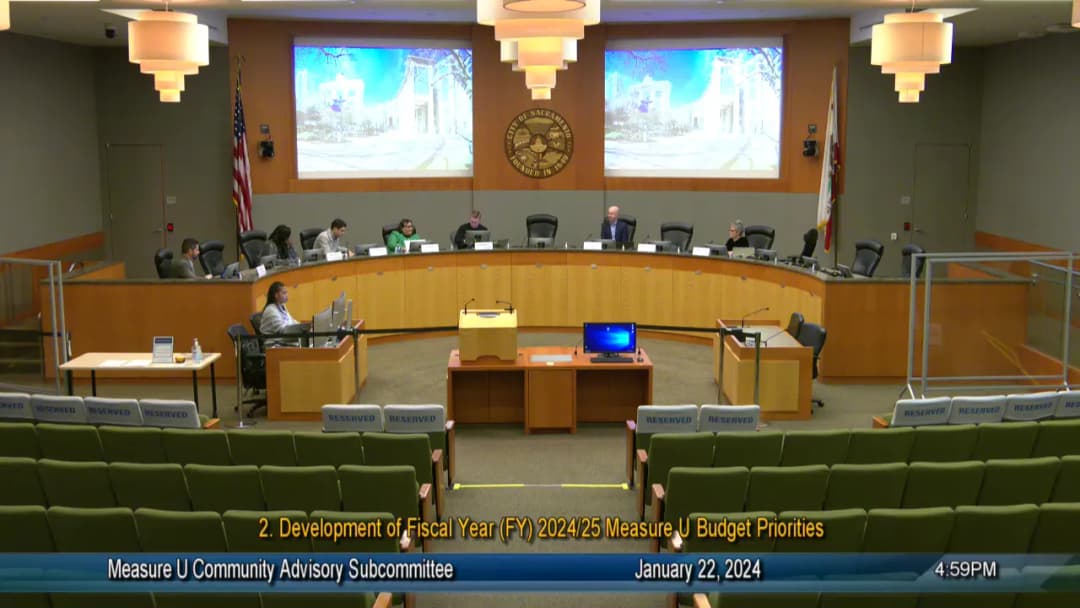
The Measure U Community Advisory Committee Budget and Policy Development Subcommittee met on Monday, January 22, 2024, from 4:00 p.m. to 5:14 p.m. at City Hall Complex, 915 I Street, Sacramento, CA. The meeting included the selection of a Chair and Vice Chair for 2024 and a discussion on developing Fiscal Year 2024/25 Measure U budget priorities. A motion was passed authorizing a single member to draft budget priorities. Discussion Items 1. Selection of Chair and Vice Chair for Calendar Year 2024 – Member Sala nominated Member Paschal for Chair; Member Macias seconded. Member Macias nominated Member Sala for Vice Chair; Member Paschal seconded. Both nominations passed unanimously (3-0, with Members Byrd and Wolf absent). The new leadership terms will commence at the next regular subcommittee meeting. 2. Development of Fiscal Year (FY) 2024/25 Measure U Budget Priorities – The subcommittee discussed the scope of Measure U as a general-purpose tax (not restricted to specific uses, but intended to align with voter expectations for underserved communities). Members reviewed a prior committee survey ranking priorities and a draft dashboard showing current Measure U allocations. Key points included: - The need to respect the spirit of the law vs. the legal fungibility of Measure U funds. - Participatory budgeting was identified as a key priority for continued funding (seeking $1 million). - Options for gathering additional input without violating the Brown Act (e.g., one-way feedback from full committee members, a new survey, or contacting city council members). - The subcommittee's 2024 schedule (March and May meetings) and the possibility of adding special meetings. - Member Macias and Member Paschal volunteered to work together on drafting recommendations; legally, only two members can collaborate without creating a quorum. Key Outcomes - Chair and Vice Chair Elected: Member Nikki Paschal was selected as Chair and Member Marbella Sala as Vice Chair for calendar year 2024. Votes were unanimous among the three present members (Macias, Paschal, Sala). - Motion Passed (4-0, Wolf absent): Authorizing Member Raul Macias to draft FY2024/25 Measure U budget priorities and recommendations for the subcommittee’s consideration at its March 2024 meeting. The draft will include input from the prior survey, the budget dashboard, and feedback gathered from the full committee that evening. - Next Steps: The draft recommendations will be discussed at the March subcommittee meeting, then presented to the full Measure U Community Advisory Committee for finalization. A potential survey of full committee members may be conducted to inform the draft. Public Comments & Testimony - Lambert Davis (public speaker): Expressed strong support for Member Sala's nomination and emphasized that Measure U funds should be used for underserved communities as originally promised, not treated as general fund dollars. He raised concerns about the handling of his participatory budgeting application, alleging a quota system and lost paperwork, and requested that his family be made whole. Member Comments – Ideas and Questions - Members discussed the need for additional subcommittee meetings beyond the three scheduled in 2024 to oversee participatory budgeting outcomes and potentially expand the subcommittee's scope. The City Clerk noted that special meetings can be arranged if necessary. - There was interest in receiving an update on participatory budgeting project completion and outcomes at the March meeting.